A sunflower for Ukraine? A tomato for farmworkers?
RABBI SARI LAUFER
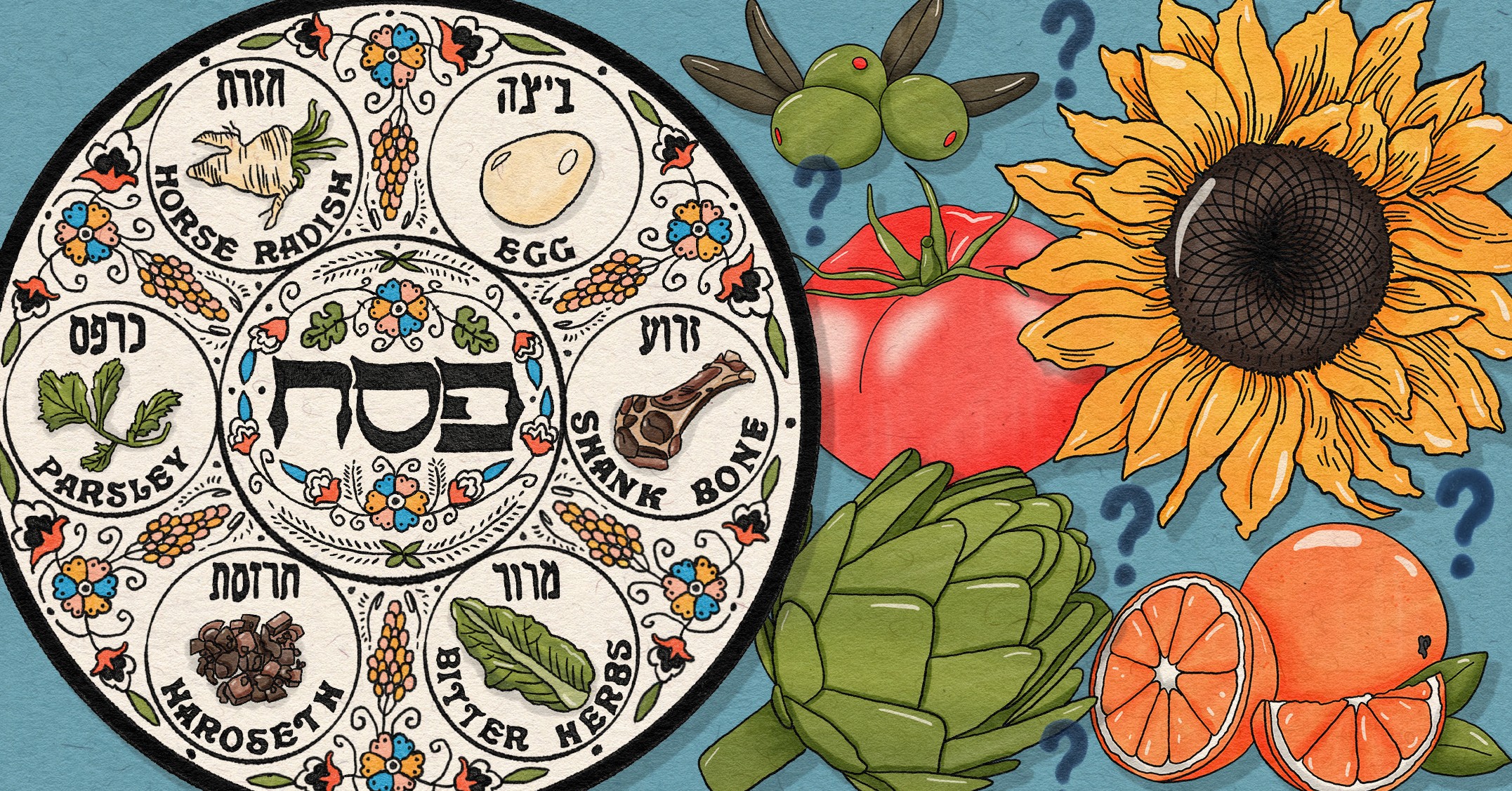
Olives. Tomatoes. Oranges. Artichokes. Dates. Cotton balls. And, now, sunflowers.
These items might look like a grocery list. But, instead, these are some of the items I’ve seen added to the seder plate, items to highlight and include stories and histories that are not, at least explicitly, part of the Passover seder.
On its surface, it is a noble goal–why shouldn’t we consider the plight of Ukrainians in spring 2023 (sunflowers), or remember the American history of slavery (cotton ball)? Wouldn’t we want to honor the farm workers who put food on our tables (tomatoes), or intertwine the story of the Palestinians along with our own (olives)? In my own family, my mother insists on the orange on the seder plate, regardless of its apocryphal origin as feminist symbol.
But I won’t be adding anything to my plate. As a rabbi, teacher, and mother, I’m sticking with the traditional items.
My decision to eschew seder plate innovation stems from the thinking about inclusion that I do all the time in my work. Both in encountering ancient text and modern community, I am always asking: Who is not in the room? When I preach or teach, my hope is always that anyone, regardless of how they identify, sees themselves in the text and in the message.
At the same time, I am always aware that by naming one story, or one identity, I might be excluding another.
One of the great tensions of Jewish life in the 21st century is between universalism–the central themes and ideas of Jewish wisdom that speak to all of the human experience–and particularism, the doctrines and injunctions meant to distinguish Jewish practice and ritual from that of the rest of the world. And of all of our stories, it is perhaps Passover that best embodies this tension.
It is a story embraced by Jews, by Black Americans, by Christians the world over. It is our story, to be sure. But it is also a story for anyone, and everyone, who has ever known bondage, who has ever felt constricted, stuck in a narrow place.
“In every generation, we are obligated to see ourselves as if we, ourselves, had come out of Egypt.”
Core to the seder, this statement is our directive–this is how we must experience and teach the Passover story. We experience it as our own story, not simply something that happened to our ancestors.
The seder night is a night for telling stories, our own, and the ones we think need to be told. But to my mind, we do not need more on our seder plate to make that happen. In fact, I worry that, in this case, more is less–in trying to include each particular story, we lose the universal truths.
I hope that we sit around our seder tables and talk about the plight of today’s refugees, whether from Ukraine, Syria, or Central America. I hope we talk about the bravery of each and every person who tells their coming out story and lives their truth. I hope we talk about the Palestinian struggle for self-determination, the ongoing struggle for farmworker and immigrant justice here in the United States, the shameful history of American slavery and its lasting legacy of systemic racism, our own stories of immigration and exile and whatever other stories you need to tell.
One of the core lessons of the Exodus is the impulse toward empathy. Over and over, the Torah returns to this narrative, reminding us to protect and love and be kind to the stranger, because we were strangers in Egypt. The Torah is not specific–our empathy, the Torah teaches, is meant to be boundless and inclusive. We are to welcome anyone-and everyone-who feels out of place or unmoored, who has been oppressed or mistreated.
I believe that each and every one of their stories is already represented on the seder plate, and in the seder ritual. No additions needed.
Rabbi Sari Laufer is the Director of Congregational Engagement at Stephen Wise Temple in Los Angeles.