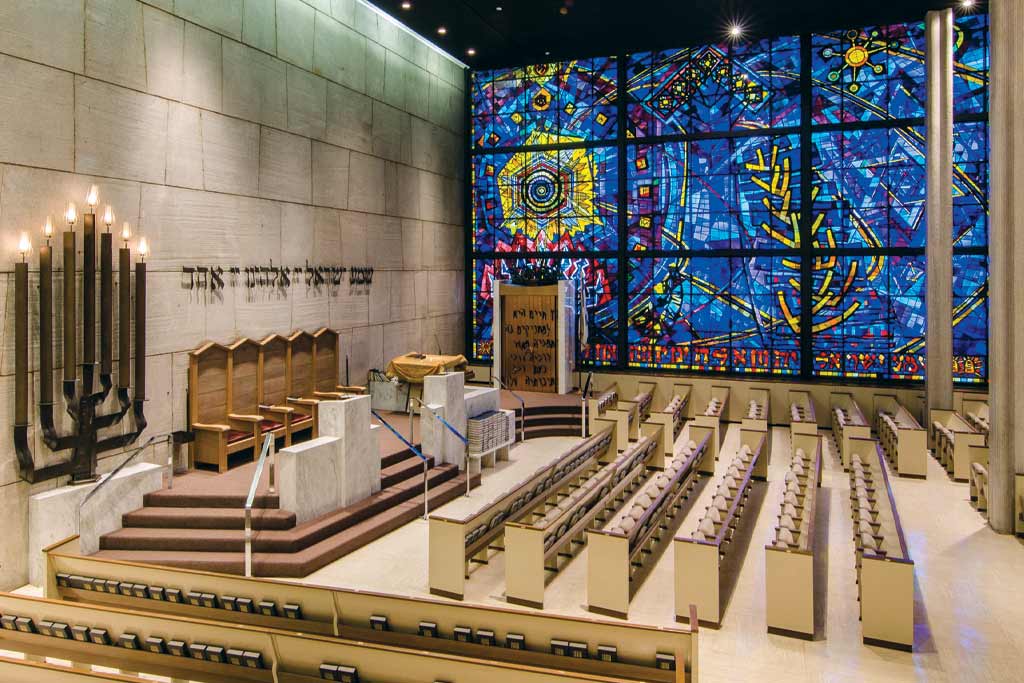
Photo: JCLP has worked with Chicago Loop Synagogue on preservation planning for their iconic stained-glass windows. (Photo credit: Eric Allix Rogers)
At its peak, Congregation Bene Shalom Hebrew Association of the Deaf and Hearing, a Reform synagogue in Skokie, boasted over 300 members—hearing, deaf, and hard of hearing—and their building on Oakton Street was abuzz with activity.
Bene Shalom was founded by Rabbi Douglas Goldhamer, who also founded Chicago’s Hebrew Seminary, initially a rabbinical school for the deaf and hearing. After Goldhamer died in 2021, Congregation Bene Shalom’s membership dwindled to 35 households, and the pressures facing the community were significant.
“We did the best we could,” said Laura Schwartz, then-president of Bene Shalom. “We hired a wonderful rabbi who also served as our cantorial soloist, [Rabbi] Charlene Brooks. She did a phenomenal job for about four years. And then we just couldn’t keep going any longer.”
In 2024, Schwartz and the board reached the point of likely needing to close the synagogue. They could sell their building, but what would become of the five decades of warmth and inclusion at Congregation Bene Shalom?
That’s when Schwartz reached out to Noah Levine, President and CEO of the Jewish Community Legacy Project (JCLP); she and Bene Shalom leadership had been in contact with the national organization a few years prior. Now, with Levine’s help, Schwartz and the board of directors shifted to creating their legacy plan.
“We want to be able to serve all small congregations, regardless of where they are in their journey of institutional life,” said Levine of JCLP’s mandate. Founded in 2010 by Chicago native David Sarnat, JCLP assists smaller congregations—150 households or fewer—in the US or Canada, addressing current challenges planning for the future. Working with JCLP comes at no cost to participants.
JCLP’s planning comes in two major areas: legacy—“what do you do when you’re no longer around,” as Levine put it, and sustainability—what do you do now to maximize your potential. Levine stresses that sustainability planning is important for congregations of all sizes.
JCLP has been effective throughout the country because many congregations are facing similar challenges. “Remember from Ecclesiastes: ‘There is nothing new under the sun,’” Levine said.
In Chicago, JCLP has been a partner to Chicago Loop Synagogue, thinking through the preservation of their iconic stained-glass windows. The organization has also provided strategic support to a congregation in the southwestern suburbs.
Working closely with JCLP, Congregation Bene Shalom’s leadership put their legacy plan in place. They donated the Torah scrolls, conducted oral history interviews, and sent archival and yahrzeit information to the American Jewish Archives and JewishGen.
Congregation Kol Emeth, who had already been renting space, purchased the property on Oakton Street. JCLP guided Congregation Bene Shalom in envisioning the use of their funds from the sale as a continuation of their legacy, and connected them to David Rosen, Senior Vice President of Endowments at JUF, and Steve Wander, Associate Vice President of Legacies & Endowments at JUF.
“When a congregation is going to set up endowments, either for their cemetery or for legacy endowments, we encourage them to have a financial Jewish institution that is a Jewish Federation or a Jewish foundation,” Levine said.
The Congregation Bene Shalom Endowment Fund, managed by JUF, will provide annual distributions in perpetuity to eight different organizations locally, nationally, and in Israel. Recipients include the Chicago Hearing Society at the Lester and Rosalie Anixter Center, to provide American Sign Language interpreters for Jews who are deaf for religious services; as well as to two universities for the deaf and hard of hearing to provide scholarships for Jewish students. Rosen said that this endowment gift will be recognized through the Centennial Campaign, a celebration of JUF’s first 100 years of service, and it enables JUF to “fulfill its role in preserving resources for the Jewish community, as proud stewards of Congregation Bene Shalom’s legacy.”
Schwartz found the process simultaneously sad and fulfilling. What made it easier, she continued, was knowing that the funds were “going to do so many good things for so many people.”
As Goldhamer would say: “Be kind, be kind, be kind.” Now Congregation Bene Shalom’s kindness will reverberate long into the future.