April showers bringing beautiful musical flowers to Chicago
Hedy Weiss
It’s Spring, and time to get ready for the Chicago Symphony Orchestra led by Vladimir Jurowski, a visit by Pinchas Zukerman and the Jerusalem Quartet, and a score by Lera Auerbach for the Joffrey Ballet’s production of The Little Mermaid . These are among the many musical events with Jewish links that will be showering Chicago stages during April. Here is a closer look:
*Vladimir Jurowski to guest conduct the CSO
Born into a Jewish family in the former Soviet Union in 1972–the son of a conductor, and the grandson of a film-music composer–Vladimir Jurowski moved to Germany in 1990. He has since held a slew of important posts, including Music Director of the Berlin Radio Symphony Orchestra and the Bavarian State Opera.
Now, almost a decade after guest conducting with the CSO, he will return to Chicago (April 27, 28 and 29), to lead the orchestra in a program featuring Mozart’s Piano Concerto No. 25 (with guest artist Martin Helmchen), and Shostakovich’s Symphony No. 8 , written in 1943, at the height of World War II.
When I sent Jurowski questions about his planned visit to Chicago, he emailed back a wonderful response, and here are his words:
“It has been a long time since my last meeting with the CSO. My work and family life ties me almost exclusively to Europe. But I remember well the orchestra’s virtuosity and vibrant style, and its immense emotional force. And I am greatly looking forward to renewing our connection.”
Asked about his choice of the Shostakovich piece, Jurawski said: “I met him when I was only 3 or 4 years old, but his family and my family knew each other well, and my father– Michail Jurowski, who sadly passed away last year– used to play piano duets with him. His music, aside from its tremendous musical and artistic worth and power, is a document of the history he lived through. The Eighth Symphony is one of his most powerful, sustained, and personal creations. And, of course, being composed in 1943 it brings an unmistakable and unignorable message to both the players and the audiences of today. I hope I will have to say very little. As a man with Russian and Ukrainian blood, the music will say more than I ever could.”
Further, Jurowski noted: “I grew up in Soviet Russia which was, of course, a society where there was essentially an enforced secularity. There was very little talk of religious faith, even at home. But there was certainly an undercurrent of a kind of collective memory. My grandmothers would speak in Yiddish when they didn’t want us to understand what was being said, and their own childhood had been in the remains of the Jewish shtetl culture. My adult life in Germany has, among many other things, been a process of re-connection with the combined cultural heritage of central and Eastern Europe. And the ‘Jewish blood’ in European musical life is an extraordinary force, including for composers like Shostakovich who were not themselves Jewish, but who shared a tremendous affinity for the culture and its history, and who employed Jewish themes and ‘colors’ both implicitly and explicitly in their compositions. It’s hard to find a composer who was not touched by that. But Mahler’s Jewishness– which I really came to understand through Bernstein’s conducting and talks– was a very strong thread. It gave me both a sense of connection to Mahler, and a way into his scores and his world. And consequently, it was also an important connection back into my own identity as a musician.”
* Pinchas Zukerman joins forces with wife and chamber orchestra
Born in Tel Aviv in 1948–the son of Holocaust survivors–Pinchas Zukerman hardly needs an introduction. The violinist, violist, chamber musician, conductor, and teacher was a child prodigy, and in 1962 (sponsored by Isaac Stern) he moved to New York to attend the Juilliard School. Very soon his career took off, and he has performed throughout the world since then.
On April 30, along with his wife, cellist Amanda Forsyth, and the members of the internationally acclaimed Jerusalem Quartet, Zukerman will fill Orchestra Hall with the sounds of Bruckner’s String Quartet, No. 5 , Dvorak’s Slavonic-influenced String Sextet , and Brahms “String Sextet” (whose second movement can be heard in an episode of Star Trek: The Next Generation ).
In a high-spirited, wide-ranging phone conversation, Zukerman noted that “these days the six of us can switch around any positions because of our musical camaraderie and our ability to share ideas, sounds, and emotions. It’s kind of like musical chairs. We love being together. I love being with my wife, who is very accurate, and makes exact markings on the music–something I am not used to doing.”
For tickets to both the Jurowski and Zuckerman concerts, visit cso.org or call 312-294-3000.
*Lera Auerbach’s score for The Little Mermaid ballet
This past November, the Chicago Symphony Orchestra performed Diary of a Madman, Concerto for Cello and Orchestra , a mesmerizing, intensely dramatic work by the classical composer, conductor, and pianist Lera Auerbach who, until then, I did not know. Inspired by Nikolai Gogol’s famous 1835 short story about the unraveling of the mind of a minor civil servant, Auerbach captured that unraveling in a score that demanded a brilliant solo cellist along with the orchestra.
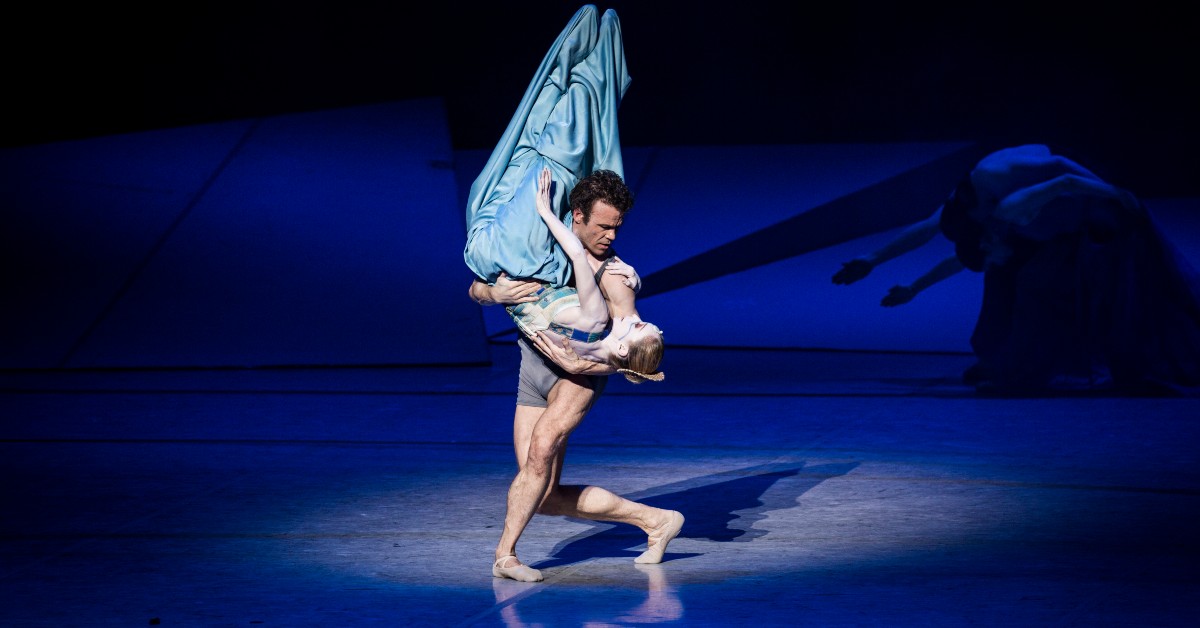
An earlier work by Auerbach–who was born into a Jewish family in Soviet era Russia in 1973 and moved to New York to study at Juilliard–will be performed when the Joffrey Ballet presents The Little Mermaid . This grand-scale production, based on the Hans Christian Andersen fairy tale, is described as “the fantastic love story of a tormented mermaid, on a journey between land and sea.” It was created for The Royal Danish Ballet in 2005 by John Neumeier, the Milwaukee-born choreographer and long-time director of the Hamburg Ballet, as a celebration of Anderson’s bicentenary.
To hear Auerbach talk about her use of a theremin–an electronic instrument played without physical contact, whose sound suggests the mermaid’s nature–Google her name and sfballet.org.
The Little Mermaid will run April 19-30 at the Lyric Opera House, 20. N. Wacker. For tickets visit joffrey.org or call 312-386-8905.
Hedy Weiss, a longtime Chicago arts critic, was the Theater and Dance Critic for the Chicago Sun-Times , and currently writes for WTTW-TV’s website and contributes to the Chicago Tonight program.