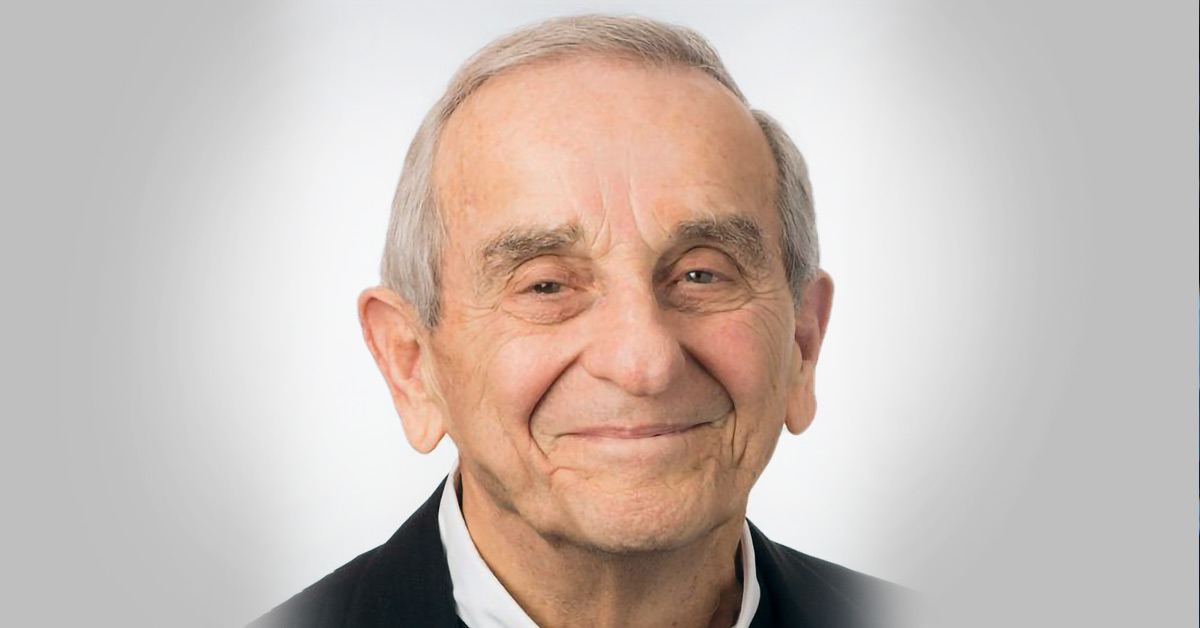
Lowell Sachnoff
PAUL WIEDER
Throughout his career, attorney Lowell Sachnoff used the law to uphold justice and defend the defenseless. “Class actions truly made one feel like Robin Hood,” Sachnoff once wrote. “If you won, you took from rich crooks, [and] gave it to the poor victims of corporate oppression.”
Sachnoff died on March 21, at 92.
He was born on Chicago’s Maxwell Street, where his immigrant grandparents would tell him stories of pogroms and antisemitism in Russia. Those anecdotes, he would say, inspired him to pursue a legal career.
Sachnoff graduated from Senn High School on Chicago’s North Side, where he swam competitively, and spent summers as a beach lifeguard. He had a full ride to Harvard College, and went on to Harvard Law School.
During the Korean War, he served with the Office of Naval Intelligence, rising to the rank of Lieutenant Commander, while learning to speak Russian. After the war, he spent a stint at a firm, but soon was appointed as General Counsel for the Illinois Department of Mental Health.
In the 1960s, Sachnoff and his colleagues founded the law firm that would become Sachnoff & Weaver–which would eventually merge with Reed Smith–known for its progressive culture. In starting the firm, he said that he and his colleagues “wanted to do good.” For the rest of his legal career–he retired at 90–he upheld that vision.
As a class action, securities, and antitrust litigator, Sachnoff won groundbreaking securities fraud, price-fixing, and takeover cases, while advocating on behalf of minority groups.
As early as 1969, his firm helped reopen the case of Black Panther leader Fred Hampton’s death. He “took all three of his children to the site of the murder,” recalled his daughter, Kate Sachnoff, “to impress upon us the injustices and abuses of power that need to be addressed in our world.”
That same year, he helped found the Chicago Lawyers Committee for Civil Rights Under Law, serving as its Chair, and on the board of its national body.
In the ’80s, Sachnoff won a jury verdict against the Chicago Police Department for its practice of strip-searching women. In the ’90s, Sachnoff and his wife, Fay Clayton, won a U.S. Supreme Court case protecting access to abortion clinics. And in 2006, he helped negotiate the release of prisoners from Guantanamo Bay.
For Sachnoff’s final pro bono case, he represented a transgender woman’s rights at an Illinois State Psychiatric Hospital, having defended trans clients as early as 1984.
He later served on the board of the Bulletin of Atomic Scientists, and helped protect the copyright of its Doomsday Clock.
An active member of the Jewish Reconstructionist Congregation for four decades, Sachnoff supported JUF and the Jewish Council on Urban Affairs, and was fond of baking challah.
With the assistance of JUF and its overseas partner, he toured the remains of his father’s hometown, Motovilivka, Ukraine, where he was able to use his Russian-language skills.
For his lifelong efforts, Sachnoff received awards from the Chicago Bar Association and the Chicago Appleseed Center for Fair Courts, as well as the Jewish Council on Urban Affairs, the Anti-Defamation League, and the American Jewish Committee.
Among his many achievements, he was a poet; his children established a writing prize at his high school in his name.
Even judges sang this attorney’s praises–he was a close friend of the Hon. Abner Mikva, who called him, “a contributor to good causes and a worker of good works.”
Lowell Sachnoff is survived by his wife, Fay Clayton, his children, Scott, Marc, and Kate Sachnoff, and his step children: Suzanne Clayton and Kim Clayton Giese. He had five grandchildren and a great-granddaughter, and was the brother of the late Everett. Memorials may be made to the ACLU of Illinois, the Chicago Foundation for Women, Planned Parenthood of Illinois, and the Center for Constitutional Rights.