Mezuzot 101
RABBI D’ROR CHANKIN-GOULD
My mother-in-law shared that many of her friends are asking whether they should take down their mezuzot this year. In a time when so many of us feel frightened about rising antisemitism, the way in which we publicly mark our homes as Jewish spaces has become, sadly, fraught.
A mezuzah is a Jewish person’s most proud, public, and vulnerable declaration of their identity. Mezuzot matter. What message about the Jewish people is a mezuzah meant to communicate to our neighbors and ourselves?
Hanging a mezuzah on the lintels of our doorposts is a tradition that can be traced back to the Torah ( Deuteronomy 11:20 ), where it says, “You shall inscribe [these words] on the doorposts of your homes and upon your gates.” Inside the mezuzah is a rolled up klaf (parchment) upon which the first two passages of the Shema are handwritten. Both paragraphs include the mitzvah of placing a mezuzah on the doors of our homes.
On the back of the klaf , one of the mystical names for G-d, Sha-dai is written. These three letters of G-d’s name are an acronym for “Guardian ( Shomer ) of the Doorways ( Daltot ) of Israel ( Yisrael ).” Clearly, the mezuzah conveys a message to our neighbors and to ourselves about faith in the divine, protection from harm, and adherence to the laws and values which have defined our people since its inception.
How is a mezuzah attached? Traditionally, a mezuzah is placed on the upper third of the doorway, on the right-hand side. Just before affixing a mezuzah , one recites a simple one-line blessing:
בָּרוּךְ אַתָּה ה׳ אֱ לֹהֵינוּ מֶלֶךְ הָעוֹלָם, אֲשֶׁר קִדְּשָׁנוּ בְּמִצְוֹתָיו וְצִוָּנוּ לִקְבֹּעַ מְזוּזָה:
Barukh ata A-donai E-loheinu Melekh HaOlam asher kidshanu b’mitzvotav v’tzivanu likboa mezuzah.
Blessed are you Adonai the Divine presence in the universe who gives us the invitation to affix a mezuzah to our dwelling place.
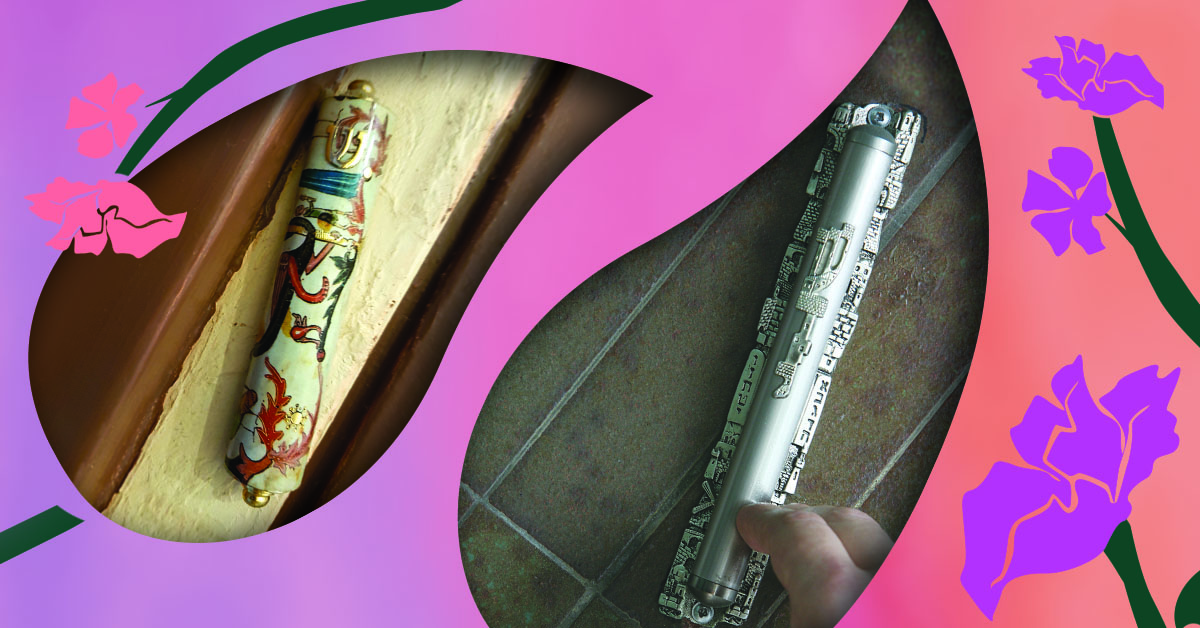
There’s one more key detail about the manner a mezuzah is affixed. This provides unique insight into the wisdom a mezuzah teaches that the world so desperately needs: a mezuzah is placed neither vertically nor horizontally, but rather on a diagonal, with its top leaning towards the inside. Why?
There was a medieval debate (see Shulchan Aruch, Yoreh De’ah 289 ) about the placement of the mezuzah . One camp said it should be vertical and one camp said it should be horizontal. And, as Tevye wisely taught us, “they are both right.” Jews acknowledge multiple opinions, perspectives, and truths. So, our mezuzot are a compromise: they are placed on a diagonal, because we know that our community is strong and rich when we honor voices from all points on the spectrum and infuse their divergent insights into our practice.
No, we should not take down our mezuzot . If anything, now is the time for the opposite. Now is the moment to proudly place a mezuzah on the doorposts of our homes. That is the courage with which Jews have acted for millennia, and we are privileged to walk in their brave footsteps.
When we enter a home with a mezuzah , we traditionally reach a hand up to touch it. We gently kiss the hand that touched the mezuzah . We lovingly embrace this symbol of our collective identity. We affectionately demonstrate our faith in the G-d who guards the doorways of Israel. We passionately teach that our community is strongest when we lean into the wisdom of a diverse collective.
May we be safe enough and brave enough to proudly place a mezuzah on the doorways of our homes and upon our gates.
Rabbi D’ror Chankin-Gould is Rabbi at Anshe Emet Synagogue. He also serves on the Executive Council and the Administrative Committee of the Rabbinical Assembly and is co-chair of its Gender and Power Committee.