Pioneer meets protégé
DONALD LIEBENSON
Together, Louis B. Mayer and Irving Thalberg transformed Metro Goldwyn Mayer into Hollywood’s most elite studio, which boasted “more stars than there are in heaven.” They worked at MGM from the birth of the studio in 1924 to Thalberg’s death, at only 37, in 1936; Mayer died in 1957 at 73.
In their respective obituaries, Mayer, former Studio Head of MGM, was hailed as “the czar of Hollywood producers,” while MGM Producer Thalberg was lauded as “the most important man in Hollywood,” and proclaimed a “boy wonder” and the “most brilliant man in his field.”
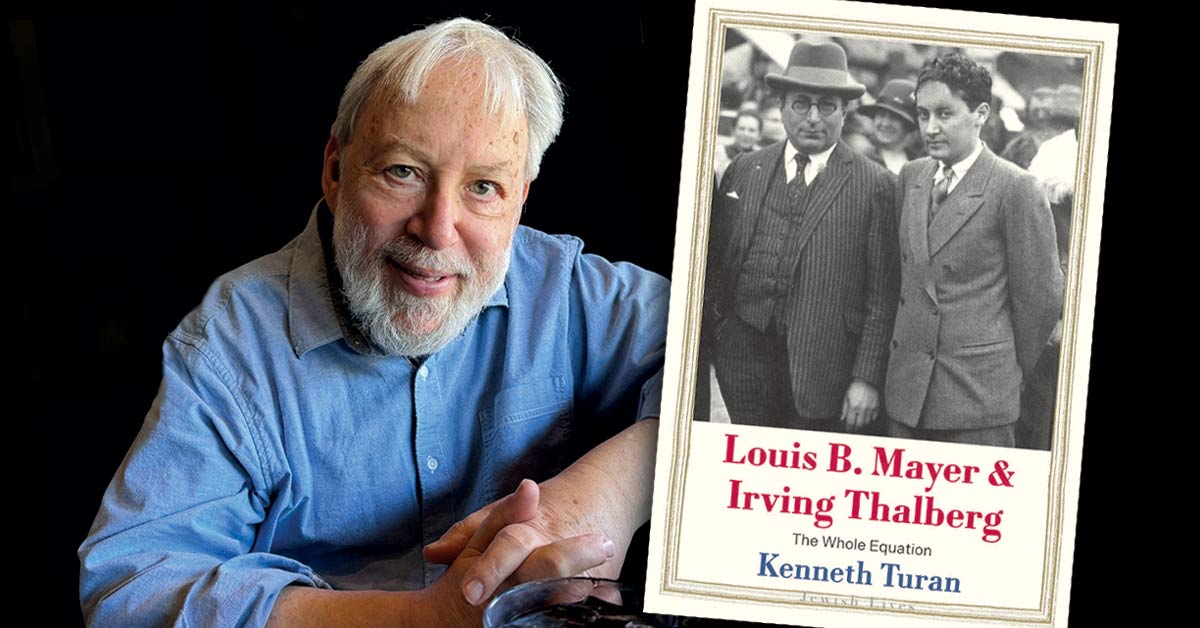
Kenneth Turan’s compelling new book, Louis B. Mayer & Irving Thalberg: The Whole Equation , the latest in Yale University Press’ Jewish Lives series, is a dual biography that explores their extraordinary and unprecedented, albeit fraught, collaboration.
Together, the former film critic for The Los Angeles Times and NPR’s Morning Edition wrote, they could do no wrong, “until, to borrow Ernest Hemingway’s phrase, ‘gradually, then suddenly, they fell apart.'” So much so, that upon Thalberg’s death from pneumonia, Mayer gloated to a confidante, “Isn’t G-d good to me.”
Mayer and Thalberg’s relationship was marked by a father/son dynamic, pioneer-protégé clash, and “a rift in the nature of their Jewish experience.”
Mayer, as were many of the other studio chiefs, was the classic Eastern European immigrant. “No one knows for sure when he was born or what his family name was,” Turan said. “He was this classic person who showed up on Ellis Island and made something of himself.”
In contrast, “Thalberg was a German Jew, born in this country,” Turan continued. “His family came to the United States earlier and had established themselves. Some of the German Jews were enormously wealthy. Walk down Fifth Avenue; the Jewish Museum is the former Felix M. Warburg mansion. They were aghast at the arrival of the Eastern European Jews, who were-as they were caricatured then-poor and often not that well-educated. There was real tension between those two groups. I think Mayer and Thalberg initially liked that aspect of things; they were bridging that divide.”
Mayer and Thalberg’s relationship had no equivalent at the other major studios. Instead, they were equal powers, which was highly unusual.
One of Turan’s favorite MGM movies of the period was the Greta Garbo historical tearjerker, Camille. “Mayer had an eye for talent,” he said. “He signed a lot of actors and actresses who became MGM’s biggest stars. Garbo was one of them. She was one of the few major stars that spent their entire career at one studio. She worked with Thalberg, who was very much involved with the day-to-day mechanisms of moviemaking. He wouldn’t have had Gardo to work with if it weren’t for Mayer, and the movie wouldn’t have been as good as it was if Thalberg hadn’t overseen it. Studio executives giving writers and directors notes is usually the bane of their existence, but people really valued Thalberg’s notes. He really understood story and audience reaction. He made films more successful.”
Turan believes that Mayer’s and Thalberg’s faith was at the heart of their belief that film could uplift a culture and speak to high things. At the time, there was a lot of commentary that film was something for carnivals-that film was, to use a Yiddish pejorative, dreck. But they refused to believe that.
“I’ve always been fascinated by Old Hollywood,” the historian said. “I do think theirs is a paradigmatic story about how immigrant and non-immigrant Jews made their way through early 20th century America. I hope readers come away thinking: ‘That’s one hell of a story.'”
Donald Liebenson is a Chicago writer who writes for VanityFair.com , LA Times, Chicago Tribune, and other outlets.