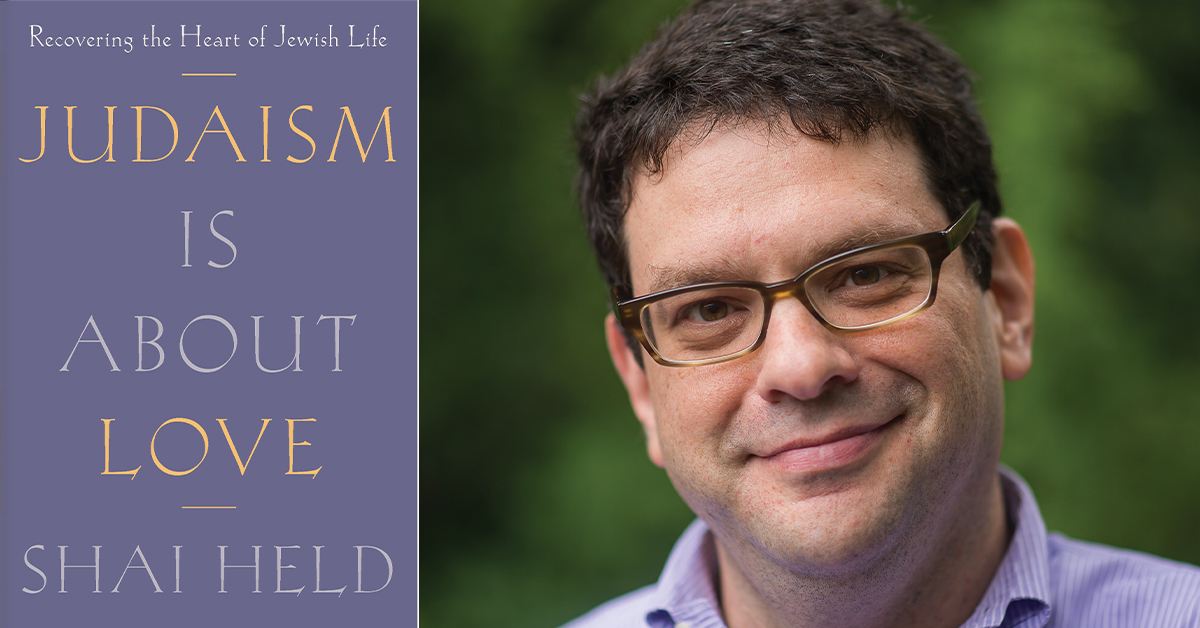
Rabbi Shai Held’s ‘Judaism Is About Love’
Aaron B. Cohen
To call Rabbi Shai Held’s latest book– Judaism Is About Love (Farrar, Straus, and Giroux)–a breath of fresh air is to risk trivializing it. Its messages about love’s place in the Jewish wisdom tradition are revelatory. Although it offers respite and a measure of “self-help” from the unsettling realities of the present, this book more importantly suggests the possibility of profound personal, communal, and even global transformation–through an embrace of Judaism’s foundational principles.
“This book is…an act of recovery,” Held writes. “My aim is to tell the story of Jewish theology, ethics, and spirituality through the lens of love, and thereby to restore the heart–in both senses of the word–of Judaism to its rightful place.”
In eloquent and meticulously researched prose, which generously references Jewish texts, Held leads the reader on a journey of (re)discovery of the Jewish wisdom tradition. He reflects upon, interprets, and clarifies what he sees as the fundamental purpose of G-d’s creation, and of the Creator’s relationship to humanity.
Held’s theological and ethical worldview emanates from an evolved–and evolving–religious worldview that is both G-d- and human-centric. Yet, Held is no dogmatist; “for me, faith is at least as much about possibility as it is about certainty,” he writes.
Rather than insisting on faith or specific beliefs, he posits that being human–“or perhaps better, becoming human–is about actualizing the potential for love that is ever-present within us. Created with love, for love, we are tasked with embodying love.”
All this talk of love begs the obvious question: what is the multi-faceted nature of the phenomenon that moved Held to write a nearly 550-page work?
As it happens, the kind of love Judaism speaks about is not an emotion or an action. Rather “it’s an emotion and an action,” Held writes. “The very idea of an emotional realm…distinct from the realm of action is foreign to the ancient world.”
“Judaism is about what you do, why you do it, and how you do it. Jewish ethics ask for deeds of love done from love…. We should not lose sight of the ideal: a life in which emotion and action are deeply integrated and intertwined.”
In Judaism, love, he says, is a posture, a disposition, a stance. That perspective includes ample and necessary space for uncertainty. In a world that is ambiguous, he calls struggle a necessity. Where love comes in is to ask questions as open-heartedly as possible.
“Religion is at its best when it helps frame questions rather than giving answers. Struggling with the gap between how we want the world to be and how it is, is essential,” he said.
For this reader, absorbing Held’s artfully rendered wisdom feels essential to facing a distressing Jewish present and concerns for the future.
Rabbi Shai Held is the president, dean, and chair in Jewish thought at the Hadar Institute in New York City. He is the author of Abraham Joshua Heschel: The Call of Transcendence and The Heart of Torah, a collection of essays on the Torah in two volumes. He lives in White Plains, N.Y.
Held will speak about his book at Anshe Emet Synagogue in Chicago on June 9 and North Suburban Synagogue Beth El in Highland Park on June 10. Learn more at tinyurl.com/RabbiShaiHeldAnsheEmet and tinyurl.com/RabbiShaiHeldNSSBethEl
Aaron B. Cohen is a writer based in Evanston and the former Executive Editor of JUF News and JUF’s former Vice President of Marketing and Communications.