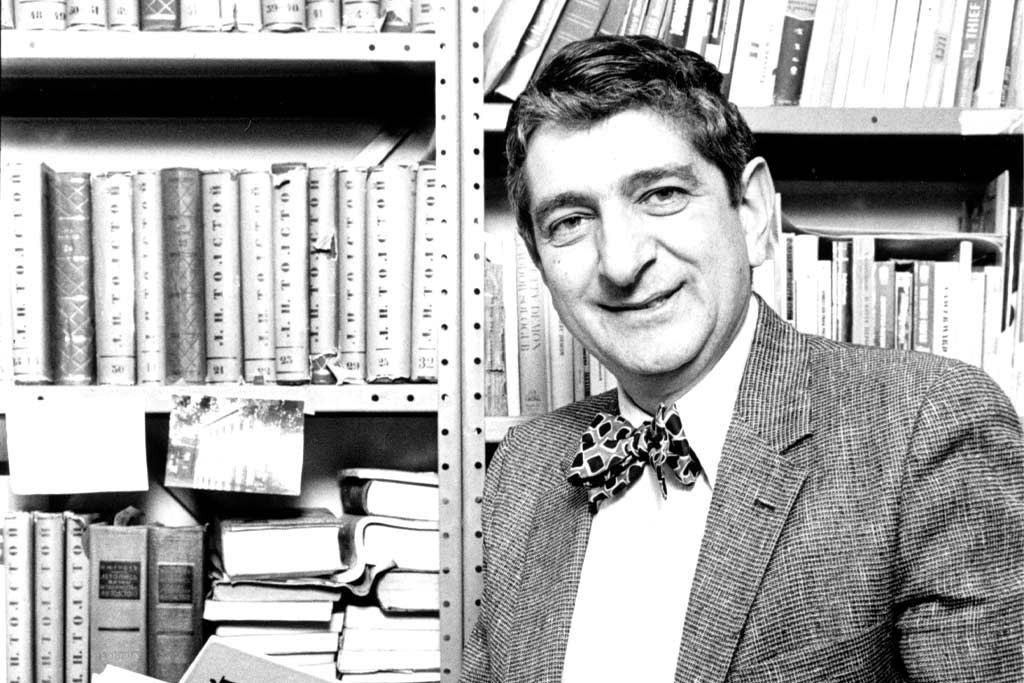
Prof. Irwin Weil holds a book about Russian author Leo Tolstoy in his office. For more than 50 years, Weil taught in the Northwestern Department of Slavic Languages and Literatures. (Photo credit: Jim Ziv/Northwestern University Archives)
It was while sitting in a required college literature course that Irwin “Irv” Weil first discovered his love for Russian culture. As he told the Chicago Tribune in 2015, “I had to read a book by someone I’d never heard of, this guy named Dostoevsky,” he recalled. “I sat down on a Saturday night to read Crime and Punishment and the next thing I knew it was Sunday afternoon and my eyes were as big as saucers, and I swore I was going to read that book in Russian if it killed me.”
That single class sparked Weil’s passion for Slavic literature, language, and culture, which would stay with him for the rest of his life. “It just fired him up to take the deep dive,” said his son, Martin Weil. “What it said about the human condition really spoke to him.”
Just as he fell in love with Slavic studies as a college student, Weil would transmit that same passion to thousands of Northwestern students over five decades through his popular Russian language, literature, and culture courses.
The beloved Jewish professor, who moonlighted as a cantor on High Holidays, died on Jan. 30, at the age of 97.
It was merely intellectual curiosity—not family ties to the region (his father’s family was Alsatian and his mother’s had Lithuanian roots)—that compelled Weil to learn Russian… and everything he could about Slavic culture.
“He appreciated a culture very different from one’s own,” Martin said. “He believed in getting outside of where you are.”
After college, Weil spent a year in New York studying drama and working in theater. He ultimately decided he belonged in front of the classroom (with his signature bowtie) rather than on the stage—but would still employ a theatrical style while teaching.
He earned his master’s degree in linguistics from the University of Chicago, and his Ph.D. in Slavic languages and literatures from Harvard University. After a few years of working on a Soviet census for the Library of Congress in Washington D.C., Weil made his first trip to Russia in 1960, returning there more than 100 times during both the Soviet and post-Soviet eras.
Weil briefly taught at Brandeis University before joining the Northwestern faculty in 1966, as the new department of Slavic languages and literatures was being formed. A decade later, he was elevated to chair of the university’s Russian language department.
Raised in a proudly Jewish home in Cincinnati, Weil inherited his love for Judaism from his parents. He also grew up attending baseball games with his father, a businessman and former owner of the Cincinnati Reds.
While he enjoyed baseball, Weil’s true passions were theater and music. As a boy, he learned to sing a cappella in his synagogue’s choir, and sustained his love of musical performance throughout his life.
During his Northwestern tenure, Weil would express himself both Jewishly and musically as the cantor for Northwestern Hillel’s Reform High Holiday services for four decades.
“Professor Weil brought extraordinary humanity, intellectual curiosity, and spirit to our community,” said Michael Simon, Executive Director of Northwestern Hillel. “He was a treasure for our community and for the world.”
In 2003, Weil transitioned to professor emeritus of Slavic languages and literatures, fully retiring in 2018.
In 2015, he penned a memoir about his eclectic life experiences called From the Cincinnati Reds to the Moscow Reds: The Memoirs of Irwin Weil (Jews of Russia & Eastern Europe and Their Legacy).
He leaves behind many beautiful legacies, said Martin, including being “a model of integrity and generosity” and having a zest for “intellectual excitement.” He influenced so many, Martin added. “My dad impacted so many people, so many students,” he said. “He gave himself to so many people.”
Weil is preceded in death by his wife of more than 65 years, Vivian Weil, professor emeritus of ethics at the Illinois Institute of Technology. He is survived by a daughter, Alice; sons, Daniel and Martin; and two grandchildren, Nathan and Anna. His family held a memorial service and a celebration of his life in Evanston in May.