Three-player chess: the US, Israel, and Iran
OFER BAVLY
Ever since its 1979 Islamic revolution, Iran has been a thorn in the side of western nations, of moderate Arab regimes throughout the Middle East, and of Israel. Its unabashed long-term plans to export its revolution to its neighbors-as well as its view of the U.S. as the “Big Satan” and Israel as the “Little Satan”-make Iran a destabilizing force and a regional threat. Those plans are manifested by sponsoring terror organizations in Lebanon, Gaza, Syria, Iraq, Yemen, and elsewhere.
Iran’s explicit pursuit of a nuclear program, coupled with a “weapons group”-the development of a long-range platform to deliver nuclear weapons-has made it more than just a thorn in the side of its neighbors. It is on a path to becoming not only a state sponsor of global terrorism but a nuclear power, a clear and imminent danger for the region, for the US… and for Israel-the most likely target for its nuclear intentions.
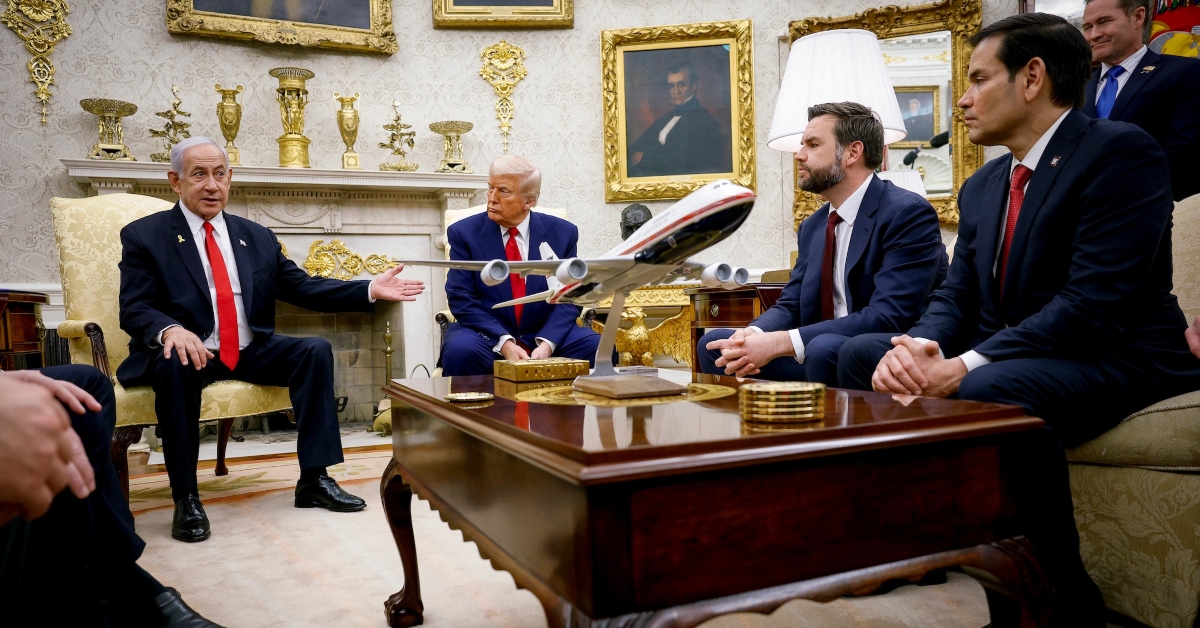
At their recent meeting at the White House, President Trump and Prime Minister Netanyahu agreed on the inadmissibility of Iran becoming a nuclear power. Both administrations (along with the rest of the Middle East) agree that Iran cannot be allowed to reach the level of uranium enrichment needed to create a nuclear weapon, especially coupled with the ability to launch a weapon over a substantial distance. The quandary is how to deny Iran’s nuclear aspirations.
President Trump appears as adamant about denying Iran a nuclear bomb as he is about the need to avoid military confrontation, if possible, for as long as possible. His declared preference is to reach an agreement with Iran that he asserts will be stronger than the previous nuclear deal signed by the Obama administration, which he abrogated. Any deal would include verifiable limitations on Iran’s uranium enrichment program, and its weapons group, in exchange for alleviating economic sanctions that have long crippled Iran’s economy.
Israel is (at least) equally adamant about denying Iran a nuclear weapon. The U.S. prefers exhausting diplomatic routes first. But Israel’s leadership has been pushing for a military solution, believing that diplomacy only gains time for Iran’s nuclear development, and will ultimately not be effective. Iran’s proven duplicity and ultimate nuclear aspirations will not be quelled and are better dealt with definitively, Israel feels, sooner rather than later, when it has further approached nuclear capability.
In this three-dimensional game of chess, the next months will be telling as to how the U.S. and Israel work together to advance their joint long-term goal, even as they disagree on the short-term tactic to achieve it. In the past, Israel was instrumental in pushing the U.S. to abandon its nuclear agreement with Iran, but the outcome of that decision is unclear. Economic sanctions imposed on Iran certainly hurt the regime, but the lack of an agreed framework for verifiable nuclear oversight allowed it to push forward with uranium enrichment and a weapons delivery program.
At this point, even if an agreement is reached (an outcome by no means guaranteed), the proverbial genie is already out of the bottle; Iran’s nuclear know-how as well as missile technology cannot be “unlearned.” The question before the U.S. and Israel is therefore how much time should be given to the diplomatic route before embarking on a military campaign against Iran, which is certain to be lengthy, costly, complicated-and not guaranteed to succeed 100%, given the multiple nuclear sites spread throughout the country and deep underground in fortified bunkers.
Plus, there are two more unknowns. The first is time-how far along is Iran from reaching the nuclear tipping point, and how long is there to reach a deal? The second is the role that other superpowers, namely Russia and China, will play in supporting or thwarting a verifiable nuclear agreement, even if one is reached.
The quandary of Iran’s nuclear program is not merely a theoretical war-game. At stake is a possible regional war with a potentially nuclear nation, a war which may become unavoidable if talks fail. At the very least, and if war can be avoided, Iran’s Islamic regime may still use its nuclear invincibility shield to become a regional hegemonic power. It would be able to negatively influence regional and global oil trade, commercial routes, and ultimately the west’s economies, all in addition to its continued destructive power as a state sponsor of terrorism.
Four decades into its revolution, a nuclear Iran would be another revolutionary development.
Ofer Bavly is a JUF Vice President and the Director General of the JUF Israel Office.