We won't be silent amid lies that we're silencing others
JAY TCATH
Those seeking to weaken Israel’s alliance with the U.S. employ multiple arguments. One of the most baseless is that Israel’s supporters suppress pro-Palestinian voices.
Their purpose, ironically, is to silence us, while depicting themselves as heroic victims.
This ludicrous attack on how we advocate for Israel was trumpeted by Chicago Sun-Times Editorial Board Member and columnist Rummana Hussain. Her January 17, 2025, op-ed asserted that pro-Israel voices are “try[ing] to muzzle pro-Palestinian protesters.”
Needless to say, our community’s main advocacy groups do not even attempt to muzzle pro-Palestinian voices. We don’t need to do so. Righteousness is on our side, and credibility our best tool.
We embrace our country’s free speech rights and remain confident in our fellow citizens’ abilities to discern between the conflicting Middle East narratives. That confidence has been borne out over decades by overwhelming U.S. public opinion–and hence public policy–support for Israel.
We trust in our ability–despite challenging media, campus, and other dynamics–to make winning arguments in the free marketplace of ideas. Our arguments, and our noble tactics, continue to serve us, and Israel, well.
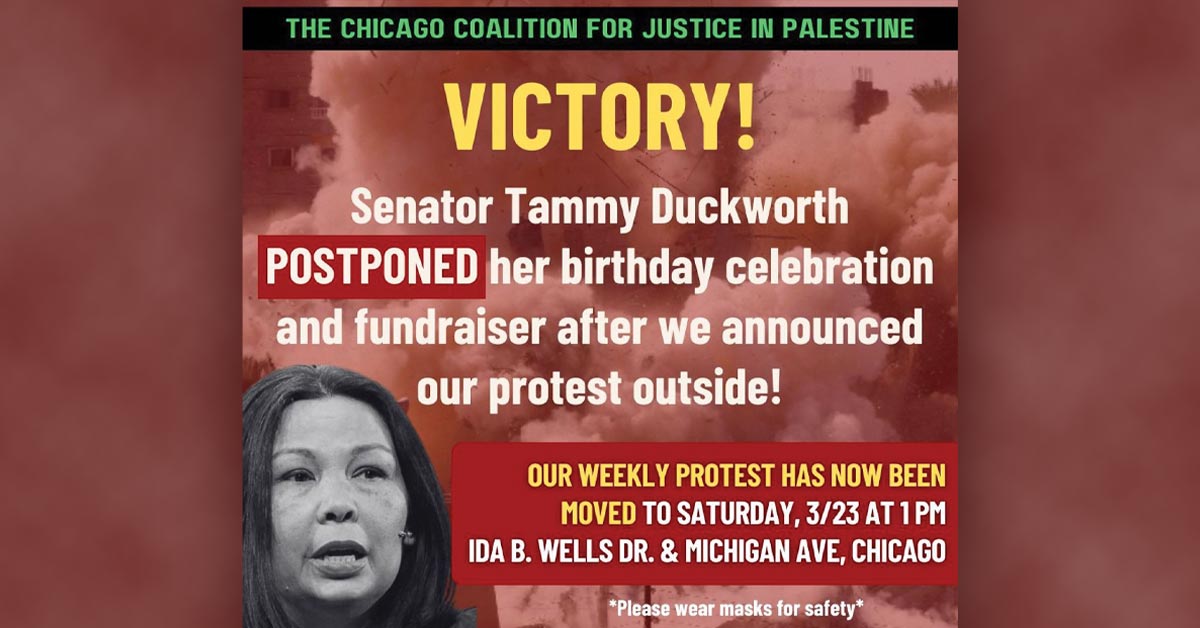
In contrast, as pro-Palestinian groups themselves shamelessly record on their social media, it is they who successfully muzzle the free speech and assembly rights of others. For example, they have interrupted and cancelled: congressional town hall meetings, League of Women Voters’ candidate forums, Jewish and Israeli performances, talks by Jewish artists and authors, and other public events that don’t pass their zealous anti-Zionist purity test.
Many of their groups are also hostile to the free-passage rights of those going to O’Hare, heading home on Metra, shopping along Michigan Avenue, or commuting on Lake Shore Drive, among other supposedly shared public spaces.
These bullying tactics reflect their apparent lack of confidence in their ideas being able to win the public debate fairly and squarely, as well as revealing their own disregard for our country’s free speech and assembly values. Ironically, bitterly so for them, these tactics backfire, antagonizing potential supporters of their cause.
Beyond suppressing the rights of others, their frequent street protests, Tweets, and their opinions securing at least equal media airtime demonstrates that no such muzzling of pro-Palestinian voices is happening.
Nothing proves that point better than Ms. Hussain’s writings: she has devoted eight of her 17 Sun-Times op-eds since October 7, 2023, to the very real plight of Gazans… while scantly addressing Hamas’ very real atrocities.
Pro-Palestinian voices shouldn’t be muzzled. They should be freely aired and subject to democracy’s rigorous free marketplace of ideas, a marketplace that for decades has shown Americans continue–overwhelmingly–to support Israel’s search for peace and security.
At the same time, there are some in our Jewish community who, trying to insulate Israel and her American supporters from unfair criticisms, in turn make unfair demands of public venues to restrict their open platforms.
Exacerbating matters further is the irrational claim that such anti-Israel content presents an immediate, direct physical threat to our community members. They don’t. Instead, it is such hyperbole that does negatively impact on our own community–deepening the mental health crisis and instilling fear in many Jews from publicly voicing their support for our community and Israel.
It is ultimately counterproductive when we make unreasonable, unwinnable arguments. While perhaps buoying our “base,” the net effect is losing a quixotic battle, and the possible sympathy of the all-important undecided segment of public opinion. Appearing like the widely disdained, proverbial “snowflakes” and selective defenders of free speech is not a good look for us.
We should have both the courage of our convictions, and the confidence that our side will continue winning the debate in this tragically zero-sum war of words.
The ultimate objective, of course, the goal that should inform and inspire us, isn’t the PR battle–but the very real battle for peace. We will never be silenced from pursuing that prayer.
An earlier version of this essay appeared January 25, 2025 in the Chicago Sun-Times.
Jay Tcath is the Executive Vice President of the Jewish United Fund.