What makes a ‘Jewish’ home?
Mimi Sager Yoskowitz
In his recent State of World Jewry address, journalist Bret Stephens suggested that the “proper defense against Jew hatred is … to lean into our Jewishness as far as each of us can.” It can be the antidote to those who seek us harm, culminating with the “building of our own table” through Jewish institutions, philanthropy, and industry.
I agree with his concept of leaning into our Jewishness, and the first tables we set should be inside our own homes. A Jewish household is our foundation for the Jewish thriving Stephens describes as “the centering fact of life.”
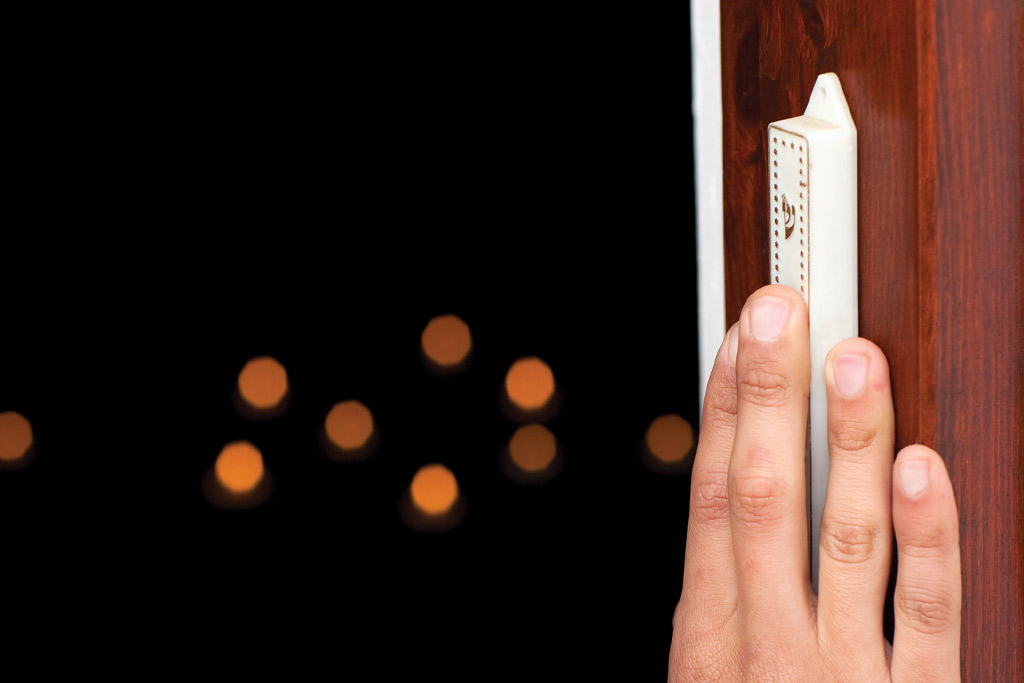
So, what makes a household Jewish? Let’s begin on the outside—specifically, on the door frame, where the mezuzah sits. The mezuzah holds a scroll with the words of Deuteronomy which remind us of our covenant with G-d and our responsibility to pass down the commandments to our children.
However, you don’t have to be married or have children to observe the mitzvah of mezuzah. It is a mitzvah anyone with a home, an apartment, or even a dorm room can perform. As the feminist author Blu Greenberg wrote, “The mezuzah serves as a symbol … that this particular dwelling is constituted as a Jewish household, operating by a special set of rules, rituals, and beliefs.”
The Jewish calendar provides a road map for creating a Jewish household, one that suits all flavors of Judaism. Whether your Friday nights consist of basketball games or z’mirot (songs), Shabbat provides a menu of ritual objects and traditions to denote what Rabbi Abraham Joshua Heschel called a “castle in time.”
From lighting and blessing the Shabbat candles in candlesticks, to blessing the wine in a kiddush cup, to ritual hand-washing, to the blessing on challah, to a full Shabbat meal, there are many ways to sanctify this special day set apart from the rest of the week. Shabbat is our north star, serving as a fixed reminder of how Judaism grounds us in a world filled with constant phone pinging, to-do lists, and the vitriol against us. By welcoming Shabbat, we establish our own Jewish household as a haven where we can lean into our tradition, guarded from other distractions.
The holidays are seasonal, adding the second layer to our Jewish calendar. Passover is the most celebrated of all. Recent research from the Pew Research Center found approximately 62% of American Jews participated in some form of seder. The seder’s primary point—to tell our children about the Exodus from Egypt—reflects the central force behind every Jewish household: passing the traditions from generation to generation, ensuring we continue to thrive.
The chanukiah (Chanukah menorah) is the most-owned piece of Judaica. Eighty percent of American Jews have one on their shelves, making it feel requisite for any Jewish household. Chanukah comes with a custom that abets leaning into Judaism. By displaying a lit chanukiah in our window, we publicize the miracle of our people’s existence, despite the odds against us.
All roads on the Jewish calendar lead to one common factor essential inside any Jewish household. It’s the very thing that brings us all to the table. Food, of course! When asked, most Jews said they made or partook in Jewish food as a way of connecting to their heritage. Because what better way to thrive, than through the traditions of our sustenance? Even that which sustains our bodies also sustains our spirits, and our community.
Mimi Sager Yoskowitz is a writer and former CNN producer who’s working on her first novel. She’s a current trustee of the Jewish Women’s Foundation and former Young Women’s Board member. She lives on the North Shore with her husband and four children. Connect with her on Instagram, @mimisy6.