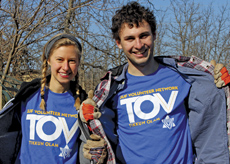
“Is this it?” A student asked as our van pulled up onto a hill next to a yard filled with bits and pieces of what was formerly a home.
A jumble of tree debris, plastic chairs, miscellaneous objects, and construction gear painted the picture of the week to come for our group as we took on tornado disaster relief work in Oklahoma. We were a group of students and staff from Metro Chicago Hillel, embarking on a Jewish Disaster Relief Corps Alternative Spring Break, conducted in partnership with JUF’s TOV Volunteer Network. When most college students are lathering on the sunscreen at popular destinations like Cancun or Miami for their spring breaks, this group decided to dedicate their week to something bigger than themselves.
“Chesed, or kindness, in general is a very important part of Judaism,” said Leah Edelman, a student from the University of Illinois at Chicago. “As human beings, we are all intertwined. Even though you might not know the people affected by any given disaster or tragedy, it is our responsibility as Jews to do the manual labor and show just how much we care about one another.”
The week was primarily spent helping a low income family rebuild after the tornados that struck almost a year earlier. The damage still echoed today in the broken trees, blown-down sheds, and destroyed porches. After a day’s work the students met for dinner and activities that helped them better understand their work and get to know each other. We met with the Oklahoma University Hillel staff and a local AEPi (Jewish fraternity) member came to express thanks and meet up with his Chicago brethren. One evening, after deep discussion and games, a teacher from the Plaza Towers School in Moore, Oklahoma joined our group.
After months of battling Post Traumatic Stress Disorder, she decided we were the group she would first speak to about her experiences on the day the F5 tornado destroyed her town. She held back tears as she explained her struggle to keep the school children alive, taking hits from flying debris as she held her students beneath her, praying that they would not be blown away. We were humbled by her courage to speak with us, her courage to stay at the school and protect those children, and her courage to remain with the parents who, after the destruction was being assessed at the school, were about to have their hearts broken forever.
“We are thrilled that our Metro Chicago Hillel students were able to join the relief effort in Oklahoma with Jewish Disaster Response Corps. Even though our communities are far apart, our students embodied the Jewish spirit for tikkun olam in helping in a critical phase of rebuilding that community,” said Yael Brunwasser, director of TOV Volunteer Services.
“Sure we are here digging holes and building decks, but it’s more than that; we are showing people we care about them,” said Andrew Van Sickle, president of DePaul University’s Hillel. The students spent the rest of the week building growing and learning, finally resting in a shared Shabbat experience that culminated the Spring Break trip with a sense of purpose and Jewish peoplehood. “We are giving people hope. We are building more than a house, we are making a home. We are building more than just a porch; we are giving people their way of life back.”
The wind blows for all who were touched by this life altering experience, and we all try to readjust as we go back to our normal lives here in Chicago, only now with a deeper appreciation for the gift that was this Alternative Spring Break.
Lisette Zaid is development manager and director of Lewis Summer Internship Program for the Hillels of Illinois.
Metro Chicago Hillel is part of the department of Campus Affairs and Student Engagement at Jewish Federation of Metropolitan Chicago/Jewish United Fund and a partner of Hillel: The Foundation for Jewish Campus Life.
Other stories
-
Local campus administrators convene on hate speech, bias
JUF and ADL brought together 17 student safety, diversity and inclusion and student affairs administrators and Hillel representatives from various Illinois campuses to discusses issues of hate speech and bias.
Read more -
Engaging students about Israel on campus
Too often we hear about difficulties facing Jewish college students on Illinois campus, but to focus solely on the politics gives only one piece of the complex narrative that is Jewish life on campus.
Read more -
Hillel International launches fellowship initiative to train young Jewish professionals
The Springboard Fellowship will train cohorts of young Jewish professionals in highly-valued skillsets and place them at local Hillel campuses for two years.
Read more
Over fifty years ago, when people were beginning to note a decline in Americans’ interest in organized religion, one of my favorite rabbis of all time made this observation:
“Religion declined not because it was refuted, but because it became irrelevant, dull, oppressive, insipid. When faith is completely replaced by creed, worship by discipline, love by habit… its message becomes meaningless.”
Rabbi Abraham Joshua Heschel, ladies and gentlemen. (And these words were tame compared to what he said about synagogue life, prayer, education, and the state of Jews’ involvement in justice issues in America in the ’60s).
While of course there have always been people satisfied and happy with synagogue, Heschel stands as a defender and protector of the Jewish community, saying that if we’re seeing declining numbers in our pews (and in the Pew study), we can’t blame the competition provided by Netflix or sports leagues or yoga studios. We must ask ourselves how have we allowed a tradition that radiates light, humor, wisdom, moral challenge, fire for social justice, intellectual rigor, and spiritual inspiration to become boring and uninspired?
The big question: How can those of us who care deeply about the current and future state of the Jewish people step up and make it more relevant and attractive? Not just doing better marketing (though that helps), but giving the product itself an upgrade and bringing Judaism into the 21st Century?
This is the question that drove me and the early supporters of Mishkan Chicago to gather for our first Friday night service in a Lincoln Park living room in September, 2011.
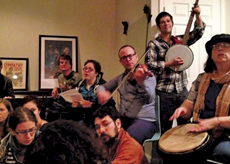
Two years later, on any given Friday night, you’ll see a scene that looks as much like a tent revival as like a Jewish worship gathering. Vocal harmonies, drum and guitar drive a rhythmic worship experience that has people on their feet, clapping, swaying. We study text together in hevruta (study pairs), and stay late into the night eating and drinking after services.
Our people come from across all denominational backgrounds from Secular Humanist to Orthodox, educated in different faith communities from Catholic to Quaker. Our people are black and white, gay and straight, trans, and cisgendered. Our people are radical progressives and conservatives and libertarians. You’ll see couples who met on JDate and interfaith or dual-faith couples. You’ll see a ton of single young adults, and a growing number of young families and baby boomers.
We daven (pray) in Hebrew, using a traditional liturgy. Our people tweet and post to Facebook after services to share pearls of wisdom said by a peer during their study, or to share a video they took on their phone during services, capturing the scene of 200 people engaged in ecstatic, soul-lifting prayer. Others walk home and won’t turn on lights until Shabbos is over. Everyone sings, eats, drinks, and shares Shabbat.
What I’m saying is, in the words of my teacher Rabbi Irwin Kula, our people are blenders and mixers and benders and switchers. You can’t pin us down and say we’re Orthodox, Conservative or Reform, secular or religious, that intermarriage or not keeping kosher are signs of disinterest in our Judaism. We show up where we feel inspired and connected, and don’t if we don’t. The bar has been raised for all of our organizations to meet this totally legitimate desire among Jews today for their religion not to be an heirloom, but a living fountain of inspiration.
When I say, “our people,” by the way, I don’t just mean Mishkan people. Mishkan people are reflective of the changing complexion of the Jewish community overall, and we would do well to begin to recognize how diverse our people are. Our people are not exclusively white and Ashkenazi, we don’t necessarily think Borscht Belt humor is funny, and are politically in a different place than our grandparents, further toward the right and the left. We have complex feelings about Israel. We want to be in a Jewish community as diverse and spiritually alive as we are. And we will leave Netflix at home for that.
We need a different metric and language to measure what it means to be meaningfully Jewish. Light is being shone from many corners of the city through organizations beyond synagogue walls-Jewish urban gardens, queer yeshivas, alternative afterschool programs, young adult spiritual communities, alternative university engagement-and we need to recognize that light as relevant and meaningful, not just some flash in the pan. That light is sparking the next generation of Jews in Chicago.
As a young start-up in one of the strongest and most established Jewish communities in the country, I want to offer a plea to those who can nurture those tiny sparks. A part of Mishkan’s success was the willingness of Rabbi Michael Siegel at Anshe Emet Synagogue to help us launch, along with a few visionary individuals who believed that we could help move the needle on Jewish engagement in Chicago. Instead of operating from a place of fear of what they could lose, they fearlessly encouraged us forward, and are now seeing people enter their building for Mishkan who would otherwise not connect with the Jewish community. Mishkan is honored to have received a JUF Breakthrough Grant, which we believe will have the same effect: Rather than shrinking one piece of the pie to grow another, together, we can expand the pie.
What would happen if we entered the future not from a place of fear of decline, but love and excitement about what’s possible?
Let’s find out.
Rabbi Lizzi Heydemann is the spiritual leader of Mishkan Chicago is an independent, non-denominational Jewish spiritual community in Chicago on a mission to engage, educate, connect and inspire people through dynamic experiences of prayer, learning, music and community-building. Find out more at www.mishkanchicago.org.
Other stories
-
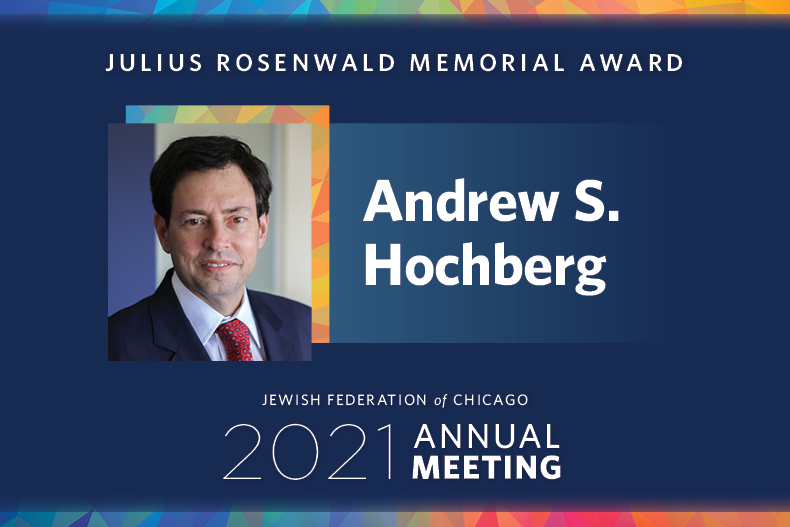
Meet Andrew S. Hochberg, 2021 Julius Rosenwald Memorial Award recipient
Celebrate Andy Hochberg at the virtual Annual Meeting on Sept. 14
Read more -
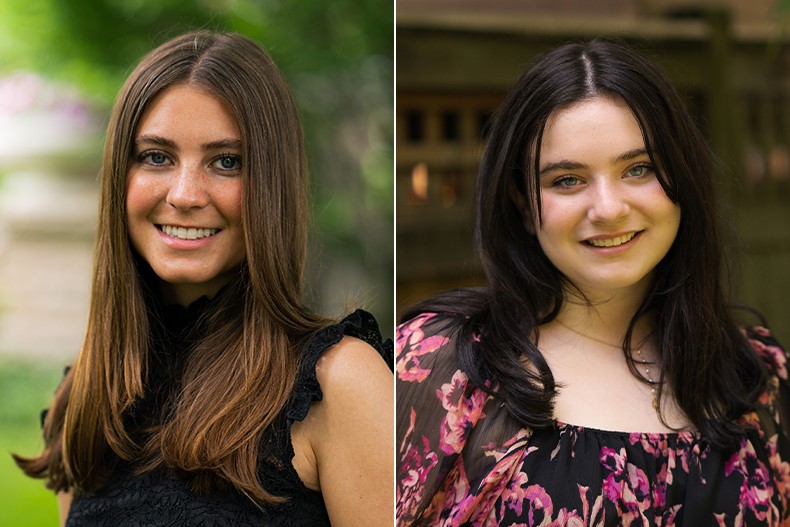
Two local teens win national recognition
Recipients of the annual Diller Teen Tikkun Olam Awards
Read more -
Celebrating six young award winners cultivating the community
Introducing young adult award winners
Read more
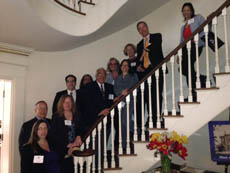
Thirty-nine Chicago Jewish community leaders and professionals boarded a bus early Wednesday morning for a two-day mission in Springfield organized by the Jewish Federation of Metropolitan Chicago to advocate for the issues that matter to their respective organizations and constituents.
“The power of collaboration among the Jewish Federation agencies is highlighted on the Springfield mission, particularly when we bring our message directly to the legislators,” said Wendy Abrams, vice chair of the Federation’s Government Affairs Committee and State chair.
Participants came from CJE SeniorLife, HIAS, Jewish Child and Family Services, Jewish Vocational Service, and Sinai Health System as well as the Jewish Women’s Foundation, the Health and Human Services Commission, JCFC and the Jewish United Fund/Jewish Federation of Metropolitan Chicago Board of Directors in addition to the Government Affairs Committee.
“In private meetings with the leaders, we talked about the critical need to fully fund health and human services and the imperative of understanding the short and long-term consequences of failing to do so,” said JUF Chairman of the Board David T. Brown.
Deep cuts in every area – health, education, human services, and public safety – are being proposed for the 2015 State Budget in the event that the temporary tax increase – scheduled to expire in January 2015 – is not renewed. The network of agencies within the Jewish Federation receive over $300 million a year in government funding, most of which, including much of the Federal funding, comes through the State.
“After focusing for many years in fundraising for JUF, after being involved in the Government Affairs Committee missions, I have a far greater appreciation for the role that government funding plays in supporting the critical work done by our agencies,” said Andy Hochberg, chair of the Government Affairs Committee. “I was very glad to have the opportunity to talk with our state officials who grant extraordinary access to our mission participants.”
There were 18 meetings held with legislators including Senate President John Cullerton, Senate Republican Leader Christine Radogno, House Republican Leader Jim Durkin, and House Majority Leader Barbara Flynn Currie. Participants felt that the legislators listened carefully to their message, even if the interaction was a bit challenging at times.
That evening, Governor Pat Quinn, Comptroller Judy Barr Topinka and various legislators joined the mission participants for cocktails at the Governor’s Mansion reception. After dinner, freshmen members of the Jewish Caucus, Representatives Scott Drury and Laura Fine and Senator Julie Morrison, called up the more senior members of the Caucus, Representatives Sara Feigenholtz, Robyn Gabel, Lou Lang, and Elaine Nekrtiz and seniors Daniel Biss and Ira Silverstein, for a tongue-in-cheek question-and-answer session.
On Thursday, Mission participants returned to the Capital for more meetings and then ended their visit by participating in the State of Illinois Holocaust Memorial Observance at the Old State Capitol.
Other stories
-
Meet Andrew S. Hochberg, 2021 Julius Rosenwald Memorial Award recipient
Celebrate Andy Hochberg at the virtual Annual Meeting on Sept. 14
Read more -
Two local teens win national recognition
Recipients of the annual Diller Teen Tikkun Olam Awards
Read more -
Celebrating six young award winners cultivating the community
Introducing young adult award winners
Read more
Recently, we have heard a lot of terrible news. The awful shootings at the Kansas City JCC. New attempts on college campuses to delegitimize and demonize Israel. Reports of Ukrainian Jews being ordered to “register” by the authorities, which turned out to be the work of rogue provocateurs, and of synagogues in Ukraine being firebombed, which turned out to be horribly real.
Since I am a leader in Chicago’s Jewish Federation, and active nationally with the American Jewish Joint Distribution Committee, when calamity strikes, my friends ask me what is happening. What are we, the organized Jewish Community, going to do? Are we ready?
The good news is: Yes, we are ready.
Always.
Thanks to you.
Thanks to your loyal support of the JUF Annual Campaign, and your commitment to the global Federation system that it funds.
For years, we — and our parents and our parents’ parents — have built that Federation system, a worldwide infrastructure to ensure that we can meet the challenges of future emergencies and opportunities. The system is at work on the ground every day, providing essential services from Buffalo Grove to Buenos Aires and Simferopol to Sderot.
That Federation system — that infrastructure — is sustained, year in and year out, through our gifts to the JUF Annual Campaign.
Now, “infrastructure” isn’t a sexy word. Neither is “planning” or “preparedness.” But we, the committed members of the Chicago’s Jewish community, have strategically invested in this capacity building because it is so important for the security and vitality of the Jewish People.
And our community knows it. We have seen the Federation system in action, airlifting Jews out of harm’s way, rushing aid to terror attack survivors, reaching across the globe anytime, anywhere a Jew is in trouble. We know that this is the benefit and beauty of a Federation.
While we are vigilant about potential threats and dangers, we are also investing in programs for your kids and mine — Jewish preschools, days schools, camps, youth groups and Hillels — that will enhance and enrich our community. We understand that infrastructure is what makes it possible to do both, to mobilize sufficient time and resources to prepare for rainy days and for better days. To meet challenges and maximize opportunities.
As we reach the height of the 2014 JUF Annual Campaign season, thank you in advance for your commitment to the work of this system and its values. For your generosity to the Campaign that makes it all possible.
Yes, we are ready.
Always.
Thanks to you.
Skip Schrayer is Chairman of the Jewish Community Relations Council and Immediate Past Chairman of the Board of the Jewish United Fund/Jewish Federation of Metropolitan Chicago.
Other stories
-
Meet Andrew S. Hochberg, 2021 Julius Rosenwald Memorial Award recipient
Celebrate Andy Hochberg at the virtual Annual Meeting on Sept. 14
Read more -
Two local teens win national recognition
Recipients of the annual Diller Teen Tikkun Olam Awards
Read more -
Celebrating six young award winners cultivating the community
Introducing young adult award winners
Read more
From the White House, Office of the Press Secretary:
On this Yom HaShoah, I join people of all faiths in the United Sates, in the State of Israel, and around the world in remembering the six million Jews – innocent men, women and children – who were senselessly murdered during the Holocaust, as well as all the victims of Nazi brutality and violence.
Even as we mourn those whose lives were taken, this day also provides us with an opportunity to honor those who emerged from the darkness of the Shoah to rebuild their lives in new communities around the world. I am honored to have the opportunity to address survivors of the Holocaust, along with many of those who have worked so hard to preserve their testimony and share their stories, when I speak at the Shoah Foundation next week. On this Yom HaShoah, let us recommit ourselves to the task of remembrance, and to always oppose anti-Semitism wherever it takes root. Together, we must give enduring meaning to the words “Never Again.”
Other stories
-
Meet Andrew S. Hochberg, 2021 Julius Rosenwald Memorial Award recipient
Celebrate Andy Hochberg at the virtual Annual Meeting on Sept. 14
Read more -
Two local teens win national recognition
Recipients of the annual Diller Teen Tikkun Olam Awards
Read more -
Celebrating six young award winners cultivating the community
Introducing young adult award winners
Read more
This year, Jews of all ages across Ukraine are celebrating Passover in spite of escalating challenges.
To help make this a reality, the American Jewish Joint Distribution Committee, JUF’s partner agency in Ukraine, provided nearly 53,000 boxes of matzah and coordinated scores of community Seders throughout the country — at Jewish Community Centers, at “Warm Home” gatherings of elderly Jews, in large cities, in towns and villages.
And just as they have been for more than two decades, some of these Seders were led by a cadre of young volunteers, who remind even the most isolated that we are all one big family.
From a spirited Seder featuring a klezmer band in Kharkov to a Simferopol Seder at the city’s “Old Crimea” restaurant to a holiday camp for families held in the outskirts of Kiev, JDC and JUF are ensuring that Passover in Ukraine and beyond is as vibrant, robust, and meaningful as ever.
At this uncertain time, celebrations of Jewish culture and tradition persevere. JUF is committed to working with its agencies overseas to care for Ukraine’s most vulnerable Jews, foster a continuing connection to yiddishkeit, and provide for needs both tangible and spiritual.
Read more about those increasing needs and how they are being addressed in JDC President Penny Blumenstein’s Letter to the Editor in the New York Times and in a JNS op-ed by JDC CEO Alan Gill.
Other stories
-
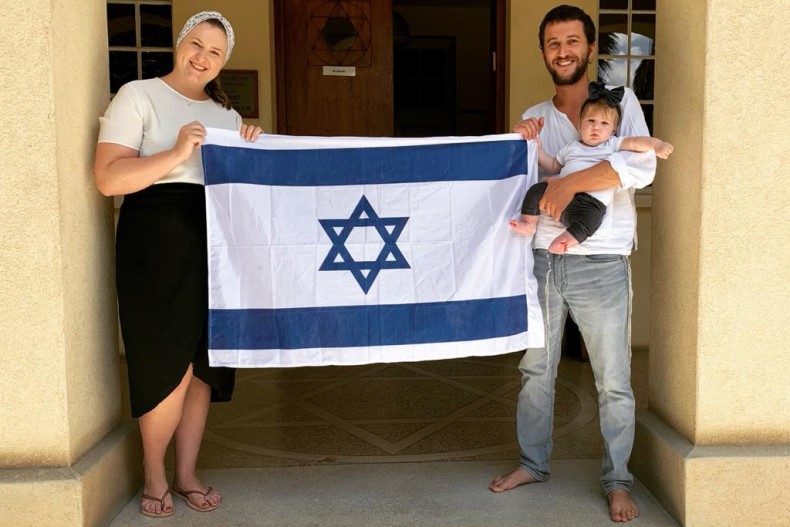
Chicago to Israel to Kenya
A family’s story of living Jewishly on three continents Michelle Cohen World May 28, 2021 Avital, Tzofia, and Netanel Kaszovitz outside their home in Nairobi on Yom HaAtzmaut. When Avital Kaszovitz prepared to be a Modern Orthodox shlicha (emissary) to the Jewish community in Ke
Read more -
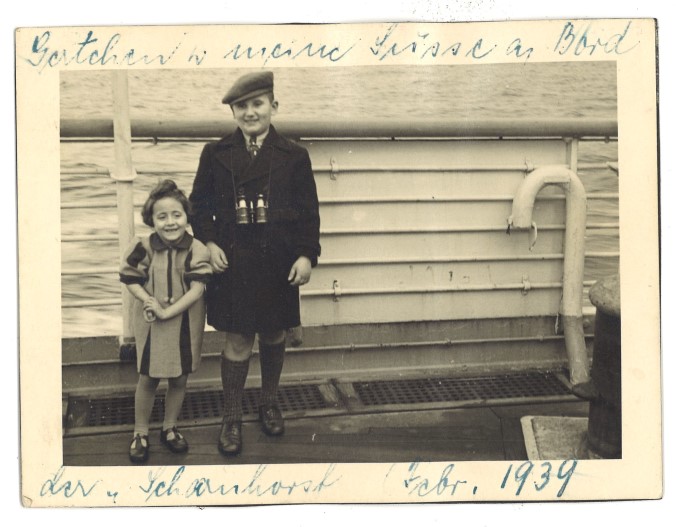
New exhibit spotlights the experience of ‘Shanghai Jews’
Explore a new Illinois Holocaust Museum and Education Center exhibit
Read more -
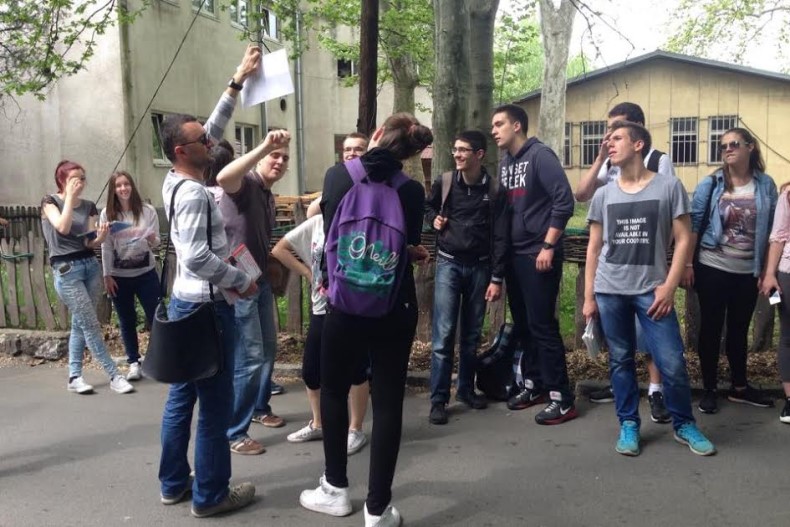
Europe’s brave new teachers of the Holocaust
Teaching the Holocaust in the modern era has its difficulties and rewards.
Read more
Our hearts and prayers are with the Jewish community of Overland Park, Kan., in the wake of the senseless shootings there. We pray for comfort for the families of the dead, and for the refuah shleymah of the injured.
On the eve of Passover, this is a painful reminder of the need for our Jewish community to be constantly vigilant. Today, as always, we have security procedures in place at Jewish institutions throughout the Chicago area, and are grateful for the excellent and continual collaboration we have with law enforcement at all levels.
Other stories
-
Meet Andrew S. Hochberg, 2021 Julius Rosenwald Memorial Award recipient
Celebrate Andy Hochberg at the virtual Annual Meeting on Sept. 14
Read more -
Two local teens win national recognition
Recipients of the annual Diller Teen Tikkun Olam Awards
Read more -
Celebrating six young award winners cultivating the community
Introducing young adult award winners
Read more
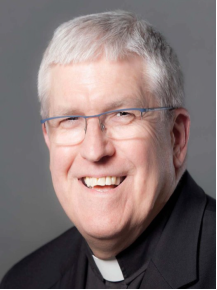
19th annual Bernardin Jerusalem Lecture brings together Chicago’s Catholic and Jewish communities to discuss the legacy of Vatican II
STEPHANIE SKLAR
Drawing over 200 community members and religious leaders representing the Catholic and Jewish communities in Chicago, the 19th Annual Joseph Cardinal Bernardin Jerusalem Lecture was held on March 31 at Temple Sholom in Lakeview.
As part of an honored and long-standing tradition of Catholic-Jewish dialogue in Chicago, the lecture has served as the significant annual event for Catholic-Jewish relations and is now recognized internationally as the premier encounter between these communities. The yearly event honors the legacy and memory of the late Cardinal Bernardin, whose efforts to encourage public dialogue with the Jewish community opened new horizons for scholarship and interreligious dialogue. The first lecture, entitled, “Anti-Semitism: The Historical Legacy and the Continuing Challenge for Christians,” was delivered by Cardinal Bernardin at the Hebrew University in Jerusalem, Israel in 1995.
This year’s event featured welcome remarks from Francis Cardinal George, OMI, and a lecture by Rev. John W. Crossin, OSFS, executive director of the Secretariat for Ecumenical and Interreligious Affairs for the United States Conference of Catholic Bishops.
Cardinal George said that the lecture has become a hallmark of the ongoing dialogue and friendship between the Jewish and Catholic communities in Chicago, and the topic of Father Crossin’s lecture is vital to our mutual understanding and relationship as we go forward. He reflected on differing perspectives on the land of Israel between Catholics and Jews, and he urged all to appreciate the different meanings of Israel and to learn from them, even if we do not share them.
“Our relationship is too important to simply talk past each other,” Cardinal George said. “Instead, our goal needs to be that of a Beit Midrash – a house of study.”
Father Crossin shared his reflections on “What Changed at Vatican II: Past, Present and Future Perspectives on Catholic-Jewish Relations.” The Second Vatican Council (also known as Vatican II) gathered around 2,000 bishops and thousands of observers for four sessions between 1962 and 1965. At that time, it was the first ecumenical council – an assembly of Roman Catholic religious leaders meant to settle doctrinal issues– in nearly 100 years.
Nostra Aetate, the 1965 Declaration on the Church’s Relationship to Non-Christian Religions, was one of the most influential and celebrated documents to arise out of Vatican II. Nostra Aetate made possible a new and positive relationship between Jews and Catholics by proclaiming that “what happened in [Christ’s] passion cannot be charged against all the Jews” and “the Jews should not be presented as rejected or accursed by God,” while also condemning acts of anti-Semitism.
As we approach the 50th Anniversary of Nostra Aetate in 2015, the time is ripe for reflections on its meaning today. Father Crossin suggested that “a new and coherent way of Catholic-Jewish self-understanding and acting will continue to emerge in the post-modern period.”
“The teaching of Nostra Aetate has been received and caused a fundamental reorientation in Catholic thinking and action,” he said. “And we are witnesses to that as participants tonight in this series of Lectures which are a significant change and a continuing development of Nostra Aetate.”
Looking to the future, Father Crossin emphasized that while we have a rich history of Catholic-Jewish friendship, both religions need to pass on this legacy to future generations, including young Catholic seminarians being taught about the Jewish religion and the Jewish community teaching young adults about Nostra Aetate. Father Crossin offered practical advice for fostering listening and understanding in order to encourage relationships of mutual understanding. He said interfaith relations need to be face-to-face and person-to-person, rather than viewing people in categories. This is the best way to establish a relationship, and honest dialogue is rooted in our deep and genuine relationships to each other.
The Program closed with Rev. Thomas A. Baima, Vicar for Ecumenical and Interreligious Affairs for the Archdiocese of Chicago, announcing the 20th Annual Joseph Cardinal Bernardin Jerusalem Lecture, which will take place on March 9, 2015 at DePaul University’s Student Campus Center. Next year’s program will feature guest lecturer Rabbi David Sandmel, currently the Crown Ryan Professor of Jewish Studies at the Catholic Theological Union and rabbi-educator at Temple Sholom, and soon-to-be Director of Interfaith Relations for the Anti-Defamation League in New York.
The 19th Annual Joseph Cardinal Bernardin Jerusalem Lecture was sponsored by the Archdiocese of Chicago, the American Jewish Committee, the Chicago Board of Rabbis, the Jewish Federation of Metropolitan Chicago, and the Spertus Institute for Jewish Learning and Leadership. This program was made possible through the generosity of 2014 co-sponsors Temple Sholom and the Aaron M. Petuchowski Fund for Excellence in Jewish Education.
For more information about similar programs, please call 312-357-4770 or email [email protected]. For more frequent updates, follow @ChicagoJCRC on Twitter.
Stephanie Sklar is Director of Domestic Affairs for the Jewish Community Relations Council of the Jewish United Fund/Jewish Federation of Metropolitan Chicago.
On May 13, 1939, a German ship sailed out of Hamburg for Havana with 937 Jewish refugees aboard. Known as the “Voyage of the Damned” for being denied permission to dock in Cuba and subsequently being turned away from the United States and Canada, the SS St. Louis was ultimately forced to return to Europe where over 200 refugees perished at the hands of Nazis in concentration camps.
Today, as part of its ongoing mission to promote greater awareness and dialogue on issues of human rights, immigration and refugee policy, the SS St. Louis Legacy Project has announced it is joining with Protravel International to commemorate the tragic sequence of events that transpired 75 years ago. Through a unique educational cruise on the Crystal Serenity this November 5-19, guests will have the rare opportunity to hear directly from surviving passengers of the ill-fated 1939 voyage, as well as to seeing a showing of the new feature documentary film Complicit, which the SS St. Louis Legacy Project describes as “the untold story of why the Roosevelt Administration denied safe haven to Jewish Refugees.” The film is an official selection of the Australian Jewish Film Festival and the Georgetown University Law School Equal Justice Film Festival.
Additionally, guests will learn about the events surrounding the SS St. Louis by renowned filmmaker Robert Krakow and producer Dr. Ruth Kalish, who will host a private cocktail reception, as well as to see a showing of the SS St. Louis Archival Exhibits, which include original documents from the U.S. State Department Archives. Guests may also participate in an interactive presentation of the critically acclaimed play, The Trial of Franklin D. Roosevelt. Both the film and the play focus directly on the events that transpired 75 years ago.
“We will breathe life into history by using this unique cruise experience aboard the Crystal Serenity to trace the voyage of the SS St. Louis in a deeply respectful and meaningful way,” explained Dr. Kalish. “To keep this history alive, it’s essential that our efforts are brought forth in today’s environment. One way to do that is by using drama to educate, but we’re finding another way is to incorporate this particular commemoration into a modern cruise experience.”
“Protravel is very honored to work with the SS St. Louis Legacy Project through this extraordinary event to help foster greater understanding of this tragic chapter in U.S. and world history,” noted Barry Liben, CEO of Protravel International. “As a testament to our support, Protravel will be making a donation to the continuing educational efforts of the SS St. Louis Legacy Project.”
On Nov. 5, the cruise will depart New York City with an itinerary that includes Baltimore, Norfolk, Charleston, Grand Turk, Curaçao, and Aruba, prior to disembarkation in Miami on Nov. 19. The sailing also coincides with the acclaimed Crystal Wine & Food Festival on the Crystal Serenity and features famous chefs and wine authorities, thus providing guests with unparalleled experiences.
In addition to Crystal’s value-added inclusions – complimentary gratuities, concierge services for personal arrangements ashore and more – exclusive amenities for the SS St. Louis Legacy Project cruise also include an autographed DVD and poster of Complicit, and a commemorative book containing copies of the original documents and a photo album containing pictures taken aboard the SS St. Louis.
Space is very limited for this special experience, which is available exclusively through Protravel. For more information on retracing the SS St. Louis history, please call (800) 785-1944.
Other stories
-
Chicago to Israel to Kenya
A family’s story of living Jewishly on three continents Michelle Cohen World May 28, 2021 Avital, Tzofia, and Netanel Kaszovitz outside their home in Nairobi on Yom HaAtzmaut. When Avital Kaszovitz prepared to be a Modern Orthodox shlicha (emissary) to the Jewish community in Ke
Read more -
New exhibit spotlights the experience of ‘Shanghai Jews’
Explore a new Illinois Holocaust Museum and Education Center exhibit
Read more -
Europe’s brave new teachers of the Holocaust
Teaching the Holocaust in the modern era has its difficulties and rewards.
Read more
Kick off Water Safety Month this May with a big splash. Four-time Olympic swimming gold medalist Lenny Krayzelburg will be at Bernard Weinger JCC, 300 Revere Drive in Northbrook, at 9 a.m. on Sunday, May 4.
Krayzelburg will be available for autographs and photos to promote Lenny Krayzelburg Swim Academy lessons being offered through JCC. Throughout the morning, children can receive a free swim evaluation and two free swim lessons when they register for a LKSA swim program. Reservations for a free swim evaluation are encouraged.
“Kids want to spend time in the water, so making sure they are water safe is one of our main objectives,” Krayzelburg said. “With our method, children develop a sense of comfort in the water, and then we teach strokes.”
Students three months and up first learn basic skills, then mastery of the four competitive strokes: freestyle, backstroke, breaststroke and butterfly.”
Since 2005, Krayzelburg’s highly successful, exclusively-JCC, learn-to-swim program has taught thousands of children water safety and the importance of knowing how to swim. His inspiration came from the excitement he observed of children taking swim lessons while he was training for the 2004 Olympics in California.
“JCC selected the Lenny Krayzelburg program because it’s based on best practices and the most advanced thinking in the field,” said Jacqueline Keane, JCC Chicago Assistant Director of Wellness. “Low teacher-to-student ratio gives each child the personal attention they need to be successful.”
“JCC Chicago’s partnership with LKSA’s high quality swim program of safety and skill demonstrates our commitment to supporting the diverse fitness and wellness needs of individuals and families in our community, and expands on JCC’s commitment of service to families in the northern suburbs,” said Alan Sataloff, JCC General Director and CEO.
Krayzelburg and his family emigrated from the Ukraine to Los Angeles in 1989. L.A.’s Westside JCC provided the opportunity for Krayzelburg to hone his skills, and for his family to explore their Judaism. Krayzelburg’s first major swim competition was the 1990 Maccabi Youth Games. In 2001, fresh off his three Olympic gold medals at the 2000 Sydney games, Krayzelburg skipped the World Championships, opting instead to join the U.S. Team of the World Maccabiah Games in Israel, where he won a pair of gold medals. His fourth Olympic gold medal came at the 2004 games in Athens.
“The World Maccabiah Games was my first experience in Israel,” Krayzelburg said. “It was a special time to be there as a Jew and I learned more about Jewish culture and history.”
For more information and to learn more about the LKSA swim programs at the Mayer Kaplan JCC in Skokie, contact Kim, (847) 763-3604 or [email protected].Other stories
-
Meet Andrew S. Hochberg, 2021 Julius Rosenwald Memorial Award recipient
Celebrate Andy Hochberg at the virtual Annual Meeting on Sept. 14
Read more -
Two local teens win national recognition
Recipients of the annual Diller Teen Tikkun Olam Awards
Read more -
Celebrating six young award winners cultivating the community
Introducing young adult award winners
Read more