Some 100 young Jewish adults volunteered on April 6 for Feed Chicago, a citywide day of service providing food assistance to people in need of all faiths, hosted by the Jewish United Fund’s Young Leadership Division and TOV Network.
Held the week before Passover, Feed Chicago served as the culminating event of JUF’s Hunger Awareness Project, a year-long initiative to raise awareness and mobilize volunteers in the area of hunger and food insecurity.
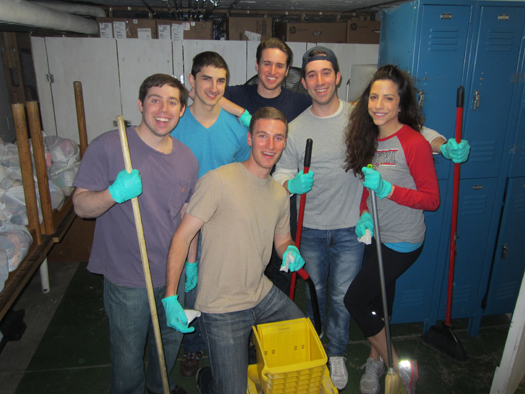
Sam Berry (center) and fellow volunteers help clean and organize the food pantry at Connections for the Homeless.
“On Passover, we say ‘Let all who are hungry come and eat,” said Ellen Hattenbach, Chair of the Hunger Awareness Project. “Feed Chicago was a truly meaningful opportunity for young adults in our community to live that beautiful Jewish value as we prepare for the holiday.”
With 12 projects taking place from dawn to dusk throughout the city and suburbs, thousands of people in need were impacted by day’s end. From stocking food pantries and delivering groceries to cooking and serving meals for people in need, the volunteers all made a significant impact at their service sites.
“Feed Chicago was a tremendous opportunity for young adults around Chicago to give back to their community,” said Sam Berry, who helped clean the food pantry at Connections for the Homeless. My friends and I had a valuable experience donating to, organizing, and cleaning Connections for the Homeless in Evanston. It was truly rewarding to see the positive impact that we had on the shelter through our work on Sunday afternoon.”
JUF’s partner organization sites included: A Just Harvest, the ARK, Breakthrough Ministries, Chicago Chesed Fund, Connections for the Homeless, Franciscan Outreach Association, Housing Opportunities & Maintenance for the Elderly (H.O.M.E.), Lincoln Park Community Shelter, Maot Chitim and The Center for Enriched Living.
“We had 12 individuals come in to help in our food pantry – they brought some food which they quickly got to work weighing and sorting onto the shelves and then completed a deep clean of the food pantry – sweeping, mopping and sanitizing the entire area,” said JoBeth Hamon, Volunteer Manager at Connections for the Homeless. “They also noticed we were low on certain items in the pantry and took it upon themselves to make a trip to the grocery store to buy additional donations. Altogether, the group donated 190 pounds of food! We couldn’t provide services for our clients without volunteer groups that help, and it has been a pleasure to work with JUF’s Feed Chicago volunteers because they always bring a particular energy and enthusiasm to their work.”
The biannual day of service is just one small part of the JUF’s year-round efforts to fight hunger. Approximately 4,100 Jews in Chicago are sustained through daily or weekly JUF-funded food programs. In 2013, JUF agencies provided local Jews in need with 469,088 meals, food packages and grocery cards.
“Because the boxes can be heavy—especially the ones with two or three frozen chickens—having young, physically strong volunteers was especially important,” said Caroline Musin Berkowitz, Director of Volunteers and Outreach at The ARK. “Thank you to our excellent Feed Chicago volunteers! We’d be delighted to have them come back at any time.”
Other stories
-
Meet Andrew S. Hochberg, 2021 Julius Rosenwald Memorial Award recipient
Celebrate Andy Hochberg at the virtual Annual Meeting on Sept. 14
Read more -

Two local teens win national recognition
Recipients of the annual Diller Teen Tikkun Olam Awards
Read more -

Celebrating six young award winners cultivating the community
Introducing young adult award winners
Read more

Israeli singer-songwriter David Broza, Paris-based singer/songwriter Keren Ann, State Rep Sara Feigenholtz, and local comedic talents Susan Messing and Aaron Freeman are among the performers and VIPs who will lead Chicagoans in a wildly imaginative and interactive Passover seder dinner hosted by City Winery Chicago, 1200 W. Randolph, Tuesday, April 8, at 7 p.m. Plus, City Winery will screen a special video by comedian Lewis Black of his version of the “10 Plagues,” created just for the venue.
The 2014 Downtown Seder will feature guests seated at elegant long family-style tables, each set with the traditional accoutrements, including seder plate and matzoh. Performers, who are seated with guests throughout the room, will creatively expound on various sections of the Passover Haggadah (seder text), which has been specially developed for this night. In approximately two hours, all of the customary traditions will be followed, including drinking of four glasses of wine (produced by City Winery), discussing the four different children, reciting the four questions, and eating a kosher-style or vegetarian meal prepared by City Winery Executive Chef Andres Barrera.
What makes the Downtown Seder different from all other seders is the addition of artists each offering their unique interpretation of the important lessons from the timeless Exodus story-the universal message of going from slavery to freedom.
The Downtown Seder is produced by City Winery impresario Michael Dorf, who has presented this annual sell-out event at his New York City venue for the past 14 years. The Downtown Seder was first produced here in April 2011 at the Cultural Center as a preview of the Chicago City Winery concept, and this is the second year being held in the West Loop location.
“The Downtown Seder is specifically being held the week prior to the start of Passover so that guests might bring the inspiration into their homes and make their own Seder dinner more relevant,” said Dorf.
Among the talent confirmed to participate in the Seder are: David Broza, Keren Ann, Susan Messing, Aaron Freeman, Sean Altman as Jewmongous, JC Brooks, Illinois State Representative Sara Feigenholtz, Louder Than A Bomb’s Kevin Coval, South African Consul General of Chicago Vuyiswa Tuelo, the Chicken Fat Klezmer Orchestra, Chef Ina Pinkney, comedian Caryn Bark, and Jewish a cappella group Listen Up!
Only 300 tickets for the City Winery Seder are available, priced at $70, $110 and $145 (based on seating location). Vegetarian and kosher-style meal is included, with a kosher option available for an additional $25.00/person. To purchase a Seder ticket or for more information, call (312) 733-WINE (9463) or visit www.citywinery.com.
Other stories
-
Meet Andrew S. Hochberg, 2021 Julius Rosenwald Memorial Award recipient
Celebrate Andy Hochberg at the virtual Annual Meeting on Sept. 14
Read more -
Two local teens win national recognition
Recipients of the annual Diller Teen Tikkun Olam Awards
Read more -
Celebrating six young award winners cultivating the community
Introducing young adult award winners
Read more
It was the end of the fourth, and all eyes were on me.
That’s the fourth question, of course. Although the unofficial fifth question (will she find the afikoman?) was on the minds of everyone in the room.
Most people’s unofficial fifth question is “Who will find the afikoman?” But when you’re the only child at the Seder year after year, no one wonders who. They only wonder when. Where. How. And in my case, if.
I admit it, hide and seek was never really my strong suit as a child. I usually preferred to play “hide and then tell me where you are when I become annoyed that I can’t find you.” Unfortunately, afikomans (dessert at the seder) can’t speak up and tell you where they are. And my grandpa, who always hid the afikoman, wasn’t talking either.
“Come on Grandpa, give me a hint,” I begged. At this point, I had scoured our three-story house approximately 12,000 times. Probably more. I had flipped every cushion, looked under every bed, and triple-checked the inside of every cupboard. Nothing.
The adults, of course, thought this was hilarious. I shared an eye roll with the dog.
As I sat back down at the table, defeated, embarrassed, and wondering if I’d still get my $18 Barnes & Noble gift card (the one that was supposed to be guaranteed, since I didn’t have any competition), it occurred to me that Grandpa’s torso seemed a bit bulkier (and more . . . square . . .) than usual.
I looked closer.
It did not appear that Grandpa had worked out anytime during the Seder.
Being the loving, totally non-sneaky granddaughter I was, I brilliantly decided to go in for a hug. Everyone likes a good Passover hug.
Hmm. Grandpa felt rather-crumby. Interesting.
Finally putting the pieces together, I dramatically pulled his suit jacket open, and watched in amazement as the afikoman fell out.
“Busted!”
Everyone laughed, and though I was relieved, I was not particularly amused.
I should’ve been happy-the precious Barnes & Noble gift card was secured, after all-but frustration lingered long after the dessert had been eaten. I searched high and low, near and far, and in some dark, disturbing places (a kid should never have to look through his/her parent’s sock drawer for any reason), and it was in his jacket, at the table, the entire time? Seemed to me like a lot of wasted time and effort.
My mom, picking up on my subtle (okay, fine, not subtle) crankiness in the way that moms do, asked what I was so upset about, and I told her.
“But you found it,” she said. “Who cares where it was or how long it took? You found it.”
She was right. The more I thought about it that night-and additional nights later on-it didn’t have to matter how long it had taken me. After all, it had taken the Jews 40 years to find their way out of the desert. While I’m sure they would have liked to skip 39.999 of those years and head right into their new lives as free people, I highly doubt they were moaning and groaning too much when their journey came to an end. They were likely pretty ecstatic to finally make it out of the desert, regardless of the disheartening amount of time it had taken. Also, that lengthy amount of time-in its own mysterious way-had probably made them even more grateful and appreciative when their journey ultimately concluded.
Of course, my afikoman adventure was obviously nowhere near the plight of the Jews in the desert in terms of levels of difficulty and aggravation, but thinking about the Passover story and what they endured helped put things in perspective. Would I have liked the afikoman to be easier to find? Absolutely. Would I have liked my search to take less time? Of course. Was I proud of myself for overcoming Dad’s nasty socks and finding it anyway? Heck yes I was.
Passover reminds us to persevere in times of struggle. Whether it’s a big wandering-through-the-desert type of struggle, a where-the-heck-is-that-darn-matzoh struggle, or anything in between, we have to trust that we’ll eventually find what we’re looking for, even if it takes longer than we’d like.
But, word to the wise: Always check your grandpa’s jacket first.
Abby Cooper lives in Chicago and works as the library intern at Bernard Zell Anshe Emet Day School. She enjoys writing, reading, running, and eating the afikoman-plus a lot of other desserts.
Other stories
-
Meet Andrew S. Hochberg, 2021 Julius Rosenwald Memorial Award recipient
Celebrate Andy Hochberg at the virtual Annual Meeting on Sept. 14
Read more -
Two local teens win national recognition
Recipients of the annual Diller Teen Tikkun Olam Awards
Read more -
Celebrating six young award winners cultivating the community
Introducing young adult award winners
Read more
When your family put meat on the table by putting meat on other families’ tables-and keeping kosher-making the Passover seder “a night like no other” could be a challenge.
Elaine Sternberg’s grandfather, Isaac Oscherwitz, started the Oscherwitz Sausage Company in Cincinnati, Ohio, more than 100 years ago, expanding the business throughout the Midwest. Elaine’s father, Philip, and his brother, Harry, came to Chicago in 1925 and established Best’s Kosher Sausage Company, an important Windy City culinary icon for decades. (See sidebar.)
As a young bride living in her widowed father-in-law’s home, Laura-Elaine’s mother, wanted to make an impression at Passover. Because the family ate meat every night of the year, Laura created her own milchig Seder, featuring butter, egg, and cream-based dishes.
“Having butter on the table was a delight,” Elaine said. “We didn’t eat butter with a meat dinner-and we had a lot of meat for dinner.
“It was a very unusual seder. We loved it. It was our favorite meal of the year.”
After the ceremonial herbs, the Seder begins with a somewhat controversial matzoh ball soup. Figuring three-fourths of a cup of soup per person, mix together half water, half whole milk, a large chunk of butter, a little pepper.
Oh, yes-and “salt, salt, salt!”
Cook the ingredients slowly. “With the amount of salt there is, it becomes soup,” Elaine said.
People’s reactions vary when they taste the soup. “It’s very mixed, from ‘I love this soup!’ to ‘Don’t ever invite me to dinner again!'” Elaine laughed.
The rest of the seder consists of homemade gefilte fish, homemade horseradish, parboiled oven roasted potatoes, asparagus, tomato, cucumbers, buttered matzoh and, for dessert, a 12-egg Passover cake that essentially becomes a strawberry shortcake topped with piles of thick, rich whipping cream.
“The whole dinner to us was absolutely the best in the world,” she said. “My friends could never get over it.” Elaine cooked the milchig (dairy in Yiddish) seder for her husband, Sheldon, and their children for years. Now, their children and their spouses have picked up the tradition-sharing in the family’s collective memory and making their Passover Seder a “night like no other.”
Remembering Best’s Kosher Sausages
Best’s Kosher Sausages were a Chicago culinary icon, particularly famous for their hot dogs, served at every major Chicago sports venue for many years.
Best’s Kosher Sausages started in 1886, when Elaine Sternberg’s grandfather, Isaac Oscherwitz, immigrated to Cincinnati, Ohio, and created a business to support himself, his five sons, and two daughters. The company was later renamed I. Oscherwitz & Sons as it expanded throughout the Midwest.
Two of Isaac’s sons, Philip and Harry, moved to Chicago in 1925 after their father died, and opened Best’s Kosher Sausage Company. Philip’s daughter, Elaine, married Sheldon Sternberg, and he eventually ran the business with help from numerous other relatives.
While Best’s was primarily famous for its hot dogs, the company expanded to make kosher lunchmeats as well. Business grew, and Best’s acquired Sinai Kosher in 1983. Ten years later, Sara Lee bought the company.
Much to the dismay of Chicago hot dog fans, Sara Lee closed Best’s in 2009, ending more than 100 years of tradition.
Susan Berger, Sheldon and Elaine Sternberg’s daughter, wrote in the Chicago Tribune: “This was a loss not only for my family, but for the millions of Jews who keep kosher and the many millions who don’t but learned to love my family’s hot dogs.”
(Source: Susan Berger, “The End of a Chicago Tradition,” Chicago Tribune, Jan. 23, 2009)
Other stories
-
Meet Andrew S. Hochberg, 2021 Julius Rosenwald Memorial Award recipient
Celebrate Andy Hochberg at the virtual Annual Meeting on Sept. 14
Read more -
Two local teens win national recognition
Recipients of the annual Diller Teen Tikkun Olam Awards
Read more -
Celebrating six young award winners cultivating the community
Introducing young adult award winners
Read more
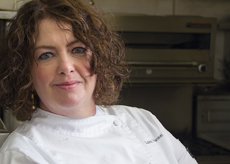
Polar vortexes and mountains of snow be damned, full speed ahead to spring and the holiday!
We Chicagoans have been through a lot and we deserve a delicious and full flavored Passover.
My theme for all the food this year is CLEAN recipes. No hidden ingredients and no faux or ersatz substitutes. Just pure, scrumptious flavors.
I get depressed when I see the piles of mixes and boxed Passover foods lining the shelves. I am not sure what those mixes have to do with Passover, but I know they are not good. I prefer to eat with whole and unprocessed ingredients. Passover should be is a feast for the senses that will nourish mind, body, and soul. I don’t see boxed and nutritionally empty foods as a part of that sensibility. I want to emerge from “Mitzrayim”(Egypt) and the holiday renewed physically and mentally.
I attended the International Association of Culinary Professionals and the Women Chefs and Restaurateurs Association, both hosted in Chicago this year. The lectures I attended at both events were remarkable similar. The topic of discussion was regarding the health of the nation and why no one cooks at home? The only way for our families to get healthy is if we spend more time cooking at home and eating wholesome homemade meals. I was saddened to hear that the First Lady of the United States and Private Chef for the First Family both said the reason people don’t cook at home is not due to time constraints or even economics; it is due to the simple fact that they don’t know how!
As a chef, it is my mission to share recipes, techniques, and any tricks I have up my sleeve to get people in the kitchen and cooking. I think one of the first steps to that end of cooking at home from fresh whole ingredients, is to skip the box of chemicals and gunk and go for the fresh and whole foods.
I think the holiday is a chance to break away from our usual work-day routines and eating habits and start the season clean and fresh, just like our freshly scrubbed kitchens and homes. And yet, more than any other time of the year, I see store shelves and shopping carts full of boxed, prepared foods that bear no resemblance to real food.
After the winter we have had, I am cooking up a holiday full of bright, fresh and clean flavors. Here’s to a holiday of home cooked and fresh meals of Clean Food. Chag Kasher v’ Sameach Pesach!
Standing Rib Roast with Smashed New Potatoes
Cooking a large piece of meat to the perfect juiciness starts with bringing the meat to room temperature before cooking.
The center/eye of the meat should be at room temperature or it will be undercooked with the outer layers being overcooked. Your goal is a large medium rare EYE of the meat with a thin browned layer on the outside.
Take the time to allow the meat to come to room temperature which should be about 1 hour or so.
I scatter the bottom of my roasting pan with small onions, baby potatoes, and whole heads of garlic. I use cipollini onions, which are small and sweet. They cook to a delicious caramel-gooey texture and make a great schmear for the meat. Divine!
Serves 8-10
6 rosemary sprigs, leaves stripped and chopped
8 cloves of garlic, finely chopped
¼ cup kosher salt
2 tablespoons freshly cracked pepper
1/3 cup extra virgin olive oil
1 8-81/2-pound bone-in rib roast
2 cups small onions (such as pearl onions or cipollini), peeled
2 pounds new potatoes
2 whole heads of garlic
- Place the rosemary, garlic, salt, pepper, and olive oil in a food processor and pulse until the mixture forms a paste.
- Schmear the paste, generously, on the roast and allow the roast to stand at room temperature for an hour or refrigerate overnight.
- Preheat oven to 425 degrees F. Place the meat in a roasting pan, meat facing up, and roast for 30 minutes. Decrease the oven temperature to 350 degrees F and cook, occasionally spooning the juices over the meat, until a thermometer inserted into the thickest part of the meat registers about 125 degrees F (about 1 ½ hours) for medium rare. (I go a little under to account for carry over cooking, so I prefer to pull the meat at 115 degrees F.)
- Allow the meat to rest for about 15 minutes before cutting the meat off the bone and slicing.
- Skim the fat off the pan juices and serve.
- Squeeze the cooked garlic out of the bulb and mash in a bowl.
- Smash the potatoes with the back of a small pan and toss with the garlic and salt and pepper.
- Place a pan, lightly coated with olive oil, over medium heat and cook the potatoes until the edges are crispy and browned.
- Serve the potatoes on a platter with the sliced meat and top with the browned onions and pan juices.
Roasted Carrots
When spring has sprung so has one of the simplest and most underrated vegetables, baby carrots. I am not talking about the carrots that are machine cut and in a bag in the produce department. I am talking about the carrots that are purchased with their tops still on and are miniature gorgeous orange, yellow and burgundy sweet root vegetables loaded with earthy flavor.
These beauties don’t need much fussing. Just a quick rinse and scrub (I don’t even peel mine) and then a good toss with good EVOO and some salt and pepper.
Simple is sometimes the best way of showing off color and flavor.
2 bunches of baby carrots with tops (carrots with tops are a good indicator of freshness. If the tops don’t look fresh and vibrant, the carrots are not fresh), tops cut off with an inch left attached to the carrot for a rustic look
EVOO
Kosher salt and pepper
Preheat oven to 350 degrees, line a baking sheet with parchment paper.
- Toss the carrots with olive oil, salt and pepper and place the lined baking pan. Don’t overcrowd the carrots or they won’t brown evenly.
- Roast the carrots about 15-20 minutes until they are light toasty brown but still show their gorgeous color. You should be able to pierce the carrot with a fork and have a little resistance.
- Toss the carrots with crispy shallots.
Crispy Shallots
Crispy shallots are a professional chef’s best friend. We use them whenever we need a tasty crunchy garnish.
The secret to crispy shallots is to cook over medium low heat and in plenty of oil. Don’t worry, the oil can be used to sauté in…bonus!
4 large shallots, peeled and sliced very thinly on a mandolin or with a knife.
Extra virgin olive oil
Kosher salt and freshly cracked pepper
Line baking sheet with paper towels
- Place a 9-10 inch sauté pan over medium-low heat. Add about ½ inch of oil. Cook the shallots very slowly until they turn golden brown. Be patient! This could take 15 minutes. Transfer the shallots to the lined pan and season with salt and pepper.
- Store the shallots in a container with a tight fitting lid at room temperature for up to 3 days.
- Save the tasty oil for sautéing, or drizzling on matzo in the refrigerator. YUM!
Meyer Lemon Sponge Cake
Sponge cakes are boring and ho-hum unless you kick them up a bit.
My sponge cake gets added oomph from Meyer lemons. Meyer lemons are cross between a tangerine and lemon. The fruit is fragrant and lively with the perfume of tangerine.
I also use vanilla bean in my cake. The essence from the vanilla bean adds an elegant flavor and aroma.
I bake my sponge in individual cake pans and add Meyer lemon curd as a filling between the layers. The curd is tart and refreshing.
You can also bake the sponge cake in a bundt style pan and place a dollop of the delicious curd right on top of the cake.
1 cup matzo cake meal
6 tablespoons potato starch
½ teaspoon sea salt
7 large eggs, separated
1 ½ cups granulated sugar, divided
1 ½ tablespoons grated Meyer lemon zest
½ cup Meyer lemon juice
½ Tahitian vanilla bean, scraped
Preheat oven to 325 degrees.
1. Mix the flour, potato starch, and salt into a bowl and set it aside. In a large mixing bowl, beat the egg yolks and 1 cup of the sugar with an electric mixer on medium-high speed for 5 minutes, scraping down the bowl once. Mixture should be thick and light. Mix in the lemon zest, juice, and vanilla on low speed just until blended. Set aside.
2. In another large mixing bowl, with clean beaters, beat the egg whites on medium-high speed until the whites are thick and quite foamy. Gradually add the remaining 1/2 cup of sugar while beating the egg whites on high speed until they are stiff and glossy, about 7 minutes.
3. Fold in 1/3 of matzo mixture using a rubber spatula into the beaten egg yolks. Fold in another third of the flour mixture along with a third of the beaten egg whites. Then, fold in the remaining flour, then the remaining egg whites, until the batter is completely mixed in. Pour slowly into 9-inch cake pans and smooth the top with a spoon.
4. Bake for 30 to 40 minutes or until a toothpick comes out clean, remove onto a wire rack and let cool completely. Carefully remove cakes from the pans.
5. Spread layers with Meyer lemon curd and finish cake with Meyer lemon glaze.
Meyer Lemon Curd
There is nothing especially Pesadich about this recipe. It is so delicious you can use it year round.
My Meyer lemon curd is a clean recipe. I don’t use margarine as a butter substitute, instead I add rich and delicious olive oil to give the curd extra richness and shine.
The curd is delicious as a cake filling and as a “dip” for berries and other fruit.
2 teaspoons Meyer lemon zest
Juice of 4 Meyer lemons
½ cup granulated sugar
6 egg yolks
2 tablespoons extra virgin olive oil
¼ teaspoon sea salt
1. Microplane lemons to make 2 teaspoons zest.
2. Whisk together zest, juice, sugar, salt, and eggs in a non-reactive pot. Place over medium-low heat and cook, whisking, until thickened and smooth, about 5 minutes. Strain curd through a fine sieve set into another bowl.
3. Add the olive oil and mix thoroughly. Chill until ready to add to cake. Cover with plastic before chilling to prevent skin forming.
Meyer Lemon Glaze
The simple glaze adds flavor and finishes the cake beautifully. Be sure to use the glaze quickly before the sugar crystallizes and becomes grainy.
1 cup powdered sugar
2 tablespoons Meyer lemon juice
Mix vigorously to combine. Use immediately.
Visit Chef Laura Frankel’s Facebook page (Chef Laura Frankel) to find out where she is teaching Passover cooking classes around town.
Laura Frankel is the Executive Chef at Wolfgang Puck Kosher Catering at the Spertus Institute for Jewish Learning and Leadership in Chicago.
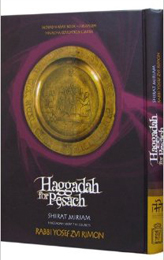
Rabbi Ramon’s Haggadah opens eyes to new ways to tell the story of Passover
RABBI MICHAEL BALINSKY
For many years, I purchase one or two new Haggadot (story of Passover). Sometimes I buy them for their commentary, sometimes because they are facsimiles of medieval Haggadot and sometimes because they are beautiful and textually clever works of art. At our family seder, everyone gets to select a Haggadah and we often compare pictures and commentaries. In advance, I always prepare notes and commentaries that I will use in explaining the different parts of the seder.
Last year I used a new Haggadah, Shirat Miriam Haggadah, by Rabbi Yosef Zvi Ramon. Using it was a joy, and it opened my eyes in new ways of looking the Haggadah. Rabbi Rimon teaches at Yeshivat Har Etzion in Israel and is a remarkable scholar and educator. His 480-page Haggadah reflects both his scholarship and his pedagogy. It is clear that Rav Rimon has not only written a masterful piece of traditional scholarship, but the very writing itself expresses and reflects the key element of the Haggadah “In every generation a person should view themselves as if they came out of Egypt.”
For each section of the seder, there is a description of the halachot (laws) associated with that section. This is not a simple prescription of what to do, but rather reflects different viewpoints and debates over time. He accomplishes this through a series of well laid out questions and answers for each section. In doing so, he follows the very question and answer model of the Haggadah itself. He also provides a useful short summary at the end of the halachic section of what the current practice should be. It should be noted that what Rabbi Rimon presents is much more than prose. Included are very useful charts. Reading through each section is as if you are sitting in a class taught by a master pedagogue who is fully aware of the different ways people learn.
Each part of the seder includes a wonderful section on “Food for Thought,” which focuses on the ideas and themes for each section. There are also riddles (the answers are in the back of the Hagaddah) and suggestions for further discussion.
But I leave the best for last. Rabbi Rimon’s introduction to the structure of theHaggadah and Maggid, the telling of the story, is brilliant. After all, it could be argued that the road not taken by the Haggadah of reading the actual story of the Exodus from the biblical Book of Exodus is what we should be doing at the seder. Rabbi Rimon shows how the actual structure of telling the story is divided into four sections each of which have the same internal characteristics. It becomes clear that what may appear to be a somewhat haphazardly put together text is really one very carefully planned and organized to impart the message of Passover. Remaining the master educator, he accomplishes this through his description and then color coding Maggid to show the common characteristics of each of the four sections. He accomplishes this so clearly that I know I wondered why I had not seen this before encountering Rav Rimon.
This is also a beautiful Haggadah, with lovely pictures of Judaica included. The pages use color well and are pleasing to the eye. The print is large. There is also a companion book which goes into a deeper analysis of the halachic (legal) requirements of the seder. A specially prepared much shorter Haggadah for youth was just published. It follows the same attractive and appealing style but with only brief explanations.
Rabbi Rimon’s Shirat Miriam is a traditional Haggadah informed by traditional Jewish thought. It may not be the Haggadah you use at your seder. You may not always agree with his theology or ideas. But it certainly could and should be the Haggadah (or one of the Haggadot) you use to prepare for your seder. This is a volume that you can refer to year after year not only for information but also for strategies in conducting the seder itself. In using it you will enter Rabbi Rimon’s classroom and leave with new knowledge, great questions to ponder, and deep respect and gratitude for this master teacher and scholar.
Rabbi Michael Balinsky is the executive vice president of the Chicago Board of Rabbis, a partner serving our community and the Jewish United Fund
Other stories
-
Meet Andrew S. Hochberg, 2021 Julius Rosenwald Memorial Award recipient
Celebrate Andy Hochberg at the virtual Annual Meeting on Sept. 14
Read more -
Two local teens win national recognition
Recipients of the annual Diller Teen Tikkun Olam Awards
Read more -
Celebrating six young award winners cultivating the community
Introducing young adult award winners
Read more
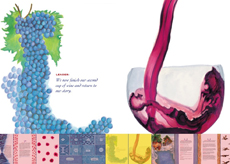
In the Exodus story, Moses decides to rescue his people after he hears God speak to him through the burning bush. But when New York City-based artist Jan Aronson imagined the famous episode in which Moses must decide which path to take in life, she didn’t see a magic fire, but rather the broiling sun rising and shining on the desert brush. In that moment of meditation, Moses heard the voice within himself that told him to go confront Pharaoh.
That is just one of the inspirations behind the illustrations that Aronson included in The Bronfman Haggadah, a collaboration with her recently deceased husband, the renowned Jewish philanthropist Edgar Bronfman. The original hard-cover book will be released as an app for the iPhone and iPad was recently released, in advance of Passover.
The app version takes the themes of the book to a digitial level. It includes video interviews with Bronfman and Aronson, narration, animation, and singing of the Passover songs by actors. The Exodus story does not appear in traditional haggadahs, but it is told in the Bronfman hagaddah. The story is narrated in the app; using animation, it shows the basket with baby Moses moving down the river.
“We get a sense of just how monumental it was that this baby was saved,” Dana Raucher, the executive director of the Samuel Bronfman Foundation, told JNS.org. Edgar Bronfman and Aronson wanted “to get this app out to audiences that are not necessarily visiting bookstores or buying hardcover books,” according to Raucher.
“They were mostly thinking of younger audiences, which this book is very much geared to, people who are transient in their lives, living in college dorms, moving from city to city, and not necessarily lugging heavy books with them,” she said. “However, they are curious about the Jewish tradition… redefining certain rituals, and in general just taking an open and expansive look at what the Jewish tradition tells us that is relevant in the modern day.”
Bronfman and Aronson worked on the hardcover hagaddah over many seders, after Bronfman had felt dissatisfied with the texts of traditional haggadahs. He decided to write his own haggadah. Aronson was enlisted to illustrate the book.
“Edgar brought not only the story of the Passover, and what’s usually in the traditional seder, but he went beyond that. He talked about lessons of justice, equality and ethics in his haggadah and often quoted texts from all sorts of people,” Aronson told JNS.org.
Bronfman and Aronson also espoused a humanist view of Judaism that favors godliness, or living an ethical life, over the idea of the supernatural God.
“This haggadah is written for a post-denominational world, a post-gender world,” Aronson said. “I think what Edgar (Bronfman) would say is that he is trying to appeal to the Jew who is not affiliated with any particular branch of Judaism. I would like to appeal to all Jews.”
Aronson believes there are “many ways to be a Jew” and that almost every Jew “is a pick-and-choose Jew.”
“We need to create an environment that every Jew is welcomed into the tent,” she said. “Just because you don’t believe in a supernatural God doesn’t mean you don’t have faith, [which is] living an ethical life, where you give back to society [and] do unto others as you wish them to do unto you.”
In fact, Aronson said she has given the Bronfman haggadah to plenty of her non-Jewish friends, who have loved it. But she says the haggadah probably does not appeal to strictly observant Orthodox Jews.
“The app allows the user to take a more in-depth look at some of the ideas and images that are present in the Bronfman Hagaddah,” Raucher said. One can use it in” pre-seder preparation” or by “learning about the seder and the traditions of the seder” during the dinner portion, she said.
For instance, in the haggadah, Aronson illustrated a biblical map. “There are many people who do not have a reference as to where certain places were or what the area really looked like in biblical times,” she said.
Aronson added that she and Bronfman questioned why the traditional seder requires that we open the door for the Prophet Elijah near the end of the service.
“Certainly we should open our door to the stranger at the beginning of the service when the children are most alert, when they are excited about being there, when the lessons of opening the door to the stranger are going to be the most welcomed,” she said. “And why should we give the stranger the leftovers? Let’s bring him in at the very beginning. That’s another big difference in the Bronfman haggadah.”
According to Amalyah Oren, the communications cirector of the Samuel Bronfman Foundation, the app’s narration gives it an entertainment-style feel for people who want to experience the haggadah in a more theatrical way.
“It’s a really good tool for learning the tunes of the songs beforehand, or if you just need help accompanying during the actual seder,” Oren told JNS.org.
There are also families who conduct a do-it-yourself seder by veering from the traditional order of event and asking a lot of their own questions at the table. There is a glossary in the Bronfman haggadah app that doesn’t exist in the hardcover book, allowing users to look up information on various topics.
“By having an app at the table, you are connected to the Internet and you can kind of bring [a] third dimension to the conversation,” she said.
Aronson, originally from New Orleans, created all the original illustrations in the hardcover haggadah by hand with watercolors. But the app can be a more dynamic and interactive experience, she explained.
“As you turn the page [in the app] you might see the wine glass being filled with wine,” she said. “You might see the lights flicker from the candles being lit at the very beginning of the service. You might see a fish circling the page instead of it being static.”
“You’re taking a traditional book and making it digital, [so] instead of turning a page you swipe it,” Aronson added. “The joy of it will be revealed as people use it.”
Egdar Bronfman, Aronson’s partner in life and on the haggadah, died in December 2013. Aronson said she cherishes the fact that she had the chance “to create something as a couple… to be able to collaborate with him in the last years of his life.”
Other stories
-
Meet Andrew S. Hochberg, 2021 Julius Rosenwald Memorial Award recipient
Celebrate Andy Hochberg at the virtual Annual Meeting on Sept. 14
Read more -
Two local teens win national recognition
Recipients of the annual Diller Teen Tikkun Olam Awards
Read more -
Celebrating six young award winners cultivating the community
Introducing young adult award winners
Read more
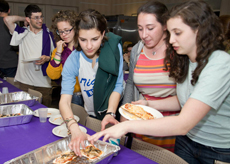
The Passover seder at my home growing up probably sounds familiar-family and friends coming together, learning through arguing, a fair share of complaining, and eventually eating lots of good food. It’s the stereotypical definition of Jewish culture that so many of us know and love.
But beyond the stereotypes, Passover reflects a deeper truth about Jewish identity. Despite a similar order of events, each seder is influenced by and infused with the customs of one’s particular family, time, and surrounding culture. This is what it means to be Jewish-to bring our tradition into conversation with our other identities and let each one affect the other.
This year, for the first time, I’ll be celebrating Passover at Fiedler Hillel at Northwestern University, which I believe similarly can provide us with a great snapshot of Jewish life at Northwestern.
From a big-picture perspective, we will be doing on Passover what we do all year round. We’re hosting different seders to meet the needs of diverse subsets of our Jewish community-a Greek seder for members of various sororities and fraternities, a musical seder, a seder for the Reform Community, and more. We’ll also be connecting students with families in the larger Jewish community for seders off campus, as well as providing students with the materials they need to host their own seder.
At Hillel, we encourage students to take ownership over their Jewish identity and experience. This is what Passover is all about: inheriting a story and retelling it in a way that is meaningful and relevant to us.
From a more detailed perspective, the amazing work that our individual student groups accomplish embodies the many values that permeate the seder.
“In each generation every individual is obligated to see oneself as though s/he left Egypt.” This Mishnah in Pesachim (9:5) is the motivation for the haggadah. Interestingly, Maimonedes reads this with a slight variation: each individual is obligated to “show oneself as though s/he has left Egypt.” This change has a profound implication; instead of reading about the exodus, we have to re-enact it. Hillel’s Jewish Theatre Ensemble, which has already produced three powerful performances this year including The Diary of Anne Frank, understands that we internalize memory and values through performance.
“We are now exempt from asking the four questions.” (Babylonian Talmud 115b). Rabah declared this after his pupil Abeye asked a question on Passover night about removing plates before the meal. We learn from here that the purpose of the four questions is solely to get people to ask questions. Questions that Matter, a Hillel group that facilitates deep conversations, operates under the same guiding principle as Rabah: the key to growth is through questions, not answers.
“All who are hungry, let them come and eat.” While many people simply recite this line on Passover night, our students internalize its message. Challah for Hunger, which bakes Challah every week at Hillel, donates all of its proceeds to fight hunger locally and internationally.
“Let us then recite before God a new song, Halleluyah.” We end the story of the exodus in song because the rabbis understood that the greatest expression of gratitude and joy was through music. Shireinu, Hillel’s Jewish a cappella group, continues to recreate Jewish music and spread joy throughout campus and the country (they recently placed third at Kol Ha Olam, the National Jewish a cappella competition!).
This reflects only some of the amazing work that our students are doing on campus. If you really want to understand the extent of our impact, you’ll have to come experience it yourself.
Rabbi Aaron Potek serves as the Campus Rabbi at Northwestern University. He was ordained by Yeshivat Chovevei Torah Rabbinical School in June 2013.
Fiedler Hillel at Northwestern University is part of the Department of Campus Affairs and Student Engagement, Jewish United Fund /Jewish Federation of Metropolitan Chicago.
Other stories
-
Local campus administrators convene on hate speech, bias
JUF and ADL brought together 17 student safety, diversity and inclusion and student affairs administrators and Hillel representatives from various Illinois campuses to discusses issues of hate speech and bias.
Read more -
Engaging students about Israel on campus
Too often we hear about difficulties facing Jewish college students on Illinois campus, but to focus solely on the politics gives only one piece of the complex narrative that is Jewish life on campus.
Read more -
Hillel International launches fellowship initiative to train young Jewish professionals
The Springboard Fellowship will train cohorts of young Jewish professionals in highly-valued skillsets and place them at local Hillel campuses for two years.
Read more
Between 1933 and 1945, the Nazis engaged in one of the biggest art thefts in history, systematically stealing millions of works from every territory they occupied. Treasures were pillaged from museums, libraries, churches, synagogues, and private collections, particularly those of Jewish artists and collectors.
Though caches of stolen artworks were recovered after the war and efforts were made to return works to their rightful owners, nonetheless huge numbers of pieces were destroyed, sold or absorbed into other collections, or are still missing.
The movie The Monuments Men, directed by and starring George Clooney, was released early this year, drawing attention to the men-and women-in what officially was called the Monuments, Fine Arts, and Archives program, an American attempt to locate and rescue Nazi-looted art.
The film hit US screens just weeks after a major discovery of art amassed during the Nazi era was made public. This 1,200-piece trove, valued at more than $1.35 billion, includes works by Henri Matisse, Marc Chagall, and Pablo Picasso. It is one of the biggest discoveries of Nazi-looted art to date and the announcement about it by German officials set off a powerful range of reactions in the art world and in Jewish communities worldwide.
In an effort to examine the complex issues surrounding Nazi-looted art, Spertus Institute welcomes veteran art journalist David D’Arcy for a lecture and discussion titled Art Loot: An Unresolved Legacy. D’Arcy has been investigating and writing about art theft for more than 20 years. The program, timed to mark Yom HaShoah (Holocaust Remembrance Day), takes place on Monday, April 28 at 7 pm.
Mr. D’Arcy will explain the history of Nazi art theft and its subsequent impact on Western and Jewish culture. n
For more information, visit www.spertus.edu or call (312) 322-1773.
Spertus Institute is a partner in serving the community, supported by the Jewish United Fund/Jewish Federation of Metropolitan Chicago.
This program is part of the Solomon Goldman Lecture Series, generously endowed by Rose and the late Sidney Shure. It is made possible, in part, with support from the Bernard and Rochelle Zell Center for Holocaust Studies at Spertus Institute.
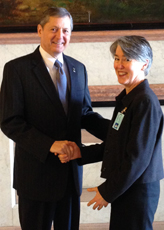
The State Department recently announced its plan to return the Iraqi Jewish Archive collection, currently on display at the U.S. National Archives in Washington, D.C., to the Iraqi government this summer, stating the Iraqi people are the rightful owners.
Under the George W. Bush Administration, shortly after Saddam Hussein’s fall in 2003, the Pentagon assigned Middle East expert and 27-year Pentagon official Harold Rhode, an Orthodox Jew, to work for the U.S. occupation authority through Operation Iraqi Freedom. When Rhode arrived in Bagdad that April, he learned through on-site intelligence officers that thousands of centuries-old Iraqi Jewish archives were discovered in the basement of Hussein’s intelligence service headquarters. For years, during Hussein’s rule, his intelligence operatives improperly seized papers from synagogues and Jewish families, mostly during random searches or shortly before Jewish families emigrated, in an attempt to marginalize the Jewish people and Jewish culture in Iraq.
During his visit in 2003, Rhode personally arranged for the artifacts to be shipped directly to the U.S. National Archives to be cleaned, preserved, and properly stored. A portion of these artifacts recently went on display at the Archives, which includes 2,700 books and 10,000 documents.
Among these documents are a 200-year-old Talmud from Vienna, a 19th century Passover Haggadah published in Bagdad, a copy of “Ethics of the Father,” published in 1928 in Livorno, Italy with handwritten notes in Hebrew, and a collection of rabbinical sermons made in Germany in 1962. When Rhode learned that these Jewish archives could be shipped back to Iraq, he equated the return to “the giving of the personal effects of Jews killed in the Holocaust back to Germany.”
Although part of an original agreement between the State Department and the Iraqi Government, U.S. Congress is pushing back and trying to stop the return of these archives to Iraq by strongly encouraging the State Department to reconsider the resolution. The U.S. Senate unanimously passed Resolution 333, calling for the State Department to re-negotiate its original agreement, and a similar resolution is awaiting a vote in
the House.
Rep. Harris feels strongly on this issue, both on a personal and professional level.
“Having served in Iraq for 14 months, I was concerned about what would happen to the artifacts if they were returned to the Iraqi government,” he said. “The decision to return them should be renegotiated so that the artifacts are returned to the original Jewish owners, if possible, and if that is not possible, then returned to the Jewish community where they would be respected and preserved.”
With this resolution, Harris hopes the Illinois General Assembly’s support will help influence the appropriate government authorities to reconsider and keep the Iraqi Jewish Archives in a location that is accessible to scholars and Iraqi Jews around the world.
Since its filing on Jan. 20, Joint House Resolution 68 has received bipartisan support, with Deputy Majority Leader Rep. Lou Lang, Rep. Michael Bost, Rep. Scott Drury, and Rep. Jack Franks as co-sponsors. The resolution passed unanimously out of committee. Harris will now read it and attempt to have it passed on the floor of the Illinois General Assembly. The Jewish Federation will continue to work closely with Harris to pass HJR 68.
Mara Ruff is the associate director of State & Local Government for the Government Affairs department of the Jewish Federation of Metropolitan Chicago.
Other stories
-

Chicago to Israel to Kenya
A family’s story of living Jewishly on three continents Michelle Cohen World May 28, 2021 Avital, Tzofia, and Netanel Kaszovitz outside their home in Nairobi on Yom HaAtzmaut. When Avital Kaszovitz prepared to be a Modern Orthodox shlicha (emissary) to the Jewish community in Ke
Read more -
New exhibit spotlights the experience of ‘Shanghai Jews’
Explore a new Illinois Holocaust Museum and Education Center exhibit
Read more -
Europe’s brave new teachers of the Holocaust
Teaching the Holocaust in the modern era has its difficulties and rewards.
Read more