
Fourth Annual JCC Chicago Jewish film festival kicks off March 9
MIMI SAGER YOSKOWITZ
The Fourth Annual JCC Chicago Jewish Film Festival opens March 9 and includes an Academy Award nominee and an exclusive special showing of a star-studded film prior to its national debut.
“We have our richest line up in terms of quality of film and the level of acclaim we are bringing to screens across Chicagoland,” said Addie Goodman, executive vice president of JCC Chicago.
The Festival kicks off with the Oscar-nominated documentary, Life, Animated , inspired by the bestselling book by Ron Suskind. The film follows a young man, Owen Suskind, who received an autism diagnosis at the age of 3 when he suddenly stopped communicating. His parents later discovered that by watching animated Disney films, Owen had found a way to reconnect with the world and create his own path.
Owen’s mother, Cornelia Suskind, will join festivalgoers on opening night at the Landmark Renaissance Place Cinema in Highland Park for a special discussion following the film’s screening. (Check out an interview with her on the next page.)
While Goodman is looking forward to all of the Festival’s features, she says Life, Animated is one of the films that has her most excited.
“JCC Chicago is doing a lot of work with the special needs community and inclusion,” she said, “and [this film] really speaks to a lot of the core programs we are working on today in welcoming all the families that come through our doors.”
The Festival will showcase 25 films at seven different venues across the metropolitan area over 10 days from March 9 to March 19. In addition to the screenings at theaters in the suburbs and city, the Festival teams up with different parts of the Jewish community for specialized programming and showings.
On Sunday, March 12, the Illinois Holocaust Museum and Education Center will host four different films about the Holocaust. The day includes a special session with director, Cellin Gluck, whose film, Persona Non Grata , tells the story of a Japanese diplomat who saved the lives of 6,000 Jews during World War II. Gluck will be introduced by one of those survivors.
There are other special events throughout the Festival to hear from filmmakers, guest speakers, and even some of the people featured in the movies, all listed on the website.
The Film Festival also seeks to attract a younger audience with free screenings of The Wizard of Oz on March 11 in Highland Park and Lakeview. The classic movie’s Academy Award winning song, “Somewhere Over the Rainbow,” was written by two Jewish composers right before the outbreak of World War II.
Goodman says a team of viewers comprised of JCC staff, lay leaders, and volunteers work over many months to ensure the community is presented with a variety of high caliber films from different genre that also have a Jewish link.
“Our Chicago Jewish Film Festival is really about Jewish peoplehood. The film could be set in a community that is identifiably Jewish. The director or producer could have Jewish roots or the film could be rich with Jewish values…It’s also really important to us that the film festival is highly accessible. We want to have not only films that resonate Jewishly, but also that might introduce Jewish film to the community.”
To purchase tickets for the Festival and see the full schedule, visit www.jccchicago.org/programs/jcc-chicago-jewish-film-festival.
Mimi Sager Yoskowitz is a Chicago-area freelance writer, mother of four, and former CNN producer. Her work has been featured on various sites including Kveller, Brain, Child Magazine, and in the anthology, “So Glad They Told Me.” Connect with her at mimisager.com.
JCC is a partner with the Jewish United Fund in serving our community.
SIDEBAR: Behind the scenes with an inspiring Oscar contender
By MIMI SAGER YOSKOWITZ
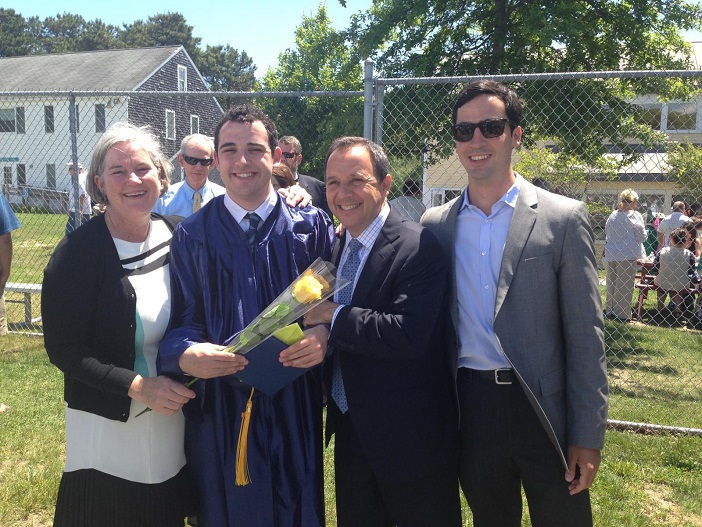
When Owen Suskind was three years old, he stopped talking and changed completely, no longer the little boy known to his parents and brother, Walter. After a slew of testing, doctors diagnosed Owen with autism. He received the best therapies and treatments available at the time, but it was his repeated viewings of Disney animated films that eventually reawakened his ability to speak and interact with his family and the world around him.
Owen is now a young man living independently, working multiple jobs, and honing his artistic talents with the goal of a career in animation. His story is documented in the Academy Award nominated film, Life, Animated , which kicks off this year’s JCC Chicago Jewish Film Festival on March 9.
At the start of the movie, there’s a clip of Owen sword fighting with his dad, Ron Suskind, whose bestselling book inspired the film. In that scene, Owen calls himself Peter Pan and tells his dad that he’s Captain Hook. Cornelia Kennedy Suskind, Owen’s mother, watched that video clip for the first time when she saw Life, Animated premiere at Sundance Film Festival last year. She spoke with JUF News by phone about what it was like to make this film and watch her son’s life unfold on the big screen.
“I had never seen that footage of Owen sword fighting with Ron,” said Suskind. “We took it days before we moved [from Boston to Washington, D.C], and he stopped talking and connecting a month after we moved. I couldn’t bear to look at it. It was from the before time, and it was too painful… I almost can’t talk about that clip without getting emotional even now.”
JUF NEWS: What inspired you to tell Owen’s story?
Cornelia Kennedy Suskind: The first part of this journey of telling the story began with our decision to write the book. That was a huge decision. People for years, because Ron’s a writer, told him he should write about autism and Owen, and our response was two-fold. I’m so in the trenches, there’s no possible way we could even think about it. But then the bigger part of it was the issue of Owen’s privacy. We weren’t going to be telling the world his story when he wasn’t in a position to make a decision about this.
When he was 19, he said people know you for who you are and Walter for who he is. But they don’t know me for who I am. He said, “I’m an unpolished gem, a diamond in the rough,” which is one of his lines from Aladdin . And we said, ‘OK, maybe the time has come.’
What he goes through during the course of the film is so universal to so many people his age: graduating, moving out, finding a love, losing a love. I think that’s why it has so much meaning with so many people who see it even if they have no experience with autism at all.
What kind of feedback have you received from other parents of children with autism?
Meeting these families and adults and siblings all over the country, it’s just been amazing…. The most meaningful have been people who are affected themselves. [They say], ‘Owen is telling my story. Thank you Owen.’ They want pictures with him, they cry, they want to hug him. And of course the families as well. The sibling issue has been enormous. There’s been enormous response to that.
What was it like finding out that Life, Animated had been nominated for an Academy Award?
We were in Boston and they called us immediately and we just started screaming on the other end of the line, jumping up and down. Walter (Owen’s brother) called us. I called Owen and woke him up. It’s exciting to him, but Owen is the guy who reminds us of priorities all the time. He has no interest in celebrities at all. He’s only interested in the no-name guys, [like] the animators.
Are you planning on going to the Oscars?
Yes. Owen will be front and center sitting with Walter on the floor in a tuxedo Tommy Hilfiger is making. He wanted to dress the boys. He has three children with special needs and he’s a friend of ours, and he’s a wonderful guy and great supporter of a lot of good causes. [Owen’s] an old hand at the red carpet. He’s so poised on stages, it’s just phenomenal…. He loves connecting with people, another great myth buster of autism.
Mimi Sager Yoskowitz is a Chicago-area freelance writer, mother of four, and former CNN producer. Her work has been featured on various sites including Kveller, Brain, Child Magazine, and in the anthology, “So Glad They Told Me.” Connect with her at mimisager.com.
Other stories
-

A ‘driving’ force for Jewish life
Updated documentary spotlights renovations in West Rogers Park
Read more -
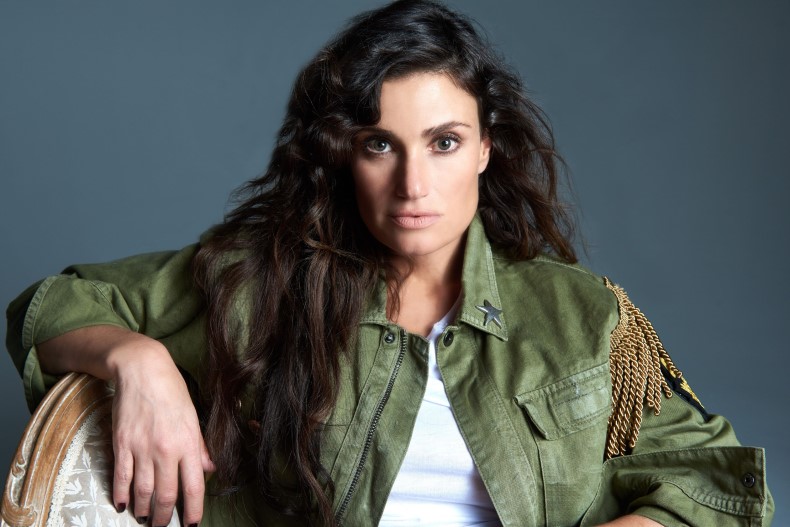
JUF Women’s Division Spring Event to feature singing superstar Idina Menzel
Renowned singer and actress Idina Menzel will be the featured speaker at the JUF Women’s Division Spring Event 2019.
Read more
There are two movies about Adolf Eichmann’s participation in the planning of the “Final Solution,” three movies about his capture, one about his interrogation, and three about his trial. Most of the other movies about the Holocaust are about the genocide he orchestrated.
But his whole story-from before the Shoah (Holocaust) he helped create to his execution in Israel-has never been on display all at once. Until now.
Operation Finale: The Capture & Trial of Adolf Eichmann is the new exhibit at the Illinois Holocaust Museum & Education Center in Skokie. It takes its title from Operation Finale, the name of the Mossad action to capture the fugitive war criminal in Argentina. It will run at the Museum from February to June, augmented by films, lectures, and other events during its stay.
The Operation Finale exhibit features some 60 artifacts from Eichmann’s story, including the camera that captured his image while he was under Mossad surveillance in Argentina, the blindfold he wore during his extraction, and items he had on his person when he was apprehended.
Aside from its run in the Chicago area, the exhibit will only run in Cleveland, New York, and Florida. The exhibit is debuting in Cleveland, as Milton Maltz, a founder of Cleveland’s Maltz Museum of Jewish Heritage, assembled the materials. Many-including some only recently declassified-are from the Mossad’ s own archival collections regarding Eichmann’s capture. Others came from the Yad Vashem archives of his Israeli war-crimes trial, which include a dossier on Eichmann compiled by Simon Wiesenthal.
While Adolf Eichmann’s name was changed to Ricardo Klement, his children- including his son, Klaus-continued to use the last name Eichmann. Sylvia Hermann, a Holocaust survivor’s daughter, dated Klaus. Her father, Lothar, recognized the last name; he contacted German prosecutor Fritz Bauer, who in turn contacted the Mossad. Lothar’s letter to Bauer is on display as well.
One large item is on loan from the Ghetto Fighter’s Museum in northern Israel. It is the clear, bulletproof booth Eichmann sat in during his trial; it was important that no one assassinated him before he was legally convicted and all his crimes laid bare. The booth is referred to in the title of one of the films about him, The Man in the Glass Booth . At the exhibit, films taken at Eichmann’s trial will be projected into and around the booth, recreating the trial itself.
Another multi-media element is a series of recordings of interviews, done in commemoration of the trial’s 50 th anniversary, of those who participated in Eichmann’s apprehension and trial. The last part of the exhibit is another set of recordings, of survivors recalling the horrifying impact Eichmann had on their lives, and their reactions to his capture, trial, and execution.
The exhibit opens on Feb. 19 with a talk by former Mossad agent Avner Avraham, Orit Shaham Gover from Tel Aviv’s Beit Hatfutsot (also known as the Diaspora Museum), and Ariel Efron, the exhibition’s media designer and producer.
Supporting the exhibit will be lectures on current challenges in the field of intelligence and on the investigation of Nazis and other genocidal war criminals. There will also be screenings of movies on the international impact of the trials at the time and on families seeking to bring war criminals to justice, as well as a reading of a play about how “good” people get caught up in fanatical movements.
The first exhibit of the Operation Finale artifacts was at the Knesset in 2011, in commemoration of the 50th anniversary of the trial. Arielle Weininger, the Illinois museum’s Chief Curator of Collections and Exhibitions, was in Israel at the time and saw the exhibit when it moved to Beit Hatfutsot. She met Avraham and began the work of bringing the items to Illinois.
For Weininger, “one of the most powerful” images is a drawing of Eichmann’s ear. Like a fingerprint, the shape of a person’s ear is unique and remains constant during the aging process. Unlike a fingerprint, it can be photographed at a distance. A comparison of ears showing in WWII-era Eichmann photos with those in surveillance images taken of him in Argentina decades later helped prove his identity to the Mossad agents.
The life’s work of Adolf Eichmann was to bring about the end of the Jewish people. Today, we can bear witness to the end of Eichmann. n
Operation Finale: The Capture & Trial of Adolf Eichmann runs from Feb. 15-June 18, at the Illinois Holocaust Museum & Education Center, 9603 Woods Drive, in Skokie. For more information, visit their website: https://www.ilholocaustmuseum.org .
Other stories
-
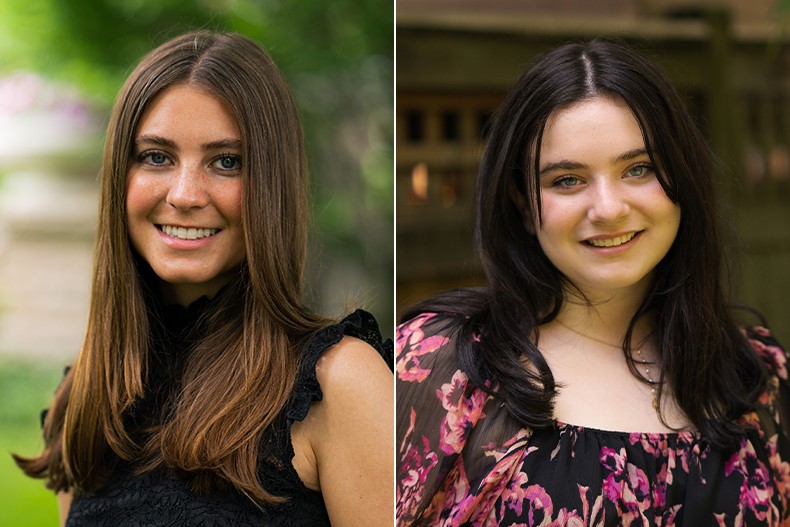
Two local teens win national recognition
Recipients of the annual Diller Teen Tikkun Olam Awards
Read more -

Celebrating six young award winners cultivating the community
Introducing young adult award winners
Read more -
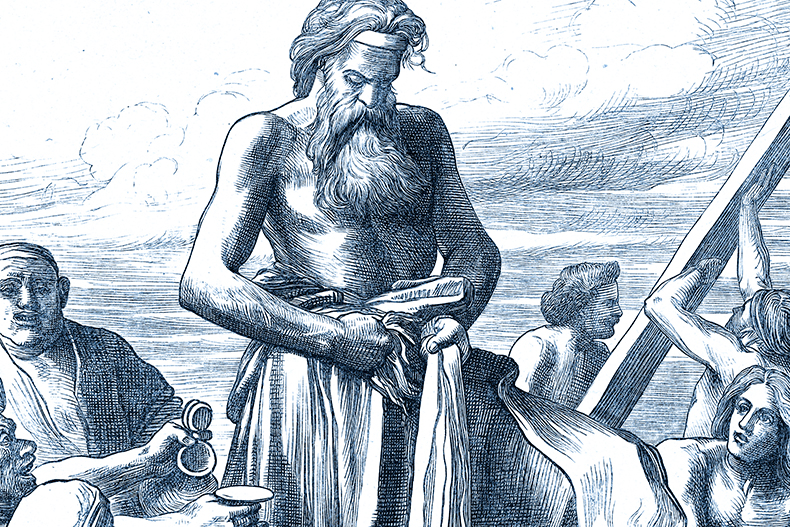
Adam and Eve were the first refugees. Driven out of Eden for their sins, God had compassion on them and made them clothing. Cain, who murdered their son Abel, was the second refugee. Driven to wander the earth, God protects Cain with a sign that shields him.
Noah was the third refugee, unique among refugees. The entire world was destroyed. There was no human to save him. God secured the welfare of the refugee, Noah, and his family in the Ark.
The next refugees were Abraham and Sarah, who fled pagan civilization to go to the Promised Land and birth the Jewish people. No sooner did they arrive than they became refugees a second time, driven out of the Land by famine and down to Egypt where God had to watch over them.
God redeemed them from Egypt and restored them to the Promised Land. Isaac is the only one who is not a refugee. However, his son Jacob has to flee the Promised Land following his brother Esau’s murderous designs. When he returns home, his son Joseph becomes a refugee in the Land of Egypt. Jacob also goes down to Egypt as a refugee. God watches over him. God says to Jacob, “Do not be afraid, I will go down with you to Egypt and I will watch over you there, and I will bring you back to this land.”
The whole Jewish people were refugees when after 400 years of slavery in Egypt they wandered in the desert for 40 years. God watched over them, sheltered them, clothed them, and brought them home. Israel to this day is the refuge of the refugee Jewish people.
The narrative of the Torah is the narrative of refugees and the ways in which God protected these refugees. Jewish experience is the stuff of mitzvot. Many mitzvot of the Torah are based on this primal experience of the Fathers and Mothers of the Jewish people.
The Fathers and Mothers of the Jewish people have two originating experiences. They are the first believers in the One God. At the same time they are the first refugees. The mitzvot of the Torah are designed to protect refugees of all sorts, beginning with the mitzvah: You shall not oppress the stranger for you know the very life of the stranger, for you were a stranger (a refugee) in the Land of Mitzrayim- Egypt. We must not allow to happen to others what happened to us. The Torah spells out all sorts of mitzvot that emerge from the nativity experience of Jews as refugees.
The Torah is not a conceptual book. Its mitzvot rarely instruct concepts, emotions, or inner-life experiences. Its mitzvot instruct behaviors. Behaviors give expression to thought and feeling. However, in one area there is a significant exception. There are three times in the Torah when love, which is surely both a thought and an emotion, is commanded as a mitzvah. We are commanded to “love the Lord, your God.” We are commanded to “love your fellow human being.” This is understandable. We might very well have developed these two great loves on our own. But now comes a third commandment to love.
For the LORD your God is God supreme and Lord supreme, the great, the mighty, and the awesome God… who upholds the cause of the orphan and the widow, and loves the stranger, providing him with food and clothing. You too must love the stranger, for you were strangers in the land of Egypt. (Devarim-Deuteronomy 10:17-19)
These verses, spoken to Israel as they are about to enter the Promised Land, are quite remarkable. They begin with the assertion that God is great, mighty, and awesome. The next verse presents the cosmic sovereignty and might of God in simple daily life. God, who is mighty and great, watches out for the widow and the orphan. Even more than that, God so loves the stranger, the refugee, that God gives the refugee food and clothing. We are expected to imitate God. The next verse commands us not just to engage in doing what God does for the refugee, providing food and clothing, it goes further. Food and clothing are not enough.
You shall love the stranger, the refugee, for you were strangers and refugees in the Land of Egypt. A Jew may never dare betray his or her own experience. In other words, not only is the Jew commanded by God to take care of the refugee because God does that, but
the Jew is commanded by personal experience.
Yet, the mitzvah to feed and clothe the stranger is still not enough. Something else is required of the Jewish people. The refugee, the stranger, must be loved. It is, at times, easy to provide food, clothing, and shelter to the refugee. Ultimately, it is not possible to care for the refugee as God cares for the refugee unless the refugee is loved. The refugee is not known. There is no family relationship with the refugee. There is no personal shared common experience with that refugee.
However, the Jewish people know what it means to be a refugee. Therefore, the Jewish people, out of their very experience and being, know that the ultimate plight of the refugee is abandonment. The opposite of abandonment is love. The Torah commands: Love the refugee.
Rabbi Yehiel E. Poupko is Rabbinic Scholar of the Jewish United Fund of Metropolitan Chicago.
Other stories
-

Mother’s Day, Father’s Day, and the Jewish way
Let us pause and consider what it means for us to truly honor our parents
Read more -
Each time we study Torah, we experience the revelation
The mystical tradition of Judaism that lifts up the number 600,000 from the Exodus
Read more -
The Jewish Federation of Metropolitan Chicago has put its money where its mouth is when it comes to socially responsible investing, or SRI, which is the latest front in the struggle for the hearts, minds-and dollars-of individual and institutional investors.
In January, the Chicago Federation became the first federation to invest over $1 million in the Jewish Advocacy Strategy of JLens. JLens connects the Jewish community to SRI by inspiring a network of nearly 10,000 individual and institutional investors to invest with Jewish values in mind.
By some estimates, SRI has expanded 33% since 2014, which indicates that its sphere of influence is growing rapidly.
“We are proud to be a trailblazing federation in this space, and hope that our involvement will inspire others in the Jewish community to do the same,” said Emily Muskovitz Sweet, executive director of JUF’s Jewish Community Relationship Council.
Through JLens, Jewish institutions use their financial investments as a vehicle to express Jewish values, support Israel, and counter the Boycott, Divestment and Sanctions movement. According to JLens Executive Director Julie Hammerman, the Jewish community’s absence has enabled BDS activists to turn SRI into a prominent and sophisticated BDS arena.
Chicago’s investment also includes separate support for JLENS’ anti-BDS shareholder advocacy strategy, which is actively working to counter efforts to de-legitimize Israel in the SRI arena.
The Israel Action Network of the Jewish Federations of North America identified a BDS presence in the SRI community years ago, and is now working to educate leaders both within and outside the Jewish community about how to counter BDS in the socially responsible investment field.
The BDS movement argues that institutional investors and multinational companies with ties to Israel are violating SRI’s commitment to protecting human rights. As a result, numerous institutional investors in Europe and the U.S. have adopted BDS, and some European companies have cut ties to Israel under pressure from pro-BDS shareholders.
One example in Europe is the French telecommunications company, Orange. After pressure from investors and others, Orange announced in 2015 that it would sever its contract with its Israeli licensee eight months early. The CEO of Orange also issued a statement that he would, “end the relationship tomorrow if it could.”
On the other side of the ledger, during the past year BDS has experienced multiple defeats in large companies. In December, in part due to JLens’ efforts, CISCO shareholders voted down two BDS resolutions. During the firm’s annual meeting, JLens Executive Director Julie Hammerman called on shareholders to “see these resolutions for what they are, and to continue to make Cisco the standard bearer for how companies should operate around the world with great sensitivity. No company has done more than Cisco to lay the economic foundation for peace between Israelis and Palestinians, including Cisco’s significant investment over the past decade to build the Palestinian tech sector.”
In the coming year, JLens plans to hire the Jewish community’s first full-time shareholder advocate to strengthen corporate relationships and advance Jewish communal concerns among SRI investors. Plans also are underway to host the first Jewish Impact Investing Summit, on Dec. 5 in New York City, to bring SRI leaders and Jewish community leaders together.
Other stories
-
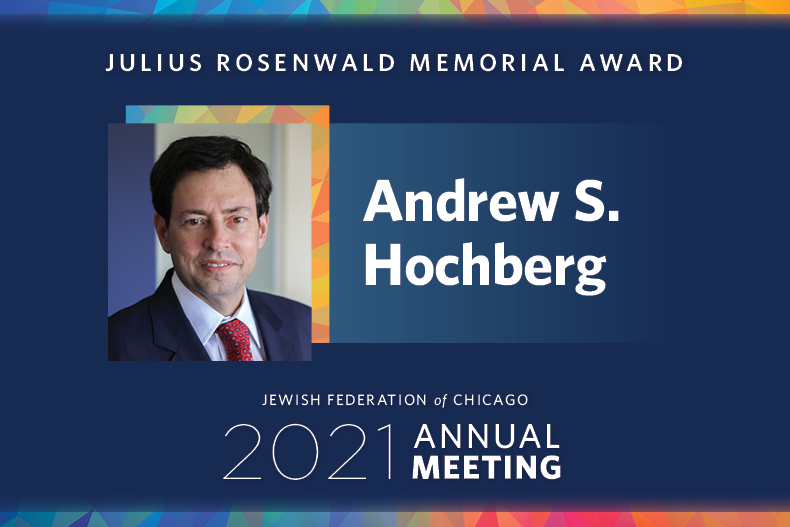
Meet Andrew S. Hochberg, 2021 Julius Rosenwald Memorial Award recipient
Celebrate Andy Hochberg at the virtual Annual Meeting on Sept. 14
Read more -
Two local teens win national recognition
Recipients of the annual Diller Teen Tikkun Olam Awards
Read more -
Celebrating six young award winners cultivating the community
Introducing young adult award winners
Read more
Two newly elected officials, Cook County State’s Attorney Kimberly Foxx and Illinois Comptroller Susana Mendoza, addressed JUF’s Government Affairs Committee at a Feb. 13 meeting, which also included updates on refugee resettlement efforts by JUF’s Deborah Covington and JCFS/HIAS Chicago’s Jessica Schaffer.
Foxx, the first African-American woman to head the state’s attorney’s office, spoke about her work to transform the criminal justice system in the middle of deepening instability. “So far, the 2017 homicide rate is outpacing the 2016 rate,” she said. “We are also seeing an increase in hate crimes against those who are foreign born and who have different faiths. Immigrants are afraid to come to the justice system, which is making our job much harder.”
When asked what the Jewish community could to do to address the increasing rate of gun violence, Foxx said “the increase in gun violence is a public health crisis, and we need more programs that deal with prevention, as well as specialized programs targeting children and adolescents who have been the victims of or witnesses to violence.” This challenge, she explained, is further complicated by the state’s budget impasse, as “current programs are closing for lack of funds.”
Mendoza, the first Latino elected to statewide office in Illinois, also spoke about the impact of the state budget crisis, which she saw as “directly leading to increased violence in Chicago because of the closing of social service agencies that aren’t getting paid. We need a state budget.”
Mendoza gave additional examples of how the budget crisis is impacting the state, including high interest payments on delayed bills, which she projects will be at $700 million by July, and the reluctance of doctors, dentists and other health care professionals to accept state group health insurance because of the $4 billion backlog in reimbursement.
The topic of refugee resettlement was added to the program in response to the Executive Order on Immigrants and Refugees signed on Jan. 27.
“One of the Government Affairs Committee’s goals is to share information back to our community on policy changes or developments that directly impact our work,” said Committee Chair David Golder. “Today we are fortunate to be joined by two local experts who can help us make sense of the recent Executive Order and how our local programs have been responding.”
The JUF/Jewish Federation of Metropolitan Chicago and HIAS-Chicago have a long history of resettling refugees. In 1975, Jewish Federation became the administrator of the Illinois Refugee Social Service Consortium, which includes Catholic Charities, Heartland Alliance, Refugee One, JCFS-HIAS, World Relief, and the Iraqi Mutual Aid Association. These organizations have helped resettle more than 125,000 refugees throughout the state, with the majority settling in the Chicago metropolitan area.
Deborah Covington, vice president for planning and allocations at JUF, who has worked on refugee issues for nearly 28 years, summarized several of the important features of the Executive Order. These included freezing the refugee resettlement program for 120 days, stopping all visas from seven countries with majority Muslim populations for 90 days, banning all Syrians from entry indefinitely, and reducing the annual refugee admission rate from 110,000 to 50,000.
Covington went on to discuss the 9th District Federal Court ruling against the Executive Order, which put an indefinite hold on these provisions. However, it was expected that a new Executive Order would be drawn up to meet some of the legal objections and/or that the president will instruct the Justice Department to file an appeal. The reduction in the annual refugee admission rate still stands.
HIAS Chicago has resettled refugees for a century, and recently expanded its program to work with some of the largest and most vulnerable groups. To support the extended program, HIAS has been reaching out to Chicago-area congregations to co-sponsor refugee families. Three synagogues have welcomed four groups to date, with three other synagogues in the process of preparing for co-sponsorship.
“We were devastated when the Executive Order was signed,” said Jessica Schaffer, HIAS Chicago’s executive director. “The most immediate effect was on the arrival of two Congolese sisters due to travel on Jan. 31. Fortunately, the State Department negotiated the admission of just over 850 refugees post Executive Order. Now we are anxiously awaiting the arrival of eight more families.”
Other stories
-
Two local teens win national recognition
Recipients of the annual Diller Teen Tikkun Olam Awards
Read more -
Celebrating six young award winners cultivating the community
Introducing young adult award winners
Read more -
Freedom Song: A musical production about addiction and recovery in the Jewish community
Dr. Beth Fishman, PhD Manager of The Jewish Center for Addiction at JCFS
Freedom Song is an original musical production created and performed by individuals who are current or past residents of Beit T’Shuvah, the interdenominational Jewish treatment program in Los Angeles. Freedom Song showcases a family celebrating a Passover Seder while also confronting the impact of addiction on the entire gathering.
Interspersed are scenes from a 12-Step meeting, giving an inside look at the process of recovery. Following the performance, audience members are encouraged to ask questions of the cast, who courageously and honestly share their own stories of addiction and recovery.
Freedom Song is an examination of the impact of addiction on a Jewish family and a celebration of the strength of the family to accept challenges and overcome shame and fear. The performance also provides-
- An opportunity for the Jewish community to confront addiction in our midst
- A chance to shine the light of openness and honesty on a hidden, often stigmatized topic
- A time to ask real questions and get real answers from cast members who have journeyed through addiction to recovery
- A chance for every one of us who cares about addiction recovery in the Jewish community to come out, stand up and support those among us who struggle
In the words of Rabbi Mark Borovitz, co-founder of Beit Tshuvah, Freedom Song “highlights the historic universality of the struggle to free oneself from external oppression and internal bondage.”
In 2015, JCA brought Freedom Song to the Chicago area for the first time, and witnessed an abundance of interest in and concern for addiction in our community. As a result, we have seen increased efforts in these areas: youth drug prevention, community members reaching out for help, the formation of community groups and foundations, professionals being trained in the latest practices and building community partnerships. However, there is so much more to do, as overdose rates continue to rise and the myth that Jews are somehow immune to addiction persists. Lend your presence and your voice to the shared challenge the Jewish community faces, for who among us has not been touched by addiction in some form?
Thanks to the generosity of the Jewish Federation of Metropolitan Chicago’s Breakthrough Fund and Fund for Innovation in Health, the Jewish Center for Addiction at Jewish Child & Family Services is proud to bring Freedom Song back to Chicago for two performances on February 26 and 27, 2017.
We hope you will attend a Freedom Song performance…to be moved, educated, empowered, and to be part of the solution to addiction in our community. For more information, visit jcfs.org
Other stories
-
Two local teens win national recognition
Recipients of the annual Diller Teen Tikkun Olam Awards
Read more -
Celebrating six young award winners cultivating the community
Introducing young adult award winners
Read more -
Other stories
-
Meet Andrew S. Hochberg, 2021 Julius Rosenwald Memorial Award recipient
Celebrate Andy Hochberg at the virtual Annual Meeting on Sept. 14
Read more -
Two local teens win national recognition
Recipients of the annual Diller Teen Tikkun Olam Awards
Read more -
Celebrating six young award winners cultivating the community
Introducing young adult award winners
Read more
Second cohort of Hillel Springboard Fellowship to expand focus to social justice
Continuing its drive to cultivate the next generation of Jewish leaders, Hillel International is expanding its Springboard Fellowship with a second cohort of 25 new participants for the next year of the program, building on the first class of 20 early career professionals.
Northwestern Hillel will host one of these Fellows starting next school year who will be trained in social action and community organizing methodologies to ensure that social justice is a theme woven into regular Hillel programming.
The two-year fellowship provides hands-on mentorship, competitive compensation and dynamic professional development opportunities from local and national Hillel staff as well as experts from across the corporate and non-profit worlds.
The “Bet” class of fellows will focus on either innovation or social justice, while the “Aleph” class will enter their second academic year, continuing their concentrations on innovation and social media.
In recent years, as the level of student activism on social justice issues has increased at Northwestern, Jewish students have become more engaged in this activism on campus and in the local community. While some student activists are connected to Hillel, others do not have a strong link to Hillel or the Jewish community.
According to Executive Director Michael Simon, “The Fellow will work with students to identify causes and partner organizations that Hillel can work with or help support in new ways. By engaging students through the lens of social justice, the Fellow will help connect them to the Jewish community while enabling them to build bridges and take action together with diverse advocates in the wider campus community.”
“The Springboard Fellowship provides Hillel with an opportunity to foster the next generation of Jewish leaders while also creating a positive impact for current students,” said Mimi Kravetz, Chief Talent Officer of Hillel International. “Adding a social justice focus was a natural progression, given our students’ interests and the Jewish mandate to pursue justice.
“By positioning these young professionals on campuses across the country, we have the opportunity to reach thousands of students in new and exciting ways,” she said.
Hillel International launched the Springboard Fellowship in 2016 to train cohorts of young Jewish professionals in highly-valued skillsets and place them at local Hillel campuses for two years. The Springboard Fellowship is a reimagining of the Steinhardt Jewish Campus Service Corps Fellowship, which Hillel ran from 1994 to 2008 and trained a generation of emerging Jewish communal leaders through their roles in Jewish student engagement.
In addition to compelling work and professional development training, Springboard Fellows will receive a minimum base salary of $40,000 as well as full benefits, jointly funded by Hillel International and by the local Hillel campuses that they serve, as well as generous donations from the Beacon and Shapira Foundations and Mosaic United.
For more information, and to apply for the Springboard Fellowship, visit hillel.org/fellowships .
Other stories
-
Two local teens win national recognition
Recipients of the annual Diller Teen Tikkun Olam Awards
Read more -
Celebrating six young award winners cultivating the community
Introducing young adult award winners
Read more -
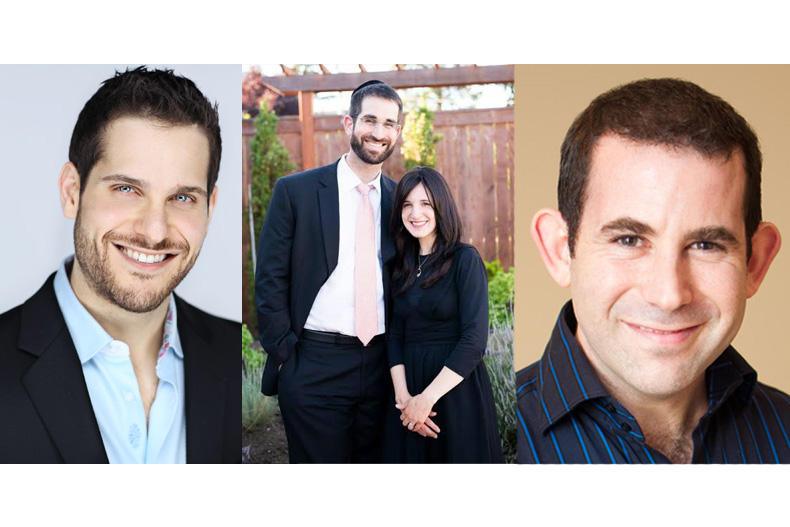
Intimate connections: Experts provide heartfelt advice from a male perspective
Abigail Pickus
Move over, Steve Harvey. Chicago is home to three Jewish men doling out expert advice on dating, relating, and everything in between.
The Relationships Rabbi
Rabbi Josh Marder has made it his mission to bring true intimacy back into our lives. It’s no surprise, then, that this rabbi and marriage and family therapist in one has become known as the “Relationships Rabbi.”
“I am humbly honored to be referred to as the Relationships Rabbi. To me, it’s a beautiful synthesis of the two worlds I am constantly striving to learn and share with the world: Torah and modern psychology,” said 35-year-old Marder.
Along with his wife, Laura, (also a therapist) Marder runs Chicago YJP (Young Jewish Professionals), a division of the Lois & Wilfred Lefkovich Chicago Torah Network, as well as seminars for singles and the newly married. He’s also in private practice as a couples and marriage counselor.
Having settled in Chicago just over three years ago, Marder and his wife, observant Jews, are the parents of five children.The thread uniting his work is helping singles to young married couples find that connection they so deeply desire.
“We live in a world that is very disconnected and yet everyone is looking for connection-especially the many young Jews in our community who are not connected or affiliated so they get lost,” he said.Marder grew up in Florida, made aliyah (immigrated to Israel) as a teenager, and studied in both New York and Israel.
“I was in so many different places-and had so many different experiences with a whole spectrum of people and cultures-that it opened my mind to the human psyche and the multitude of emotional experiences life brings,” he said.
Marder began as a grade-school therapist, where he quickly found out that most of the children’s issues were really the parents’ marital issues trickling down.
Thus began Marder’s specialty: counseling couples using Emotionally Focused Therapy, a research-based program designed to help adults connect and improve emotional attachment.
Because what he has found is unlike fairytales where the story ends just when the couple ties the knot, in reality the real story-and work-begins within the bond of a committed, intimate relationship.
The only problem is many people today have no idea how to do that. “One thing [couples] know about marriage is that they don’t want to add another notch in the alarming divorce rate, but they don’t know what they do want out of their marriage or how to get there,” said Marder.
That’s probably why so many of the young couples Marder counsels come to him on the verge of divorce.
Through marriage counseling, workshops and his blog , Marder aims to help people cultivate the skills necessary “to create deep, intimate relationships and bonds” and to reach interdependence.
“I’m not promoting dependency,” he said. “I am promoting interdependence as in ‘I need you and you need me.’ That is what Adam [in the Bible] knew and that is the divinely built genetic makeup of mankind.”
The Advice Columnist
If you ask Harlan Cohen, the reason he got into the advice business was because he wanted answers for his own problems. (“I had many,” he likes to say.)
What he quickly found out was that everyone had problems. And as a student at Indiana University, his advice column for the student newspaper took off and Cohen had to turn to real-life experts to help answer all the questions tumbling in.
Now, Cohen is the expert. In addition to being a nationally-syndicated advice columnist, he is the New York Times bestselling author of six books about everything from love to college life to parenting. He’s also a popular speaker, including for many Jewish youth groups.
Cohen is also a nice Jewish boy who grew up on Chicago’s North Shore and still lives in the area with his family.
“I’m an expert on life transitions,” he said. “Transition is the richest and most delicate part of life and the most important part. There is birth then death and everything in between is transition, from being single to being in relationship to being in a couple to navigating children. My specialty is helping people get comfortable with the uncomfortable when they navigate through transitions.”
His books, in particular, often stem from personal experience.
Take Getting Naked: Five Steps to Finding the Love of Your Life (While Fully Clothed & Totally Sober) , which Cohen wrote based on the trials and tribulations (and ultimate transformation) he underwent in his 20s while looking for love.
“I’ve been rejected most of my life and dating was always very painful. I didn’t understand why so many people were in relationships and I was single,” recalled Cohen who now is married and has children.
So he decided to crack the code.
In Getting Naked , Cohen unveils the five steps singles must take to live in a world of opportunities, abundance, and options as opposed to scarcity, fear and avoiding pain.
“For most of us, dating is less about what we want and more about avoiding pain and rejection,” he said.
What he discovered is finding true love hinges upon some deep inner work.
“Physically: I need to know I’m attractive enough; emotionally: I need to know I am good enough; spiritually: I need to know my life is fulfilling enough,” he said. “We can’t depend on someone else to complete us.”
Embracing these truths will change your life, according to Cohen. And will make dating and relationships about “…giving someone an opportunity to participate in the most incredible thing in the world and that’s you.”
(Cohen was actually rejected by his wife on JDate before they met by chance at a UPS store in Chicago, where she apparently began to change her mind.)
Judaism has always been important to Cohen. “Judaism and Jewish values have always been an essential part of my life and my identity. It’s a sense of belonging that is the opposite of rejection,” he said.
But Cohen is something of an outsider in the advice business, following in the footsteps of greats such as Anne Landers and Dear Abby.
Which hasn’t lessened his appeal. “Women find my advice comforting because I can share a little more insight into how the male mind works,” he said.
And what about men? “Unlike women who have a sisterhood, men often do not have a lot of people they can safely communicate with. That’s why men are very comfortable sharing things with me because there is no judgment and they don’t have to put on a façade; I am going to help them,” he said.
Because at the end of the day, Cohen’s role is about much more than dispensing advice.
“I love that I’m here just to help people,” he said.
The Dating Coach
Chicagoan Jason Silver has made it his mission to help singles find their one and only.
But unlike many of his dating and matchmaking counterparts out there today who focus on the external, Silver helps singles transform from the inside out.
“I help give my clients a new experience in dating that is individually tailored for each of them but whose ultimate goal is to find committed, healthy long term relationships,” he said.
Silver, who is 34 and married, got into the business after many years of personal struggle.
It began as a teenager when he dug into his mom’s spiritual books to help him shed extra pounds.
“I went through a spiritual journey to deal with the excess weight and I ended up learning a lot,” recalled Silver who grew up in Buffalo Grove in an affiliated Jewish family.
His journey helped him lose a monumental 100 pounds, at which point he finally felt ready to date.
“For the first time in my life, I felt I could go out there but I didn’t know how to deal with women or attract them,” he recalled.
So he hit the spiritual books again and began applying their principles. To his surprise, he did attract a girlfriend. But he still didn’t feel at peace.
“I thought if I lost the weight and got into a relationship I would be happy but instead, I was really unhappy and I gained back a bunch weight,” he said.
So Silver took a dating break. He also started spending a lot of time with his Orthodox cousins in West Rogers Park.
“I felt this really peaceful loving energy from them,” Silver said. “They invited me over for Shabbat the second I sat down to dinner and I saw their family interact, I thought, this is what I want.”
He became fascinated in particular by the dating customs of Orthodox Jews. “I saw cousins dating one month before they got engaged and I thought, that is so irresponsible! You have to live with someone, right?”
That was then he went into “obsessive learning mode.” By day he was working in Internet marketing, but at the Shabbat table and out in the world he was doing his own informal research.
“I am the inappropriate guy at the party who doesn’t want to chit chat. I have a hard time with small talk and I unabashedly ask everyone questions,” he said. “I would ask everyone I spoke with about their experience: how they met, how they dated, what the secret to the healthy, happy long-term relationship is,” he said.
After speaking to 100 people, Silver reached some basic conclusions. “I learned that it’s not just about interests, but about values. I also learned that people may say they value something but the best indicator of what they value is how they spend their time,” he said.
Only a few weeks after absorbing these lessons, Silver met his wife, Kathy, on JDate. “I ended up picking the sweetest woman,” he said about his wife, a school psychologist. “I was shocked this worked for me. I had spent so long learning that when I applied the principles, I met her in such a short amount of time.”
Soon Silver started coaching his friends, to great success. “I started seeing some extraordinary results,” he said.
Although passionate about his findings, he didn’t realize that this could be a career. Until one day in his cubicle, Silver started Googling and discovered that there was a whole universe of professionals out there who help singles find love. On a whim, he flew to Miami for a matchmaker conference, which eventually led to him quitting his job and becoming first a successful matchmaker and then the director of a leading matchmaker-training institute.
Finally, in 2016, Silver decided to follow his true passion of coaching others.
As the CEO of We Just Match, Silver helps his single clients focus on increasing the quality of the match they attract. “I do this by helping them feel and be a more attractive version of themselves because the only way to attract a truly high quality match is by becoming a high quality match,” he said.
Silver also hosts live workshops in Chicago on how to meet and attract higher quality matches. And he serves as one of Match.com’s in-house educators.
While Silver’s coaching is open to all, his approach is steeped in Jewish principles. “One of the Jewish principles I learned is to give more than you receive. If you’re looking for someone, you want to develop that muscle of giving and appreciating the other person,” he said.
But his coaching is all about taking personal responsibility. “When we begin to accept life as it is (versus how we wish it were), we can begin to focus on the next right action and be proactive in our own success and happiness,” Silver said. “If we live in blame, frustration and anger, we usually attract more of that. What we focus on tends to get bigger.”
Other stories
-
Two local teens win national recognition
Recipients of the annual Diller Teen Tikkun Olam Awards
Read more -
Celebrating six young award winners cultivating the community
Introducing young adult award winners
Read more -
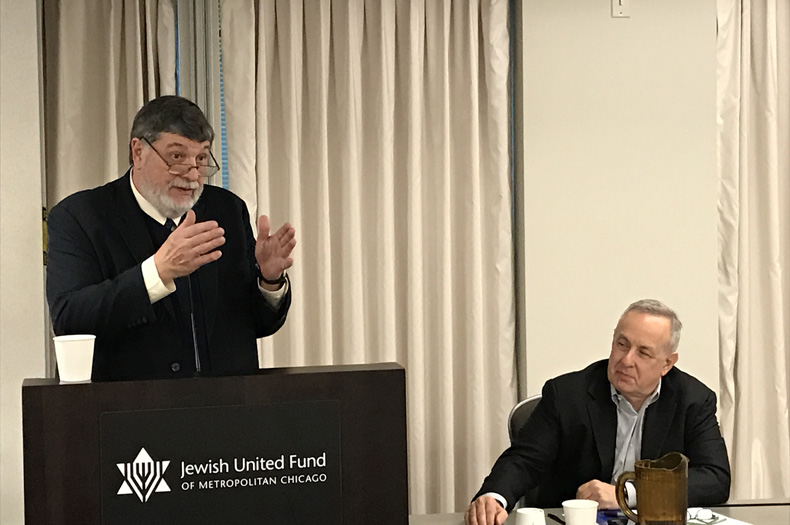
Government Affairs Committee discusses impact of proposed Medicaid changes
Mara Ruff
JUF’s Government Affairs Committee hosted a timely discussion Jan. 24 on the impact proposed changes to Medicaid could have on JUF affiliated agencies and the clients and communities they serve. Speakers included Cook County Commissioner Larry Suffredin and Roberta Rakove, Senior Vice President of External Affairs at Sinai Health System.
Medicaid is a federal and state-funded health insurance program which originally served only low-income children and individuals who were pregnant, disabled, living in a nursing home. In 2010, as part of the Affordable Care Act, this program was expanded to serve all low-income adults ages 18 to 64, with Federal funds providing a 90 percent match. Thirty-two states adopted this provision, including Illinois.
The Cook County Health System and Sinai Health System have a longstanding commitment to serving low income adults without healthcare insurance. Before the expansion, Cook County raised $500 million in tax revenues to fund services to this group. Sinai devoted $50 million, largely from private fundraising, to pay for “charity care.”
The Medicaid expansion significantly reduced that need. Rakove reported that before Medicaid expansion, 15 percent of individuals Sinai treated were uninsured, which left no money for new initiatives. Today, Sinai’s uninsured population has been reduced by half, and the charity care contribution is closer to $20 million. With the extra cash flow, Sinai Health System has been able to serve more people and invest in new initiatives like behavioral health, primary care partnerships, and basic structural improvements.
As debates are underway in Congress about the future of the Affordable Care Act, the status of the Medicaid expansion is unclear. If eliminated, many, including Suffredin, are concerned the outcome would be devastating.
“Roughly a quarter — or 3 million — of Illinois residents are now covered under the Medicaid program. This will drop if the Medicaid provision is eliminated,” Suffredin said. “The costs of serving low-income adults without health insurance will quickly fall back on the county tax-payers and downstate residents.”
The impact would also be felt on the network of Jewish Federation affiliated agencies according to Government Affairs Committee Chair David Golder, who indicated this issue would likely be on the agenda for the upcoming agency advocacy missions to Washington, D.C. and Springfield, Ill.
“With over $208 million in funding coming into our system as a result of Medicaid, it is our responsibility to ensure that the policy priories of the Government Affairs Committee reflects the issues that directly impact the programs and clients we serve,” Golder said.
To learn more on upcoming advocacy trips to Washington, D.C. on March 20-21 and Springfield on May 9-10, please contact Mara Ruff, [email protected] .
Other stories
-
Two local teens win national recognition
Recipients of the annual Diller Teen Tikkun Olam Awards
Read more -
Celebrating six young award winners cultivating the community
Introducing young adult award winners
Read more -