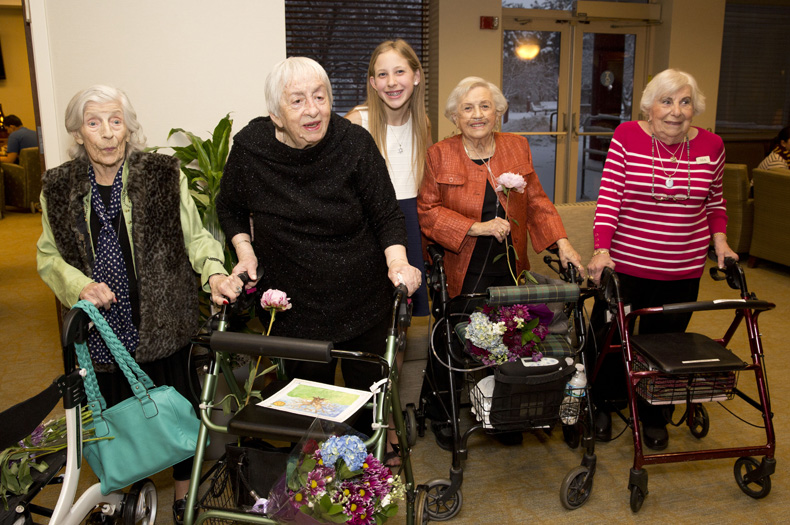
Last winter, four women who survived the Holocaust attended a movie about their own lives and stories. The director attended, too. Her name is Ariella Bernstein, and she goes to Shepard Middle School in Deerfield.
Bernstein got the idea when her mother invited her to an event at CJE SeniorLife Weinberg Community for Senior Living in Deerfield, during the time she was pondering what she would do for her bat mitzvah project.
She interviewed the women over the course of several months at Weinberg, where her mother is Community Outreach Liaison. She also interviewed their friends and family members.
The survivors ranged in age from 88-90. Two came from Poland, one from Latvia, and one from Greece. Each had a unique story: One survived a concentration camp; one endured a labor camp; one was hidden in a house by a neighbor, and one hid in a cave for more than two years.
Once the interviews were completed, Bernstein edited them into an hour-long video. The completed movie had about 15 minutes for each survivor’s story, and included photos from their lives. She also gave videos of the complete interviews, each more than an hour long, to the survivors’ families.
More than 170 people attended the December screening at Weinberg-the interviewees’ friends and family, including some of their great-grandchildren, as well as other residents and staff. The screening was part of a celebration for the women, complete with a live klezmer band.
But Bernstein didn’t stop there. She knew that the survivors had lost siblings in the Holocaust, young Jews who had never gotten bar or bat mitzvahs of their own. So she incorporated their names into her January bat mitzvah ceremony at Shir Hadash Synagogue in Wheeling, with empty, tallit-draped chairs on the bimah. Ariella led the entire two-hour service, read from the Torah, and spoke of her reading and her project in her speech.
Then she went one step further to honor those fallen children. Ariella had trees planted in their honor in Israel, in a special grove commemorating the 1.5 million children killed in the Holocaust.
Now, Bernstein is offering to share her video with schools, hoping to show it to seventh and eighth grade classrooms.
Bernstein said she hopes to impart the survivors’ messages to others. “After everything I went through, I never turned my back on God,” one said. Said another: “I was born Jewish and I will die Jewish. I could have changed my name or hidden my identity many times, but never did.” n
CJE SeniorLife is a partner with the Jewish United Fund in serving our community.
Other stories
-
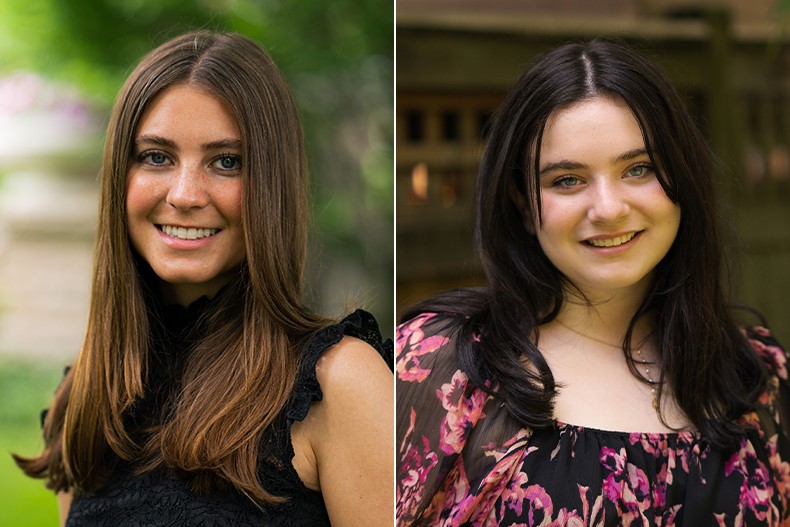
Two local teens win national recognition
Recipients of the annual Diller Teen Tikkun Olam Awards
Read more -
Celebrating six young award winners cultivating the community
Introducing young adult award winners
Read more -
Enhancing the security of local Jewish institutions long has been a critical role of the Jewish United Fund of Metropolitan Chicago. In the wake of increasing vandalism and threats against Jewish communal institutions, a newly launched JUF Security Grant Program has just issued a Request for Proposals.
According to FBI reports, Jews and Jewish institutions are the single largest targets for religion-based groups hate crimes in the United States.
Through the Security Grant Program, JUF will award matching grants for Jewish institutions in the Chicago area to support new or increased security operations and new or expanded capital security projects.
JUF will award one-year grants of up to $50,000 per facility toward site-specific projects. Applicant organizations will be required to match some percentage of the grant amount, with a variety of factors determining the proportion of the match.
Details of the program’s priorities and application process have been distributed to eligible 501(c)(3) nonprofit religious and secular organizations. Proposals may include, but are not limited to, staff training, hiring security personnel, or capital projects such as access control systems.
Many of the Jewish organizations expected to submit proposals for the Security Grant Program attended a JUF Security Summit in March. Drawing more than 180 participants from over 70 organizations, the Summit featured presentations from FBI, Department of Homeland Security, Chicago Police and JUF staff that covered a wide range of security issues and JUF services. Participating organizations completed a detailed security survey, which helped inform the design of the JUF Security Grant Program and dissemination of the RFP.
In addition to the Security Grant Program, JUF continues to provide, as it has for years, a wide range of security-related services in collaboration with Jewish institutions throughout the community. Together with partner agencies, JUF invests significantly in meeting ongoing security training and other needs for JCCs, schools, and other agencies and facilities, and helps secure millions in federal and state grants to make security improvements. JUF also maintains seamless cooperation with every level of law enforcement.
Organizations and facilities wishing to apply may submit a proposal online or inquire about the JUF Security Grant Program — and the full range of JUF security services — at [email protected] .
Other stories
-
Two local teens win national recognition
Recipients of the annual Diller Teen Tikkun Olam Awards
Read more -
Celebrating six young award winners cultivating the community
Introducing young adult award winners
Read more -
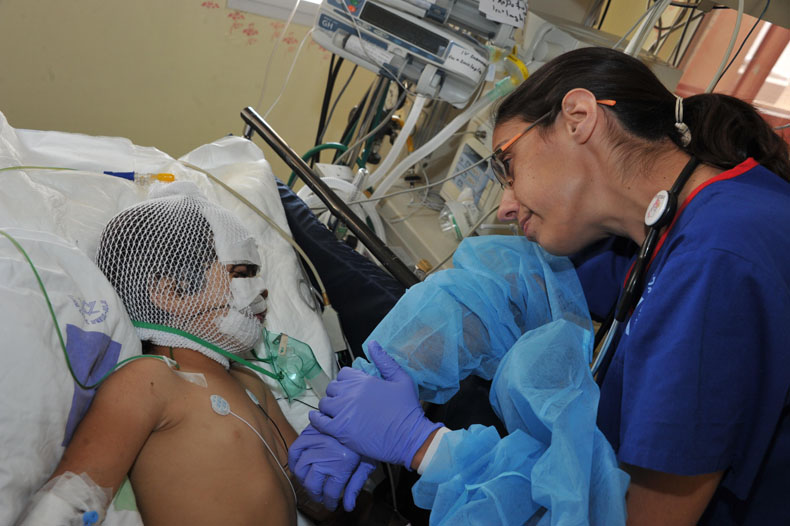
The chemical attacks in Syria this week provoked an outcry from world leaders and organizations trying to help those affected by the ongoing crisis.
On April 4, Rabbi Michael Balinsky, Executive Vice President of the Chicago Board of Rabbis, and Steven Dishler, JUF Assistant Vice President for International & Public Affairs, participated in a press conference organized by the Syrian American Medical Society condemning the chemical bombings, which have killed over 70 Syrian children, women and men, and injured hundreds.
The U.S., Great Britain, France, Germany, and the United Nations accused the Syrian regime — supported by Russia and Iran — of perpetrating the attack.
“In a war that has already inflicted incomprehensible horrors on millions of innocent civilians, this latest chemical attack conducted by the Assad regime reached a new level of depravity,” said David T. Brown, chair of JUF’s Jewish Community Relations Council. “The Assad regime and its allies must be held accountable for their war crimes. The Chicago Jewish community joins together with our friends in the Syrian community in condemning this heinous act and will continue to raise awareness on the current humanitarian crisis and provide assistance to the Syrian people through our Aleppo Assistance Fund.”
Through the Jewish Federation Aleppo Assistance Fund, with the assistance of 268 donors, the Chicago community has provided a total of $118,892 in aid thus far to assist victims of the humanitarian crisis.

Last week, JUF funds supplied the Galilee Medical Center in Israel with a mobile auditory brainstem response device for its Syrian children’s clinic , which sees as many as 50 children a week injured in the conflict, many of whom suffer from head and neck injuries.
Millions of people first learned about the horrors of the Holocaust by tuning into the historic 1961 trial in Jerusalem of escaped Nazi war criminal Adolf Eichmann. The story of his capture has all the elements of popular spy thrillers.
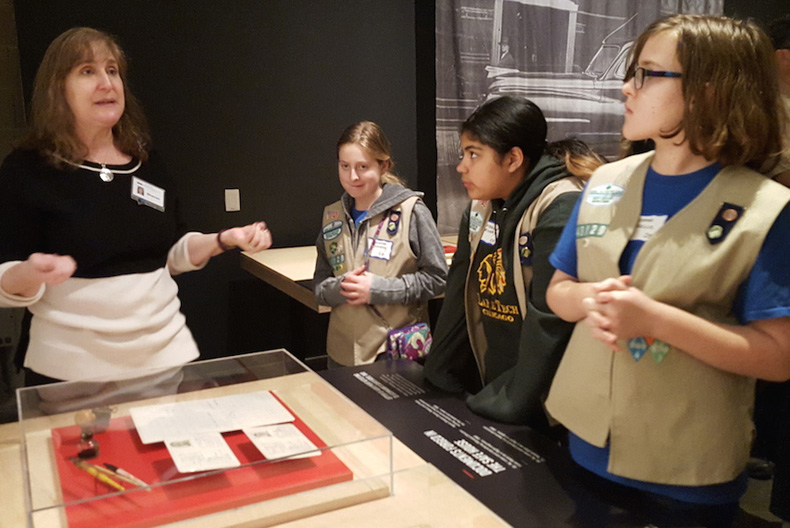
For a few hours this past winter, local Girl and Boy Scouts were able to step into that world during a tour of Operation Finale: The Capture and Trial of Adolf Eichmann , an exhibit currently showing at the Illinois Holocaust Museum & Education Center in Skokie.
More than 200 people-including Boy and Girl Scouts from diverse cultures as well as their parents and Scout leaders-participated in two different museum tours as part of the first “Scouting Out Intolerance” program held at the museum. Younger children took the “Stand Up, Speak Out” tour and participated in interactive, age-appropriate activities.
Through this program-sponsored by the Jewish Committee on Scouting of the Northeast Illinois Council (NEIC), with support from the Jewish War Veterans-scouts from different faiths and backgrounds can develop a better understanding of how hatred and intolerance shape mass opinion and be more aware of injustice.
“Many of the ideas discussed, especially around cyber-bullying and being an upstander rather than a bystander, affect all people,” said Michele Bauman, chairman of Scouting Out Intolerance.
Curated by Avner Avraham, a former Mossad agent, the exhibit chronologically tells the story of the legendary 1960 operation that brought the top Nazi officer to justice. Eichmann, a key architect of the mass deportation of Jews to extermination camps, was a prisoner of the Allied Forces after the war. But he managed to escape and flee to Argentina in 1950 under the alias “Ricardo Klement” with a passport issued by the Red Cross. By the time Israeli operatives seized him in a Buenos Aires suburb, he had been living in Argentina for 10 years.
“There are so many layers to this story-from what did the world think about Israel kidnapping Eichmann to what is the legacy of the trial,” said docent Sharon Kohn. “This trial brought the Holocaust into people’s living rooms around the world.”
Girl Scout Samantha Kaminsky, who took the tour, said her great-grandfather, Zelig Kalmanovich, survived the Holocaust but lost his wife and 5-year-old daughter. “I was amazed [during the exhibit] by how many survivors and witnesses were speaking. It’s interesting and disturbing. Eichmann was very powerful-but in an evil way. He’d go home at night and think about how to kill Jews. That’s hard to take in,” she said.
“Hearing people talk at the trial and seeing someone break down about his experience-this was really intense and impactful,” said Life Scout Reid Wilson of Northbrook.
Scouts in third through sixth grades toured the Make A Difference! The Harvey L. Miller Family Youth Exhibition with docent Dina Krause . The tour begins at a gallery of lockers, the kind you’d find in a school hallway. But, inside these lockers are upstanders’ stories.
Among them are Civil Rights icon Rosa Parks and Japanese diplomat Chiune Sugihara who risked his life and his position issuing visas to Lithuanian Jews. Both took a stand against hatred and intolerance.
Krause gives everyone time to pick a locker and read about that bystander. Tomas Krupa, who opened Canadian Ryan Hreljac’s locker, said, “I learned not everyone had clean water.”
Ryan’s African pen pal Jimmy had to walk an hour each way before school just to provide water to his family. “Ryan decided to do something about it,” said Krause. “He started the Ryan Wells Foundation and has wells all over Africa-all because of his pen pal Jimmy.”
Junior Girl Scout Anna Guest’s favorite part was learning about how the survivors escaped Germany, while fifth-grader Jesse Goldberg said he enjoyed learning about the upstanders.
“[Mine was a] wrestler who spoke against hatred toward gay people,” said Goldberg. “That was the best part-finding out what everyone did to help.”
Operation Finale: The Capture & Trial of Adolf Eichmann runs now through June 18, at the Illinois Holocaust Museum & Education Center in Skokie. For more information, visit
www.ilholocaustmuseum.org.
The Illinois Holocaust Museum and Education Center is a special grantee of the Jewish United Fund/Jewish Federation of Metropolitan Chicago.
Jennifer Brody is a former associate editor at JUF News and a freelance writer living in Chicago.
Other stories
-
Two local teens win national recognition
Recipients of the annual Diller Teen Tikkun Olam Awards
Read more -
Celebrating six young award winners cultivating the community
Introducing young adult award winners
Read more -
Israel Solidarity Day (ISD) is an event for all ages. Our community will come together to showcase our love of Israel and all things Israeli, from food, to entertainment, to the arts, to Israeli spirit!
The fun starts at 2 p.m. with the Walk With Israel. Walkers can choose between the Three-Mile Walk and the One-Mile Family Walk. Both will feature fitness activities along their routes, courtesy of JCC Chicago.
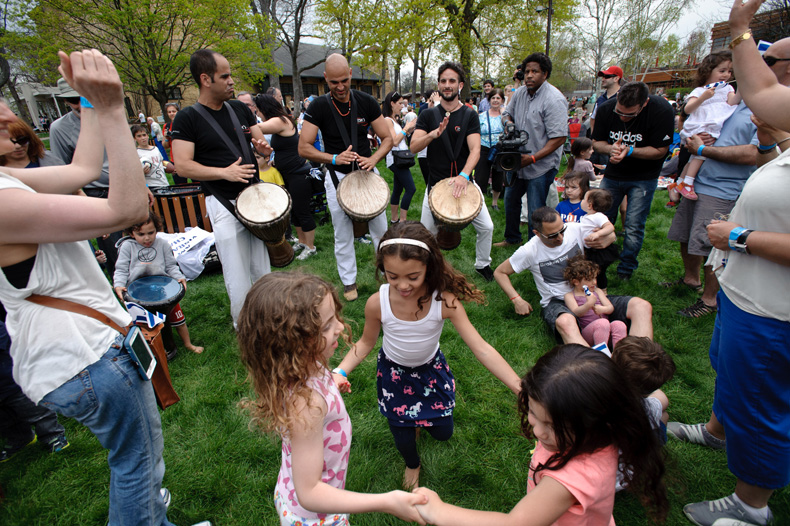
The music kicks off at 3:30 p.m. with the Jamman Drum Circle-all are welcome to join in. Then at 4 p.m., Nefesh Mountain takes the stage for a Family Concert combining Jewish spirit with bluegrass.
Idan Raichel, the music headliner, begins his solo show at 5 p.m. A world-renowned singer, songwriter, and keyboardist, Raichel has brought his inspiring example and soul-stirring music to some of the world’s biggest stages.
Children’s activities throughout the afternoon will include arts and crafts, and a musical “Instrument Petting Zoo,” where kids can pick up and play classical musical instruments.
Also new this year will be an Israeli Market Place and Art Festival, with unique, handmade Judaica, jewelry, and more.
Gifts raised through Israel Solidarity Day will help 6,500 at-risk youth in JUF’s Partnership Region of Kiryat Gat-Lachish-Shafir. Our community has been partnered with this region for over 20 years and we are proud to call it our home in Israel.
“Showing our solidarity with Israel has always been important for diaspora Jews, but perhaps now more than ever,” said Dana Hirt, ISD chair. “Celebrating Israel’s 69th birthday is a wonderful opportunity to come together as a Jewish community, demonstrate our spirit and pride, and stand with our brothers and sisters in Israel. Plus it will be a lot of fun for the entire family.”
ISD participants who raise or give $18 or more toward Israel Solidarity Day will receive an ISD T-shirt at the event. Those raising or giving $100 or more toward Israel Solidarity Day will receive a $100 voucher for a JUF Israel Experience or JUF Mission (one voucher per person per year).
Seating in the Ravinia Pavilion is first-come, first-served; seating on the lawn is open. A variety of fresh kosher food will be available for purchase.
To receive a “speed pass” for admission to ISD, preregister at www.juf.org/ISD. On-site registration begins at 1:15 p.m.
Many volunteers will be needed. ISD Volunteers can sign up at the same webpage, and request the time slot and manner in which they would like to lend a hand.
The Ravinia Festival Park is fully accessible, including its parking, seating, pathways, and restrooms.
Metra’s Union Pacific North Line makes Sunday stops in the village of Ravinia, and free shuttle buses will take attendees to and from that stop to Ravinia Festival itself. Free parking is available at the Ravinia Festival grounds as well. Ravinia Festival is located at 200 Ravinia Park Road, in Highland Park.
Other stories
-
Two local teens win national recognition
Recipients of the annual Diller Teen Tikkun Olam Awards
Read more -
Celebrating six young award winners cultivating the community
Introducing young adult award winners
Read more -
Entrepreneur Larry Levy chairs 2017 JUF Annual Campaign
Christine Sierocki Lupella and Linda Haase
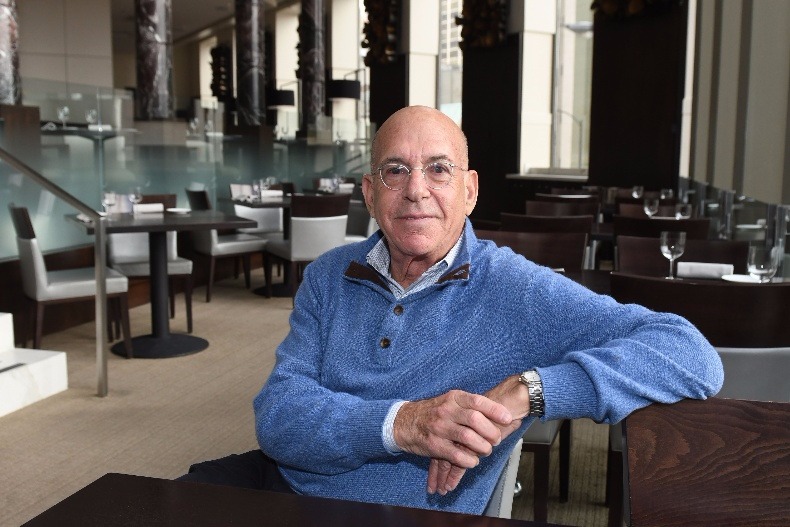
Entrepreneur Larry Levy, the innovative restaurateur who is credited with transforming the sports concessions business around the world, has been named 2017 General Chairman of the Jewish United Fund Annual Campaign.
Levy is renowned for putting people first and creating a culture of caring among his employees.
His vision, determination and insight will serve him well as he chairs the 2017 JUF Annual Campaign. One of the largest annual fundraising events in the country, the JUF Annual Campaign raised $84.3 million in 2016, supporting a wide variety of humanitarian and community-building efforts that benefit 500,000 Chicagoans of all faiths and millions of Jews in Israel and around the world.
“Larry’s energy and creativity will be a driving force in this year’s Campaign. He is a perceptive leader and his charismatic personality engages people from all walks of life,” said Dr. Steven B. Nasatir, JUF President. “Our community is fortunate to be the recipient of his expertise and exceptional leadership.”
“I am incredibly proud of our Chicago Jewish community’s generosity, and humbled by the passion and commitment its leaders have demonstrated in caring for the vulnerable,” Levy said. “I am truly honored to continue in the great tradition of the leaders who have come before me in this role.”
The co-founder and owner of Levy Restaurants until he sold it in 2007, Levy opened his first restaurant in 1976, the venerable D.B. Kaplan’s Delicatessen in Water Tower Place, with creative culinary guidance from his late mother, Edith (“Eadie”). Beginning with the old Comiskey Park and later, Wrigley Field, he upgraded and revitalized the concessions business at Ravinia Festival, McCormick Place and the Lincoln Park Zoo, and at more than 100 sports stadiums, arenas and other venues around the world, as well as longstanding restaurants at Florida’s Walt Disney World.
He is now the Managing Partner of Levy Family Partners, investing in local tech startups and developing large commercial real estate ventures such as the new River Point office tower. Over the years, Levy has been an owner/developer of numerous major Chicago projects, including One Magnificent Mile and other office and industrial properties around the country. In addition, Levy owns Esperanza, a luxury resort in Cabo San Lucas, Mexico.
Levy is passionate about taking something good and making it better, intuitively understanding people and what they want, and taking time to mentor promising young professionals. His Jewish values have been a guiding force in his life.
“Anyone who knows me knows that family is everything to me,” Levy said. “But my sense of family goes beyond my wife and kids. I have always considered my coworkers and employees to be family, too. I also have a greater, worldwide Jewish family, and the quality of their lives matters to me.”
He serves as a Vice Chairman of the JUF Board of Directors, and is a member of the JUF’s Executive, Litigation Review, and Overall Planning & Allocations committees. Previously, he chaired JUF’s Advance & Major Gifts dinner; the most successful Vanguard Dinner to date; and the Israel at 60 Gala. Levy has been a longtime member of the JUF Campaign Cabinet and active with JUF’s Trades, Industries & Professions division.
In addition to JUF, Levy is a member of the Board of Trustees of the Art Institute of Chicago; a Life Trustee of Northwestern University; a member of the Northwestern Kellogg Graduate School of Management Board of Advisors; Lincoln Park Zoo Board of Trustees; and Northwestern Memorial Hospital Foundation.
Levy earned his undergraduate degree at Northwestern University, and his MBA from the Kellogg School of Management, where he and his wife, Carol, endowed The Larry and Carol Levy Institute for Entrepreneurial Practice.
“We are standing on the shoulders of the entrepreneurial giants that built this community,” Levy said. “I view this as an opportunity to pay that good fortune forward.”
The Jewish United Fund is the one organization that impacts every aspect of local and global Jewish life, providing human services for Jews and others in need, creating Jewish experiences and strengthening Jewish community connections. JUF brings the community together from across the spectrum of Jewish life to take part in collective action and ensure the Jewish future.
Other stories
-
Two local teens win national recognition
Recipients of the annual Diller Teen Tikkun Olam Awards
Read more -
Celebrating six young award winners cultivating the community
Introducing young adult award winners
Read more -

Spring is rapidly approaching and with it, to the relief of many, comes the return of some much needed sunshine. While we wait for spring to hit its stride, the Hillel House at Bradley University has already taken steps to prepare for some of that additional sunshine. Earlier this month, the Hillel on campus became the first building on Bradley University’s campus to begin using solar panels as its primary source of energy.
Though Bradley’s Hillel might be small in size, it stands at the forefront of the environmental movement. The Hillel became the first Hillel in the state of Illinois, and the third Hillel in the entire country, to implement solar panels. These panels aren’t just for show either. The project consisted of 47 solar panels that were installed over a six-day span and will provide the Hillel house with 90 percent of its annual electricity. This calls attention to the growing importance of environmental issues on Bradley’s campus and around the world.
“So often we forget that everything we use requires energy and we are draining the earth of fossil fuels,” said Natalie Cabell, student president of Bradley Hillel. “Solar energy is the perfect solution to this issue and utilizes an energy source that will never go away-the sun! Not only are we saving money down the road but we are also saving the planet and that is something I am extremely excited about.”
This project did not come together overnight. It took two years of intensive planning to find a financial model that worked best. The planning paid off though, as this installation will not cost Bradley’s Hillel any money. The panels were financed by Yona Lunken, president of Bradley Hillel’s corporate board. Lunken is passionate about the real difference these projects can make. “The world that we create is the world that the students of today will live in. And creating a world where environmentalism matters was a central motivation in making this solar project into a reality,” Lunken said.
There will be an open house to celebrate the addition once the sun fully comes out. The event will be open to everyone, including Bradley students, and Hillel hopes this solar project will begin moving our campus in the direction of cleaner energy. Bradley’s Hillel has shown that projects like this are possible, and will continue to shine light on this movement for Hillel houses, no matter the size or the location.
Charlie Cohen is a senior Political Science and Public Relations double major who works as JUF’s Israel Education Center Israel Intern at Bradley University Hillel.
Other stories
-
Two local teens win national recognition
Recipients of the annual Diller Teen Tikkun Olam Awards
Read more -
Celebrating six young award winners cultivating the community
Introducing young adult award winners
Read more -
Why India?
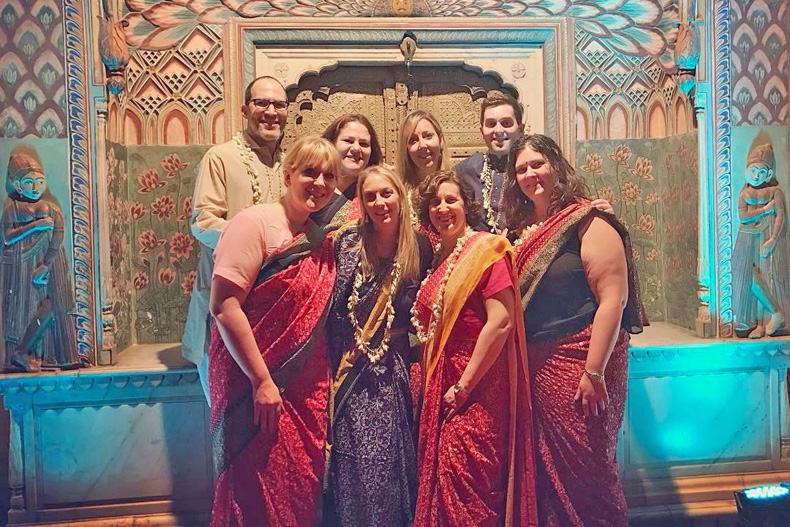
It was the most-asked question whenever we mentioned our Study Mission for the National Young Leadership Cabinet (NYLC) of the Jewish Federations of North America (JFNA). It’s the question I kept asking myself. Yes, I was excited. India is a place I have always wanted to see but I never made it a destination. Still — why India for our NYLC Study Mission? Why would we be the first to visit of any JFNA group?
Preparing for the trip, we learned there actually are Indian Jews (not only expats) found in six cities. The smallest groups are in New Delhi (12 Jews) and Cochin (28 Jews); then there is a vibrant Jewish community of 3,000 in Mumbai.
The Jews of India arrived in three waves, beginning 2,000 years ago with 14 survivors of a shipwreck off the coast of Mumbai. These Jews — the Bene Israel — are thought by many to be one of the lost tribes. They were followed by the Cochini Jews, who arrived around 1520, expelled from Spain. The third to arrive were the “Baghdadi” Jews, coming from Persia in the 1830s, initially as merchants.
Our mission began in the footsteps of the Bene Israel on the beach near Mumbai. They survived a shipwreck but were left without Torah scrolls, books, or any ritual objects. Maintaining their Jewish identity in such isolation is truly remarkable. The Bene Israel were sustained by their oral tradition and observance of Shabbat, above all, plus circumcision, kashrut, and reciting the Sh’ma , the only prayer that was known from memory. Standing on that beach 2,000 years later and thinking of their dedication to the religion we share with them was truly moving.
At its largest point, there were 30,000 Jews living in India, forming a successful and prosperous community. After the British departed in 1947 and after Israel declared its independence in 1948, many Indian Jews started making aliyah . In 1961, the American Jewish Joint Distribution Committee (JDC) arrived to support India’s Jews. We heard from Elijah Jacobs, executive director for JDC-India, about programs that sustain the remaining Jews of India.
Our JUF dollars help Jewish elderly live in dignity in Bayiti Old Age Home, help fund Gan Katan (basic Judaism study for youth) as well as Hebrew/Torah study for adults to supplement their Jewish-Indian traditions. With our assistance, JDC is molding young adult leaders for their community through the Jewish Youth Pioneers.
Selected youth gain skills and knowledge-and learn important Jewish values-as part of their formal and informal Jewish study programs then enhance those skills by going into the community through JDC partner programs like The Gabriel Project Mumbai, Sundara, and the Naya Initiative. These young adults learn important Jewish values-Jewish study, helping others, helping your own community but also helping the wider community around you, no matter the religion. It’s certainly something we work to teach here at home.
We also had time to see some amazing sites across India, the colorful faces of India, and to experience the kindness of so many people. There is no history of anti-Semitism because the majority population is polytheistic and has no problem with Jewish belief. They value kindness and compassion, for anything else would burden them is this life and in their future lives.
I decided Indians must have supernatural serenity to survive typical, everyday city commuting. Their traffic jams make rush hour on the Dan Ryan look like warp speed. And for them, red lights and crosswalks are, at most, advisory.
Our NYLC Study Mission India experience showed us a story of perseverance, a story of living Jewish values. Maintaining their Judaism for 2,000 years as a tiny minority took strong commitment and deep belief. Now, the JDC, through the Jewish Youth Pioneers, is helping women and children of the slums, supporting programs to teach health, education, and the skills to make a living. We were so inspired by their work that together, NYLC members are raising funds for two of these programs: Gabriel Project Mumbai and JDC’s Youth Pioneers Program. To date we’ve raised over $37,000.
As members of NYLC, we learn from our peers, strengthen our own Jewish communities, and see firsthand the impact of our gifts through partners like JDC. Experiences like this trip to India make me confident of our Jewish future. We are a people who persevere. Just ask India’s Bene Israel.
Jen Leemis, a Chicago resident, is a JUF board member, chair of the Marketing & Communications Committee, and a past president of YLD. She joined JFNA’s National Young Leadership Cabinet — the premier leadership philanthropic program for Jewish men and women ages 30-45 across the U.S. and Canada — in 2013.
National Young Leadership Cabinet is now recruiting new members. To learn more about Cabinet, email [email protected].
Other stories
-
Chicago to Israel to Kenya
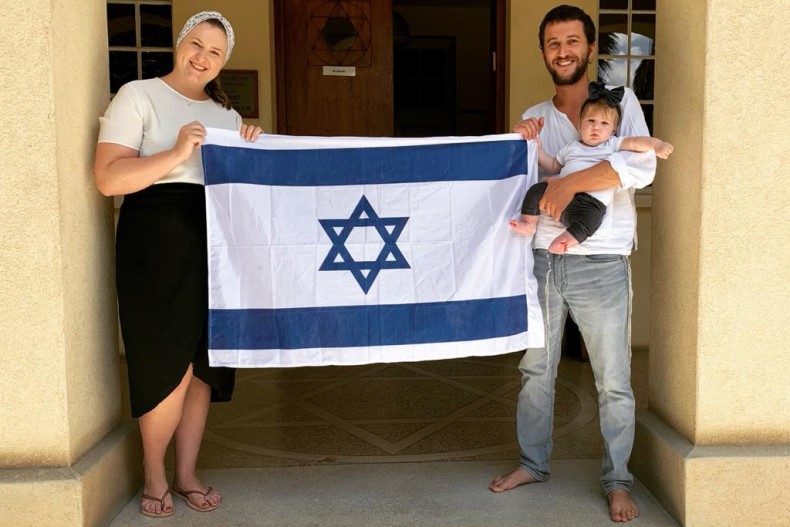
A family’s story of living Jewishly on three continents Michelle Cohen World May 28, 2021 Avital, Tzofia, and Netanel Kaszovitz outside their home in Nairobi on Yom HaAtzmaut. When Avital Kaszovitz prepared to be a Modern Orthodox shlicha (emissary) to the Jewish community in Ke
Read more -
New exhibit spotlights the experience of ‘Shanghai Jews’
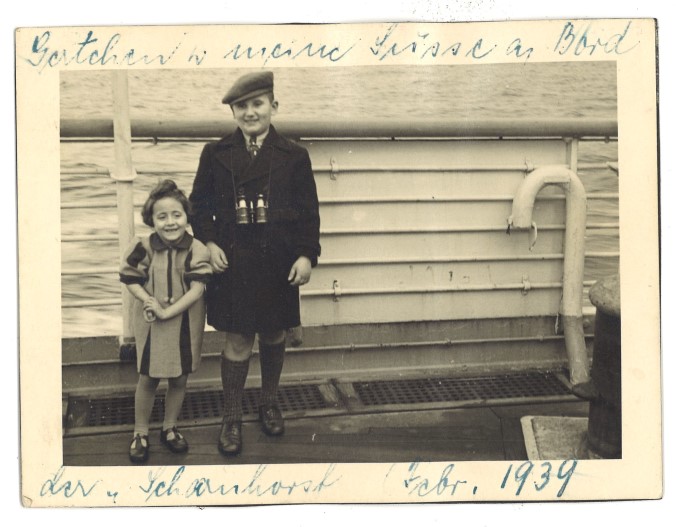
Explore a new Illinois Holocaust Museum and Education Center exhibit
Read more -
Europe’s brave new teachers of the Holocaust
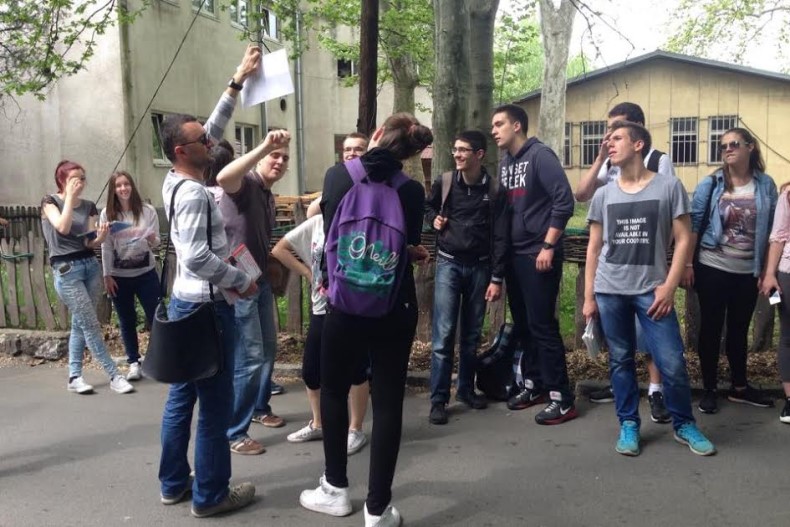
Teaching the Holocaust in the modern era has its difficulties and rewards.
Read more
For generations, the Jewish United Fund of Metropolitan Chicago has assisted those in need, supported Israel and Jews abroad, and helped build community here in Chicago. If you live in the Jewish community, you have seen the impact of JUF, whether you are a donor or recipient. Behind most Jewish organizations is the helping hand of JUF.
In our dynamic world, with changing demographics, evolving needs, and new ways to connect, JUF works to make Jewish life in Chicago more accessible, engaging, and meaningful for children, teens, families, and adults. By innovating new programs and updating long-running ones, JUF offers a broad variety of programs to meet diverse interests and needs. You might find yourself discovering, “Wow! I didn’t know that this is a JUF program.”
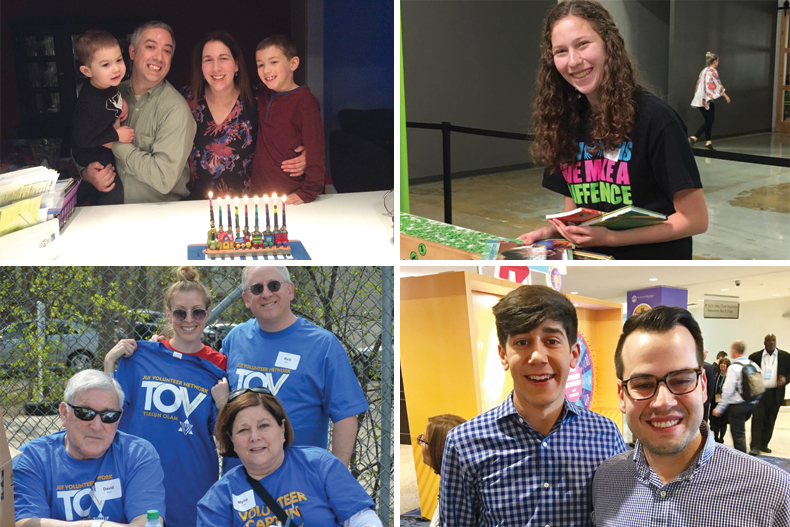
On the following pages, meet four people from different backgrounds and age groups who are volunteering, connecting, blazing trails, and learning philanthropy through JUF. They appreciate the fulfillment of giving back, both for the community at large and themselves — while inspiring others to join them. We hope their stories compel you to find your own place within JUF, as we work together for good.
Julie DiGuiseppe, Connector Extraordinaire
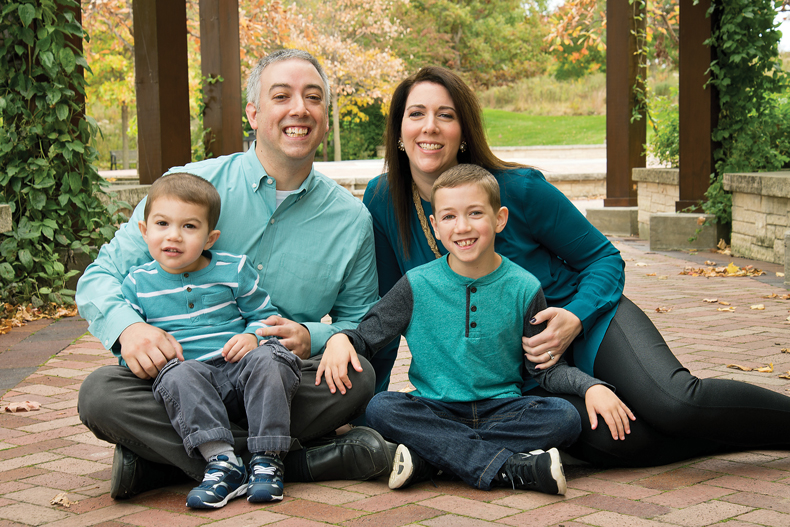
As a suburban mom of two boys, Julie DiGuiseppe heard about jBaby Chicago classes from friends living in the city and wanted to check one out. Two years ago, she got her wish when JUF offered a class at Temple Chai in Long Grove. She jumped at the chance to attend with her younger son, and made sure others knew about it too.
“On the first day, 14 families I had told about the class showed up. The Temple Chai liaison told me I seemed like a good connector — would I be interested in a jBaby ambassador position?” DiGuiseppe relates, as she tells the story of how she became an integral part of JUF’s outreach program for young families.
When parents sign up for jBaby Chicago at www.juf.org/jBabyChicago, DiGuiseppe schedules a time to get together so she can welcome them to the community. She covers the northwest suburbs, while other jBaby ambassadors do similar outreach throughout the Chicago area. When DiGuiseppe meets with a mom for the first time, she brings a “swag bag” full of goodies and a laundry list of ideas how a young family can become involved in the Jewish community.
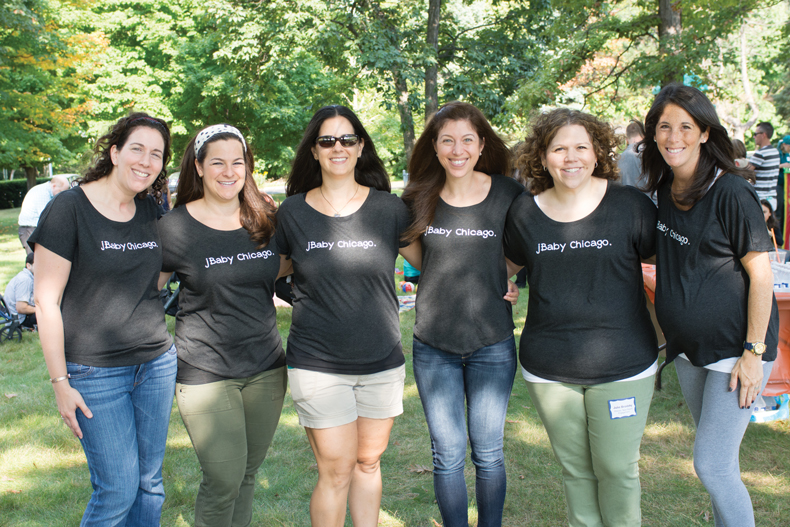
“I give them an overview of what I have to offer. There are playgroups, partner classes with Solomon Schechter Day School, JCC Chicago, and some of the synagogues, and monthly events, which are like a large play date for people to come and mingle,” DiGuiseppe explains
Those monthly events started out in the summer with families meeting at local parks in their communities, but JUF now offers get-togethers year round with activities including a musician, crafts, and even Havdallah some Saturday evenings. DiGuiseppe says the Jewish link helps parents connect from the get-go.
“Even if one is 27 and one is 47, they have things in common, which is a good ice breaker. Even if they weren’t raised Jewish, but are raising their family Jewish, attending some of our events is a good way for them to be exposed to Jewish customs and traditions,” DiGuiseppe says.
She speaks from first-hand experience how jBaby events can influence an interfaith family. While DiGuiseppe was born and raised Jewish, her husband was not. But she says he always feels welcome when they attend JUF events together.
“They are very inclusive. We celebrate Judaism without excluding anyone,” DiGuiseppe says.
JUF’s outreach to young families includes the PJ Library program where children receive a Jewish book in the mail every month for free. DiGuiseppe says the books are helpful when she wants to teach her children or husband about an upcoming holiday. Her favorite is Nosh, Schlep, Schluff: BabYiddish, by Laurel Snyder, a board book that teaches Yiddish words to the stroller set. She says her husband likes to “impress her” with his vocabulary!
DiGuiseppe’s work as a jBaby ambassador, seeing the value of the programs JUF helps to fund, has inspired her and her husband to become JUF donors.
“I feel like I’m doing my part and helping the cause with Jewish programming and classes that keep us going.”
Julie Diguiseppe’s picks of tunes and tales
On her PJ Library shelf:Nosh, Schlep, Schluff: Babyiddish by Laurel Snyder
In her PJ Library earbuds: Rick Recht — Saw him perform at a baby event
Favorite parenting site: Baby Sideburns & Kveller
Last book read just for Julie:Small Great Things by Jodi Picoult
Carly Colen, Budding Philanthropist
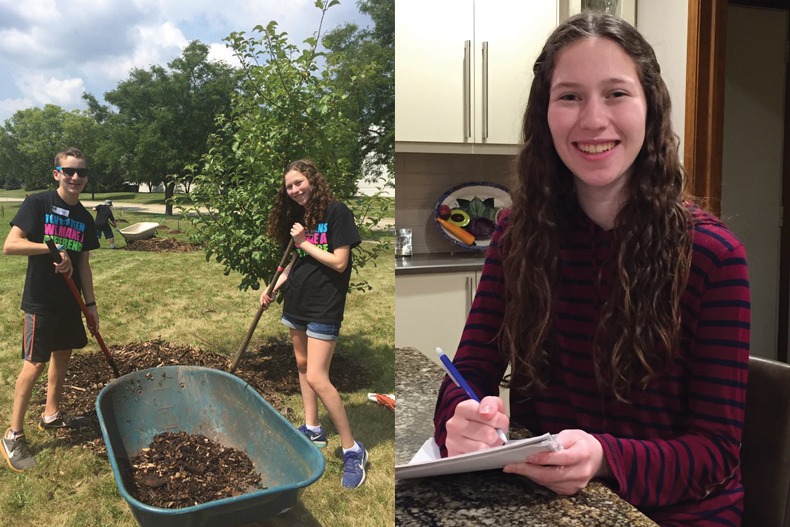
Anyone who worries about the Jewish future needs to look no further than Carly Colen to put their fears to rest. Giving back to her Jewish community comes naturally for this Buffalo Grove High School sophomore.
“I have always been interested in helping others. I would put birthday money in the tzedakah box. But I never knew how I could give money more strategically to better help others,” she says.
Colen is now gaining those strategic skills through Voices: The Chicago Jewish Teen Foundation, one of the many ways teens can become involved in JUF. Last year, as a Voices 101 participant, Colen learned the fundamentals of Jewish philanthropy and grant-making, using funds provided by JUF. This year, as a member of the Voices Alumni Foundation, Colen’s focus is on securing funding for the organizations that apply for grants.
“We don’t start with any money. What we raise, JUF matches and then we allocate that money to non-profits,” Colen explains.
She is planning a fundraiser at Anshe Emet Synagogue in Chicago that will entail an art fair filled with vendors selling their wares along with a crafts booth for kids. She and other Voices alumni also will sell doughnuts and coffee, donated by Anshe Emet, as part of their fundraising efforts. Colen says she loves being “so hands-on.”
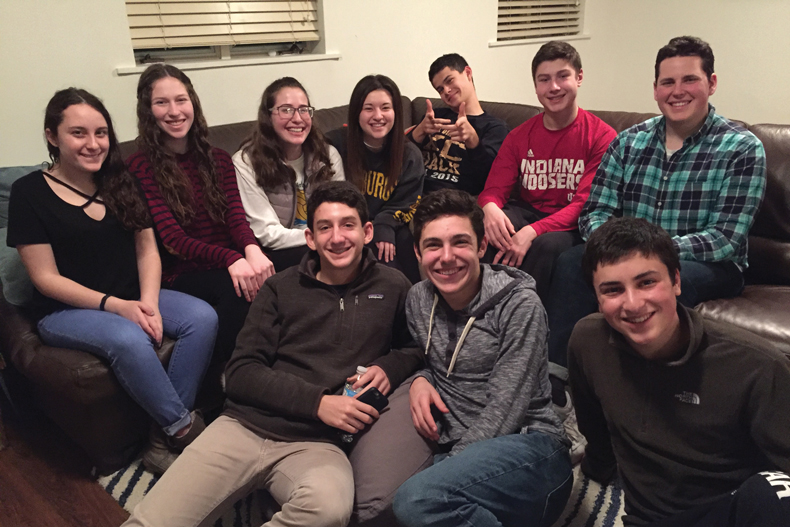
Voices is not the only JUF program where Colen is learning to give back. For the past three summers, she participated in JUF’s Camp TOV, a weeklong day camp on wheels where teens volunteer at different organizations every day. Colen says she especially liked serving at soup kitchens such as the JUF Uptown Cafe.
“I could not imagine not being able to put food on the table every day, so I think it’s really important that we help those who can’t. It always cheers me up to see… how happy they are to receive food, knowing they will be better off for another couple of hours and they won’t have to go hungry,” she says.
This past summer, Colen provided an Uptown Cafe recipient with even more than the gift of a meal. An elderly, hearing-impaired woman had never been able to fully communicate with anyone there. But Colen changed that when she conversed with the woman in sign language, which Colen learned in school.
“She was so happy that she could finally talk with someone — and someone could finally understand her. That was cool,” Colen says.
Through Voices, Colen has made friends with teens from all over the Chicago metropolitan area. “We all have the same goal, and we’re all working toward the same thing, which is really nice and different from my friends from school,” she says.
Colen encourages others in her age group to join her and her Voices friends in the JUF world.
“There’s something for everyone. Get involved. You won’t regret it!”
Carly Colen’s mitzvah moments
Most meaningful donation: Children Of Peace, a charity that works to build trust and friendship between Israeli & Palestinian children
Most inspiring Tikkun Olam experience: Signing with a hearing impaired woman at JUF’s Uptown Cafe
Making social media meaningful: Forget Snap Chat or Instagram. Carly only uses Facebook as a way to stay connected with Voices.
Rich Biller, Ultimate Volunteer
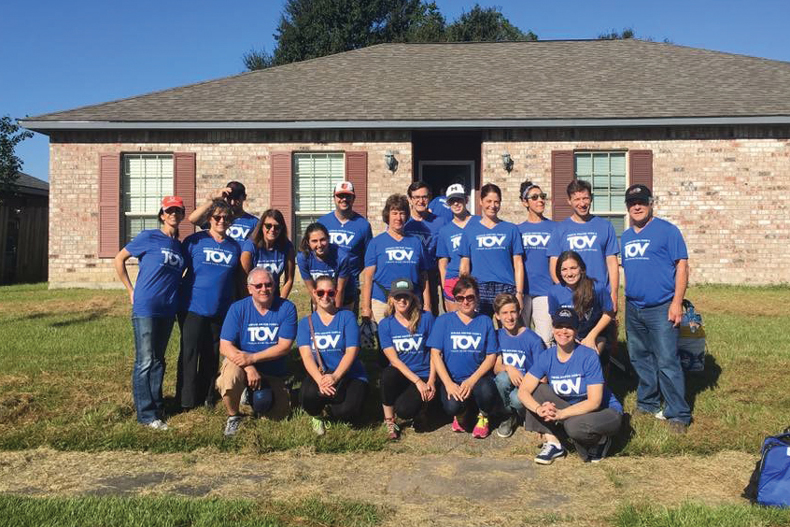
When Richard Biller retired in 2009, he could plan his days as he wanted. Instead of hitting the links or traveling the world, the now 57-year-old decided to fulfill his “desire to give back” by becoming what he calls a “professional volunteer.”
“I get more out of volunteering than I give. I’m a TOV groupie. I think what they provide to our community is incredible,” Biller says.
JUF’s Tikkun Olam Volunteers (TOV) provides community members multiple ways to become involved. Some of the hands-on volunteering opportunities are ongoing, such as the JUF Uptown Cafe where you can serve a meal to the homeless. Others are annual, like delivering packages of Passover food to those in need through Maot Chitim of Greater Chicago, where Biller is board executive vice president.
“It’s an organization with a very big roll-up-your-sleeves lay leadership,” Biller says. “I spend two days a week in their office during much of the year doing data entry, stuffing envelopes, helping with development strategies, or making phone calls to recipients or volunteers.”
Biller’s TOV participation spans a wide range of activities, from reading with kids from underprivileged backgrounds through TOV Reads, to serving in soup kitchens. He’s also hit the road, participating in TOV relief missions to devastated areas like New Jersey, where he helped residents clean up from Hurricane Sandy. He also went to Washington, IL, through TOV’s referral, along with his son and nephews, to volunteer with NECHAMA right after a tornado devastated the small town.
“People’s homes were ripped down to toothpicks. We were wading through the debris and finding a few cherished memories, a photograph or a dish. Finding those things and giving them back to the homeowners made it personal,” Biller says.
While TOV provides Biller with multiple volunteer opportunities, his efforts extend into other parts of the Jewish community and beyond. His wife, Eve, is a breast cancer survivor, so he’s worked with the Susan G. Komen Foundation. Biller says he likes finding organizations with a personal connection. He’s also involved with Hillel, an organization he calls a “critical point of entry into the Jewish community for young adults.”
Biller also volunteers with the Illinois Holocaust Museum and Education Center, which held a multigenerational Passover Seder last year with JUF’s Holocaust Community Services, Maot Chitim, and BBYO. Biller, who helped forge the partnerships for that event, says bringing organizations together is another “passion” of his volunteer work. “We reach more people and do more things when we all work together.”
Biller appreciates the importance of financial gifts as well, and says he likes donating to JUF because of its broad reach. He recognizes he is “incredibly blessed” to be able to dedicate his time to causes that are important to him, but he emphasizes how giving back is what matters most whether it’s financial, volunteering, or both.
“Your check can spread out all over the world, but doing it yourself is a totally different experience. It’s just an overwhelming feeling of impact and of making a difference in a life.”
Rich Biller by the numbers
Hours spent volunteering in 2016: 200 hours volunteering and 300 to 400 hours providing administrative support for Maot Chitim.
Years he has been a JUF donor: 30+
Meals served at the JUF Uptown Cafe: 25
Volunteers who helped deliver packages for Maot Chitim: 1,500
Alex Entratter, Trail Blazer
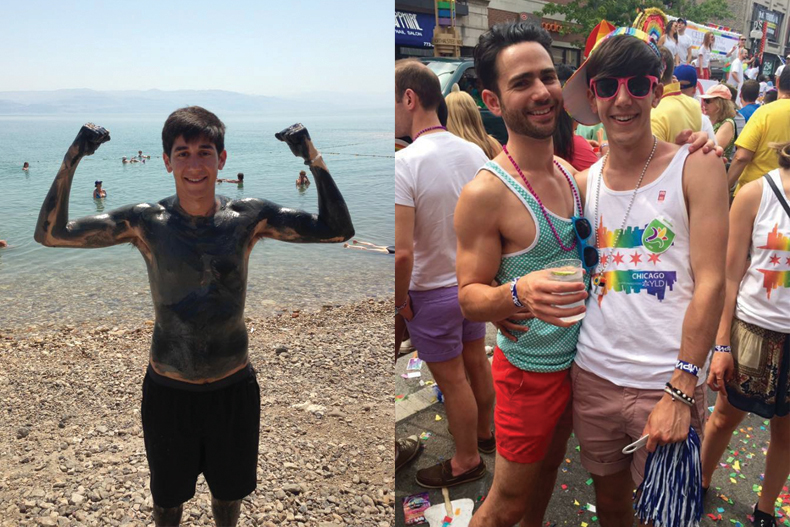
When Alex Entratter went on a JUF Birthright Israel trip in 2013, he could not have predicted that visiting the Jewish homeland would be a gateway to becoming a Jewish leader in his hometown, but that’s what happened when he returned to Chicago.
“I was the driving force keeping my friends involved once we got back from the trip,” he says.
He served on the Back from Birthright Israel Committee and soon became the group’s social chair, planning events like the Bar Mitzvah Bash, which hosts 400 to 500 young adults at a club in the city, honoring people who celebrated their bar or bat mitzvahs on their Birthright Israel trip. The event also gives Birthright alumni the chance to get together and engage with the Jewish community in Chicago.
Around the same time he was proving himself as a leader in the Birthright community, he became a founding member of JUF’s Young Leadership Division (YLD) Pride Committee.
“There wasn’t something to bridge the LGBTQ community to Israel and the Jewish community in general. We had a meeting that started off with 15 people. We decided to do a happy hour at Sidetrack in the Boystown neighborhood of Chicago. It was our first big event,” Entratter explains.
Entratter says the happy hour was supposed to be a testing ground of sorts to gauge interest. The first year, 89 people attended. The following year they were up to 99, and the year after 102 people joined. That success led to more programming for YLD Pride, and now Entratter says the committee is an integral part of YLD.
“We’re becoming really immersed in typical YLD programming, which was our goal from the beginning… It’s a great way for the LGBTQ community to have a seat at the table.”
In November, Entratter attended the Jewish Federations of North America’s General Assembly in Washington, D.C., an annual gathering where federation leaders from around the country discuss topics affecting the American Jewish community. The GA presented a video highlighting the positive effect of YLD Pride on the Jewish community in Chicago.
“It was great to see that our work is not only appreciated, but also is a model for other Federations around the world,” Entratter says.
Entratter is now a YLD Board member, serves on the Social Media Committee, and is honing his fundraising skills. This year, he increased his own gift and became a member of JUF’s Ben-Gurion Society, a national donor recognition society for adults ages 25 to 45 who make a contribution of at least $1,000 to the JUF Annual Campaign.
“I’ve learned how far everything we raise goes,” he says. “I increased my donation this year because I really see the impact of the money I’m donating.”
Entratter says his aunt and mom have always been “huge role models” for him as Jewish leaders and philanthropists. His aunt is a member of the JUF Board of Directors and his mom serves on the North Shore Auxiliary of Jewish Child and Family Services. Now it’s Entratter’s turn to be a role model for his fellow Millennials. He says he wants to impart how JUF’s broad reach lets you receive, even as you give.
“You cover such a large variety of organizations locally and abroad. You are able to have a greater impact through involvement with JUF and YLD — YLD gives you so much and then it’s great to be able to give back that way as well.”
Alex Entratter’s globetrotting favorites
Israel: The Old City and The Western Wall
Washington, D.C.: National Museum of African American History and Culture
Sweet home Chicago: YLD & Oy!Chicago’s Double Chai in the Chi, YLD Pride’s Pre-Pride Bagel Brunch
Destination: Argentina
Dream Getaway: Australia & New Zealand
Other stories
-
Two local teens win national recognition
Recipients of the annual Diller Teen Tikkun Olam Awards
Read more -
Celebrating six young award winners cultivating the community
Introducing young adult award winners
Read more -
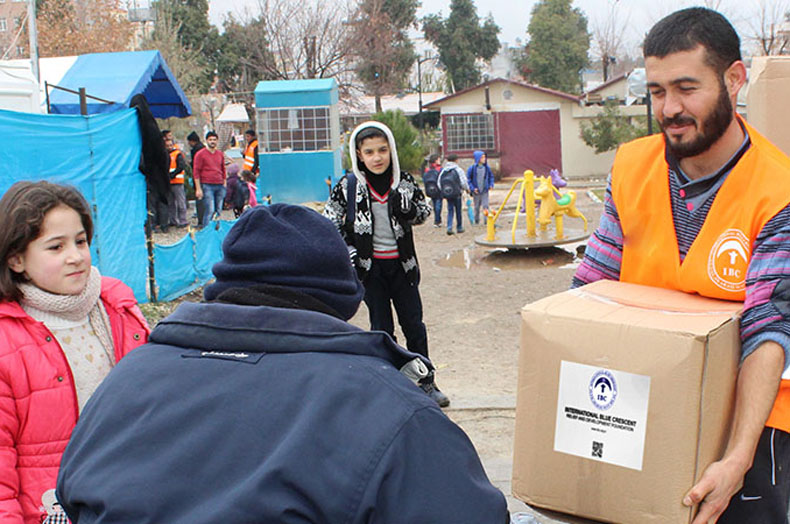
In December 2016, the Jewish Federation of Metropolitan Chicago launched its Aleppo Assistance Fund with an initial grant of $25,000. Coupled with support from 268 generous donors, our community has provided a total of $118,892 in aid thus far to assist victims of the ongoing humanitarian crisis in Syria.
The Fund has provided relief to Syrians through support of the Jewish Coalition for Syrian Disaster Relief, Ziv Medical Center in Tsfat, Galilee Medical Center in Nahariya, and IsraAID.
These organizations have been at the forefront of relief efforts and meeting needs since the early days of the crisis in Syria.
During the past three years, the Jewish Coalition for Syrian Disaster Relief, a group convened by one of our primary overseas partners, the American Jewish Joint Distribution Committee (JDC)-of which the Jewish Federation of Metropolitan Chicago is a member-has provided $2 million of humanitarian aid to Syrians. The funds are reaching hundreds of thousands of people-especially women and children with severe medical conditions due to abuse, torture, and mutilation. The Israeli medical facilities have served more than 2,000 Syrian patients, most of whom arrive to the hospitals in Israel in critical condition.
“Humanitarian catastrophe transcends distance and religion,” said Steven B. Nasatir, Federation President. “As Jews, it is our responsibility to step up when we see injustice and suffering in the world.”
With total Syrian civilian deaths over the last five years of conflict reportedly totaling some 450,000, including 50,000 children, the latest atrocities in Aleppo-including chemical warfare, according to the UN-write another dreadful lament in the 21 st century dirge of savagery and indifference.
Guided by the Jewish values of repairing the world and welcoming the stranger, the Federation has responded to the crisis through monetary contributions, fostering relationships and providing educational programs with key Chicago Syrian community organizations. Local synagogues have also welcomed Syrian refugee families through HIAS Chicago, a program of Jewish Child & Family Services and a partner with the Jewish United Fund of Metropolitan Chicago in serving our community.
“Our Chicago Federation has always been at the forefront of disaster response,” said Michael H. Zaransky, Federation Chairman. “The funds we’ve been able to send through the Aleppo Assistance Fund, as well as other efforts on the ground at home and abroad, are a testament to the ongoing generosity of this community.”
To contribute to the Aleppo Assistance Fund online, visit https://donate.juf.org/jfaleppo. You may also send a check to the Aleppo Assistance Fund, Jewish Federation of Metropolitan Chicago, 30 S. Wells St., Chicago, IL 60606. As is Federation policy, 100 percent of all funds will be distributed without any administrative cost reimbursement to the Federation.
Other stories
-
Chicago to Israel to Kenya
A family’s story of living Jewishly on three continents Michelle Cohen World May 28, 2021 Avital, Tzofia, and Netanel Kaszovitz outside their home in Nairobi on Yom HaAtzmaut. When Avital Kaszovitz prepared to be a Modern Orthodox shlicha (emissary) to the Jewish community in Ke
Read more -
New exhibit spotlights the experience of ‘Shanghai Jews’
Explore a new Illinois Holocaust Museum and Education Center exhibit
Read more -
Europe’s brave new teachers of the Holocaust
Teaching the Holocaust in the modern era has its difficulties and rewards.
Read more