Reps. Dold, Quigley and ‘Crain’s’ columnist discuss top policy issues with JUF’s Government Affairs Committee
MATTHEW LUSTBADER
Reps. Bob Dold and Mike Quigley, along with Crain’s Chicago Business columnist Greg Hinz, shared their insights on the legislative outlook for 2016 with JUF’s Government Affairs Committee on April 4 and discussed several of JUF’s federal domestic policy priorities.
Noting the continued gridlock in Washington, Quigley offered a bit of optimism.
“There is still a group of us, both Democrats and Republicans, who do not shy away from compromise, but rather see it as our responsibility to come together and get things done,” he said.
As a member of the House Appropriations Committee, Quigley stressed the importance of spending tax dollars on programs that do the most to improve our community, especially in an era of federal sequestration and state-level funding uncertainties.
Dold echoed a similar sentiment and highlighted some important legislative accomplishments over the past year, such as the reform of the Medicare reimbursement system, known as the “doc fix,” the reauthorization of the Elementary and Secondary Education Act, the permanent extension of the IRA charitable rollover, and the reauthorization of the Older Americans Act, which passed the House just a few weeks ago.
Both representatives expressed gratitude for the work that JUF and its affiliated agencies do in the community.
“We can count on JUF/Federation and its agencies to put federal resources to good use by serving and creating opportunities for the most vulnerable members of our community,” Dold said.
Hinz voiced his appreciation for Dold and Quigley’s willingness to make compromises and work in a bipartisan manner on important pieces of legislation. He also offered insights into the 2016 presidential and congressional elections, as well as the latest news on the budget impasse in Springfield.
“This meeting was a great opportunity for our agency executives and community leaders to hear from, and be heard by, members of our Illinois Congressional delegation and local political experts regarding the federal policy outlook in 2016 and what it means for the issues we care about,” said Government Affairs Committee Chair David Golder. “This ongoing, bipartisan dialogue also ensures that our priorities remain at the top of our delegation’s to-do list.”
Other stories
-
Meet Andrew S. Hochberg, 2021 Julius Rosenwald Memorial Award recipient
Celebrate Andy Hochberg at the virtual Annual Meeting on Sept. 14
Read more -
Two local teens win national recognition
Recipients of the annual Diller Teen Tikkun Olam Awards
Read more -

Celebrating six young award winners cultivating the community
Introducing young adult award winners
Read more
Seventeen Jewish teens from 13 schools spent their spring break writing, filming, acting in and editing an anti-bullying video through Springboard , a new initiative to increase the number of Chicagoland teens engaged in Jewish life.
At JCC Camp Chi in Lake Delton, Wisc., participants in StudioChi learned about the filmmaking process, Jewish values and social media under the guidance of filmmaker Kobi Swissa. The group decided to focus their project on cyber-bullying, drawing on the Jewish values of kavod (respect) and chesed (kindness).
Watch their film, “Be Kind. Be Respectful. Be Human,” below.
Springboard Chicago is made possible by generous grants from the Jim Joseph Foundation, the Jewish United Fund of Metropolitan Chicago, the Crown Family, and an anonymous donor. Those interested in offering a Springboard school break program next year should email [email protected] to receive a copy of the request for proposals. Letters of intent for all interested program providers are due by 5 p.m. on Wednesday, April 13.
Other stories
-
Meet Andrew S. Hochberg, 2021 Julius Rosenwald Memorial Award recipient
Celebrate Andy Hochberg at the virtual Annual Meeting on Sept. 14
Read more -
Two local teens win national recognition
Recipients of the annual Diller Teen Tikkun Olam Awards
Read more -
Celebrating six young award winners cultivating the community
Introducing young adult award winners
Read more
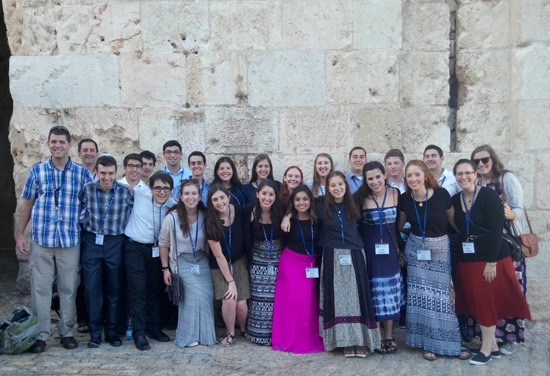
Students in Write On for Israel Cohort 11 on their Israel mission.
Twenty high school seniors from across the Chicago area graduated from Write On for Israel on Tuesday, April 5.
In a gala ceremony attended by parents, teachers and other members of the community, the teens of Cohort 11 celebrated their completion of the two-year fellowship and shared insights about the skills and knowledge they will take to campus next year.
“We didn’t learn some fantasy about Israel,” said Matthew Rivlin, who will graduate from Deerfield High School later this spring. “We learned reality. A lot of people will not agree with us, but we have a support system within our cohort and with the people at JUF. We will be able to take on the challenge in the next four years and beyond.”
Also at the ceremony, Write On alumnus Daniel Hochberg was honored with the White Rose Award in recognition of his courage of conviction and leadership in Israel advocacy at Boston University. The White Rose Award is supported by the Dr. Herbert and Shari Rosen Foundation.
Write On for Israel is now accepting applications for its next cohort from Chicago-area Jewish teens who are completing their sophomore year of high school. Get more information and apply here by Friday, May 6.
Other stories
-
Meet Andrew S. Hochberg, 2021 Julius Rosenwald Memorial Award recipient
Celebrate Andy Hochberg at the virtual Annual Meeting on Sept. 14
Read more -
Two local teens win national recognition
Recipients of the annual Diller Teen Tikkun Olam Awards
Read more -
Celebrating six young award winners cultivating the community
Introducing young adult award winners
Read more
Claudine Guralnick, Buddy Schreiber to receive Jewish education awards at CFJE symposium
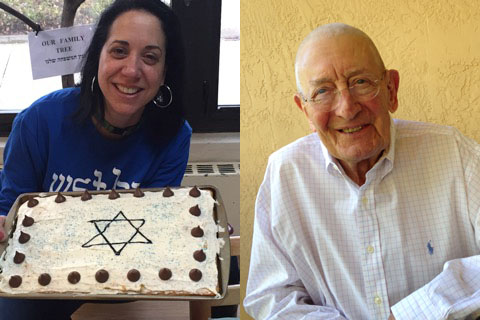
Claudine Guralnick (left) and Buddy Schreiber (right) will be honored at the CFJE symposium May 10.
Claudine Guralnick, an educator at West Suburban Temple Har Zion in River Forest, has been chosen as the second annual recipient of the Sue Pinsky Award for Excellence in Jewish Education, administered by JUF’s Community Foundation for Jewish Education (CFJE).
The Pinsky Award, established last year, is an annual award given by CFJE to a Chicago area early childhood or congregational school teacher.
Members of the WSTHZ community describe Guralnick as “understanding, perceptive, patient, and fun… Her support [for children and families] is unwavering, and her engagement with the children is constant and active.”
An Oak Park resident, Guralnick currently teaches two year olds and has been working at the Temple’s preschool for 17 years.
The Pinsky Award was established by her family in honor of Sue Pinsky, a long-time Jewish educator who was instrumental in the founding of the North Suburban JCC. In her 50 years of being a Jewish educator, it is estimated that Sue worked with over 5,000 children in our community. Sue’s son, Mark Pinsky, and his wife, Lisa, generously established an endowment fund in Sue’s honor to ensure the award in perpetuity through JUF’s Agency Endowment Program.
“My hope is that this award will be a way to recognize dynamic Jewish teachers who serve as an inspiration for the next generation,” says Sue Pinsky, of Highland Park. “It’s those small tastes of Judaism in preschool, in camp, and in congregational programs – those little sparks that come out of an innovative teacher saying something to a child – these are the things that can turn into a lifelong love of learning and Judaism.”
The 2016 Pinsky Award will be officially presented to Guralnick at CFJE’s upcoming symposium on May 10.
In addition, Buddy Schreiber, a teacher at Am Shalom in Glencoe, will be awarded CFJE’s first annual CFJE-Grinspoon Foundation Award for Excellence in Jewish Congregational Education at the May 10 event.
While this is Chicago’s first year to celebrate congregational educators through this prize, the Grinspoon Awards (formerly Grinspoon-Steinhardt Awards) have recognized over 700 outstanding educators in the U.S. and Canada in the past 15 years. Today the award celebrates successful innovation in Jewish education.
Chicago’s inaugural recipient, Buddy, has been teaching confirmation (10th grade) for over thirty years.
As his supervisor, Rabbi Phyllis Sommer, told the selection committee, “I’m constantly impressed by the quiet way that Buddy impacts the students with whom he works. His determined presence and desire to bring them a high level discussion about higher level ideas is not lost on any of his students.”
Both awards will be presented at CFJE’s upcoming symposium, Thinking Together: Communal Conversations about Jewish Congregational and Early Childhood Education in Chicago , which will take place from 9 a.m. – 2 p.m. on Tuesday, May 10 at North Shore Congregation Israel in Glencoe.
For more information or to register, visit http://www.cfje.org/cfje/jcece.aspx .
Other stories
-
Meet Andrew S. Hochberg, 2021 Julius Rosenwald Memorial Award recipient
Celebrate Andy Hochberg at the virtual Annual Meeting on Sept. 14
Read more -
Two local teens win national recognition
Recipients of the annual Diller Teen Tikkun Olam Awards
Read more -
Celebrating six young award winners cultivating the community
Introducing young adult award winners
Read more
JTA – When Jews visit the baseball Hall of Fame in Cooperstown, New York, they can learn about the two most celebrated members of the tribe who have been inducted into the hallowed museum: Hank “The Hebrew Hammer” Greenberg and Sandy Koufax.
Now they’ll have the chance to find out about the dozens of other Jews who played in the major leagues or made contributions to the game.
Thanks to the effort of a dedicated memorabilia collector, clearly taking Theodor Herzl’s legendary words to heart — “If you will it, it is no dream” — a Jewish baseball museum is, at last, a reality.
Well, make that a virtual reality.
An extensive new website, The Jewish Baseball Museum , is a veritable Jewish baseball nerd’s dream. Set to launch Monday, the site is complete with biographies of nearly all the Jews who made it to the big leagues. There are interviews with former players and prominent baseball-industry types, as well as a timeline of Jewish baseball stories that dates to the 1860s.
The bat one-time MVP Al Rosen used in the 1955 All-Star Game is among the treasures found in the Jeff Aeder collection. (Courtesy of Jeff Aeder)
The site could be the precursor to an actual Jewish baseball museum in Chicago, according to its creator, Jeff Aeder, a Chicago-based real estate investor and Cubs fanatic.
The Jewish Baseball Museum is a passion project for Aeder, 54, who says he has amassed one of the largest collections of Jewish baseball memorabilia in the country. His collection, which is showcased on the site, comprises some 2,000 objects — among them are a Ron Blomberg bat with a Star of David on the knob and a letter written by Greenberg to a friend during World War II — and approximately 2,500 pre-1990 baseball cards of Jewish players.
Aeder says the website is an opportunity to introduce the stories of older Jewish ballplayers to younger generations.
“Of all the [Jewish] ballplayers who’ve played in the major leagues, everybody always says Koufax and Hank Greenberg,” he told JTA. “But when you learn and read about people like Jimmie Reese [born James Herman Solomon], Al Rosen, Sy Rosenthal, Moe Berg, there are just so many people. And they have unbelievable stories.”
Take Lipman Pike, who in 1871 became the first Jew to play for the majors – and earned a salary of $20 a week.
The two other Jews in the Hall of Fame — early Pirates owner Barney Dreyfuss and Lou Boudreau, who was raised Catholic and never identified as Jewish — are not featured on the site.
Aeder — who with his wife, Jennifer Levine, were named Chicagoans of the Year in 2013 for opening the Wolcott School, a high school for kids with learning challenges — will gauge the reaction to the website before moving ahead with plans for the physical museum. He hopes it will open as early as 2017 in his native Lakeview neighborhood on the city’s North Side.
Aeder said his collection would form the core of the museum’s permanent exhibit.
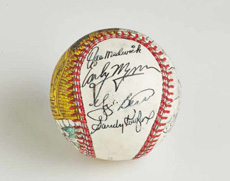
This custom baseball signed by Sandy Koufax and other Hall of Famers, including Yogi Berra, is another prized possession in the Jeff Aeder collection. (Courtesy of Jeff Aeder)
For now, the site lives up to its title as an “online museum.” Viewers can zoom in for closeups of Aeder’s collectibles and scroll through dozens of videos with footage of classic Jewish baseball moments, from Koufax’s World Series wins to Shawn Green’s four home-run game. Stories and interviews by well-known baseball writers populate the site’s many other sections.
Perhaps surprisingly, Aeder, who says he has a “fairly obsessive personality,” hasn’t spent decades amassing his huge collection. Rather it has taken shape only the past few years, during which Aeder attended auctions, scoured eBay and sent personal letters to owners looking to sell.
Aeder is no stranger to having a successful “hobby” — he’s also the founding owner of Milt’s Barbecue for the Perplexed, a popular kosher barbecue joint near Wrigley Field that serves up old-fashioned ribs and sides and gives its profits to worthy causes. The restaurant has earned the respect of Cubs fans — Jews and non-Jews alike — as well as last year’s Cy Young Award winner, Jake Arrieta .
Aeder’s motto for his labor-of-love ventures sounds like something the late Yogi Berra might say: “If you’re going to do something, do it first class,” he said. “Otherwise don’t do it.”
So here’s hoping another sage’s words will come true. In this case, “the voice” from “Field of Dreams”: “If you build it, they will come.”
Other stories
-
Meet Andrew S. Hochberg, 2021 Julius Rosenwald Memorial Award recipient
Celebrate Andy Hochberg at the virtual Annual Meeting on Sept. 14
Read more -
Two local teens win national recognition
Recipients of the annual Diller Teen Tikkun Olam Awards
Read more -
Celebrating six young award winners cultivating the community
Introducing young adult award winners
Read more
On March 31, over 70 women from across Chicago gathered to discuss pressing issues impacting the city. Convened by Fierce Women of Faith, an interfaith coalition of women committed to increasing peace in our communities, the program included testimonies from mothers who had lost children to gun violence, and discussions on issues ranging from education, health care, and violence prevention.
In a closing call to action, JCRC Vice Chair Rabbi Shoshanah Conover called upon participants to commit to “lifting up the voices of those who have been impacted by violence and work together to create the change we so need in our city.”
Participants committed to continuing the conversation on May 10 as part of the Chicago Community Trust’s On the Table Program .
Other stories
-
Meet Andrew S. Hochberg, 2021 Julius Rosenwald Memorial Award recipient
Celebrate Andy Hochberg at the virtual Annual Meeting on Sept. 14
Read more -
Two local teens win national recognition
Recipients of the annual Diller Teen Tikkun Olam Awards
Read more -
Celebrating six young award winners cultivating the community
Introducing young adult award winners
Read more
On March 21, the House of Representatives passed one of JUF’s longstanding federal advocacy priorities, the reauthorization of the Older Americans Act (OAA). An earlier version of the bill passed the Senate in July 2015, and both versions of the legislation include a provision that would expand supportive services for Holocaust survivors.
This legislation is now pending a final vote in the Senate, which could happen as early as next week.
The news comes on the heels of JUF’s Government Affairs Committee’s Washington D.C. Agency Advocacy Mission , during which nearly 20 agency professionals and community leaders met with members of the Illinois delegation and advocated for this legislation.
“Our agency professionals’ and community leaders’ advocacy for vital federal dollars proved to be timely and valuable,” said David Golder, chair of the Government Affairs Committee. “We are very optimistic that we will see final passage this year.”
Mark Weiner, CEO of CJE SeniorLife, said, “We are grateful for the House of Representative’s work on advancing this important piece of legislation. OAA funds are essential for us as we continue to provide services, such as adult day care, congregate and home-delivered meals, elder abuse prevention, family caregiver support, mental and behavioral health counseling and referrals, and transportation to vulnerable older adults living in our communities.”
JUF’s Washington, D.C. Office will continue to monitor this legislation as it moves back to the Senate for a final vote.
Members of the Illinois delegation have long supported this program, including Rep. Jan Schakowsky .
Other stories
-
Meet Andrew S. Hochberg, 2021 Julius Rosenwald Memorial Award recipient
Celebrate Andy Hochberg at the virtual Annual Meeting on Sept. 14
Read more -
Two local teens win national recognition
Recipients of the annual Diller Teen Tikkun Olam Awards
Read more -
Celebrating six young award winners cultivating the community
Introducing young adult award winners
Read more
More than 200,000 pounds of food will be packed Sunday, April 10, as Maot Chitim-the Jewish charity that fights hunger-prepares to feed 15,000 people for the eight days of Passover, which starts the evening of Friday, April 22.
Boxes of food will be delivered a week later to more than 5,000 individual homes as well as to college Hillels, The Ark, Operation Ezra, food pantries, shelters, and other funds. Each box will contain kosher chicken, matzoh, onions, celery, carrots, wine, matzoh meal, potato starch, soup mix, cake, tea, and candles-all the necessities for preparing food for the Passover Seder and for the eight
days following.
“We believe we are delivering Jewish continuity,” says Joellyn Oliff, Executive Director of Maot Chitim, headquartered in Lincolnwood. “Because of us, many needy community members will be able to have a traditional kosher holiday meal.”
The Hebrew words “maot chitim” come from the Torah and refers to the centuries old custom of leaving the corners of one’s field unharvested-so the poor can gather wheat to provides themselves with sustenance. Maot Chitim in Chicago is more than 100 years old. Originally, Rabbis set up tables in front of their synagogues and gave money to those in need so they could provide themselves with meals for Passover.
“Today, we buy 45,000 pounds of kosher chicken, 11,000 dozen eggs, and everything else with money that we get individual donations throughout the city,” Oliff says.
“We are delighted to say that we have second and third generations of families who continue to deliver packages to the needy,” Oliff adds. “This is an opportunity for people to actually see the persons they are helping.”
To volunteer or donate, call (847) 674-3224 or go to www.maotchitim.org .
Maot Chitim is a special grantee of the Jewish United Fund of Metropolitan Chicago.
Other stories
-
Meet Andrew S. Hochberg, 2021 Julius Rosenwald Memorial Award recipient
Celebrate Andy Hochberg at the virtual Annual Meeting on Sept. 14
Read more -
Two local teens win national recognition
Recipients of the annual Diller Teen Tikkun Olam Awards
Read more -
Celebrating six young award winners cultivating the community
Introducing young adult award winners
Read more
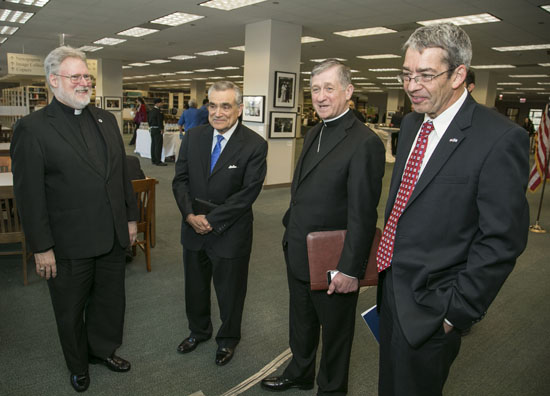
From left: Rev. Thomas Baima, JUF President Steven B. Nasatir, Archbishop Blase Cupich and Consul General of Israel to the Midwest Roey Gilad at the opening of the exhibit, Tuesday, March 29, 2016. (Photo by DePaul University/Jamie Moncrief)
A photographic exploration of five decades of papal visits to Israel will be on display at DePaul University this spring in a special exhibition co-sponsored by DePaul and the Consul General of Israel to the Midwest.
The exhibit, “Building Bridges of Faith,” opened March 29 on the second floor of DePaul’s John T. Richardson Library, 2350 N. Kenmore Ave. Opening ceremonies featured remarks by Archbishop Blase Cupich, DePaul President the Rev. Dennis H. Holtschneider and JUF President Steven Nasatir. The exhibit continues through June 10.
“In a world ridden with conflict and strife, Jewish-Catholic relations stand as a model for authentic human reconciliation,” Nasatir said. “This exhibit photographs and portrays that reconciliation over the past half-century.”
The 44 historic images displayed depict stirring scenes as well as quiet, intimate moments during visits by Pope Paul VI, Pope Saint John Paul II, Pope Emeritus Benedict XVI and Pope Francis.
There also will be a related panel discussion, “The Catholic Church, the Jewish People and the Jewish State,” at 5:30 p.m. Monday, April 18, in the library. That will feature the Rev. John T. Pawlikowski, OSM, professor of social ethics and director of the Catholic-Jewish Studies Program at the Catholic Theological Union; Rabbi Yehiel Poupko, the Rabbinic Scholar at JUF; and Consul General Roey Gilad. Thomas O’Brien, associate professor and director of the Center for Religion, Culture and Community at DePaul, will moderate.
For additional information, contact Alice Farrell at [email protected] or 312-362-8822.
Other stories
-
Meet Andrew S. Hochberg, 2021 Julius Rosenwald Memorial Award recipient
Celebrate Andy Hochberg at the virtual Annual Meeting on Sept. 14
Read more -
Two local teens win national recognition
Recipients of the annual Diller Teen Tikkun Olam Awards
Read more -
Celebrating six young award winners cultivating the community
Introducing young adult award winners
Read more

A volunteer organization called Repair the World will partner with the JUF-supported HIAS to direct #SupportforRefugees, an effort to inspire support for newly resettled refugees. Thousands of young adults are expected to participate during the two-week program, from April 15-30.
Repair the World coordinates volunteer projects with organizations that provide access to food, education, housing, job training, or after-school care. Its ongoing “Turn the Tables” initiative provides materials that facilitate Jewish dialogue on issues- including the refugee crisis- during a Seder or Shabbat dinner.
“We are a refugee people. [Soon,] we will gather to tell the story of our people’s escape from persecution and our wandering without a home. The parallels to today’s global refugee crisis are inescapable,” noted Rabbi Jennie Rosenn, vice president for Community Engagement at HIAS . “We hope that the conversations that begin around the table will raise awareness and call today’s emerging Jewish leaders to action.”
JUF/Federation has played an important role in establishing programs and services for refugees in Illinois, including serving as a founding member and administrator of the Illinois Refugee Social Service Consortium since 1975.
More information, including #SupportforRefugees registration and “Turn the Tables” materials, is at werepair.org/passover.
Other stories
-
Meet Andrew S. Hochberg, 2021 Julius Rosenwald Memorial Award recipient
Celebrate Andy Hochberg at the virtual Annual Meeting on Sept. 14
Read more -
Two local teens win national recognition
Recipients of the annual Diller Teen Tikkun Olam Awards
Read more -
Celebrating six young award winners cultivating the community
Introducing young adult award winners
Read more