An “old saw” laments that everyone complains about the weather, but no one does anything about it. The same seems true of political polarization among American Jews.
In fact, there are efforts to promote civility and cooperation in our community. It is just that the countervailing forces are daunting: social media, zero-sum politics, the knee-jerk replacing the contemplative, and the ever-rising stakes for our community, country, and Jewish world.
This internal Jewish acrimony did not germinate within us. For most of American history, Jewish politics were largely immune to American partisanship. Today, we too are infected by the polarization disease.
It is a super-spreader among our organizations and, painfully, our families.
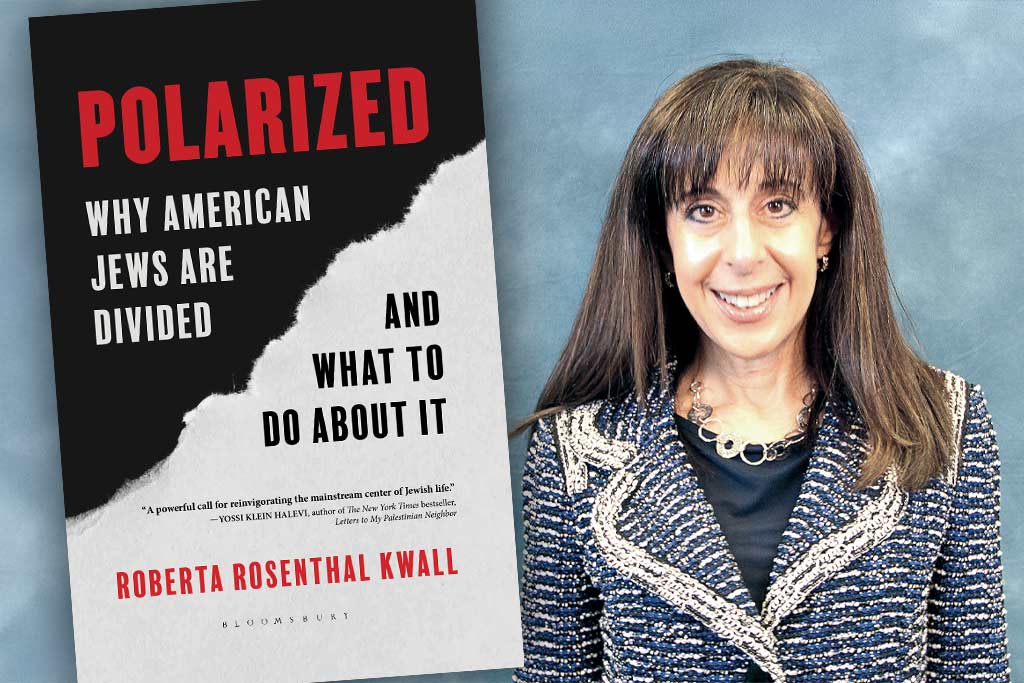
In her persuasive new book, Polarized: Why American Jews Are Polarized And What To Do About It, Roberta Rosenthal Kwall diagnoses these ailments. Her prescription would alleviate several of our symptoms. Likely, many will resist taking the required hard-to-swallow pills.
A DePaul University law professor, she has published on legal and Jewish topics. Her latest is an all-too-rare combination of a multi-disciplinary academic approach leavened with insights gleaned from a lifetime of active Jewish communal experience.
Kwall details the divisive national American issues, and how they have seeped into our community. She pulls no punches on the poisonous politics of the political fringes. Yet, because Jews are, by and large, ensconced in the institutions of the left — legacy media, academics, big philanthropy, cultural arts, professional associations, the Democratic Party— it is there where the growing hostility has been most disorienting, and where her analysis focuses.
She bemoans the apparent shrinking of the American and Jewish political middle.
Surely the decibel levels of left- and right-fringe voices, as well as their worrying electoral successes, reinforce the impression of a shrinking middle. Frighteningly, the fringes are no longer so fringe.
The impact of the middle’s impotency cannot be underestimated. Amid far-right and far-left vigor, futility is a moderate’s understandable sentiment.
Kwall implores our Jewish community to set a healthy, replicable example of how America can return to civility and moderation. She outlines an eight-point platform to (re)develop a Jewish centrist consensus.
Six of the points involve Israel; the other two, antisemitism.
Those eight points merit every Jew’s (and non-Jew’s) support, wherever they are on the political spectrum. Still, as Kwall realizes, there are implementation challenges with this game plan.
It relies upon a self-defined centrist platform converting many American Jews of the left and the right to a new political holy grail, something they are exhibiting little inclination to.
About one third of American Jews self-define as moderate, the other two thirds are solidly, even proudly, in one of the other camps.
For them, that political orientation is not trivial. It is a profound part of their self-definition and deeply linked to conceptions of what Judaism teaches. A plea to join the middle is no small hurdle, especially in these days of intersectional and highly partisan politics. (Kwall’s platform is unlikely to attract the 30% of American Jews who think Israel committed a genocide in Gaza or the 63% who don’t embrace the label “Zionist.”)
Most challenging is that building a Jewish consensus on a platform of just Israel and antisemitism bypasses what American Jewish voters — even after October 7, 2023 — say matters most: healthcare, the economy, inflation, the future of democracy (including church-state separation), gun control, reproductive rights, race relations, and crime. Less than 10% rank Israel as the issue determining their presidential vote.
Kwall, appropriately alarmed by the multiple troubling trend lines, is undeterred by these and other obstacles. Her book is not merely another kvetch about the Jewish political predicament. She’s the meteorologist looking to change the weather.
Her plan merits a wide audience. And action. Our community would be wise to heed her pleas if we want to weather the current — and still gathering — storm.
Jay Tcath is JUF’s Executive Vice President. He and Roberta Rosenthal Kwall know one another, and Tcath is acknowledged in the book’s credits.
Interview with the author
Q. What inspired you to write the book?
A. I started thinking about this book around 2021. After COVID, the world had changed. In 2020, with the murder of George Floyd, academia seemingly changed. We were getting tons of educational programming—indoctrination—around DEI (Diversity, Equity, and Inclusion). And yet it was silent when it came to anything involving antisemitism. Even though it was prior to October 7, there was still plenty to talk about.
How did October 7 change the trajectory of the book?
I envisioned discussing Israel, but after October 7, the book largely focused on Israel because that has become the most visible issue.
Is polarization unique to our people?
American Jewish polarization mirrors the larger country in certain ways, but it also has its unique qualities: First, there is this political/religious stew and all polarization is driven by a combination of religion and politics. Second, American Jews skew 75% politically liberal and religiously liberal, which is different from other groups…October 7 has forced a lot of religiously and politically liberal Jews to say ‘Where am I?’
It’s a hard moment for Jews and I think we have a lot of work to do as a community. We have to get our act together.
You write in the book about that religiously liberal Jewish circles stress the importance of a “big tent” in our community, but you say there also need to be some boundaries around the tent. What are they?
What would collapse the big tent is a completely open tent. I did draw the line at the anti-Zionists. The boundaries can’t be porous. Those who truly do not believe that Israel has the right to exist as a democratic Jewish state I think of as synonymous with anti-Zionism. I don’t think they can be part of the tent because they just want to tear the tent down.
How does the Jewish tradition help to guide us at this moment of polarization?
We have to keep some space for someone who may disagree with you. There is an art to productive disagreement and the Talmud is filled with narratives of how we can do that.
When does disagreement turn destructive?
It’s not just the ability to express different opinions, but it’s the ability to refrain from vilifying those with whom you disagree. It’s one thing to have a different point of view, but all too often the conversation on both sides turns into vilifying the other side, making them feel like they’re immoral or less than.
What is the prescription for our community to meet more in the middle?
It’s both a top down and bottom up approach: The organized Jewish world has to take the lead on this, and that means we have to be in constant dialogue with one another. In addition, it has to be from the bottom up because those who are going to be in charge of crafting the educational narrative for the next generation have to be the ones that implement what that looks like for their constituents.
We really have to concentrate on the group that are low hanging fruit. These are the people who I feel we need to keep in the tent and broaden their commitment.
We also need more cross discussion between Orthodox and religiously liberal Jews. We have to see the importance of this cross fertilization because we’re all one.
Are you hopeful for our people?
Yes, being Jewish means being hopeful. Being Jewish means having faith, and having faith means being hopeful.
~Cindy Sher