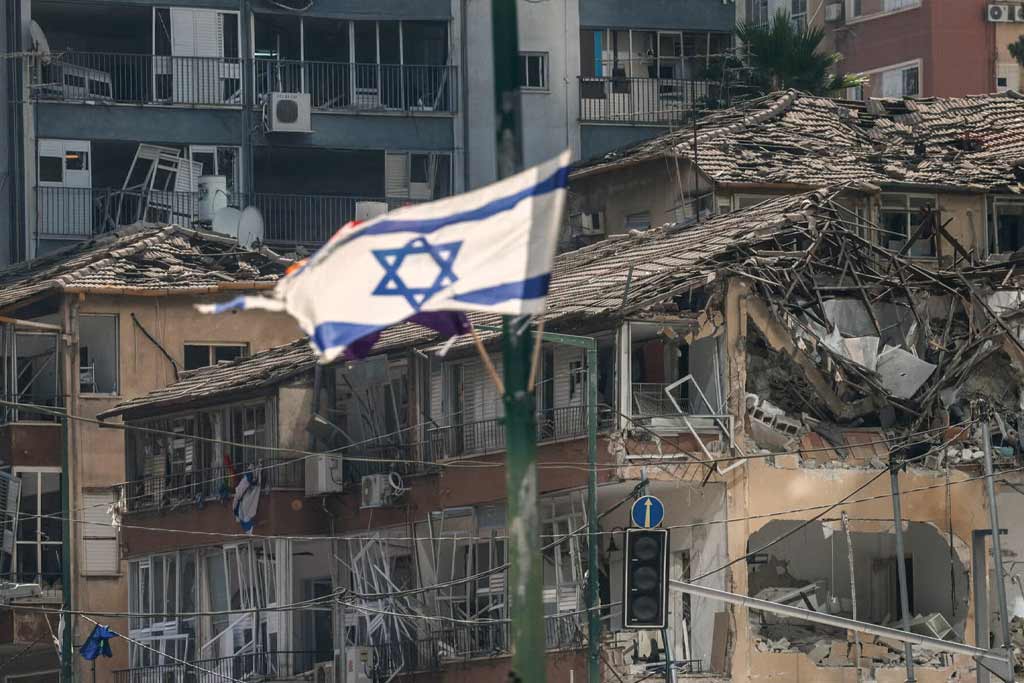
The Israeli flag flutters in front of a destroyed building at the site of an Iranian missile attack in Ramat Gan in central Israel near Tel Aviv, on June 19, 2025. (Photo credit: Ahmad Gharabli/AFP via Getty Images)
At the time of this writing, the ceasefire between the U.S. and Iran is still holding, tenuously. While Israel is not a party to this ceasefire, it agreed to its terms as requested (or imposed) by the U.S. to exhaust all possibilities for a peaceful resolution to the war with Iran—before resorting to another round of strikes. But, while Israel did not sign a ceasefire nor determine its terms, no country will be more affected by the outcome of the crisis than Israel, and possibly not in a positive way.
The danger posed by Iran is multi-faceted:
- Iran has publicly acknowledged nuclear aspirations, the target of which is Israel. Its stockpile of almost 900 pounds of enriched uranium would enable it to produce multiple nuclear warheads, if enriched to weapons grade. Its secret centrifuge labs, only some of which were destroyed by the U.S. and Israel, could enrich that uranium and more. Iran’s ballistic missile program allows the regime to project its nuclear power far beyond its borders—putting Israel, the Gulf States (including Israel’s allies in the region), and Europe within range. The remaining stockpile of missiles is huge, even after the war with the U.S. and Israel, and Iran’s missile production facilities are already being rehabilitated.
- Iran is a state sponsor of terrorist proxies, including Hamas, Hezbollah, and Yemen’s Houthis and militias in Iraq. Its proxies have already carried out attacks in Europe, Latin America, and Eastern Asia.
- With its blockade over the Strait of Hormuz, Iran impacts world trade and commerce, as well as the price of oil, driving energy prices up.
However, the dangers posed by Iran are perceived differently by different nations. For the U.S., the closure of the Strait and its economic effects are of prime importance, with the administration believing that a deal to reopen the Strait is within reach, to be followed by agreements on delaying (but not eliminating) uranium enrichment.
The U.S. would like the uranium to be taken out of Iran’s hands, but it has not insisted on disposing of Iran’s stockpile of ICBMs or disconnecting Iran from its proxies.
For Israel, the top priority is Iran’s nuclear program and the “weapons group” from low-level uranium to enrichment to missiles. Israel believes that if Iran keeps the enriched uranium or even transfers it (to Russia, for example), eventually that uranium will be enriched to military grade. Coupled with thousands of missiles that Iran has and will produce, its nuclear aspirations will not disappear once a Hormuz deal is reached; on the contrary—a nuclear Iran will have the invincibility to deny the U.S. and Israel the ability to halt its agenda.
Israel’s challenge? It is not a party to the negotiations with Iran. If Israel had a say, the demands would include transfer of the uranium to a Western power, and the destruction of Iran’s missile stockpile and production facilities. Israel must therefore take a back seat to American negotiators who, while listening to our positions, are not bound by them—and view the Iranian menace differently.
If a deal is made that does not resolve the nuclear issue (as well as the proxy question), many in Israel will feel that the next Iran war is not a question of “if” but “when.” Possibly against a nuclear Iran.
One exit from this impasse involves a change of regime in Iran. If a Western-facing leadership (though not a puppet regime) would renounce Iran’s nuclear aspirations and export of terror, then the nuclear problem could be resolved, and Iran would cease to be a threat to its neighbors and to Israel.
But how to achieve regime change is also a matter of disagreement. Do you choke Iran financially and energy-wise, in the hope that the masses will take to the streets? Or would that backfire and turn Iran’s people against the West?
Three rounds of bombings in Iran have not achieved the desired regime change—will a deal on Hormuz produce a different result? Will financial warfare achieve that result? While the decision is being made far from Jerusalem, Israelis are nervously following the news.
For the first time, decisions about a future military campaign, in which Israel would be attacked, are not made locally. All we can do is prepare for any eventuality—and hope for a positive outcome.
Ofer Bavly is a JUF Vice President and the Director General of the JUF Israel Office.