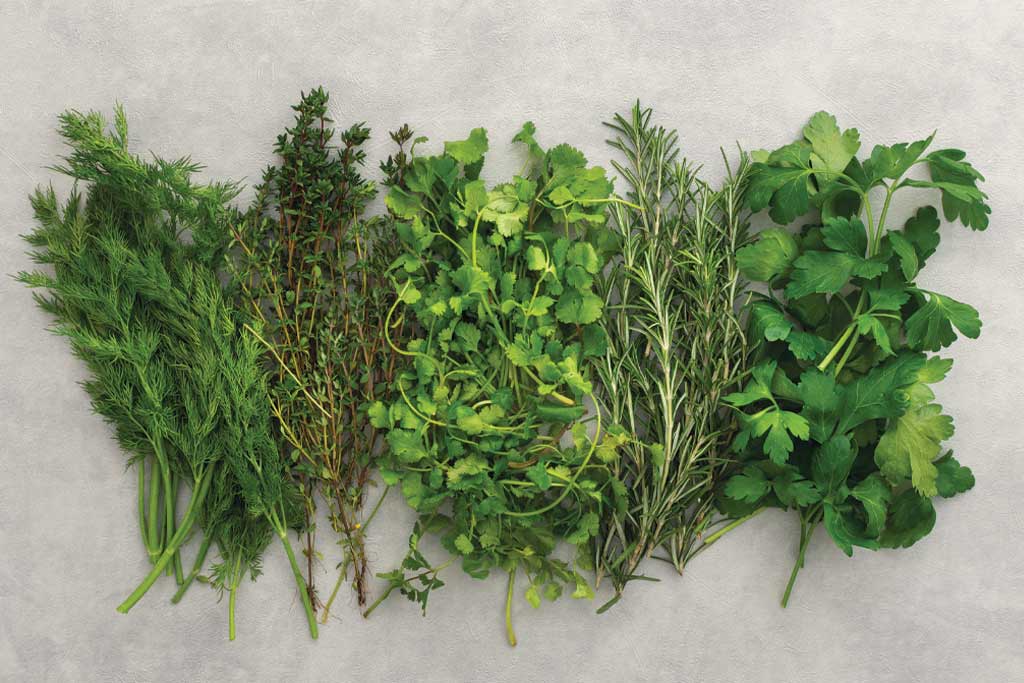
The soul of my kitchen is in the garden. When I need inspiration for creating a recipe, or making dinner, I look to my favorite herbs.
Herbs are the leaves and stems of plants, while spices are the bark, seeds, and roots. Herbs are often used as garnishes right before serving a dish and add vibrant flavor, freshness, and aroma to recipes without added salt. One of the fastest, most economical ways to boost the flavor of food is to add fresh herbs.
This year, spring started slowly, giving us herbs with tiny, light green leaves with delicate, nuanced flavors. Summer usually comes in with BANG of darker army-green leaves that are full of flavor and perfume. By the time summer winds down, the leaves are still giving off flavor, and so are the stems. Those stems are the backbone of fall and winter stocks, sauces, and long-cooked dishes.
The garden provides pop and personality to food. Our short Midwest growing season means we need to grab what we can of these tiny leaves and use them in as many different ways as possible.
I love the classic Simon and Garfunkel quartet of “parsley, sage, rosemary, and thyme.” But I also love basil, chives, tarragon, chervil, and more!
Whether you have an outdoor garden, a pot in a window, or like me, you enjoy a trip to the farmers markets, herbs can give you inspiration for every meal. A fish is just a fish until it comes to life with a fragrant, delicious herb sauce. A simple pasta dish can become exciting depending upon what is growing and when.
Capture the flavors, colors, and inspiration of the season by cooking with herbs.
Tabbouleh
This is one of my favorite hot-weather dishes. Refreshing—and easy to make without heating up the entire house—tabbouleh is a meal by itself or pairs with fish, chicken, beef, or grilled Halloumi cheese.
I like the added touch of cinnamon, but it is not traditional and can be left out.
Serves 4-5
½ cup coarse bulgur
1 pound of tomatoes, diced
1 medium cucumber, peeled and seeded (optional)
1 large shallot, minced
2 teaspoons sea salt
½ pound chopped flat leaf parsley (about 2 cups)
2 tablespoons chopped fresh mint
½ teaspoon freshly cracked black pepper
A good pinch of cinnamon (optional)
Zest and juice of 2 lemons
½ cup best quality EVOO
- Toss tomatoes, cucumber, and shallot with salt and place in a strainer to prevent the salad from becoming soupy.
- Place bulgur in a glass or metal bowl. Bring 1 cup of water to a simmer and pour over bulgur.
- Cover the bowl and allow it to absorb for about 20 minutes. Season with salt to taste.
- Combine tomato mixture, bulgur, parsley, cinnamon, lemon zest and juice, mint, pepper, and EVOO. Toss to combine. Adjust seasoning with salt.
Chill and serve. Leftover tabbouleh can be stored, covered in the fridge for up to 3 days.
Chimichurri
I love uncooked sauces in the summer. Fresh herbs are at their vibrant peak in color and flavor. Traditionally this sauce, from Argentina, is a condiment for steak or chicken, I find it delicious on grilled vegetables, fish, tomatoes, and grilled bread also.
The sauce is traditionally made with parsley and oregano, but I have added cilantro, dill, mint, basil, and whatever I have growing. I also substitute some of the vinegar for fresh lemon or orange juice, especially when serving with grilled fish and veggies.
To avoid the herbs from going from silky to slimy, I recommend chopping the herbs by hand or, even better, grinding them in a mortar and pestle to yield a silky and creamy sauce. A food processor cuts the herbs over and over again, squeezing out the essential oils and water and yielding a greasy and separated sauce.
Yields 2½ cups
1 cup fresh flat leaf parsley
1 cup fresh oregano leaves
2 teaspoons sea salt
½ teaspoon or more red pepper flakes
6 cloves garlic
½ cup red wine vinegar
1 cup best quality EVOO
1 teaspoon freshly ground black pepper
- Pound parsley, oregano, and salt in a mortar and pestle until creamy and smooth (adding the salt here breaks down the leaves). Or chop parsley and oregano by hand until finely chopped.
- Add red pepper flakes and garlic to mortar and pestle and pound until pureed.
- Stir herbs, garlic, red wine vinegar, EVOO, and pepper in a bowl until combined. Adjust seasoning.
- Allow flavors to meld for about 30 minutes at room temperature before serving.
Store leftover sauce, covered, in the fridge for up to 3-5 days.
Falafel
I always have a batch of falafel paste in my freezer. Homemade falafel freezes well and cooks quickly—plus, you control the ingredients. Falafel made with fresh herbs is intensely flavored, aromatic, punchy, and with a beautiful bright green interior. Falafel paste can be frozen for up to 6 months.
Yield: about 30 falafel balls
1pound dried (not canned) chickpeas
½ teaspoon baking soda
1 medium white onion, peeled and coarsely chopped
1 cup mixed herbs: flat leaf parsley, cilantro, dill, and (optional) mint
5 cloves garlic
2 teaspoons sea salt
1 teaspoon black pepper
2 teaspoons cumin
1 teaspoon ground coriander
2 teaspoons baking powder
Oil for frying (I use EVOO for best flavor and nutrition)
- Line a baking sheet with paper towels
- Soak chickpeas, covered in water, with baking soda, overnight in the fridge.
- Drain chickpeas and process, in batches, with onion, parsley, cilantro, garlic, salt, pepper, cumin, and baking powder, until mixture resembles couscous, but not a puree.
- Heat a sauté pan with about 1-inch of oil, over medium heat.
- Scoop about 2 tablespoons of falafel mix into your hands and press into a ball or patty.
- Place in oil and fry until dark brown (about 3 minutes). Gently flip over and continue cooking on the other side. You can fry several falafel at a time.
- Once browned on both sides, transfer to the paper-towel lined sheet.
Reheat at 350°F for a few minutes before serving. Leftover falafel mix can be frozen for up to 3 months.
Classic Pesto
I feel like I wait all winter and a lot of spring to make and devour pesto. For me, pesto just doesn’t taste the same when I am wearing my thick sweaters. For me, basil is the flavor of summer, and the ultimate green sauce of summer is the classic pesto.
Basil needs sunshine, heat, and the wind beating the stems to create texture on the leaves (hydroponic basil leaves are very thin and delicate).
Purchasing premade pesto is just not ever going to happen, so I plant and wait. When I finally have enough basil, I blissfully get my mortar and pestle ready.
The best way to store basil is to fill a vase or measuring cup with water and place your basil in it like fresh-cut flowers. The basil will stay fresh for several weeks at room temperature if you refresh the water.
Yield: about 1 cup
¼ cup pine nuts
3-4 cloves garlic
Coarse sea salt
4 ounces basil (about 4 cups loosely packed leaves)
¾ cup Parmigiano Reggiano
¾ cup Pecorino Romano
¾-1 cup best quality EVOO
- Toast pine nuts in a dry pan, over medium heat, until lightly toasted and golden brown. Watch the pan closely as the pine nuts go from pale to burned in seconds.
- Pound pine nuts and garlic into a paste. Add a few handfuls of basil and a pinch of salt to the mortar. The salt will act as an abrasive and help the process. As each batch of leaves breaks down, add more basil and a pinch of salt.
- Once the mixture has become creamy, add cheeses and drizzle in EVOO until you have an emulsion. Season to taste.
Do not heat the pesto or the flavors will be destroyed. Toss pesto with cooked pasta. Drizzle over grilled vegetables or on beautiful tomatoes.
Pesto can be stored, covered with a light layer of EVOO, in the fridge for up to 3 days, and frozen for up to 3 months.
Lemon-Lavender Pound Cake
This is a great summery cake. The lavender adds just a slight herb note to the bright lemon flavor. Serve with your favorite berries and a dollop of whipped cream.
Serves 8
¾ cup plus 1 tablespoon granulated sugar
2 teaspoons dried lavender or 1 tablespoon fresh lavender
1 heaping tablespoon grated lemon zest
½ cup unsalted butter, room temperature, plus more for pan
1½ cups all-purpose flour
¾ teaspoon sea salt
¾ teaspoon baking powder
¼ teaspoon baking soda
2 teaspoons vanilla extract of vanilla bean paste
2 large eggs, room temperature
½ cup buttermilk
3 tablespoons fresh lemon juice
- In a small bowl, rub sugar with lemon zest and lavender until sugar is sandy textured, aromatic, and yellowed from the zest. Measure 1 tablespoon of lemon-sugar and set aside.
- Generously butter an 8½ x 4½ loaf pan and line with parchment, letting the parchment droop over the long sides of the pan.
- Sift flour, salt, baking powder, and baking soda.
- Cream butter and lemon-sugar until light and fluffy, and there is no grittiness from sugar.
- Add vanilla and eggs, one at a time, taking time to scrape the bowl before adding the next egg.
- Mix buttermilk and lemon juice together. Alternate adding dry and wet ingredients to the butter mixture, beginning and ending with dry ingredients. I always add the last addition of flour and mix it by hand. This reduces the chance of over-mixing.
- Transfer batter to prepared pan and smooth the top.
- Bake in preheated oven for about 50-60 minutes or until a cake tester comes out clean.
Place cake on a cooling rack for 20 minutes before removing the cake from the pan to cool completely.
For the glaze
You could just sprinkle the cake with powdered sugar, but the glaze really cements the lavender flavor, and the cool icing makes each bite lemony.
1 cup powdered sugar, sifted
2 tablespoons milk
Long strips of lemon zest
Reserved lemon-sugar
- Whisk powdered sugar and milk until a thick glaze forms. Drizzle over cooled cake.
- Toss strips of lemon zest with reserved lemon-sugar and arrange over the top of the cake
Lavender Limeade
This refreshing drink is tart and aromatic, with a calming botanical note. Lavender is part of the mint family and has flavor notes like basil, thyme, and oregano.
I grow lavender for culinary purposes and for the beautiful and fragrant flowers that perfume my garden. I plant rows of lavender around my garden, and the fragrance deters mosquitos, moths, and fleas.
For the lavender syrup
2 cups water
2 cups sugar
½ cup fresh lavender
- Bring water, sugar, and lavender to a simmer. Simmer until sugar has dissolved.
- Steep lavender for about 20-30 minutes. Strain out lavender.
You may store syrup, covered in fridge, 1 month.
Mix with 1 cup fresh squeezed lime juice 4 cups water. Garnish with fresh lime slices
Variations: substitute sparkling water for a sparkling lavender soda, or mix lavender syrup
with lime juice and a splash of vodka to make it an “adult” lavender limeade.
Laura Frankel—a noted kosher chef, and cookbook author—serves as Director of Culinary Operations at Tamarisk NorthShore. She is also a product development specialist and has worked as culinary director for a media company.