‘Hostage Square Chicago’ pop up conveys stories of sorrow and survival through art
Cindy Sher
A mile down the road from the Democratic National Convention flurry of activity at the United Center on a balmy August day, Chicago Jewish tattoo artist Noah Elder tranquilly paints a koi fish on a large canvas in an empty lot.
His painting depicts a recreation of the tattoo he inked, on a recent visit to Israel, on Elyse, a survivor of the October 7 attack on her kibbutz near the Gaza border. She selected the tattoo, Elder explained, because koi fish swim against the tide and represent resilience in Japanese culture.
“I was able to permanently ink this message of resilience on her body,” he said. “I didn’t undo the trauma Elyse went through, but this was a way to help her shape that trauma into [a symbol] of perseverance.”
Elder’s recreation was part of a one-day pop up experience on Tuesday, Aug. 20, in a private West Loop lot–called “Hostage Square Chicago”–featuring poignant and provocative art installations tied to October 7, and created by six Israeli and American artists.
The art was juxtaposed by the reality of safety concerns, the event protected by fences, metal detectors, and a fleet of security guards. The exhibition kicked off on a somber note that morning, only hours after the Israeli government announced the recovery of six dead hostages.
The inspiration for the exhibit–organized by the Israeli-American Council (IAC)–emerged when the organization was denied a permit for public assembly outside the United Center during the DNC. That rejection by the City of Chicago, delivered less than a month before the convention, forced IAC to scramble to find an alternative space for Israel supporters and family members of the hostages to gather and to raise awareness of the 109 hostages still being held in Gaza.
“We wanted to have a space for Israel out in the open,” said Aya Shechter, IAC’s Chief Programming Officer and an Israel native. “We wanted to bring our solidarity for Israel to the street.”
That’s when IAC representatives partnered with Chicago Jewish philanthropist Jeff Aeder who had dreamt up the concept for the event and was able to rent the private lot from a friend.
JUF partnered with the organizers to ideate and enhance the installations’ visibility, and also to help ensure the safety of the artists, hostage families, and exhibit itself.
At a time when pro-Israel voices are often drowned out by louder anti-Israel voices, Aeder said, the day served to express the stories of October 7 through the healing power of art-rather than through shouting matches.
“Art is a great way to portray your feelings in a non-confrontational way,” he said. “This is very Jewish–to be creative, to think alternatively–and not in a vengeful, screaming at each other way.”
In addition to Elder’s work, the installations included:
*Israeli artist Avi Tal’s graffiti mural depicting a boy in shackles clutching a teddy bear, emblematic of the youngest victims kidnapped by Hamas.
*Tel Aviv artist Neil Salti’s replica of a tree burnt and dripping with bloody tears to represent “the tree that saw too much,” a tree Salti noticed when visiting Nova music festival in the aftermath of the massacre, where 20 of his friends were killed or taken by Hamas.
*Portraits sketched by Miami artist Erik Rutzick (who goes by the artistic name Shmutz) in real time-five to 15 minutes each–of all the remaining hostages to convey the urgency of bringing them home.
*A 22-ft. replica of Naama Levy’s pair of blood-soaked sweatpants–created by L.A.-based Israeli artist Tomer Peretz–a searing image that went viral when Levy was kidnapped by Hamas on October 7.
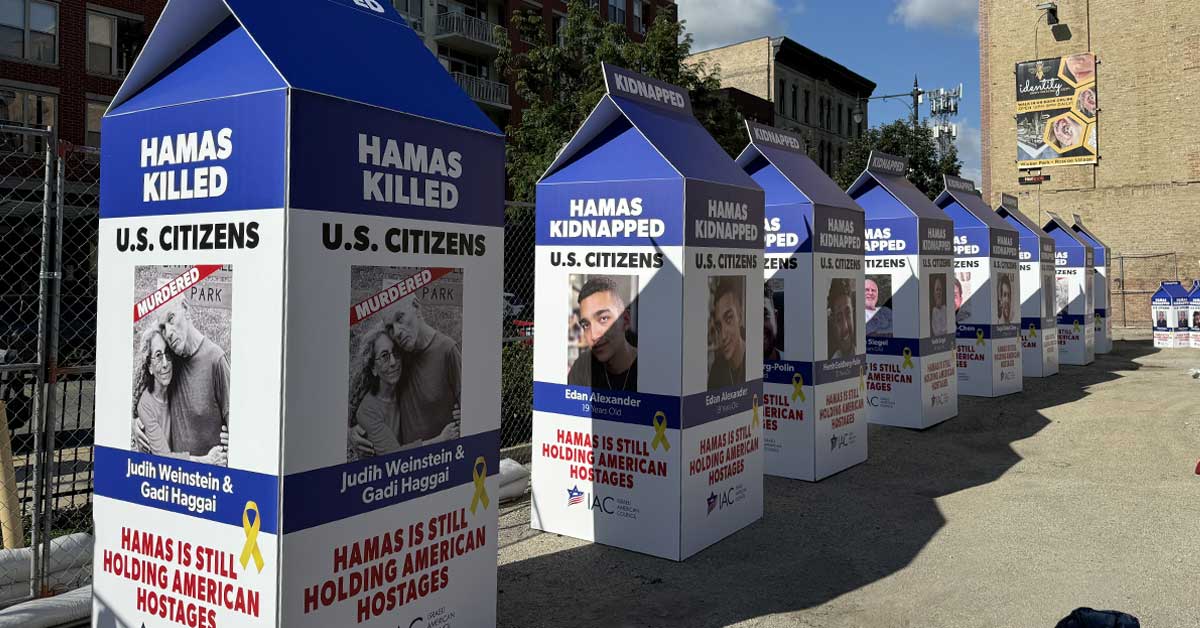
Along with the installations stood eight towering milk cartons, each displaying the face of one of the eight American hostages remaining in Gaza, meant to evoke “missing persons” campaign launched in the 1980s.
“The message we’re trying to create here is a no-brainer perspective,” Aeder said. “Who with any degree of humanity does not want to see these hostages released? Who does not feel the pain that happened on that day?”
That sense of humanity was palpable at the exhibit, said Maya Roman, a Tel Aviv-based cousin of 39-year-old Carmel Gat–still being held hostage in Gaza. “The one thing that has been consistent since the beginning has been the support of the American Jewish community,” Roman said. “You have showed us [Israelis] that we have family here,” she said. “In the middle of all that is happening [in Chicago this week], you made sure that there was a space dedicated to us. It is powerful that you are so dedicated to making sure our loved ones come home.”
To learn more about the artists featured at Hostage Square Chicago, visit tinyurl.com/hostagesquarechicago .