‘Irena’s Vow’
ROBERT NAGLER MILLER
Irene Gut Opdyke was a successful interior decorator enjoying a comfortable, middle-class life with her family in postwar Southern California when she had a transformative experience.
In 1972, Opdyke, born Irena Gut in Poland in 1918, began opening up about her early years as a nursing student who had hidden a dozen Jews in the basement of a Nazi-occupied villa. The home had become the residence of Wehrmacht Major Eduard Rügemer, and Opdyke was his housekeeper. When Rügemer discovered her secret, he agreed that he would not expose her or the Jews she was helping-so long as she consented to becoming his mistress.
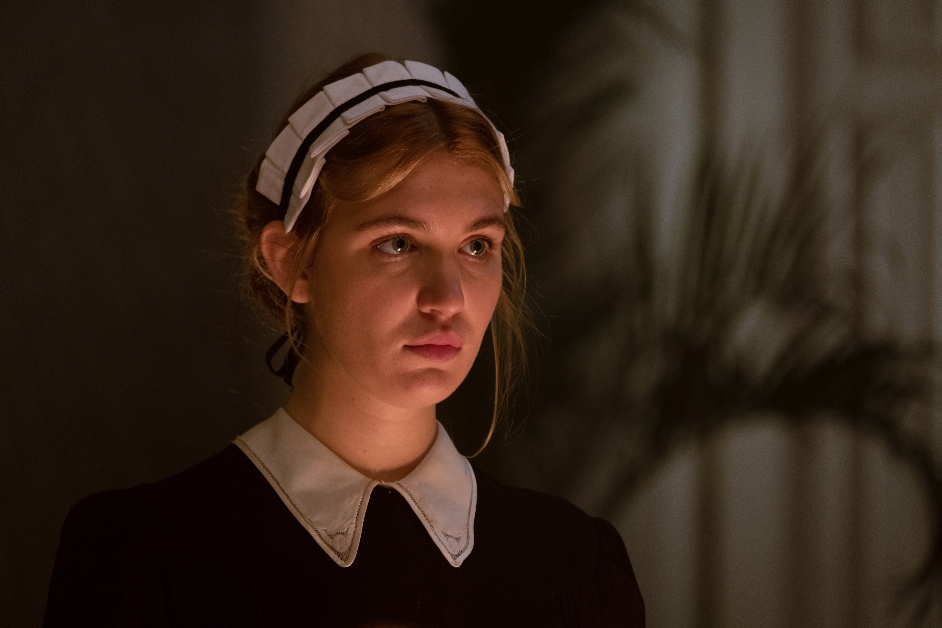
Opdyke’s courageous exploits are now the subject of a major motion picture, Irena’s Vow , a Canadian-Polish venture that has been making the festival circuit-Chicago’s premiere is April 15-and will soon receive wider distribution across the country. The film, created by Louise Archambault and adapted from the same-titled play, starring Tovah Feldshuh, ran on and off-Broadway in 2009. The play itself was based on Opdyke’s 1999 memoir, My Hands: Memories of a Holocaust Rescuer (Random House), which she co-wrote with Jennifer Armstrong.
From the early 1970s until her death in 2003, Opdyke, who was honored as Righteous Among the Nations by Yad Vashem, spoke frequently to students and other groups about her wartime experiences. For the last 20 years, that mantle has been assumed by her only child, Jeannie Opdyke Smith, who recently spoke with Jewish Chicago magazine about her mother’s valor. Excerpts from the interview follow.
Q: When you were growing up, how much of your mother’s story did you know?
A: I didn’t know anything. When my mom came to this country in 1949, to Ellis Island, she said she put a “Do Not Disturb” sign over her memories. She was not going to talk about it at all, and she truly kept her word.
But that changed in 1972 with a triggering event. Would you recount it
My dad, mom, and I were having dinner, and the phone rang. She got up from the table to answer it, and on the other end of the line was a college student doing a survey for a report. The topic? The Holocaust never happened. It was just propaganda by the Jews so people would feel sorry for them. He was calling random people to find out what they thought. Words came tumbling out of my mom’s mouth. He hung up on her at one point.
I remember her standing there holding the phone receiver, with tears streaming down her face. She was shocked that someone had been brainwashed. She said, “All these years, I’ve kept silent. I have allowed evil, and I’ve allowed the enemy to win. From now on, I will talk to anyone and go anywhere so these things will not repeat themselves.”
What happened after this?
At first, it was my dad’s Rotary Club. The speaker had canceled last minute, and she went to that event, terrified. That was the beginning. After this, it didn’t take long before she went around telling her story, especially to schools.
How did her story become known?
There was a rabbi in Orange County, Haim Asa [of Temple Beth Tikvah, Fullerton, Calif.], who was responsible for getting the ball rolling.
How did her book come about?
My mother befriended a lot of people. There was a super-intelligent woman fascinated by my mom’s story. She would ask my mother questions about her life. She tape-recorded the interviews and typed them out. I put them on a computer, and Random House got a hold of them. I’m not sure how it all came about, but so many people appreciated my mother’s story. Random House sent out a ghost writer, Jennifer Armstrong, who lived with my mother for three weeks.
What would your mother say about today’s surge in antisemitism in this country?
She would be shocked. She really believed in America and the words, “Never again.”