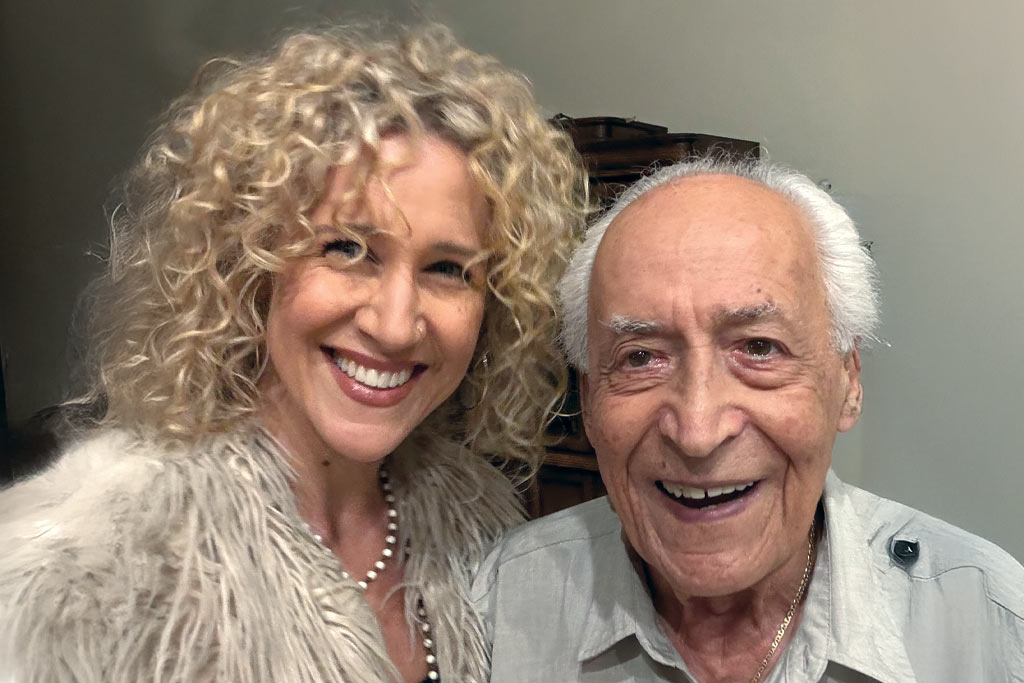
The late Dr. Hai Solomon with his daughter, Rebecca “Be” Solomon.
This will be the first Father’s Day that Rebecca “Be” Solomon will not observe with her own father, Dr. Hai Solomon, a longtime River Forest obstetrician-gynecologist, who died last September at 96. But she will take comfort in calling up her memories of her father, an Iranian Jewish immigrant and a beloved figure in the community.
Solomon can also turn to Enjoy the Moments: A Lifetime of Valuable Lessons, a book she created with her father, based on the 70 pithy sayings he imparted to loved ones in his role as paterfamilias.
The origins of the book are bittersweet to Solomon. “My father was in the hospital in July 2025, and I asked him whether he had any regrets,” she recounted. “He said, ‘My regret is that I didn’t write a book.’ I said, ‘Okay, we’re going to do it.’”
Solomon took out her computer and, listening carefully to her father, typed his sage advice for living a good life. Among the physician’s prescriptions: “Your thoughts become your behavior,” “Do your best, forget the rest,” “Don’t hold people back,” and “If you save someone, you may save the world.”
Following each of the 70 maxims are Dr. Solomon’s succinct thoughts on his life lessons. For instance, on “Ask someone you trust what you need to work on,” he elaborated: “We all have some problems in life that we don’t recognize. You should ask someone you trust to assist you in identifying those things. Do so with an open mind, and then make the commitment to work on it.”
Each opposing page of the book is blank, allowing readers to write down their own reflections on Dr. Solomon’s truths.
“I tried very hard to retain his inflection,” Solomon added, noting that her father’s voice stood out for both its warmth and authority—a powerful combination.
Growing up with her father, Solomon saw the respect he commanded wherever he happened to be. “We’d go out to dinner as a family, and people would run up to my dad, and say, ‘You delivered my baby,’” she recalled. “He was like a celebrity.”
Over many decades, Dr. Solomon practiced obstetrics/gynecology at Gottlieb Hospital, now part of Loyola Medicine. Solomon and her mother, Carol, believe that he delivered upwards of 14,000 babies during his years of practice.
They also marvel at the trajectory of Dr. Solomon’s life. He spent his impoverished childhood in the Jouybareh, the Jewish section of Isfahan, an ancient city in central Iran, where as many as 10,000 Jews lived in close quarters before the middle of the 20th century. But he became a successful physician who brought his parents and all of his younger siblings to the United States and Israel as antisemitism spread in their home country.
“He loved the U.S. Constitution,” Solomon said, “and he wanted freedom,” which he knew he couldn’t find if he stayed in Iran.
Their family’s rabbi, Adir Glick, of River Forest’s West Suburban Temple Har Zion, is likewise impressed at the doctor’s tenacity. “When you heard the stories of Hai growing up,” said Rabbi Glick, at Dr. Solomon’s funeral this past fall, “it was not easy. He had to fend for himself and was often a powerful advocate, while simultaneously being embraced within the Old World mingling of community and family.” Through perseverance, grit, and a gleaming intellect, Dr. Solomon—the first in his family to attend university—completed medical school in Iran by age 24 before he set sail for the United States.
He found his calling at Gottlieb—as well as his wife, a nurse, whom he met during a delivery. “It was truly love at first sight,” Carol said.
Dr. Solomon and Carol raised their children in River Forest, where they devoted time, energy, and resources to Har Zion. “He lived religion at its best,” Glick said. “It was a profound part of who he was. … And he loved chanting … in his unforgettable Persian melody that seemed to come out of those old stories he told.”
Robert Nagler Miller is a journalist and editor who writes frequently about arts and Jewish-related topics from his home in New York.