Gubernatorial candidates discuss community concerns in separate Government Affairs forums
SUZANNE STRASSBERGER
As it does every cycle with key political races, in the lead up to the election on Nov.4, the Jewish Federation of Metropolitan Chicago met with the candidates for Illinois Governor. These discussions help the candidates learn more about issues of importance to the Jewish community, and for community leaders to learn more about the candidates.
The Federation’s Government Affairs Committee (GAC), in partnership with the network of affiliated agencies that provide critical, life spanning human services, works closely with federal, state, county, and municipal levels of government. In addition to successfully advocating for over $400 million in government funding annually for agency-provided services, the GAC serves as a trusted resource for government officials, from brainstorming new public policies to the actual provision of effective services with taxpayer dollars.
Governor Pat Quinn (Democrat) and Republican gubernatorial candidate Bruce Rauner, on Sept. 4 and Sept. 19 respectively, addressed health care delivery, reimbursement rates and delayed payments for government-contracted services, community based models for engaging people with disabilities, security at Jewish institutions, and expanded opportunities for cooperative partnerships between Israel and Illinois, among other issues.
David Golder, GAC Chairman, said, “Our meetings with both candidates were significant, providing an important opportunity to discuss how, together, we can better serve the people of Illinois. These sessions reflect and reinforce the reality of how Federation prioritizes our relationships with leading public officials in a non-partisan, trusting way. The community relies upon our ability to work with whoever wins any election.
“This approach is another way we have earned and seek to deepen the community’s trust.”
Suzanne Strassberger is the Associate Vice President, Government and Community Partnerships, at the Jewish United Fund/Jewish Federation of Metropolitan Chicago.
Other stories
-
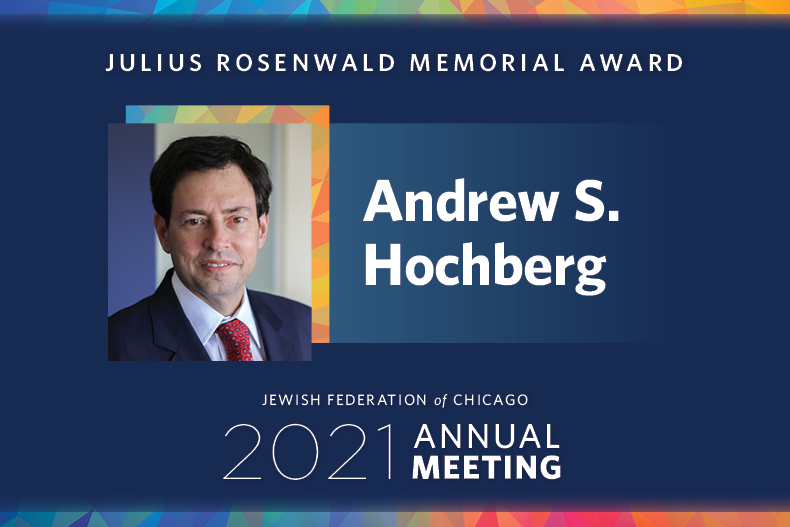
Meet Andrew S. Hochberg, 2021 Julius Rosenwald Memorial Award recipient
Celebrate Andy Hochberg at the virtual Annual Meeting on Sept. 14
Read more -
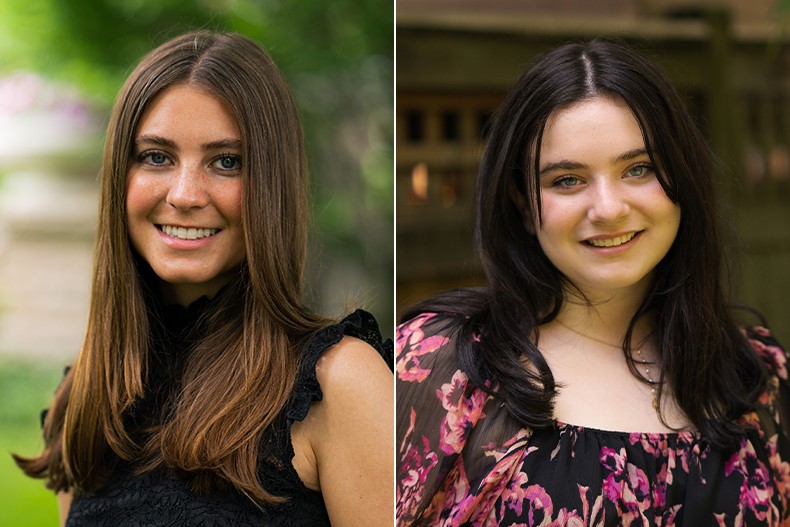
Two local teens win national recognition
Recipients of the annual Diller Teen Tikkun Olam Awards
Read more -
Celebrating six young award winners cultivating the community
Introducing young adult award winners
Read more
While Jews throughout America were feasting on apples and honey this holiday season, close to 130 Jewish Chicagoans helped make the new year a little sweeter for the less fortunate in their communities.
On Sunday, Sept. 21, JUF’s Young Leadership Division and its TOV Volunteer Network hosted the third annual fall Feed Chicago, a citywide day of service providing food assistance to those in need in Illinois-where 2.1 million adults and children struggle with hunger every day.
“It’s so important to instill the value of giving back,” said Sammantha Marks, 22, who served lunch to residents at Cornerstone Community Outreach alongside volunteers of all ages. “Growing up, my mom and dad put a high value on contributing all the time we could to the community we lived in. That lesson has been a huge part of why I decided to get involved.”
With 13 projects scheduled across the city, throughout the day, thousands of lives were touched by day’s end. From sorting food donations to cooking meals, the volunteers all made a significant impact at their service sites.
“The members loved having the volunteers here!” said Heather Wirth, program supervisor at the Center for Enriched Living, where volunteers helped adults with special needs make pizzas. “It was a big hit, and it’s so beneficial for them to be able to work with new faces.”
Other organizations hosting projects included: the JUF Uptown Cafe, A Just Harvest, The ARK, Breakthrough Ministries, Connections for the Homeless, Inspiration Corporation, The Lincoln Park Community Shelter, and Maot Chitim.
“We were thrilled by the success of Feed Chicago this year,” said Marissa Comin, event coordinator. “Our projects throughout Chicago made an enormous impact, and helped spread awareness of the needs of our greater community.”
The biannual day of service is just one small part of the JUF’s year-round efforts to fight hunger. More than 4,000 Jews in Chicago are sustained through daily or weekly JUF-funded food programs-which, in 2013, amounted to 470,000 meals, food packages, and grocery cards.
For more information on getting involved through JUF’s TOV Volunteer Network, contact Marissa Comin at [email protected].
Other stories
-
Meet Andrew S. Hochberg, 2021 Julius Rosenwald Memorial Award recipient
Celebrate Andy Hochberg at the virtual Annual Meeting on Sept. 14
Read more -
Two local teens win national recognition
Recipients of the annual Diller Teen Tikkun Olam Awards
Read more -
Celebrating six young award winners cultivating the community
Introducing young adult award winners
Read more
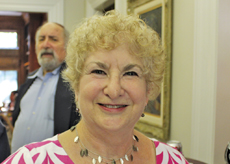
Former Metro Chicago Hillel Executive Director Marla Baker was honoredat the home of Amy and John Lowenstein for her 34 years of devotion to Jewish student life on campus at the University of Illinois at Chicago (UIC) and across the Chicago area.
Baker, who recently retired, was instrumental in the development and success of Hillel programs in Illinois, from her work establishing the Lewis Summer Intern Program over 25 years ago to her guidance in creating the Metro Chicago Hillel system in the last two years. She was a pioneer as one of only few female Hillel Directors early in her career, changing the status quo that allowed women in Hillel to be the norm.
After John Lowenstein, executive director of the Hillels of Illinois, welcomed everyone, Frances H. Krasnow, chair of the Hillels of Illinois Governing Commission, along with Marla’s colleagues, lay leaders, and former students, offered Baker their heartfelt thanks. Her work at UIC was recounted and applauded by UIC administrator and emcee for the evening, Roberta Bernstein.
Board member Robert W. Matanky spoke about Baker’s contribution to the future of our Jewish community and read a letter from his daughter Katie Matanky, a former student of Marla’s, who now lives in Israel.
“Marla was there for me during my college career and she’s been there for me since,” she writes. “If I am any indication, and I am just one student of one graduating class of 34 years at Hillel, Marla has had quite an impact. A powerful resource and an inspiration, Marla has touched hundreds, probably thousands of students; her impact extends far beyond the limit of 34 years, it extends exponentially and generationally as we (the impacted) spread what she’s taught us.”
After other students and colleagues spoke about the impact that Marla and Hillel had on their lives, Baker said this: “Working in a field that engaged my full self so deeply, so completely, has been a rare privilege. I’ve had the opportunity to participate in the lives and development of so many young people-students and young professionals-and to watch their lives continue to unfold over time. I’ve witnessed their struggles and triumphs, celebrated their professional successes and marriages, and kvelled over the new generation of lovely Jewish children they are raising. And I’ve watched with pride as they have taken on leadership positions within the Jewish community, including Hillel. I continue to be grateful for these blessings every day.”
This event was also an opportunity to introduce Rabbi Seth Winberg, the new executive director of Metro Chicago, to the Hillel community and to have him outline his plans for the future of Metro Chicago. He began his new position in June after a smooth transition and with great excitement. He previously served as assistant director of the Hillel at the University of Michigan. And so the proud Hillel tradition continues, evolving and growing with each new generation of students.
Metro Chicago Hillel is part of the department of Campus Affairs and Student Engagement at Jewish Federation of Metropolitan Chicago/Jewish United Fund and a partner of Hillel: The Foundation for Jewish Campus Life.
Other stories
-
Local campus administrators convene on hate speech, bias
JUF and ADL brought together 17 student safety, diversity and inclusion and student affairs administrators and Hillel representatives from various Illinois campuses to discusses issues of hate speech and bias.
Read more -
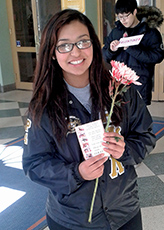
Engaging students about Israel on campus
Too often we hear about difficulties facing Jewish college students on Illinois campus, but to focus solely on the politics gives only one piece of the complex narrative that is Jewish life on campus.
Read more -
Hillel International launches fellowship initiative to train young Jewish professionals
The Springboard Fellowship will train cohorts of young Jewish professionals in highly-valued skillsets and place them at local Hillel campuses for two years.
Read more
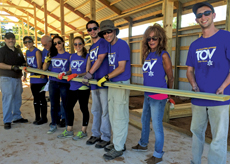
It was a most incongruous sight: a Chabad rabbi sounding the shofar in the dusty frame of a barn, in Bethel Acres, Oklahoma. In the audience, among the JUF TOV and Jewish Disaster Response Corps volunteers, was an eclectic mix of local and faith based groups. Firefighters, representatives from Oklahoma Indian Missionary Conference, Oklahoma Conference of the United Methodist Church, and Chickasaw Nation were all gathered for the annual 9/11 service project kickoff, coordinated by the New York Says Thank You Foundation (NYSTY). Each year, NYSTY rallies hundreds of volunteers in service to honor the victims of 9/11 and pay it forward to communities around the country that helped rebuild New York 13 years ago.
This year’s project is 1 Day Ranch, a horse rescue, therapeutic riding, and animal educational center destroyed by E4 tornadoes last summer.
The shofar’s beckoning call sounded and everyone was captivated. The sound of the shofar, said Rabbi Ovadia Goldman, is a reminder of our responsibility, our obligation to justice and tikun olam (repairing the world). It is a call to action. And here we are, I thought. Eight TOV volunteers had risen to the occasion to do our small part in helping repair a very broken world.
And while raising a barn may not come naturally to many of us, the desire to help was overwhelming. Eight newly minted construction workers were intent on building as much of 1 Day Ranch as humanly possible in two days. “We felt truly united as one in our TOV goal,” said Dr. Donna Turek, professor of Criminal Justice, a volunteer in Oklahoma.” Everyone worked and worked as hard as possible. Our group was spectacular in that way. Every single one of us was eager to assist in any way we could.”
“This was a very moving and inspiring experience,” said Sy Sarowtiz, a retired engineer. “The friendliness and cooperation I experienced was only matched by the incredible results achieved. On Thursday morning, when I first saw the barn, only the crude outside frame was basically supported. When I left Friday by lunchtime, the roof was virtually complete, the outside siding was on, and most of the animal stalls were complete. The barn looked beautiful, and I was very proud of the small part I played in this enormous accomplishment.”
This is what the spirit of New York Says Thank You is all about. “We are honored to help Oklahomans rebuild just like they supported us 13 years ago following the tragedy of 9/11,” stated Jeff Parness, founder and chairman of New York Says Thank You Foundation. “We are also thrilled to…support this inspiring effort which truly pays tribute to the volunteer spirit, kindness, and humanity that united the nation on 9/12.”
Yael Brunwasser is the director of Volunteer Services (TOV) for the Jewish United Fund Metropolitan Chicago.
Other stories
-
Meet Andrew S. Hochberg, 2021 Julius Rosenwald Memorial Award recipient
Celebrate Andy Hochberg at the virtual Annual Meeting on Sept. 14
Read more -
Two local teens win national recognition
Recipients of the annual Diller Teen Tikkun Olam Awards
Read more -
Celebrating six young award winners cultivating the community
Introducing young adult award winners
Read more
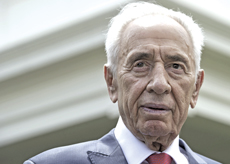
The Honorable Shimon Peres, former President and Prime Minister of the State of Israel, will be the special guest speaker at the annual Jewish United Fund of Metropolitan Chicago Vanguard Dinner. The event, set for Tuesday, Oct. 28, begins at 5:30 p.m. at the Hilton Chicago, 720 S. Michigan Ave. Couvert $100 per person. Attendance requires a contribution at the Vanguard level to the 2015 JUF Annual Campaign.
Neil G. Bluhm, 2015 Vanguard Chair, and Sara Crown Star, 2015 General Campaign Chair, will host the event.
Peres, 91, has been committed to Israel and its citizens for most of his lifetime. He served as a member of Knesset for 48 years, the longest term of service in Knesset history. He served as Minister in 12 cabinets and twice as Prime Minister (1984-1986, 1995-1996), Deputy Minister of Defense under David Ben Gurion (1959-1965), Treasury Minister (1988-1990), Minister of Defense (1974-1977, 1995-1996), and Foreign Minister (1986-1988, 2001-2002). In 2007, Peres was elected to serve as the ninth President of the State of Israel.
Among his numerous accomplishments, Peres has been at the forefront of Israel’s development as an independent state. During his term at the Ministry of Defense, he headed Israel’s research, production, and acquisition front, and his initiative brought about the establishment of the aerospace industry, the electronic and nuclear industries, and the Armaments Development Authority.
Peres has said, “In Israel, a land lacking in natural resources, we learned to appreciate our greatest national advantage: our minds. Through creativity and innovation, we transformed barren deserts into flourishing fields and pioneered new frontiers in science and technology.”
He is known as a promoter of peace. In 2005, he joined Prime Minister Ariel Sharon in founding a new political party, Kadima. Sharon had departed from the Likud party and accepted a peace agreement with the Palestinians on the basis of the “two states for two peoples” principle, beginning with the unilateral evacuation of the Gaza Strip. “Democratic and science-based economies by nature desire peace,” Peres has said. “Israel does not want to be an island of affluence in an ocean of poverty. Improvements in our neighbors’ lives mean improvements to the neighborhood in which we live.”
During his term as Minister of Defense, Peres devoted most of his efforts to restoring the Israel Defense Force (IDF), which was damaged in the Yom Kippur War. He initiated the Entebbe Operation, approved by the government, and succeeded in rescuing kidnapped Israelis from Uganda.
As Prime Minister, Peres led an economic stabilization plan that saved the Israeli economy from collapse and reduced hyper-inflation that reached 400 percent per year. In 1986, while serving as Substitute Prime Minister and Foreign Minister, he held negotiations and secured a far-reaching peace agreement which included Israeli-Jordanian cooperation in administrating the West Bank.
In 1994, Peres, along with Yasser Arafat and Yitzhak Rabin, was awarded the Nobel Peace Prize.
In 1996, work began on the Peres Peace Center, which deals in initiating and operating going projects with Israel’s Palestinian, Jordanian, and Egyptian neighbors in the fields of economy, culture, education, sports, computer sciences, agriculture, communications and medicine. One of the Center’s important projects is the treatment of injured and ill Palestinian children at hospital in Israel. To date, some 8,000 children have been treated and cured under this arrangement. The Center also operates a program for training hundreds of Palestinian doctors.
As President, Peres focused on Israel’s high-tech development, and supported environmental protection efforts that included the use of alternative energies. He also promoted civil equality for minority populations, to reduce social gaps and promote affirmative action for weak and marginal populations.
Peres has published six books, including “The New Middle East,” with Aryeh Naor, which was translated into more than 30 languages.
For tickets and information, contact Robyn Brenner at (312)357-4961, or email [email protected]. You may register online at www.juf.org/vanguard.
For a complete biography of Shimon Peres, visit here.
Other stories
-
Meet Andrew S. Hochberg, 2021 Julius Rosenwald Memorial Award recipient
Celebrate Andy Hochberg at the virtual Annual Meeting on Sept. 14
Read more -
Two local teens win national recognition
Recipients of the annual Diller Teen Tikkun Olam Awards
Read more -
Celebrating six young award winners cultivating the community
Introducing young adult award winners
Read more
Remembering Vatican II: The Religious Significance of the Catholic Church’s Relationship with the Jewish People
FRANCIS CARDINAL GEORGE
The following speech was delivered by Archbishop Francis Cardinal George at the 114th Annual Meeting of the Jewish Federation of Metropolitan Chicago. You can watch this speech here.
Thank you, Lester, for your very kind introduction and for your friendship over the years. I am grateful to be here. In a sense, I don’t have to give much thought to what I’m going to say, because David Brown gave my talk! He said “relationship, relationship, relationship” and that’s all I’m basically going to say for, I hope, 15 minutes or so while I get the chance to talk to you. I want to truly thank from the deepest part of my heart, Steven Nasatir and the Board of the Jewish United Fund and the Jewish Federation of Metropolitan Chicago, for the invitation to address you here today.
It is very impressive to come together in such a large gathering, one dedicated to remembrance. It brings to my mind the first time that I talked with a rather large number of Jewish leaders here in Chicago 17 years ago. I was invited to a cocktail party in the home of a Jewish businessman, and there were perhaps 60 or 70 people there. At a certain moment, everyone sat down and they started to ask me questions. I was glad to be part of that dialogue. The questions were obviously designed to tell them who I was, and I was interested as well in what they were interested in because it told me who they were; but behind all the questions about who I was, I knew there was a deeper question that wasn’t spoken directly: “Can we trust you?” And, “How far can we trust you?” I thought of that after I left. It stayed in my heart and I thought to myself, “Well, that’s a fair question. Can they trust me?” What does that mean and who am I, really, as part of a community that lives with so many good people who were interrogating me for their own purposes but for mine as well. Whoever I am, it has to be in relationship to them and that has, I hope, developed in my own thinking and also in my experience here. I am very grateful for all those encounters and especially grateful for the chance to encounter you again today in this marvelous setting.
The Catholic Church is in the process of remembering a great event that redefined us, that helped us know who we are by refocusing us. The Second Vatican Ecumenical Council, as it’s called, took place between 1962 and 1965. It shaped the direction of the Church at the end of the twentieth century and into the Third Millennium of Christianity. But it didn’t speak just about a particular time. It’s important for me to say that, because I’m going to make reference to a document that some of you have heard of and, perhaps, some have not. In Latin, its official title is Nostra Aetate. Sometimes people outside the Church don’t understand what is stable and what is policies. A document from an ecumenical council is not just a statement of policies, it’s not even midrash. It is perhaps closer to Torah. It is something that we have to make reference to not only when it is published but for generations to come. It is a constant part now of a rather small book that contains the decrees of ecumenical councils from the fourth century up to the present time. Those aren’t reformable – they can be interpreted – but they are always there as a constant point of reference. So it’s not a question of examining a policy statement that can be reversed. Nostra Aetate can’t change as a point of reference. I say that because sometimes people remain uneasy: “We’re fine right now. What happens in the future? Will the Catholic Church change back to its being a carrier of anti-Semitism as it has been in some places over many years?” Should that happen, then it will happen in some group that is no longer living within the terms of Catholic identity as it has been defined for us by Vatican II. While much of the work of the Council was aimed, therefore, at the renewal of the inner life of the Church: “Who are we?” – other aspects, equally important, involved turning the Church toward an engagement with the world in both mission and service. Who are we vis.-a-vis. others? We don’t know who we are as Catholics unless, in some fashion, we talk to everybody else. This intentional focus brought a new reflection on relationships. One of the most significant reflections had to do with our relationship with the Jewish people. That reflection eventually led to the Declaration on the Relationship of the Church to Non-Christian religions, Nostra Aetate.
Before I speak about that document, Nostra Aetate, which simply means, “in our times,” I want to share with you the vision of the world which the Fathers of the Second Vatican Council were using in their deliberations. Pope Paul VI, who guided the council to its conclusion after the death of Pope John XXIII, in his first encyclical letter described the human community in terms of relationships. He spoke of circles of dialogue between the Church and the whole of humankind. The first and largest circle was, in fact, all humanity. The Holy Father’s point was that there is no one outside of the widest circle of relationship whom we can simply count off or not pay some attention to. Recall, however, this was the 1960s – the Cold War was at its height, and the common thinking presupposed an ineradicable opposition between East and West. Most of the bishops of Vatican II had lived through the horrors of the twentieth century, which were caused, in part, by demonizing whole peoples and groups and declaring them outside of the circle of relationships, outside of humanity itself. So, at the outset, Paul VI excludes this possibility. The first circle includes everyone. He then turns to the second circle, those who believe in God. Belief, again in the days of state-sponsored atheism, moved a person closer to us and established a bond of commonality which allowed for a closer relationship. The third circle contained those who believe in Jesus Christ, our fellow Christians of the various churches and ecclesial communities. Finally, the fourth circle was the Catholic Church, in all her global diversity.
This way of seeing the world through these circles of dialogue provided a basis for the Fathers when they went on to express the religious significance of the Catholic Church’s relationship to the Jewish people. You have to understand that, from the beginning of the time of modernity and even a little before that, the stance of the Church vis.-a-vis. others was much more defensive. It wasn’t dialogical. It was a stance generated by fears from the French Revolution and other movements that were obviously anti-Catholic and had resulted in persecution. This defensive reaction to the development of atheistic modernity had to be broken down. It was broken down and broken through with the documents of Vatican II. The movement from defensiveness to dialogue was the purpose of the Council. Of particular importance was dialogue with the Jewish people, because that is a unique relationship. It always will be unique even though we ourselves haven’t totally determined it because we haven’t talked enough, even, perhaps, to one another.
One of the elements of Nostra Aetate is its intentional focus on remembering. When applied to the Jewish people, Catholics are called upon to remember the anti-Judaism which was often customary among Christians throughout history, to remember anti-Semitism as a racist philosophy, and, of course, most profoundly, to return to the Shoah itself, which must never be forgotten. This sensitivity grew out of the conversations that John XXIII had with the rabbis from France when they began to teach him the consequences of the teaching of contempt over many, many centuries; often, there was not outright persecution of Jews, but there was an attitude of deep-seated contempt. The rabbis showed Pope John XXIII what follows from that teaching, what horrors were prepared by that kind of attitude over the centuries. John XXIII became very sensitive to that attitude also because of his own work with Jewish and other refugees as a papal diplomat in Istanbul and in Sophia, Bulgaria, during the war, when he attempted, often successfully, to save people from the Nazi atrocities. But these conversations had still to be made explicit in his own mind, as they finally were.
Nostra Aetate also extends the notion of remembering in another direction, calling on Catholics to remember the spiritual bonds which unite Jews and Christians. That remains the basis of our ongoing conversation, ensuring that neither party co-opts the other. You can be yourselves without us; we can’t be ourselves without you. But who are you, and is our understanding of you your own understanding of yourselves? If it’s not, and in some areas of our lives and beliefs there cannot be a shared understanding, nonetheless, how can we respect that difference and even rejoice in it?
Three phases followed the Council in terms of relations with the Jewish people. The first phase was devoted to what Fr. John Pawlikowski here in Chicago said has been a cleansing phase. Father John has been an important participant in the Jewish-Catholic dialogue here and elsewhere, as you know. This cleansing phase involved re-writing texts, taking care to re-craft the language used in homilies and catechetical materials in a sustained effort to eradicate evidence of the sin of anti-Semitism from Christian texts. A second phase involved rethinking the relationship of Jews and Christians in the light of renewed biblical studies. Perhaps a little detail here will illustrate how significant that shift has been even though it isn’t often appreciated outside the circles of theologians and other scholars.
Biblical scholarship has helped us to understand more clearly that the first century of the Common Era was more complex than either Jewish or Christian writers of that age usually admit. Rather than the simplistic framework which saw Christianity replacing Judaism, the historical fact was that Rabbinic Judaism was already evolving, so that when the destruction of the Temple occurred in 70 C.E., Rabbinic Judaism became the form of Judaism for the new millennia and the form that we live with now and what we understand as Judaism. Christianity also developed its identity at that time as distinct from either biblical Judaism (meaning the Temple) or Rabbinic Judaism, Christianity during this period was developing more closely to Rabbinic Judaism and even to Temple Judaism, than Catholics themselves perhaps understand. In this historical sense, both Rabbinic Judaism and Christianity are off-springs of biblical religion. We might now employ the metaphor of Judaism as Christianity’s elder sibling. And we do use it, provided that everybody accepts it as a reality. It raises historical questions: What does it mean, since the elder sibling can be someone who welcomes a younger brother or sister or who doesn’t, and what are the reasons for that? The meaning of being joint heirs to biblical religion is obviously important in the contemporary period as well.
A third phase, according to Fr. Pawlikowski, involves imagining a new narrative about the relationship. This more nuanced notion about the relationship of Jews and Christians in the first centuries has allowed the Catholic Church to move beyond supersessionism, that is, replacement theory. Part of the genius of Nostra Aetate is that it allows the Church to affirm, that,
“. . . the Jewish history of salvation, the basis for the religion of Israel as we find it in what we call the Old Testament, is the historical foundation of the Christian history of salvation and revelation.”
That has always been the case, but our new understanding of it opens up intellectual possibilities for dialogue and opens us up personally to a different understanding of who are we, after all, as Catholics, not so much inheritors of your history as partners building on the same history up to the present day. This connection remains intact, although according to our faith something completely new, the new covenant centered on Jesus of Nazareth, has come to be. That rock of our belief always remains the difference that is a genuine difference, and yet it can remain also a point of dialogue that proposes and never imposes, rather than a point for defensiveness. In other words, to some extent, we have found a way to honor each other without any compromise to the identity and integrity of our dialogue partnership.
Father John Crossin, whom many of you heard in his fine talk earlier this year at the Bernardin Lecture, summarized some of the things I have said over the years here and used them to frame the next direction for the new narrative as together we engage another dialogue partner, secularism, the inheritor, unfortunately, of modernity in its most extreme form. I have suggested that a “trialogue” between the two pre-modern biblical religions, you and us, and secularism, could be a fruitful conversation. It would force secularists to recognize that they are espousing a philosophy of life that has religious overtones; it is not something that is neutral. Fr. Crossin summarized how this new narrative might develop, if together Jews and Catholics would first of all:
- Reflect together on what we have each learned from the Enlightenment.Enlightenment was born with modernity. But we have different attitudes toward the Enlightenment. It was liberating for Jewish communities in many parts of Europe, even as it was destructive of the Church in her then formal and governmental relationship to the world.
- Look together at consumer culture and how it influences us and our relationships to one another. We heard those marvelous testimonies of philanthropy a few minutes ago.It is important that we succeed, but success doesn’t mean accumulating a lot of money. It means most of all using money to help other people. We go beyond consumer culture if we touch the best bases of our different faiths.
- Thirdly, then, focus together on human interdependence, on the universalism that we just heard spoken about.We deal more explicitly then with “ecumenism” in the broad sense and how that might impact further the Jewish-Catholic dialogue. Then we can move on to work together towards a common and honest history that we can both acknowledge: “Yes, that’s how it is,” even though we feel it and think about it differently.
Father Crossin summarized finally by saying “What I am suggesting is that a new and coherent way of Catholic/Jewish self-understanding and acting is emerging in the post-modern period . . . the presupposition and foundation for this suggestion is that we will continue to walk and talk together as colleagues and as friends.”
That too is something I have often said, that we have come a great distance and it is good to celebrate that, but our very progress has now brought into relief ways in which we could go farther, particularly in our spiritual relationships, if in fact we understood the narrative adequately.
Here in Chicago, I believe that we are well along the way with this journey and conversation. It was well established before I came. I only had to build on what you were doing, what the Archdiocese of Chicago was doing when I came here. I want to thank the Jewish United Fund and the Jewish Federation of Metropolitan Chicago for all that you have done to foster this closer relationship. I also want to mention the other Jewish partners of the Archdiocese of Chicago: the Chicago Board of Rabbis, the American Jewish Committee, Spertus Institute, the Jewish Community Relations Council, the Jewish Council on Urban Affairs, Hillel and the Holocaust Museum for the various programs and partnerships that we have been privileged to share. I’d like to name several examples of what our dialogue efforts have produced.
As has been mentioned, the Fassouta Project brought together diverse concerns in a mutual project. Fassouta is a small village – it is populated by Greek Catholics, that is, its people are not Latin but Byzantine in their liturgical expression. It is Greek but Catholic, in communion with the Bishop of Rome. The village lies about four kilometers south of the Lebanon border. The Fassouta Project, in 2003, was a joint effort to raise awareness of the effects of emigration on the Christian community in Israel. The project established a computer literacy center in the Christian village of Fassouta so that the young people would find employment at home. We provided $100,000 over three years to outfit and staff a computer lab and offer classes to the local community. Both the State of Israel and their Christian citizens could then profit from the skills which would make it possible for young Christian men and women to find the work that would enable them to stay in Israel.
Another project worthy of note is the Social Studies Curriculum in our Catholic schools. Together with JCRC we developed the “Modern Israel: Holy Land and Jewish State” program. In addition to a curriculum, over 35 teachers in theology, history, English, art and science have travelled to Israel to be formed in this curriculum. Twenty different Catholic high schools now have participated. In a special way therefore, I want to acknowledge the work of Sister Mary Ellen Coombe, who has led our efforts to engage Catholic and Jewish schools for many years and contributes to the new narrative being developed. Sister Mary Ellen’s religious order, the Sisters of Sion, have as their charism Catholic/Jewish dialogue. She has brought that charism to life here and for over two decades has placed it at the service of the Archdiocese and of the Jewish community, and she continues to do so. I want to take this opportunity to thank the Sisters of Sion for their contribution to Catholic/Jewish relations in Chicago and particularly to express my gratitude for their work and their presence here through Sister Mary Ellen.
There is much more I could say to the way the Jewish community sends volunteers to work with Catholic Charities during the holidays, to the Catholic/Jewish Scholars’ Dialogue, to the Joseph Cardinal Bernardin Jerusalem Lecture, to the work of Hillel with Catholic campus ministries and, of course the work of the Holoucast Museum. It’s interesting when I talk to Catholic campus ministers and ask, “Whom are you working most closely with?” I used to expect them to say, “Lutherans, Episcopalians” – and they say, “The Jews – Hillel. And we are doing very well.”
In one way or another, all of these developments are fruits of Nostra Aetate. Standing here, nearly fifty years after the Second Vatican Council, I lift up a prayer of gratitude to God for all that has been accomplished and for all that still might be. I know the office of the papacy has often been a mixed blessing or even a curse for the Jewish community. What I would like to point out is that no matter how individual popes have helped or hurt our dialogue over the centuries, in the last 50 years, starting with John XXIII who took to heart the consequences of the teaching of contempt when French rabbis pointed it out to him, and who, with the help of Cardinal Bea, a German Jesuit who, with the help of his scholarly background in Scripture, was able to bring to the Pope what we had to do if we were to be a genuinely biblical people, a new moment did arise. Pope Paul VI succeeded John XXIII and, while his actions too were sometimes problematic during his visit to Israel, nevertheless, the formal recognition of the State of Israel began with the work of Pope Paul VI.
Pope John Paul II, of course, was who he was, a truly monumental figure, one who brought history into a genuine alignment with the demands of dialogue by acknowledging and confessing publicly the sins of the Church but not stopping with that. He brought hope – hope for everyone. In that, he deserves to be remembered as a good friend of the Jewish people as well as a great pontiff of the Catholic Church.
In the years of Pope Benedict XVI there were some decisions that people interpreted badly. I think he saw himself as someone immersed in God’s Word, who knew and lived Scripture and who was convinced that we could also advance the dialogue through an emphasis on culture, for religions form cultures, as John Paul never tired of saying. A faith that does not become culture, that is, if the faith in your heart is not expressed in customs that are common and not just individual, if it does not shape an entire way of life, it is not truly faith. It hasn’t really permeated all the aspects of one’s existence. That conviction was taken a step farther in Pope Benedict’s request that we not talk to one another only as religions; rather, we should talk to others as cultures, because then we touch the whole dimension of our lives, and there can appear openings that perhaps we hadn’t noticed before.
And now we have Pope Francis. Based upon his own friendship and personal relationships with the rabbis of Buenos Aires, he is able to bring his own particular personality to the present dialogue and, I hope, to a more profound relationship in the years to come.
As I conclude, let me say that what I have personally learned from Vatican II and especially from my seventeen years as Archbishop of Chicago is that the new narrative of Catholic/Jewish relations will be written if we write it together. This will only happen if we deepen our relationships. For too much of our common history we spoke of each other without any relationship, or even as enemies, imagined or real. I have said many times, (the priests are tired of hearing me say it,) that if you get the relationships right, everything else will follow. After the death of Pope Saint John Paul II, Rabbi Yehiel Poupko, here with us today, shared what he was looking for in the new pope. He said simply, “Someone who knows us.” Relationships come first, don’t they?
I hope that the real legacy of Nostra Aetate and the Second Vatican Council will be that, at its one hundredth anniversary, our two communities will look back and say that, because of that Council and its very important and normative document on interfaith dialogue, we do know each other through the eyes and hearts that each of us has as members of our own faith community. For this afternoon and for your abiding together with me for so many years, from the bottom of my heart I again want to say thank you, Mazeltov.
Other stories
-
Meet Andrew S. Hochberg, 2021 Julius Rosenwald Memorial Award recipient
Celebrate Andy Hochberg at the virtual Annual Meeting on Sept. 14
Read more -
Two local teens win national recognition
Recipients of the annual Diller Teen Tikkun Olam Awards
Read more -
Celebrating six young award winners cultivating the community
Introducing young adult award winners
Read more
On Sept. 16, close to 400 members of the Women’s Division came together for the Jewish United Fund’s 2015 Lion Luncheon at The Standard Club. The event featured a moving talk by Linor Abargil, former Miss World and leading global advocate against sexual violence.
Linda Fisher, campaign vice president of the 2015 Women’s Board, also spoke at the event. Her stirring remarks told the story of an emaciated Auschwitz inmate, who, upon being freed by American soldiers at the end of the war, cried out in anger with his last breath of strength, telling his liberators: “Ish payt! You’re too late!”
The tale is a cautionary one, Fisher said, drawing a parallel between the anti-Semitism of the 1930s and the burgeoning crisis faced today by Jews around the globe: “The names have changed and the places have changed, but for Jews, one aspect of our world has not: we are targets. We have received a bittersweet reminder that Jews share one common destiny as a people. We are one family. Now is our moment – we cannot afford to be too late.”
Several members of the Women’s Division also spoke, sharing their individual reasons for becoming Lions of Judah – women who support JUF’s important work through annual gifts of $5,000 or more.
“I have seen firsthand how JUF-funded agencies change the lives of people in need, and I treasure the way Lions connect to one another through our philanthropy,” said Shari Slavin. “We are women who care passionately about Jews in need, whether they live in Buffalo Grove or Beersheva, Belarus or Buenos Aires. We believe all Jews are responsible for one another.”
Ann-Louise Kleper, too, spoke about the power of being a Lion of Judah – and of wearing the iconic Lion pin.
“When it comes to inculcating values to children, what we do speaks louder than what we say,” said Kleper. “All of us make statements about what is important to us by where we live, how we dress and what clubs and organizations we join. Wearing the Lion pin is one of my most important statements.”
The luncheon also featured the presentation of the Kipnis-Wilson/Friedland award, given biannually to women who demonstrate exceptional leadership and commitment. The 2014 award was presented to Edie Cadden by Wendy Abrams, president of the Women’s Board.
In her keynote, Abargil, a survivor of sexual violence herself and star of the Emmy-nominated documentary Brave Miss World, said she found strength in telling her personal story, and hopes her experience will bring critical attention to women’s issues.
“There’s a moment in your life when you think: it’s over. You think you’ll never smile again,” she said. “But I learned that women are strong. Unfortunately, we realize it in our worst moments. Only then do we realize how much power – how much strength – is inside us. It doesn’t matter who you are, how you look, where you come from; you can become your own hero.”
Susan Berk chaired the overall event, along with co-chairs Lori Komisar, Edie Cadden, Lisa Rubinstein, Jane Lederman, Andi Saffir, Laurie Lustbader, Gita Berk, Beth Gross, Trudy Jacobsen, Arlene Lewis, Wendy Nathan, Devra Resnick Shutan, and Tristin Goldberg.
Other stories
-
Meet Andrew S. Hochberg, 2021 Julius Rosenwald Memorial Award recipient
Celebrate Andy Hochberg at the virtual Annual Meeting on Sept. 14
Read more -
Two local teens win national recognition
Recipients of the annual Diller Teen Tikkun Olam Awards
Read more -
Celebrating six young award winners cultivating the community
Introducing young adult award winners
Read more
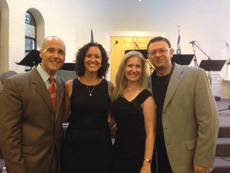
Some 350 community members gathered at Beth Hillel Congregation Bnai Emunah in Wilmette on Sept. 7 to stand in solidarity with Israel through music and by supporting JUF’s Israel Emergency Campaign.
Wondering what he could do to support Israelis during the conflict with Hamas, BHCBE Cantor Pavel Roytman reached out to some of his colleagues and arranged a free concert-fundraiser entitled “Kol Israel Arevim Ze Ba Ze: All Jews are Responsible for One Another.”
Joining Roytman were Cantors Steve Stoehr from Congregation Beth Shalom in Northbrook, Vicky Glikin from Congregation Solel in Highland Park, Andrea Rae Markowicz from Am Shalom in Glencoe and the Kol Zimrah Community Singers, conducted by Richard Boldrey.
The performance raised over $14,000 to the JUF Israel Emergency Campaign and demonstrated the impact that just a few people can have when it comes to building community and supporting Israel.
In addition to this event, 16 other congregations quickly organized IEC events during the recent Israel/Hamas war, attracting over 1,000 community members. To learn more about the Israel Emergency Campaign, or to donate, please visit http://www.juf.org/israelemergency/.
Other stories
-
Meet Andrew S. Hochberg, 2021 Julius Rosenwald Memorial Award recipient
Celebrate Andy Hochberg at the virtual Annual Meeting on Sept. 14
Read more -
Two local teens win national recognition
Recipients of the annual Diller Teen Tikkun Olam Awards
Read more -
Celebrating six young award winners cultivating the community
Introducing young adult award winners
Read more
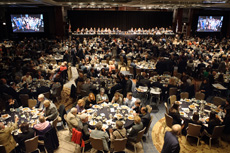
Some 1,300 people hear message of hope for peace and partnership at Federation Annual Meeting
CINDY SHER
After a summer of hardship for the Jewish people in Israel and around the world, the Jewish Federation of Metropolitan Chicago’s 114th Annual Meeting held Thursday at the Hyatt Regency Chicago, reflected the community’s commitment to Jewish life and Israel in the past year—and looked ahead to hopes for peace, light, and partnership in the Jewish year ahead.
Chicago Archbishop Francis Cardinal George, OMI, a longtime friend to the Chicago Jewish community, delivered the keynote address. The Federation also recognized Max “Skip” R. Schrayer, with Federation’s highest honor, the Julius Rosenwald Memorial Award. (View photos from the Annual Meeting.)
The luncheon featured the State of the Federation address by Dr. Steven B. Nasatir, president of JUF/Federation, and the viewing of the 2014 JUF year-in-review. (Read about the morning business meeting.)
David T. Brown, chairman of the Jewish United Fund/Jewish Federation of Metropolitan Chicago, completed a two-year term as Federation chairman. Brown passed the gavel to Bill Silverstein, incoming chairman of the JUF/Federation Board.
Lee Miller received the Shofar Award for his work as chairman of the 2014 JUF Annual Campaign and Sara Crown Star was recognized as the incoming chairman of the 2015 annual campaign. Jodie Berkman chaired the Annual Meeting, while Rabbi Vernon Kurtz, spiritual leader of North Suburban Synagogue Beth El in Highland Park, gave the invocation.
More than 1,300 people attended the luncheon, including city, state, and U.S. official representing all branches of government, as well as local members of law enforcement, a United Way representative, human service colleagues, including a special mention of colleagues from the Refugee Social Service Consortium of the State of Illinois, of which the JUF/Federation is the coordinating agency.
Also in attendance were diplomats in Chicago serving their home countries from Bulgaria, Burundi, Canada, Chile, Dominican Republic, France, Greece, Haiti, Hashemite Kingdom of Jordan, Italy, Japan, Macedonia, Netherlands, the Phillipines, Spain, and Ukraine, and, of course, the Jewish community’s very own Roey Gilad, Israel’s Consul General to the Midwest.
Students from area Hillels as well as from the Bernard Zell Anshe Emet Day School, Chicago Jewish Day School, Chicagoland Jewish High School, Ida Crown Jewish Academy, and Solomon Schechter Day School also attended the luncheon. In addition, students from area Catholic high schools also joined, as well as students and staff from Newman House at the University of Illinois at Chicago.
A Catholic-Jewish friendship
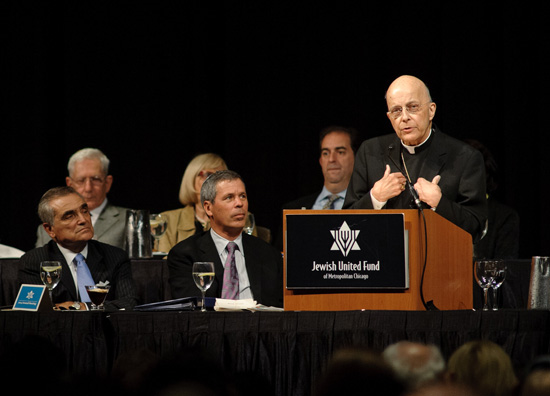
Francis Cardinal George delivers the keynote speech at the Federation Annual Meeting.
Francis Cardinal George, Archbishop of Chicago, was introduced by Chicago Jewish leader and humanitarian Lester Crown.
The Cardinal, who has served as the city’s archbishop since 1997, has dedicated himself to enriching the Catholic-Jewish relationship in the Chicago area and is an ardent supporter of the Catholic-Jewish Scholars Dialogue.
In his remarks, he discussed the growth of friendship and understanding between the Catholics and Jews, especially in Chicago, and the fostering of new beginnings led by popes of the last 50 years. (Watch the Cardinal’s speech.)
The Cardinal outlined the Second Vatican Council—which took place between 1962 and 1965—and shaped the direction of the Catholic Church in modern times. Vatican II passed a number of declarations, focusing on themes of reconciliation. He discussed Nostra Aetate, the declaration that lays out Jewish/Catholic relations, passed at Vatican II.
Cardinal George referred to the array of projects, all stemming from Nostra Aetate, that the Chicago Jewish and Catholic communities have partnered in, such as Israel education, Holocaust education, and work with Hillels on campus.
Catholic High School students and teachers have participated in two Federation sponsored program—one, an ongoing interfaith dialogue between students from Chicagoland Jewish High School, and the other, a project that brought 24 Catholic high school teachers to Israel, who are teaching today about Israel in their classrooms.
“What I’ve learned from Vatican II and from my 17 years as Archbishop of Chicago is that the narrative of Catholic/Jewish relations is best written if we write it together,” said Cardinal George. “This will only happen if we deepen our relationships…you get relationships right and everything else will follow. After the death of Pope John Paul II, [JUF’s] Rabbi Yehiel E. Poupko shared what he was looking for in a new pope and he said simply: ‘Someone who knows us.’ Relationships come first.”
First third-generation Rosenwald honoree
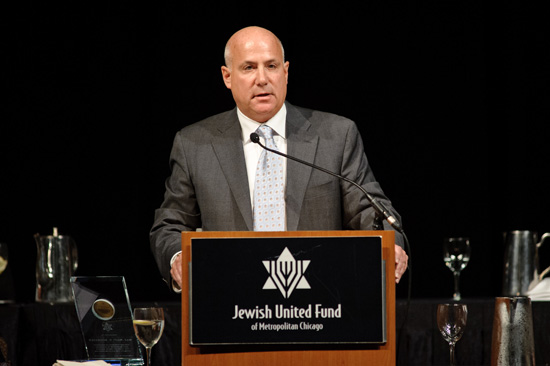
Max “Skip” R. Schrayer accepts the 2014 Julius Rosenwald Award.
Max “Skip” R. Schrayer is the 51st recipient of the Rosenwald Award, named for the iconic Chicago business leader and philanthropist of the early 1900s, and presented annually to a person who has demonstrated a lifetime of exemplary service to the Jewish community. (Watch Skip Schrayer accept the Julius Rosenwald Award.)
The award was presented to Schrayer by his dear friend, David T. Brown, the Chairman of the Federation. “He’s the Skip who sends out “Shabbat Shalom” messages nearly every week. Who follows me and my family on Facebook—and “likes” nearly everything we post. He’s the Skip who…went to school plays to see other people’s kids, when his own children weren’t even in the show,” Brown said. “…He approaches every situation with intelligence, sincerity, kindness, and sensitivity. He truly is a treasure to me, and to our community.”
Schrayer is the first third-generation recipient of the Julius Rosenwald Memorial Award, following in the philanthropic and leadership footsteps of his grandfather, Max, and father, Robert. In his remarks, Schrayer talked about carrying on the legacy of his grandparents and parents to make the world a better place through his work in the Jewish community. “Our dinner conversations were pepped with discussions of who was taking active roles in our community and who were making meaningful gifts,” he recalled. “My sisters and I were taught to admire people of means who shared their bounty and time—as opposed to people who just made a lot of money.”
Schrayer—who runs his family insurance business—has been a leader in the Federation community for more than three decades, serving a variety of roles, including chairman of the board, chairman of the 2006 Annual Campaign, the current chairman of JUF’s Jewish Community Relations Council, as well as key posts with national and international Jewish humanitarian and communal organizations. Abroad, for instances, in 2002, he co-founded the Federation’s Nachshon Mission, which annually travel to Israel other countries where JUF provides support and service. He has held roles with the Jewish Federations of North America, the National Conference on Soviet Jewry, and the American Jewish Joint distribution Committee. Closer to home, he’s been an active supporter of Solomon Schechter Day School, Chicagoland Jewish High School, and North Suburban Synagogue Beth El.
He spoke to the wisdom that he’s learned along his journey so far, including balancing life in terms of family, work and community; walking the walk; the power of the Jewish people to take care of each other; and the power of the collective and federated giving. “Our world is changing from the collective to individuals,” he said, “but we need to remind ourselves that we do things collectively that we cannot accomplish individually.”
A president calls for a global partnership to ‘defeat evil’
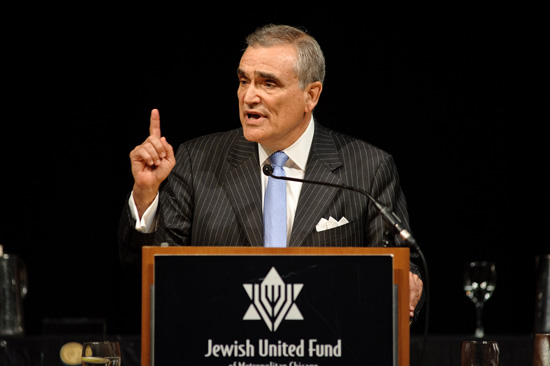
JUF/Federation President Dr. Steven B. Nasatir delivers his annual State of the Federation address.
In his state of the Federation address, Nasatir reflected on the vital work that the Federation and its agencies have done this past year, during a year of challenges in Israel and around the world. (Watch the State of the Federation address.)
This work is all possible thanks to an increased JUF annual campaign, which last year raised $81.54 million. This past year, the Federation board allocated $193 million from all sources to create Jewish experiences, build community, and help Jews in need here, in Israel and around the world.
Here in Chicago, among the many accomplishments was the new Breakthrough Fund, in which JUF invested $1 million into 17 cutting-edge local programs and initiatives in the Jewish nonprofit sector. The Day School Guarantee Trust Fund continues to provide extra dollars into day schools on top of the funds that come through the Annual Campaign. The Community Foundation for Jewish Education is under new leadership and the JCFS and JVS have created an alliance, and the JCCs are expanding, and the reach of CJE SeniorLife to the elderly and Holocaust survivor community is widening its service. “Everywhere you look in this community, we are uplifting the lives of children, families, young adults, and seniors, helping peopled express their American values with rich Jewish context,” Nasatir said.
Beyond our shores, the JUF/Federation is helping to repair a very broken world. In Ukraine, our community is helping to provide a safety net to the nearly 200,000 Jews living there. And Russia is by no means the only trouble spot.
Israel dominated the Jewish world’s focus this past summer. Nasatir recalled being in Israel in June when the three boys were abducted by Hamas. “I witnessed an entire country come together as one mishpacha—one family—to search, to pray, and to resolutely protect their children from harm,” he said.
JUF/Federation raised more than $9 million raised in emergency aid to Israel, as Hamas put civilians in the line of fire to sway public opinion. Nasatir said that the goals of Hamas are clear—to wipe Israel, and the Jews, off the map.
He blamed the western media for doing little to convey “the true nature of Hamas” and the context of the Gaza conflict. “Let me be clear, the death of innocents troubles everyone of conscience,” he said. “No country in the world at time of war does more than Israel to protect innocents. They and we believe all life is sacred. But, let the blame go where it belongs…”
The threat to Israel is the same poison that threatens America, said Nasatir. “…The reality of the threat that Israel faces from Hamas and Hezbollah is the exact same threat that America and the world faces from the likes of ISIS and Al Quaeda, and all the other theocratic, genocidal groups,” he said. “They all hate America and Israel because both are free, democratic, liberal and respectful of all religions.”
He suggested that there is something different about this conflict, which was expressed in an explosion of anti-Semitism around the world—particularly in France as well as Germany, England, Sweden, Belgium, and throughout much of Europe—where action and rhetoric changed from anti-Israel to anti-Jewish.
Anti-Jewish sentiment isn’t limited to Europe. Here at home, the demonization of Israel plagues Chicago streets, and anti-Semitism is reaching a boiling point on college campuses, just kicking off a new school year.
But it’s not only Jews, he said, persecuted for their religion. The Vatican, he said, reported that 100,000 Christians were killed worldwide, including in Syria and Iraq, because of their faith, with hundreds of thousands more persecuted and driven from their homes.
He recognized Cardinal George and other Catholics in the audience and talked about the growth in friendship and understanding between the two communities. “Your Eminence, you personify, as does Pope Francis, the essence of good relations between our communities,” Nasatir said. “You are a great friend in word and in deed.”
Then Nasatir suggested that the relationship between Jews and Catholics in Chicago serve as inspiration for a model between Jews, Christians, and Muslims, and others of goodwill who face the threat of religious radicalism.
As he prays for a peaceful new year ahead, he sounded the call for a new kind of global partnership—starting in Chicago—to forge a religious coalition to take on brutal radical terrorists. “Together, let us confront the resurgence of anti-Semitism,” Nasatir said. “Together, let us act on the shared values of our faith traditions and tell those who are threatened that they will not be abandoned. Together let us insist that the world protect the innocent and defeat the evil that endangers decency in our time…Let us pray for peace.”
Other stories
-
Meet Andrew S. Hochberg, 2021 Julius Rosenwald Memorial Award recipient
Celebrate Andy Hochberg at the virtual Annual Meeting on Sept. 14
Read more -
Two local teens win national recognition
Recipients of the annual Diller Teen Tikkun Olam Awards
Read more -
Celebrating six young award winners cultivating the community
Introducing young adult award winners
Read more
Jewish Federation business meeting honors rising leaders, spotlights young family outreach
JESSICA LEVING
The Jewish Federation of Metropolitan Chicago’s 114th Annual Meeting, held Sept. 11 at the Hyatt Regency Chicago, featured a keynote address by Archbishop Francis Cardinal George, OMI, and recognized Max “Skip” R. Schrayer, of Highland Park, for his lifetime of service to the Jewish United Fund/Jewish Federation of Metropolitan Chicago and the global Jewish community.
The morning business meeting opened with the unanimous election of the 2014-15 JUF/Federation board, while outgoing directors were honored for their service. (Read about the afternoon luncheon program.)
Following the election, several prestigious awards were presented to promising community leaders.
Davis, Gidwitz and Glasser Young Leadership Awards
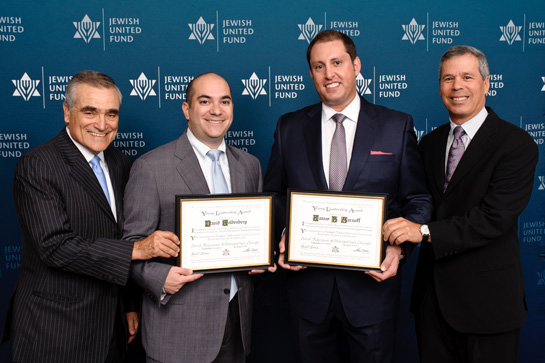
(Left to right) Jewish Federation President Steven B. Nasatir, Davis, Gidwitz, and Glasser Young Leadership Award recipients David Goldenberg and Jimmy Sarnoff, and Federation Chairman David T. Brown.
David T. Brown, JUF/Federation chairman, presented the 50th annual Davis, Gidwitz and Glasser Young Leadership Award to David Goldenberg and Jimmy Sarnoff. The award honors young volunteers who have demonstrated exemplary dedication and made significant contributions to Chicago’s Jewish community.
David Goldenberg: Shaping Jewish journeys
Goldenberg, 35, of Highland Park, is currently serving his third year on the board of JUF’s Young Leadership Division, as well as on JUF’s Communications & Marketing Committee and the Contributor Account Relations Committee. He served as YLD Campaign Chair in 2013 and is a former participant in YLD’s Gesher leadership program. Goldenberg is also a member of the Jewish Federations of North America’s National Young Leadership Cabinet.
Outside of JUF, Goldenberg has worked with many other Jewish organizations, including as a former Hebrew school teacher, BBYO advisor, AIPAC supporter, and trustee of Michigan State University’s Hillel. In 2012, Goldenberg was named to YLD and Oy!Chicago’s annual “36 Under 36” list in honor of his many commitments to the Jewish community.
In his remarks, Goldenberg spoke about the vital role that the Jewish United Fund has played in shaping his Jewish journey.
“Where else can you impact virtually every corner and facet of Jewish life? Where else can you collectively build and strengthen our community? Where else can you have so many diverse experiences like me, yet a common thread and contributor throughout? … JUF’s commitment to building a Jewish community is second to none,” Goldenberg said.
Professionally, Goldenberg is the Executive Vice President of Resolute Consulting.
Jimmy Sarnoff: Keeping the Jewish community strong
Sarnoff, 36, of Lincoln Park, joined the YLD board in 2009, where he served as YLD Campaign Chair in 2012 and later as YLD Division President. Sarnoff also chaired YLD’s largest Big Event Fundraiser to date featuring comedian Jimmy Fallon, and founded the now-annual YLD Golf Tournament.
In addition, Sarnoff is a former participant in YLD’s Gesher leadership program, and was chosen to participate in JUF’s inaugural Jewish Leaders Institute cohort. He has traveled with several JUF missions abroad, including co-chairing the 2014 Nachshon mission to St. Petersburg and Israel, and currently serves on JUF’s Contributor Account Relations Committee. He is also a member of the Jewish Federations of North America’s National Young Leadership Cabinet. In 2012, he was named to YLD and Oy!Chicago’s annual “36 Under 36” list in recognition of his achievements.
Sarnoff’s acceptance speech was a call to action stressing the importance of a strong Jewish community in today’s changing world.
“Our work is more important now than it has ever been. The Jewish people are not only fighting wars in Israel, but wars in our own country. I am talking about a different kind of war that past generations didn’t have to deal with – I’m talking about a social networking war,” he said in his remarks. “It is up to all of us to fight back and educate the world that never again will we let our people fall. Nobody is going to help the Jews but the Jews ourselves.”
Professionally, Sarnoff is an attorney with Sarnoff & Baccash.
Samuel A. Goldsmith Awards
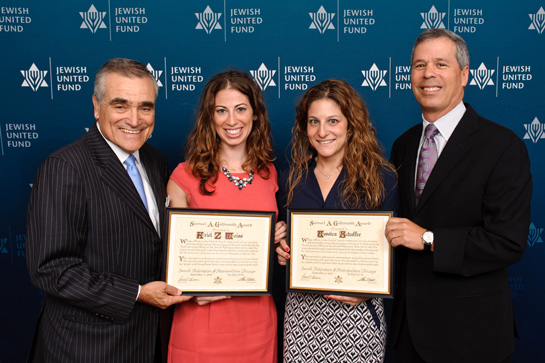
(Left to right) Jewish Federation President Steven B. Nasatir, Samuel A. Goldsmith Award winners Ariel Zipkin Weiss and Jessica Schaffer, and Federation Chairman David T. Brown.
Jessica Schaffer and Ariel Zipkin Weiss received the 26th annual Samuel A. Goldsmith Award, given to exceptional young professionals who have shown outstanding performance at a Jewish agency in the Chicago area.
Jessica Schaffer: Embracing diverse narratives
Schaffer, 29, of Edgewater, is the Safer Communities Project Coordinator at Jewish Child and Family Services, where she works to prevent and combat abuse in the Chicagoland Jewish community. In that role, Schaffer has developed training curricula for the Safer Communities program, which have been critical to helping schools and synagogues implement new safety protocols. Under her leadership, the Safer Communities Initiative has become one of the most comprehensive programs of its kind in the country.
Accepting her award, Schaffer spoke about the importance of embracing the diversity of the Jewish community, and keeping cultural differences in mind when doing outreach work.
“To be and to have a strong, safe Jewish community, we need to celebrate diversity, promote diversity, and provide for diversity,” Schaffer said in her remarks. “We need to embrace the many narratives that make us whole – for if we don’t we risk misunderstanding, and the opportunity to build strong, healthy relationships.”
Ariel Zipkin Weiss: Passion for tikkun olam
Weiss, 30, of Lincoln Park, was recently promoted to Director of Donor Engagement at JUF, where she formerly served as Director of YLD. During her tenure, she has launched dozens of new programs and initiatives. A recent YLD event that Weiss organized, the Blue and White Bar Night, attracted over 800 people last spring – an 80 percent increase over the previous year. She has also served as the lead professional for the past three Big Event Fundraisers, which were enormously successful and broke both fundraising and attendance records.
In her remarks, Weiss credited her work at JUF for providing her with a sense of identity, community, and a place to put her passion for tikkun olam to work.
“What the Federation does in Chicago affects the entire world,” she said. “I have seen how tenant support prevents homelessness; how Holocaust survivors have a safety net to live out their lives with dignity; how a hungry mother receives food assistance for her family. In Ukraine, I visited a summer camp where Jewish life thrived. This is Jewish revitalization at its best, and it is taking place all over the world – in struggling Jewish communities, in places where Hitler committed to Jewish destruction, in places where pogroms were prominent. The impact of what we do spans the globe, and I am privileged to play a small role in it.”
JUF Young Families: Planting the seed
The business meeting culminated in a showcase of the work of JUF Young Families, JUF’s department focused on engaging families with children under the age of eight.
“Parents are looking for connections at this stage in their family life and they would like to get that within the Jewish community,” said Deborah Cooper, assistant vice president, Young Family Engagement.
Several JUF agencies and programs presented updates on their work to engage these families, including jBaby Chicago, JUF Right Start, PJ Library, Sinai Preschool and the Harold Grinspoon Foundation, one of the generous funders of JUF’ work in this area.
Deborah Schrayer, JUF Board member and chair of JUF’s Community Outreach and Engagement Committee, explained that “today’s families with young children look differently than they have in the past…and the world they operate within looks different, too. To find and connect with these families, we need to understand their thoughts and behaviors. We must be willing to change up our traditional approaches and programs if we, the Jewish community, want to appeal to them.”
JUF’s Young Family programs have had a tremendous impact on the community. Since 2009, over 40,000 parents, grandparents and children have connected to JUF through PJ Library, jBaby Chicago & JUF Right Start. Further, 85 percent of JUF Right Start recipients, whose children attend Jewish preschool feel closer to the Jewish community and 3 in 4 families, say that being a part of PJ Library has enhanced their family’s Jewish life.
Other stories
-
Meet Andrew S. Hochberg, 2021 Julius Rosenwald Memorial Award recipient
Celebrate Andy Hochberg at the virtual Annual Meeting on Sept. 14
Read more -
Two local teens win national recognition
Recipients of the annual Diller Teen Tikkun Olam Awards
Read more -
Celebrating six young award winners cultivating the community
Introducing young adult award winners
Read more