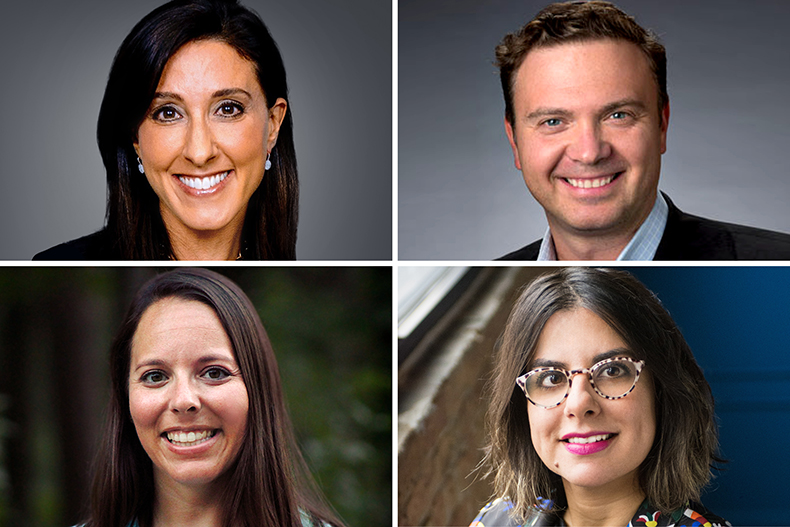
Prior to the Jewish Federation’s Annual Meeting at noon Thursday, Sept. 13, the Federation will hold its Business Meeting and Members’ Forum featuring the presentation of the Davis, Gidwitz & Glasser Young Leadership Award and the Samuel A. Goldsmith Young Professional Award.
Marisa Helfgot Mandrea and Alex Turik will receive the Davis, Gidwitz & Glasser Young Leadership Award, presented to volunteers age 40 and under who have demonstrated exemplary dedication and have made significant contributions to Chicago’s Jewish community.
Marisa Helfgot Mandrea has been a member of the Young Women’s Board of JUF for eight years and had served as the Vice President of Campaign, Area Development, and Community Outreach and Engagement. She was a participant in the second cohort of the JUF’s Jewish Leaders Institute. Marisa is also a Vice Chairperson for the JCC Board of Chicago and JCC Women’s Board.
Alex Turik is the immediate past Chair of JUF’s Russian Jewish Division Advisory Board. He is the first Russian-speaking member of the JUF/JF Board of Directors and also serves on the Jewish Federations of North America’s National Young Leadership Cabinet. In 2009, Alex co-founded the Russian Jewish Leadership Forum (RJLF) initiative, which later became JUF’s Russian Jewish Division.
Davis, Gidwitz & Glasser Award honorees have the opportunity to attend the annual General Assembly of the Jewish Federations of North America, which this year takes place in Israel Oct. 22-24.
Elizabeth Robbin and Irene Lehrer Sandalow will receive the 31st annual Samuel A. Goldsmith Young Professional Award, honoring Jewish professionals whose exemplary performance in their work at a Jewish agency in the Chicago area has benefited the entire Jewish community.
Elizabeth Robbin is the Director of Camp Firefly, an overnight camp for campers with Autism and other related social disorders. Camp Firefly is a partnership program between JCFS and JCC Camp Chi. In addition to working at Camp Firefly, Liz has worked for over twelve years as a speech-language pathologist. Elizabeth also serves on the Camp Chi Alumni Committee and was a member of the Anti-Defamation League’s Glass Leadership Institute. In 2016, Liz was named one of Chicago’s “36 under 36” by YLD and Oy!Chicago.
Irene Lehrer Sandalow is the founder and director of SketchPad, a Jewish shared workspace and community for innovative, mission-driven Jewish organizations and entrepreneurs. Previously, Irene was the Chicago Senior Project Manager of URJ’s B’nai Mitzvah Revolution, she founded the Parent to Parent Initiative at The Jewish Education Project, and she worked at the Jewish Council on Urban Affairs (JCUA) where she educated, mobilized, and organized members of the Jewish community in local and national social justice campaigns. Irene now serves on the board of directors for JCUA and SVARA.
The business meeting will begin at 10 a.m. and is free to attend. It will be followed by a lunch session featuring the report of the President, Dr. Steven B. Nasatir; presentation of the Julius Rosenwald Memorial Award to Andrea R. Yablon; and special reports. Luncheon charge is $45 per person; $25 for senior citizens, rabbis, Jewish communal professionals, and students.
For information, call (312) 444-2095 or email [email protected] .
Register online at www.juf.org/AnnualMeeting .
Other stories
-
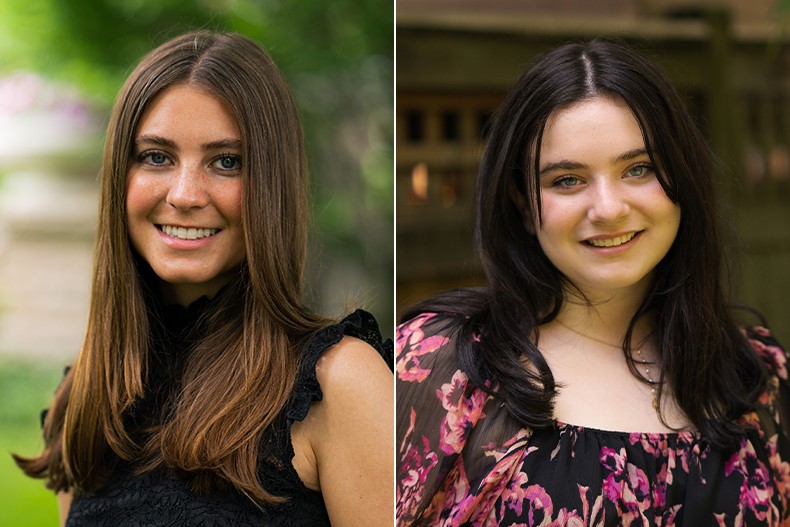
Two local teens win national recognition
Recipients of the annual Diller Teen Tikkun Olam Awards
Read more -
Celebrating six young award winners cultivating the community
Introducing young adult award winners
Read more -
JUF and day schools partnership builds a foundation for the future
Joel Schatz
It’s expensive to teach our kids. And vastly more expensive not to.
For the Jewish community in Chicago, and worldwide, Jewish day schools have been critical to conveying Torah and our traditions, beliefs, and values to the next generation, and generations beyond them. And they are essential to developing our future leaders.
Over the past decade alone, JUF has provided more than $50 million to Chicago-area Jewish day schools that span the denominations. This year’s allocation totaled nearly $3.2 million to 15 schools, with another $1.5 million coming from the Jewish Day School Guaranty Trust Fund, a Jewish Federation endowment that has distributed nearly $19 million since it was created.
Beyond those dollars, JUF has nurtured relationships within and among the schools; provided resources that have significantly improved teacher training; streamlined administrative operations; created resources for students needing specialized services; offered training and facilitated grant requests to upgrade security; and administered some $80 million in loan guarantees that made new school buildings and classrooms possible, while reducing the cost of financing them.
“Day schools are vital to the continuity of our people and the Jewish community,” said JUF President Steven B. Nasatir. “And the unique partnerships we have here in Chicago, between JUF and the schools, and among our incredibly diverse schools themselves, has given us the precious opportunity to strengthen our schools, our community and, most importantly, the future of our children.”
Joel Schatz is the director of News and Information for the Jewish United Fund of Metropolitan Chicago.
Other stories
-
Two local teens win national recognition
Recipients of the annual Diller Teen Tikkun Olam Awards
Read more -
Celebrating six young award winners cultivating the community
Introducing young adult award winners
Read more -
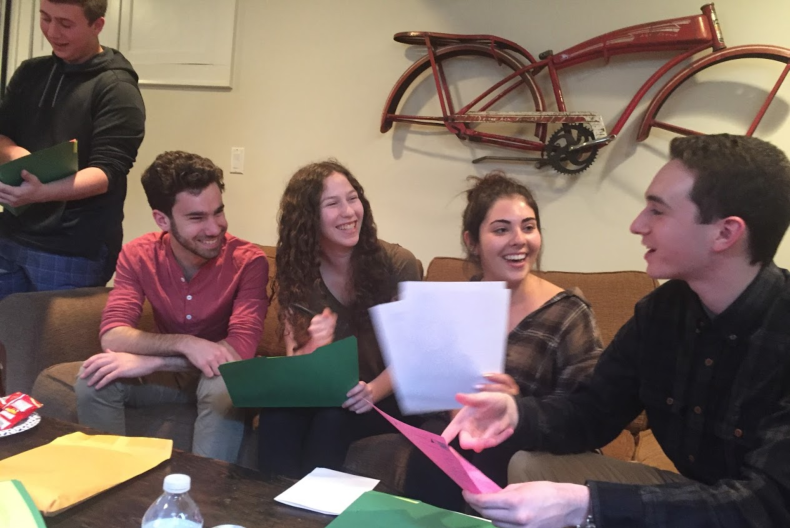
Doing good. Sometimes, it’s a two-way street.
Each year, the high school students of Voices: The Chicago Jewish Teen Foundation learn how to give money away. To make their community, and their world, a bit better.
In the process, the lessons the students learn are, by their own account, priceless.
“In my life now, I have a different outlook,” said Abbey Finn, who this past year was sophomore at Buffalo Grove High School. “I know how to read a budget. I understand the story behind the numbers. I can see the back story that I couldn’t before.”
During the first year of the program, known as Voices 101, two dozen teens spend a full school year learning how to create and run an actual foundation. To kickstart the effort, they get $25,000 from an anonymous donor.
Then they raise additional funds. Decide the foundation’s priorities and requirements. Request proposals from charities seeking funds. Review and winnow down the requests. Analyze the details and budgets of each one. Question the finalists face to face during site visits. Champion the causes nearest and dearest to them. Make final decisions about which efforts should be funded, and for how much. And finally, actually award the grants.
Through the entire process, they learn Jewish values and concepts of charity, and figure out how they apply to the real-world decisions they are making.
“I’ve never seen a program that enables teens to do this,” Finn said, “where we are treated like adults and given such power and opportunity.”
Teens who continue in the program become Voices Alumni, further honing their philanthropic skills, raising the funds on their own (with the help of a matching grant), and mentoring the 101 students.
“I’ve been in Voices three years,” said Jeremy Stein, who recently graduated from Glenbrook North, and is now headed to Miami University in Ohio. “Each year I learn more about making an impact as a person of the Jewish faith. We’re fortunate to be able to do these things, to help people who can’t.”
“It’s connected me with all of these other Jewish teens from all over the Chicago area who I never would have met,” said Carly Colen, who this past year was a Buffalo Grove junior. “They all want to give back.”
While the teens in Voices gain invaluable life and business skills, the greatest impact comes from experiencing first hand the good they are doing, and the effect it has on people’s lives.
The story of one woman in particular stuck with Jacob Kline, a Lane Tech sophomore this past year. Six of the woman’s friends contacted SHALVA, the Jewish community’s domestic violence program. The agency explained that, in order for SHALVA to help, the woman needed to make the contact herself.
But rather than leaving it there, Kline said, SHALVA helped her friends discuss the situation and options with her, which allowed her to seek help on her own.
“SHALVA was able to not only help the woman, but help her friends help her,” Kline said. “That went above
and beyond.”
Stein, the Glenbrook North alumni member, said that for three years he has supported funding overnight camp scholarships for students in Keshet, a program that promotes the inclusion of children and young adults with developmental and learning challenges.
“I’ve been able to see the impact these scholarships have,” he said, “because I’ve been a camper and counselor there. I love what they do.”
When Max Marino, a Highland Park High School junior last year, was in his first year of Voices, the group provided start-up funding for a project called Gendernauts, a Jewish Child & Family Services effort to provide a safe space and counselors for LGBTQ teens and those questioning their gender.
“A couple of weeks later,” Marino said, “I saw an ad on Facebook saying ‘Graciously Funded by Voices.’ We had funded this incredible thing. It made me very happy.”
Voices: The Chicago Jewish Teen Foundation 2017-18 Grants
SHALVA, Night Therapy
SHALVA offers confidential domestic abuse counseling services to the metropolitan Chicago Jewish community in a culturally sensitive and caring environment. This grant will support additional therapists to see clients in evening hours.
Response, Mental Health Services for Teens
Response provides prevention, outreach, counseling, and sexual health services in a teen-friendly environment that empowers youth to make healthy life choices.
The ARK, Dental Clinic
The ARK is a nonprofit social service agency that provides medical care, food, and other basic necessities to more than 4,000 families throughout the Chicago area. This grant will support its free Dental Clinic.
The Illinois Holocaust Museum & Education Center, Teaching Trunks Program
The Museum is dedicated to preserving the legacy of the Holocaust by honoring the memories of those who were lost and by teaching universal lessons that combat hatred, prejudice, and indifference. This grant will support the Teaching Trunks Program, an experiential teaching mechanism that engages under-funded schools in Holocaust education and awareness.
Holocaust Community Services, Financial Assistance
Holocaust Community Services helps ensure that Chicago-area survivors and their families continue to live independently and with dignity. This grant will provide financial assistance for necessities like utilities, food and other life-sustaining needs.
JUF, Annual Campaign
The Annual Campaign is the primary resource powering JUF’s support of more than 100 agencies and programs, including Voices.
Voices Alumni: $30,180 Awarded
Keshet, Camp Keshet
Guided by traditional Jewish values, Keshet provides educational, recreational, vocational, and social programs for Chicago-area individuals with intellectual disabilities. This grant will provide nine financial-need scholarships to families sending their kids to summer camp this year.
EZRA, JUF Uptown Cafe & Food Pantry Program
EZRA’s services alleviate homelessness, hunger, unemployment, and other barriers to self-sufficiency, while ensuring that Jews who live in poverty remain actively connected to their heritage. This grant will provide hot meals and bags of groceries through the JUF Uptown Cafe & Food Pantry programs, which feed hundreds of people each year.
Illinois Safe Schools Alliance, Action Camp & Youth Engagement
The Alliance promotes safety, support, and healthy development for LGBTQ youth in Illinois through advocacy, education, youth organizing, and research. Action Camp is a 5-day sleepaway camp that brings together young leaders from across the state to sharpen their critical lens, strengthen their own anti-oppressive frameworks and actively skill-share and practice what it means to create spaces where all identities are safe, supported, affirmed, and celebrated.
Jewish Vocational Services, Job Coaching Support for Youth and Adults with Disabilities
JVS provides career counseling, job skills training, job referrals, financial literacy, small business development, and more. This grant will support job coaching for youth and adults with disabilities.
JCC, J at School Program
J at School offers year-round after-school, before-school, enrichment, School’s Out, and Adventure Camp programs. Staff guide children through entertaining and academically enriching activities, assist with homework, and provide a nurturing, safe environment where kids can learn and grow. This grant will subsidize the cost for dozens of students.
JUF, Annual Campaign
The Annual Campaign is the primary resource powering JUF’s support of more than 100 agencies and programs, including Voices.
Total 2017-18 Grants: $60,730
Joel Schatz is the director of News and Information for the Jewish United Fund of Metropolitan Chicago.
Other stories
-
Two local teens win national recognition
Recipients of the annual Diller Teen Tikkun Olam Awards
Read more -
Celebrating six young award winners cultivating the community
Introducing young adult award winners
Read more -
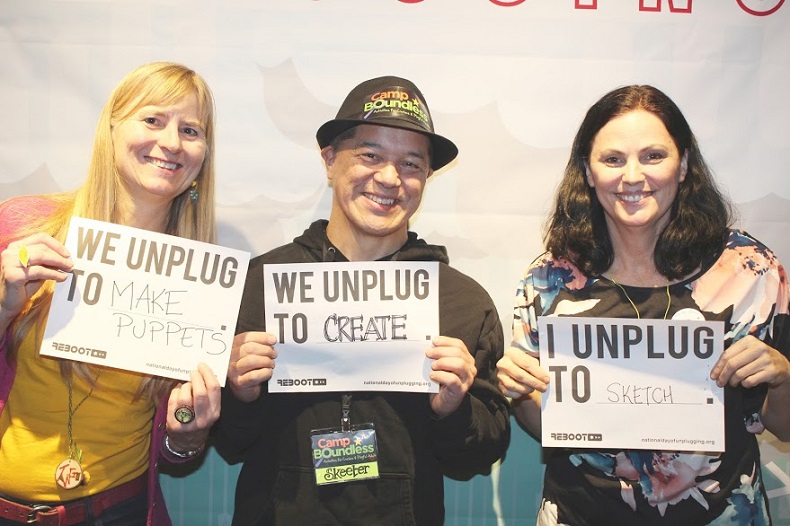
During the 10 days between Rosh Hashanah and Yom Kippur, more than 40,000 people across the world will receive an email from Reboot’s “10Q” project.
The daily emails pose questions of reflection, engaging people in the Jewish High Holiday tradition by meeting them where they are-online. Questions include “Describe one thing you’d like to achieve by this time next year?” and “What is a fear you have and how has it limited you? How can you overcome it?” At the end of the 10 days, participants’ answers are locked in a digital vault and returned next year for the process to begin anew.
10Q is one of several creative initiatives of Reboot, a think-tank dedicated to making Jewish concepts accessible through the arts, humor, comedy, and writing.
“[Our programs are] really DIY, so we aren’t telling anyone how to connect to Judaism,” said Becky Adelberg, Reboot’s local program coordinator in Chicago. “We’re just showing them all these different ways that they can [connect], so that hopefully a few will resonate. It’s very accessible.”
10Q is one of Reboot’s eight signature programs. Others include Death Over Dinner-Jewish Edition, which encourages people to host dinners and have guided conversations about death and grieving, and the National Day of Unplugging, a 24-hour period dedicated to embracing the values of Shabbat and detoxing from electronics.
“People like the concept of unplugging, and then they look further, and realize, ‘Oh, this is a really Jewish concept,'” Adelberg said.
Reboot is piloting two programs in Chicago: Death Over Dinner, and The Last Act, an initiative where people in their 20s and 30s create short documentaries featuring interviews with seniors, ages 80 and older.
Original programming isn’t Reboot’s only mission. Adelberg strives to connect with existing organizations. In the last year, Reboot has partnered with more than 50 young adult groups, synagogues, and other communities.
“I’m providing really cool tools other organizations can use to enhance their programming and events,” Adelberg said. “There are multiple ways people can work with us in Chicago. The goal is to have people use our material in any way that works for them.”
JUF’s Young Leadership Division (YLD) has partnered with Reboot on three events, including a YLD Pride Shabbat dinner in the spirit of the National Day of Unplugging.
“Reboot is great for the Chicago Jewish community because they provide people different ways of thinking about their own Jewish connections and identity,” said Hanna Holman, YLD Campaign Associate. “Reboot is a great supplement for programming and helps everyone find a place where Judaism can fit into their life.”
Other stories
-
Two local teens win national recognition
Recipients of the annual Diller Teen Tikkun Olam Awards
Read more -
Celebrating six young award winners cultivating the community
Introducing young adult award winners
Read more -

From multi-media to mission-driven—and what I’ve learned along the way
ELIZABETH ABRAMS
It’s taken me 40 years to embrace the fact that I am a planner.
In high school, I knew where I wanted to go to college and what I wanted to study. In college I set my sights on working at large, global media companies and ultimately spent the better part of two decades working at ABC, CBS, and Harpo Studios. So, when a close friend told me about a job at JCC Chicago, my first reaction was a big pause. This was not in my plan.
Age, and with it, some wisdom, has also taught me to embrace life’s biggest surprises, because with those surprises can come some of the greatest gifts. When I started working in the Marketing and Communications Department at JCC Chicago in the Fall of 2015, I really had no idea what to expect; how I could impact the organization and how my new role could affect me. The impact of working for a Jewish, mission-driven organization continues to surprise me, inspire me, and fulfill me in some of the most unexpected ways.
A few weeks ago, while standing in the parking lot of Westfield Old Orchard mall on a steamy summer morning, I gathered with scores of anxious and emotional parents-that iconic picture of Lamers buses ready to transport the next generation of kids up to JCC Camp Chi. I’ve done this twice before with my oldest daughter, so that combination of heart-pounding excitement and stomach pit sadness was not new for me.
However, on that particular morning, I was not there with my own children. Instead, I was there as a JCC volunteer to ensure everything ran smoothly and every camper was on the bus, ready to go. Being there without my own family was like watching a movie filled with every intense emotion-something I hadn’t previously noticed at the buses when preoccupied with my own kids.
Along with every excited, anxious parent was a child, or two, or three, filled with his or her own mix of emotions. There were first time campers, older returning campers, campers with special needs, and campers who had already driven hundreds of miles from their homes out of state to meet the bus.
This moment, for each of these children and their parents, was huge. Huge. It was evident that for some kids, this very day might have been the biggest in their lives so far. Free from the worry about getting my own kids on the bus, I took it all in-even calming some nervous parents and reassuring a few hesitant kids. As the buses pulled away, I stood there alongside the other parents, waving, smiling, heart-pounding, so proud of those kids and so proud to be part of an organization that makes experiences like this happen.
Where I work, moments like these, big and small, fill the weeks, months, and ultimately the years. And my not-in-the-life-plan job lets me be part of these experiences in so many ways. My not-in-the-life-plan job allows me to connect with the community every day, to be part of enriching one person’s life and on a really, really good day, impact thousands.
My not-in-the-life-plan job continues to challenge me professionally. It’s offered me the chance to partner with some of the most talented people with whom I ever worked-people filled with passion, dedication, and boundless creativity. Like every other job I’ve had, this one has kept me up at night, brought some long, grueling hours and deadlines that seem to never go away.
This wonderful, challenging, thrilling work I get to do continues to amaze and fulfill me. This job was not in the plan, but every day it feels like this is exactly where I am supposed to be.
Elizabeth Abrams is the director of Program Marketing for JCC Chicago.
Other stories
-
Two local teens win national recognition
Recipients of the annual Diller Teen Tikkun Olam Awards
Read more -
Celebrating six young award winners cultivating the community
Introducing young adult award winners
Read more -
Israeli organization trains Bronzeville faith, community leaders in trauma resilience
Abby Seitz
During a 2013 trip to Israel, a lightbulb went off in Pastor Christopher T. Harris, Sr.’s head when he visited NATAL, an Israeli NGO that seeks to advance the resiliency of Israeli society by addressing trauma.
When Harris, the spiritual leader of Bright Star Church in Chicago’s Bronzeville neighborhood, learned about the trauma Israelis experience from war and terror, he drew parallels between the communities on the South and West Sides of Chicago and Israeli cities near Gaza.
“One of the things that plagues Chicago is not only violence, but lack of access to mental health resources and facilities,” Harris said. But five years ago, “nobody was talking about trauma. If they talked about it, it was so minor it had absolutely no traction or attention.”
In NATAL, he saw a model for mental health treatment to address community trauma.
Upon his return to Chicago, the pastor reached out to NATAL, hoping to facilitate a partnership between Bright Star Church, Bright Star Community Outreach (BSCO), and NATAL, with the goal of identifying, training, and certifying faith leaders to provide trauma counseling based on the NATAL model.
NATAL professionals have traveled to Chicago twice, including early this summer, to assess the situation and explore possibly synergies between NATAL and the Bronzeville community.
The professionals saw many similarities between Israel and Chicago, according to Dr. Sigal Haimov, NATAL’s director of professional programs and model development.
“People react and cope with trauma the same way, and resilience is built the same way,” Haimov said. “When we came here, we realized there are many similarities between Israeli-Jewish culture and African-American culture, in terms of history and the multi-generational trauma we carry.”
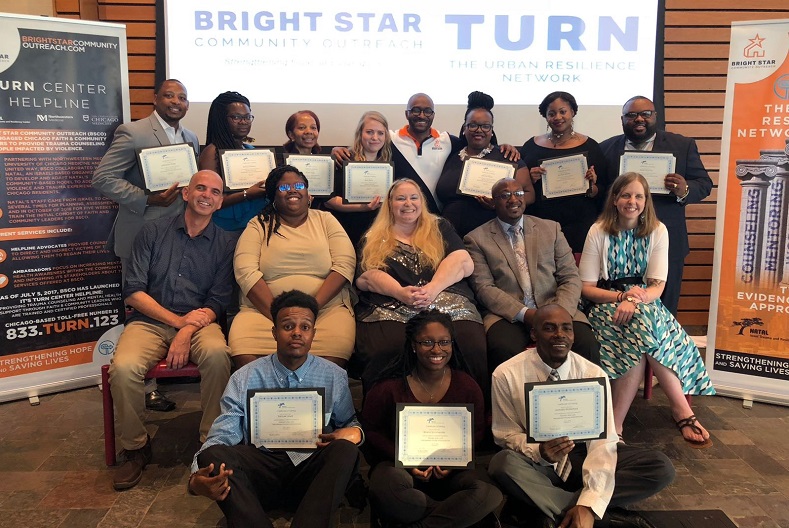
BSCO and NATAL worked together to create The Urban Resiliency Network (TURN) Center, a branch of BSCO’s work addressing systemic issues in Bronzeville.
In late 2016, the TURN Center held its first five-week training for clergy in Chicago. A second cohort of religious, mental health, and community leaders completed the training in July, with a focus on the impact of trauma and how to heal from it.
“Part of what we teach them as individuals is that seeking help isn’t weakness-it’s a strength, and it’s a domino effect,” Haimov said. “Once you work with this group, they deliver the message throughout the community.”
The training allowed the leaders to address their own personal traumas, some for the first time.
Through NATAL’s training, Pastor Albert Simmons, of First Paradise Baptist Church, discovered the importance of self-care. “In my vocation, everyone expects you to give them an answer,” he said. “I was there for everybody, not realizing I was neglecting myself. I realized that in order for me to help someone else, I had to first be whole myself.”
The 22 leaders who went through NATAL’s training have reached more than 12,000 people with messages of mental health awareness. In addition to public advocacy and education, the TURN Center operates a toll-free helpline. To date, 40 Chicagoans have received counseling, referrals to clinicians, and assistance with other needs, such as finding a job or housing.
JUF has been a proud supporter of NATAL’s trauma intervention and resiliency programs for years, which is a source of pride for Skip Schrayer, who is both a longtime JUF board member and a BSCO board member.
“It’s so easy for me to live in Highland Park, read the paper on Monday, and say, ‘tsk’ about how many people were shot over the weekend-but it made me uncomfortable-and I felt we all needed to be part of a solution,” Schrayer said. “When I met Pastor Harris, I was inspired and excited that I can work in partnership with Israel, the Chicago Jewish community, and the Chicago African-American community to help fix this.”
While many of NATAL’s resources in Israel have translated to Chicago, some differences remain.
“A lot of the trauma they have been addressing in Israel is different than here,” Harris said. “We don’t have missiles, we have bullets. It’s the same result-a missile can destroy a family, a home, a body, but we don’t have 15 seconds of a warning. It’s a drive-by shooting. You can be standing there and not even be the target. We don’t have a place to run.”
Despite Chicago’s unique challenges, the partnership has strengthened the ties between Chicago’s Jewish and black communities. “If you want to impress me, don’t show me another picture of Dr. King and Rabbi [Abraham Joshua] Heschel,” Harris said. “Let’s keep the old frame and put in new pictures of us doing work together. This work allows us to do that.”
For more information on Bright Star Community Outreach, visit BrightStarCommunityOutreach.com .
Other stories
-
Two local teens win national recognition
Recipients of the annual Diller Teen Tikkun Olam Awards
Read more -
Celebrating six young award winners cultivating the community
Introducing young adult award winners
Read more -
Gubernatorial candidates J.B Pritzker, Gov. Rauner address community leaders
AYELET SHEFFEY
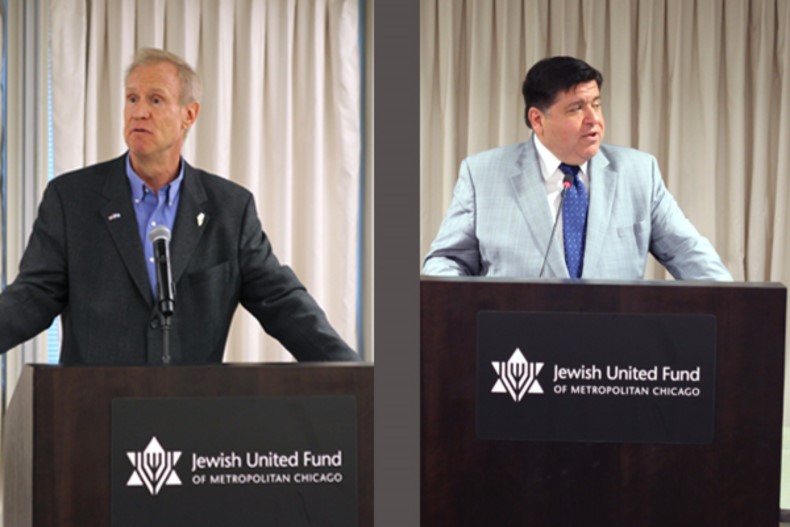
Gubernatorial candidates J.B. Pritzker and Gov. Bruce Rauner took the podium at separate JUF forums recently, continuing a long election-year tradition of dialogue and advocacy with major candidates on issues of key concern to the Jewish community.
Educating public officials on our community’s health and human services agenda, as well as public policies that strengthen the U.S.-Israel alliance and encourage philanthropic giving and sound non-profit governance, is a primary focus of the forums. Issues, outlined by JUF Government Affairs Chair David Golder, include healthcare, services for the elderly and disabled, expanded mental health services, charitable tax incentives and, at the state level, implementation of the country’s first anti-BDS legislation.
At each event, the audience of JUF, affiliated agency and other Jewish communal leaders active in advocacy efforts in Springfield heard from the candidate and then reinforced policy concerns through statements and questions.
Also in attendance were many JUF Lewis Summer Interns, who had an opportunity to hear directly from the candidates and learn about the community’s state policy agenda prior to what for many of them will be the first election they can vote in.
“As part of JUF’s long-standing non-partisan approach to public policy and because our community has so much at stake in D.C. and Springfield,” JUF Board Chair Michael H. Zaransky said, “these sessions are important opportunities to re-engage with long-standing friends running for office, to hear their vision on issues that directly impact all of us, and for us in turn to share our policy agenda priorities.
“That leaders of both parties, be it in Congress, Springfield or City Hall, look to JUF to partner on policy development and implementation is a testament to our non-partisan approach and to the esteem in which our lay leadership and professional staff are held.”
Other stories
-
Two local teens win national recognition
Recipients of the annual Diller Teen Tikkun Olam Awards
Read more -
Celebrating six young award winners cultivating the community
Introducing young adult award winners
Read more -

Planning any event involves making decisions-where to hold it, what to serve, who to invite. But a bar or bat mitzvah often includes a mitzvah project that goes with it, which also must be decided. There are so many choices, though. How do you even start thinking about it? Here are some ideas:
1. Fundraise
Think of an issue that moves you. Then find a worthy organization working to solve that issue. You can ask your guests to donate directly to that organization instead of giving you a gift, or you can take some of the money you get as gifts and donate that yourself. You could also throw them a fundraiser-they’ll even help.
2. Collect
People need things! Help them get them! You can collect and donate so many things-books, clothes, luggage, school supplies, toiletries, art supplies, sports equipment-and on and on. But first contact an organization and find out what they need. Your rubber band collection? You can keep that for yourself.
3. Teach
Do you know how to use a guitar or spatula or baseball bat or sewing machine? Then you can teach someone else, or lots of someone-elses, how to do it too. Many people want to learn a new language, or how to use technology, or even just how to read or write. Teaching someone a skill is rewarding for both the student and the teacher-that’s you.
4. Write
With just words and paper, you can make a huge difference. Organize a letter-writing campaign to support a cause you believe in. Then send the letters to someone in the government who handles that matter. Or, you can write to a group that would love to have your support, like American or Israeli soldiers or kids in hospitals.
5. Read
Just sitting with someone and reading them a book or magazine can be a mitzvah. Especially if that person has a hard time reading, or even just holding a book. Then you can talk about what you read. Reading with people is a great way to make friends by making them happy.
6. Shovel
Or rake or mow or weed. Find someone who has a hard time taking care of their yard and do it for them or with them. You can also do this for many organizations and schools. They will appreciate it, and the whole neighborhood will look nicer.
7. Clean
The world’s a dirty place-help clean it up! You can pick up trash in your neighborhood, around your school or library, at the beach or a park-and organize a group to do it with you. Or you can find someone who needs help cleaning their home and give them a hand (and mop).
8. Declutter
Remember how we said earlier that people need things? Well, some people need-fewer things. Some people have a hard time getting rid of stuff, and you can help them go through everything and decide what to keep, what to donate-and what to just toss.
9. Walk
Walkathons raise both money and awareness for causes. But you can also hold a bikeathon, or swimathon, or an “athon” for any kind of exercise, sport, or activity. Have the participants get sponsors and ask for a certain amount of money for a certain number of miles or laps. Make it something challenging that takes an afternoon, though. A hold-your-breath-athon would be over too quickly.
10. Care
Even if you are not old enough to babysit, maybe you can pet-sit! Taking care of an animal on a regular basis is challenging but fun and rewarding. And you might prove to your parents than you are responsible enough to have a pet of your own.
11. Garden
Tending a flower or vegetable garden is a lot of work, but some people have a hard time doing it and need help. The reward is so great-beautiful blooms and healthy dinners. Working on a garden also teaches you many other skills, like planning, math, chemistry, and biology. And then maybe you get to learn to cook what you grow!
12. Craft
You might already make some sort of artwork or craft project. You can turn this into a mitzvah in so many ways. You can make things people need, like warm scarves, and donate them. You can sell things you make, and then donate the money. Or you can beautify your school, library, or congregation.
13. Volunteer
Still don’t know what you want to do? Find an organization that works on a problem that you care about, contact them, and just say: “I want to help! What can I do?” Many organizations even have a list on their website of things they need done by volunteers. You may find yourself doing something you never even knew you were good at!
JUF has a whole team of people helping connect bar and bat mitzvah-aged teens with the projects and causes they care about. Go to www.juf.org/teens/TOV_About.aspx to learn more, and get started!
Other stories
-
Two local teens win national recognition
Recipients of the annual Diller Teen Tikkun Olam Awards
Read more -
Celebrating six young award winners cultivating the community
Introducing young adult award winners
Read more -
Ten outstanding Chicago-area students are receiving 2018 Israel Experience Merit Scholarships from JUF as they prepare for a variety of extended programs in Israel.
The awards-which go to high school, college, and graduate students to age 23 who demonstrate significant leadership skills-encourage the development of Jewish identity, nourish greater commitment to Israel, and the Chicago Jewish community, and recognize future leaders.
Eight of the students will receive Jewish Federation Naftali Steinfeld Israel Experience Merit Scholarships, and two others will get the Women’s Board Presidential Israel Experience Merit Scholarship.
The Naftali Steinfeld Merit Scholarship recipients are Meitav Aaron, Chicago, Senn High School; Bayla Alter, Tamar Dallal, Nathan Fensterheim, and Yaakov Rosenberg, all from Skokie, and Daniela Kluk, Lincolnwood, Ida Crown Jewish Academy; Samuel Hunt, West Rogers Park, Fasman Yeshiva High School; and Allison Wasserman, Deerfield, University of Delaware.
Women’s Board Presidential Merit Scholarship recipients are Nechama Braun, Skokie, Ida Crown Jewish Academy; and Rachel Hale, Naperville, Naperville North High School.
Winners were selected for their involvement in multiple activities (Jewish and secular), their leadership roles, and their ability to be role models for their peers.
“All of the Merit Scholars this year were stellar,” said Debbie Berman, chair of the Scholarship Committee. “They showed a strong commitment to Judaism, the Chicago Jewish community, and Israel. We are thrilled to be able to recognize their contributions and look forward to seeing what they achieve in the future.”
Each recipient will receive $1,000 toward his or her upcoming approved Israel Experience program.
For more information about the JUF Israel Experience Merit Scholarship Program, visit juf.org/israel_experience/merit_scholarship.aspx .
Other stories
-
Two local teens win national recognition
Recipients of the annual Diller Teen Tikkun Olam Awards
Read more -
Celebrating six young award winners cultivating the community
Introducing young adult award winners
Read more -
Baseball and Judaism are 14-year-old Coby Kamish’s two passions.
As an observant Jew, Coby never misses *minyan and regularly *davens with one of his closest friends at their synagogue in West Rogers Park. Coby has been bringing his faith with him to the baseball diamond-wearing his yarmulke under his cap and his *tzitzit underneath his jersey and tucking his *payot behind his ears-ever since he was introduced to the game at age five.
As the only Jew, let alone observant Jew on his current travel team at Chicagoland Baseball Academy (CBA), his teammates inquire about his Judaism. “Many of the other guys on the team go to school together and they ask me where I go to the school,” he said. “They ask me about my *payos too.”
One of Coby’s baseball mentors was former Chicago Cubs pitcher Sean Marshall. The two first met a couple of years ago at a local park after team pictures for the house league that Kamish and Marshall’s son were playing for. While Kamish was playing catch with Marshall’s son, Marshall remarked on Kamish’s kindness and dedication to baseball, and taught Kamish how to throw a curveball-a pitch Kamish now uses to dominate opposing hitters.
If it weren’t for Marshall, Kamish wouldn’t be playing for the CBA travel team. When Kamish’s father first called the league and told them that his son would not be able to play Friday and Saturday games, he was told his son couldn’t play. But when the Cubs pitcher explained Kamish’s devotion not just to Judaism, but to the game too, the league reconsidered and let him try out for and, ultimately, join the team.
Then this past fall, life threw Kamish and his family a curveball. His mother was diagnosed with cancer, making it difficult for her to attend games. “It’s easier when she is in the crowd cheering me on,” he said.
Even though his mother can’t be there for every game, she’s always there, in spirit, to motivate him. “She has inspired me to fight through these difficult times,” he said.
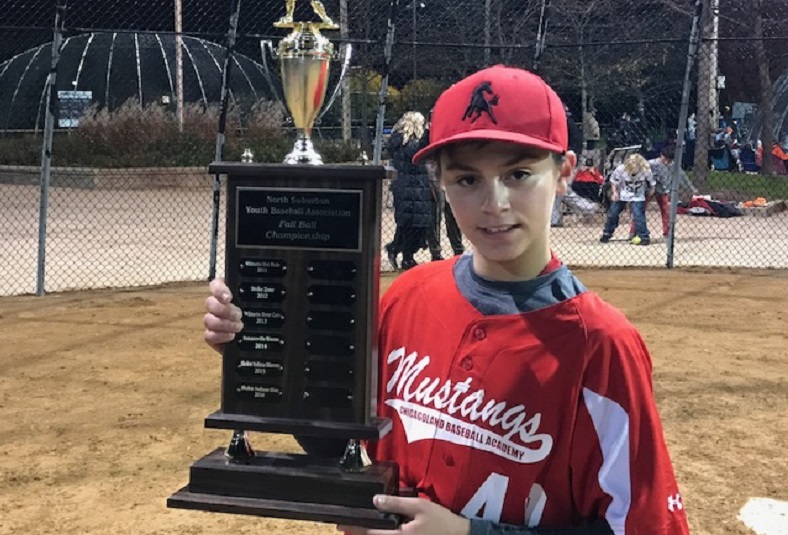
On a frigid late fall night, he took the mound and was going to pitch the first two innings of a championship game against Evanston with a boisterous Evanston crowd on hand outnumbering the CBA fans. Not only were most of the spectators rooting against him, but Kamish’s mom couldn’t attend the game. And, he was also struggling with a sore shoulder that pitchers encounter toward the end of the season.
Despite his setbacks that night, he pitched a stellar first two innings, and then his coach asked him to pitch two extra innings, finishing the game with eight strikeouts and two runs batted in at the plate. CBA won the game, and Kamish took home the “Most Valuable Player” award for his inspirational performance.
His mom, who is currently on the road to recovery, was on his mind throughout the championship game. After the big game, he announced, “This one is for mommy.”
Glossary of terms in this article:
*Minyan-quorum of 10 required for public Jewish worship
*Davens-prays
*Tzitzit-ritual fringes
*Payot/Payos-side curls
Other stories
-
Two local teens win national recognition
Recipients of the annual Diller Teen Tikkun Olam Awards
Read more -
Celebrating six young award winners cultivating the community
Introducing young adult award winners
Read more -