The war in Syria — now in its fifth year — has claimed the lives of more than 400,000 people and forced over 12 million others to flee their homes, creating the worst humanitarian crisis since World War II. The war and its effects have also become a potent topic in the current election.
JUF, the Syrian American Medical Society and Syrian Community Network will host a discussion titled “Humanitarian Crisis in Syria: Realities and Responses” at 1:30 p.m. Sunday, Sept. 25 at 4th Presbyterian Church, Buchanan Chapel, 126 E. Chestnut St.
Speakers include Dr. Georgette Bennett, founder and president of the Tanenbaum Center for Interreligious Understanding and founder of the Multifaith Alliance for Syrian Refugees; Shadi Martini, senior Syria advisor to the Multifaith Alliance who fled Syria in 2012; Dr. Zaher Sahloul, founder of the American Relief Coalition for Syria leading the SAMS effort to provide medical relief for refugees in Europe; and Lina Sergie Attar, co-foudner and CEO of Karam Foundation, which is providing therapy and services to Syrian youth.
The event is free and open to the public.
Other stories
-
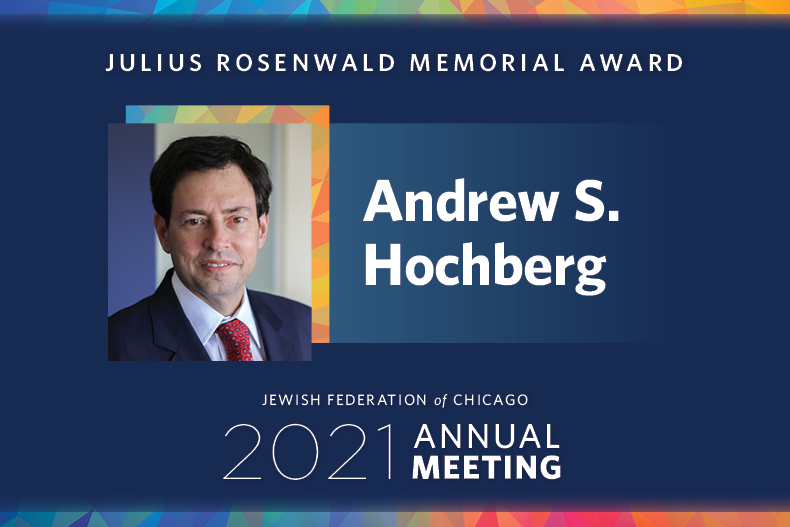
Meet Andrew S. Hochberg, 2021 Julius Rosenwald Memorial Award recipient
Celebrate Andy Hochberg at the virtual Annual Meeting on Sept. 14
Read more -
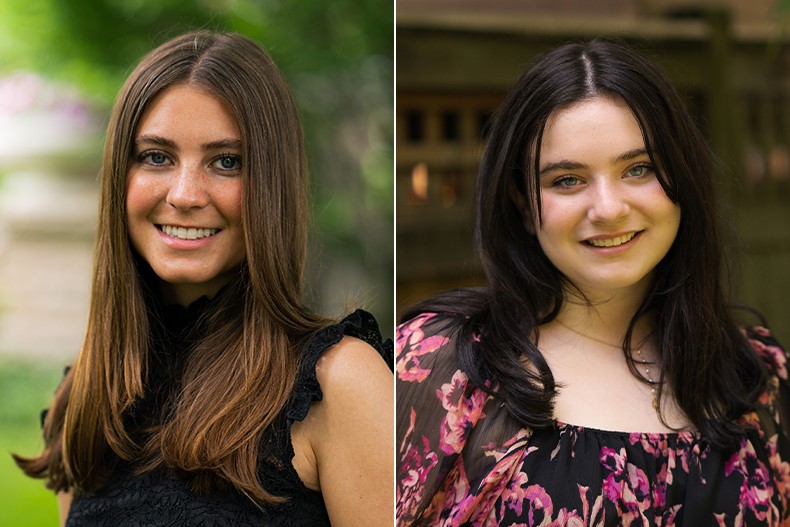
Two local teens win national recognition
Recipients of the annual Diller Teen Tikkun Olam Awards
Read more -
Celebrating six young award winners cultivating the community
Introducing young adult award winners
Read more
Creativity and innovation come naturally to some. But they also are skills that can be learned, honed and heightened in the right environment.
That’s exactly what CHIdush wants to bring to countless classrooms in synagogues around Chicago. By teaching rabbis, education directors and lay leaders the skills of innovation, the program hopes to invigorate congregation-based Jewish education, spark new ideas and approaches, and introduce the best practices used in schools around the country.
CHIdush — the name puts a Chicago spin on the Hebrew and Yiddish word for an innovative idea or insight — is a collaboration between the Jewish United Fund’s Community Foundation for Jewish Education and UpStart, a San Francisco-based national incubator for innovation in Jewish life with a growing Chicago hub. The program is made possible through the generous support of the Crown Family, The Jack and Goldie Wolfe Miller Fund, and an anonymous donor.
“Our research showed that, given the overall decline in enrollment and budgetary struggles congregations are facing, as well as the changing culture of the American family, new ideas had to be nurtured because the status quo is not sustainable over the long term,” CFJE Executive Director Scott Aaron said.
“With UpStart here, we have a local partner with which we can experiment in an innovation model for our schools.”
Nine synagogue schools have been selected for the initial cohort of CHIdush: Anshe Emet Synagogue in Lakeview; Congregation Solel in Highland Park; Emanuel Congregation in Edgewater; Jewish Reconstructionist Congregation in Evanston; Lakeside Congregation in Highland Park; North Shore Congregation Israel in Glencoe; Temple Beth Israel in Skokie; Temple Chai in Long Grove; and Temple Sholom of Chicago.
Through a series of workshops and retreats, individualized coaching, networking and a customized mini-grant program, CHIdush will work with leadership teams at each synagogue over the next 18 months to develop new mindsets and skills that will empower them to create compelling educational experiences.
“We don’t tell them what their schools should look like or how they should operate,” said Lisa Solomon Mann, Chicago director for UpStart. “That may be different for each school.
“Instead, we empower leaders with the tools to figure out what’s likely to work for their own students and members. We support them in developing new ideas to meet these needs, and introduce them in ways that engage long-time members and newcomers alike. Along the way, we also teach them how to adapt their efforts as they learn what works and what doesn’t.”
“Over the decades, so much has changed in our lives, interests and activities,” said CFJE project manager Joy Wasserman, “and that is reflected in our relationships with synagogues and Jewish education. CHIdush will help our congregations and schools identify what families and students are looking for today, and to develop creative, welcoming ways that meet those needs.”
“Congregation Solel seeks to build a sacred learning community focused on children’s social, emotional and spiritual growth,” said the synagogue’s Director of Congregational Learning, Ashley Plotnick. “Change requires patience, commitment, humility and, most importantly, collaboration, and we hope that by engaging in this long-term project with respected mentors and peers, we will best be able to design a congregational school consistent with our values and vision.”
“In order to experiment with how to best reach 2-3 year olds and their families, Anshe Emet turned to CHIdush to provide our team with the tools, guidance, resources and networking to fill a gap in our programming and outreach,” said Rabbi D’ror Chankin-Gould. “We believe CHIdush will give us the capacity to creatively reach children and families with whom we’ve yet to fulfill our fullest potential. We are so excited and so grateful.”
“UpStart is honored to partner with CFJE and nine forward-thinking synagogues in the Chicago area in elevating the inspired work they’re already doing in their communities,” said Linda Gerard, UpStart’s Chief Program & Innovation Officer. “We look forward to empowering synagogue teams to leverage leading-edge innovation tools — guided by Jewish wisdom — to create new and compelling Jewish learning experiences.”
For more information about CHIdush, contact Joy Wasserman at 312.673.3281 or [email protected] .
Other stories
-
Meet Andrew S. Hochberg, 2021 Julius Rosenwald Memorial Award recipient
Celebrate Andy Hochberg at the virtual Annual Meeting on Sept. 14
Read more -
Two local teens win national recognition
Recipients of the annual Diller Teen Tikkun Olam Awards
Read more -
Celebrating six young award winners cultivating the community
Introducing young adult award winners
Read more
Stone Temple Baptist Church, once a synagogue, recognized as Chicago historic landmark
JANE CHARNEY
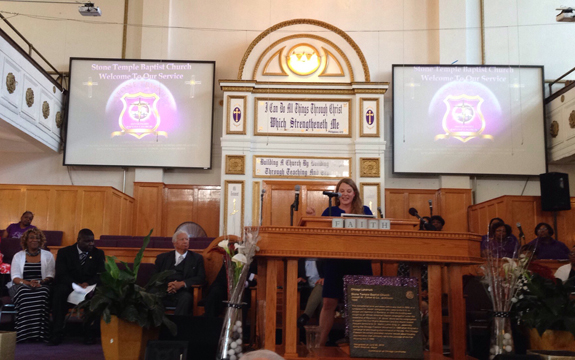
Rabbi Wendi Geffen of North Shore Congregation Israel speaks at the dedication service for Stone Temple Baptist Church.
Members of Chicago’s Jewish community were on hand Sunday, Aug. 28 as the congregation at Stone Temple Baptist Church celebrated the designation of its building as a Chicago historic landmark.
The Church, led by longtime Jewish Community Relations Council partner Bishop Derrick Fitzpatrick, officiated a special service featuring remarks from Chicago Mayor Rahm Emanuel, Rep. Danny Davis, JCRC Chair David T. Brown, and Rabbi Wendi Geffen of North Shore Congregation Israel.
“This building is a sacred place, with a remarkable history, and we share your pride as you receive this special recognition from the City of Chicago,” Brown told worshippers and guests at the ceremony. “The granting of historical landmark status is not the end of the story for this building, but the beginning. It serves as a continued call to action to all of us who enter its doors — to ensure that the important work that has been done here continues.”
Founded as the First Romanian Congregation synagogue, the building was part of an area known as “Chicago’s Jerusalem” because of a large number of Jewish residents. It later became the home to Reverend J. M. Stone’s Baptist congregation in 1954. In the 1960s, it was one of the few churches to host Dr. Martin Luther King, Jr. for a series of sermons, even as city administrators threatened to cut off funding from daycare and school programs for letting him speak there.
Speakers at the ceremony recognized the vision of both King and the church’s founding pastor, whose grandson now leads the congregation.
Geffen gave the keynote speech, drawing parallels between God opening Hagar’s eyes to the well she could not see before her and the idea that we must recognize both the continued injustice in our midst as well as the resources available to us to help address it.
Following the service, the church hosted its annual community festival, where JUF-affiliated agency Sinai Health System offered health screenings, and JCRC led a voter registration drive.
“The relationship that has been forged between the Jewish and African-American communities here in North Lawndale is powerful,” Bishop Fitzpatrick said, “and we have the potential to do even greater things going forward.”
Other stories
-
Meet Andrew S. Hochberg, 2021 Julius Rosenwald Memorial Award recipient
Celebrate Andy Hochberg at the virtual Annual Meeting on Sept. 14
Read more -
Two local teens win national recognition
Recipients of the annual Diller Teen Tikkun Olam Awards
Read more -
Celebrating six young award winners cultivating the community
Introducing young adult award winners
Read more
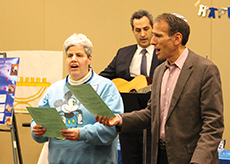
Just in time for the High Holidays, synagogues across the Chicago metropolitan area are making inclusion a priority.
The Chicago Synagogue Inclusion Project, which is funded by a JUF Breakthrough Grant and administered by JUF’s Synagogue Federation Commission in partnership with Encompass of the Jewish Child andFamily Services, recently completed a year-long research and planning process that aims to answer key questions about barriers to participation in synagogue life for individuals with disabilities and their families.
With 20 percent of the population (including the Jewish population) having some kind of disability-including everything from cognitive and emotional to physical-not having an effective inclusion approach alienates a significant percentage of the Jewish community and prevents congregations from gaining from the unique contributions of these potential members, according to experts.
“ Ultimately, the goal is to use the research to develop tools and strategies for identifying the resources, mechanisms, and structures that would best foster a synagogue’s ability and readiness to facilitate inclusion for the long-term,” said Tracy More, associate vice president of Community Outreach and Engagement of the Jewish United Fund/Jewish Federation of Metropolitan Chicago.
A nationally recognized Inclusion and Outreach Specialist led the community outreach and engagement efforts and a Research Consultant developed the research instruments and data analysis efforts, according to More.
“The process of engaging with synagogues so broadly was unique. The way we triangulated with two surveys, meetings, and layering in other data like the Chicago population survey and JData was different than other communities. To our knowledge, no one has documented some of our findings. The approach was innovative because it engaged the full geographical and denominational spectrum of the Jewish community through one process of collective learning, coordinated study and strategic development in the complex synagogue space,” continued More.
What the findings gleaned is that synagogues across Chicagoland are in different stages of readiness and are in major need of education and training, the development of strong networks and the utilization of outside resources before they are able to move closer to inclusion.
“Raising the issue across the community through individual conversations and basing all decision making on good data will lead to a much better knowledge of who is in need of services in the community and where there are gaps in a synagogue’s ability to include people with disabilities,” said Ed Frim, the nationally recognized inclusion and outreach specialist engaged to consult on this effort.
One significant finding is that “synagogue leaders rate inclusion efforts higher than household respondents.”
“There is a gap between how well synagogues feel they are doing and how the people we spoke to feel about how well synagogues are support them in participating in synagogue life,” said Frim.
Another finding is that those affected by disabilities feel invisible to synagogues-and this has affected their membership (or lack thereof), according to the study.
While many synagogues in Chicagoland are doing something to support people with disabilities, people in the community are not always aware of the supports available to them. Beyond this, programming that isolates those with disabilities-as opposed to including them-while often good intentioned, can be counterproductive.
As one participant of the survey said, “I don’t want to be someone else’s mitzvah project, I want to be doing mitzvahs.”
“The fact is, those with disabilities have a right to contribute and they have an ability to contribute and be part of the community. Inclusion is a huge opportunity for people with disabilities to enrich congregations and for congregations to help them realize their potential,” said Frim.
In addition to break-out grants to support inclusive programming, next steps for the project include a series of workshops led by nationally-recognized experts in synagogue inclusion open to all congregations throughout Chicagoland. A one-year Cohort of Practice consisting of up to 8 congregations is also available for those ready to take existing inclusion efforts to the next level.
The first program led by nationally recognized inclusion specialist Shelly Christensen takes place on Tuesday, Sept. 13,at Temple Beth-El in Northbrook. For more information, visit http://juf.org/inclusion .
Read the report at www.juf.org/congregants/Congregations-Connections.aspx.
- To apply to participate in the Cohort of Practice, contact Tracy More, JUF Associate Vice President of Community Outreach & Engagement ([email protected] or (773)765.3146).
2015-2016 Chicago Synagogue Inclusion Project
Key finding:
1. Households touched by a disability report feeling invisible, left out or perceived as disruptive.
2. Congregations don’t always know who has disabilities.
3. Perceptions of inclusion impacts synagogue membership.
4. Synagogue leaders rate inclusion efforts higher than household respondents.
5. Synagogues are inconsistent and ad-hoc in their approach and ability to be inclusive of individuals with disabilities and their families.
6. All synagogues state that they share inclusion as a value, and momentum exists to move these efforts forward, yet many do not know where and how to begin.
Survey respondent highlights:
Households
*Almost 1,500 household respondents representing all areas of Metropolitan Chicago.
*56% were synagogue members.
* 30% of households had a person with a disability, with half of those between ages 23-64.
Synagogues
* Fifty synagogues responded to the survey; eight were Orthodox.
* Synagogues identify including children with disabilities and the elderly with physical disabilities as priorities.
Other stories
-
Meet Andrew S. Hochberg, 2021 Julius Rosenwald Memorial Award recipient
Celebrate Andy Hochberg at the virtual Annual Meeting on Sept. 14
Read more -
Two local teens win national recognition
Recipients of the annual Diller Teen Tikkun Olam Awards
Read more -
Celebrating six young award winners cultivating the community
Introducing young adult award winners
Read more
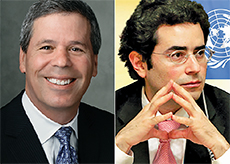
Human rights activist Hillel C. Neuer to keynote Sept. 15 Jewish Federation Annual Meeting
CHRISTINE SIEROCKI LUPELLA
Hillel C. Neuer, executive director of U.N. Watch, a human rights non-governmental organization in Geneva, will keynote the 2016 Annual Meeting of the Jewish Federation of Metropolitan Chicago, set for Thursday, Sept. 15, at the Hyatt Regency Chicago, 151 E. Wacker Drive.
Neuer’s group monitors United Nations activities, fights anti-Israel bias, and promotes human rights. His “banned speech” admonishing the U.N. Human Rights Council’s condemnation of Israel has become the most-viewed NGO speech in U.N. history. He has testified before the U.N. and the U.S. Congress, intervening for causes that include rape victims of Darfur, political prisoners in Cuba, and peace in the Middle East.
The Federation’s 116th Annual Meeting also will feature the State of the Federation address by President Steven B. Nasatir, and the presentation of several major leadership awards.
Foremost among them will be the organization’s highest honor, the Julius Rosenwald Memorial Award, which this year goes to David T. Brown . The award, named for the iconic Chicago business leader and philanthropist of the early 1900s, is presented each year to an individual who has demonstrated a lifetime of outstanding dedication and service to the Jewish community.
Brown, a former Federation Board Chairman, currently chairs the Jewish United Fund’s Jewish Community Relations Council and the Jewish Federations of North America’s Global Operations: Israel and Overseas Council. He has worked tirelessly for Jewish issues on the local, national and international levels, serving in leadership roles for numerous organizations. In 1993, he received the Federation’s Davis, Gidwitz & Glasser Young Leadership Award, and he also has been honored by the American Jewish Congress, SHALVA and other groups for his outstanding efforts on behalf of the Jewish people. Brown is an attorney and chairman of the firm Much Shelist.
Lindsey Paige Markus and Brandon C. Prosansky will receive this year’s Davis, Gidwitz & Glasser Young Leadership Award, presented to volunteers who have demonstrated exemplary dedication and have made significant contributions to Chicago’s Jewish community.
Markus, 39, the incoming chair of JUF’s Lawyers Division, currently serves on the JUF Professional Advisory and Legacies and Endowments committees. She served on JUF’s Young Leadership Division Board of Directors, and was a member of the YLD Executive Committee and a past chair of the JUF Standard Club event. She was in the second cohort of the Jewish Leaders Institute, and is finishing her first year as a member of the National Young Leadership Cabinet. She also serves on committees and has chaired events for the Standard Club, Chuhak & Tecson’s Women Helping Women Initiative, and other nonprofit organizations. Markus is a principal with the law firm of Chuhak & Tecson, P.C., and heads its Estate Planning group. She was named to the first cohort of the YLD/Oy!Chicago “36 Under 36” list.
Prosansky, 37, joined the YLD Board in 2012. He served as YLD Board President in 2014; as YLD Campaign Vice Chair in 2013; and as an ex-officio member of the JUF/Federation Board. He is a past chair and Campaign co-chair of JUF’s Young Lawyers Group, and has served on the event committee for JUF’s Lawyers & Government Agencies Dinner, chairing it in 2009 and 2010. He also has served on the Israel & Overseas Commission. Prosansky was in the second cohort of the Jewish Leaders Institute, and is currently a member of the National Young Leadership Cabinet. In 2012, he was named to the YLD/Oy!Chicago annual “36 Under 36” list.
As part of the Davis, Gidwitz & Glasser Award, the honorees are given the opportunity to attend the annual General Assembly of the Jewish Federations of North America, which this year takes place in Washington, D.C., in November.
Two exceptional young professionals who have shown outstanding performance in their work at a Jewish agency in the Chicago area will receive the Samuel A. Goldsmith Award, now in its 28th year. This year’s award will be presented to Caroline Musin Berkowitz and Erez Cohen .
Musin Berkowitz, 38, is the Director of Volunteers and Outreach at The ARK, recruiting, screening, placing and retaining over 2,000 volunteers. She oversees The ARK’s food pantry and has streamlined redundancies and introduced multiple technology resources to increase the quality of communication with volunteers, staff and clients. She helped create, fund and implement volunteer opportunities specifically designed for families with young children. She works closely with and formally and informally mentors future leaders and interns according to their needs and abilities.
Cohen, 33, is Executive Director of Illini Hillel at University of Illinois Urbana-Champaign, where he manages staff and 25 student interns to engage the 3,500 Jewish students on the campus. He has implemented Hillel International’s Circle of Educational Excellence program to strategically meet the needs of students from a wide variety of Jewish backgrounds and experiences, and is a core team member of the Hillel International Measuring Excellence program that researches and defines the metrics of success for the Hillel movement. He helped initiate Illini Hillel’s Café Sababa, a regular kosher restaurant-style lunch service, which sold 3,000 meals during its first semester. He also spearheaded a five-year strategic planning process with the Illini Hillel board, and reestablished University of Illinois Jewish alumni events in Chicago.
The Federation’s Annual Meeting begins with a business meeting at 10 a.m., followed by a noon luncheon.
The business meeting, open to all Federation members, will feature the election of directors, and presentations to outgoing board members and the recipients of the young leadership awards.
The lunch session will feature Neuer’s speech, the annual State of the Federation report, and presentation of the Rosenwald Award to Brown.
Jewish Federation of Metropolitan Chicago
116th Annual Meeting
Thursday, Sept. 15, 2016 – 12 Elul 5776
Hyatt Regency Chicago – 151 E. Wacker Drive
10 a.m. Business Meeting
Noon Luncheon Meeting (Kosher dietary laws observed)
For information, call (312) 444-2099 or email [email protected]
Register online: www.juf.org/Annual-Meeting/
Lunch: $40 per person/$20 for senior citizens, rabbis, Jewish communal professionals, and students
There will be no solicitation of funds.
Other stories
-
Meet Andrew S. Hochberg, 2021 Julius Rosenwald Memorial Award recipient
Celebrate Andy Hochberg at the virtual Annual Meeting on Sept. 14
Read more -
Two local teens win national recognition
Recipients of the annual Diller Teen Tikkun Olam Awards
Read more -
Celebrating six young award winners cultivating the community
Introducing young adult award winners
Read more
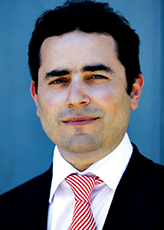
Hillel C. Neuer is the executive director of UN Watch, a human rights non-governmental organization based in Geneva, Switzerland, that monitors and reports on the actions of the United Nations. Neuer, an international lawyer, diplomat, writer, and activist, was listed in the “Top 100 Most Influential Jewish People in the World,” by the Israeli newspaper, Ma’ariv. Neuer will be the keynote speaker at the Jewish Federation’s 2016 Annual Meeting, to be held at the Hyatt Regency Chicago on Thursday, Sept. 15. Here are some excerpts from a recent phone interview with JUF News.
JUF News: Of all the resolutions condemning the action various countries, how many times has the UN condemned Israel, specifically?
Hillel Neuer: Since 2006, when the UN Human Rights Council was officially ‘improved,’ they have issued 61 resolutions against all other countries in the world. In this same decade, they have issued 67 against Israel alone.
What has Israel done to elicit some of these condemnations?
Recently? Jerusalem built a light-rail system that runs through Jewish and Arab neighborhoods, making transportation easier and cleaner. UNESCO has a draft resolution, likely to pass, condemning the train for blocking the view of the Old City walls.
The World Health Organization condemned only one country this year for violating people’s health rights: Israel-over [its] ‘treatment’ of Syrians in the Golan Heights. Israel should be singled out, but for their incredible medical treatment of refugees from Syria’s war. It’s Orwellian, paradoxical, and absurd.
What have other countries done that has not received UN condemnation?
The list is endless. Some recent examples: Turkey just arrested or fired 50,000 academics. It’s a Cultural Revolution-like radical undermining of the social order. For this, they received from the UN no resolution, no emergency session, no commission of inquiry. In Venezuela, there is mass poverty and hunger in a nation with an abundance of resources. Their president, (Nicolas) Maduro, was just reelected, and the nation was reappointed to the UN Human Rights Council. No resolution, no emergency session, no commission of inquiry. Saudi Arabia is waging a war in Yemen that has killed thousands of civilians, including some 600 children. Again, no resolution, no emergency session, no commission of inquiry. They get a free pass. And the Saudis backed resolutions condemning Israel for actions it took to defend itself.
What can we, as American citizens, do to raise awareness of the UN’s anti-Israel bias?
People should become educated and informed. Resolutions by the UN have the appearance of international legitimacy and are regarded as authoritative. American citizens concerned with justice, Israel, and human rights can go to our website, unwatch.org, can receive briefings, and follow us on Facebook. Then they can write letters to the editor and to Congress, and share what they have learned on the Internet. People can make sure their government is paying attention. When the United States shows they care, it can make a big difference.
Other stories
-
Meet Andrew S. Hochberg, 2021 Julius Rosenwald Memorial Award recipient
Celebrate Andy Hochberg at the virtual Annual Meeting on Sept. 14
Read more -
Two local teens win national recognition
Recipients of the annual Diller Teen Tikkun Olam Awards
Read more -
Celebrating six young award winners cultivating the community
Introducing young adult award winners
Read more
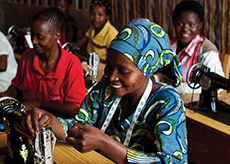
In a few short weeks, the Illinois Holocaust Museum & Educational Center will open its newest exhibit, Women Hold Up Half the Sky. In cooperation with the Skirball Cultural Center in Los Angeles, and inspired by the book Half the Sky by Pulitzer Prize-winning authors Nicholas Kristof and Sheryl WuDunn, the exhibition identifies and explores one of the central moral challenges of the 21st century: equality for women in the United States and around the world.
The exhibition, opening Sept. 25, is divided into three primary subjects: maternal health, gender-based violence, and sex trafficking. Each section honestly portrays the injustices perpetrated against women and girls around the world and shares amazing personal stories of women working individually, and in partnership with social justice-based organizations, to improve the quality of life for women in their culture and communities.
Despite the serious subject matter, to walk through Women Hold Up Half the Sky is an inspirational and thought-provoking experience. The exhibition occupies the museum’s downstairs exhibition space and transforms the normally dark basement into a vibrant, living classroom. Colorful art hangs from the ceiling and on the exhibition’s walls, alongside photographs, and multimedia installations designed to engage museum visitors while educating them about the extraordinary challenges facing women and girls across the globe.
Among these accounts is the inspiring story of Goretti Nyabenda of Burundi. During the early years of their marriage, Goretti’s husband regularly beat her and prohibited her from leaving their family home. Goretti and her six children lived in constant fear of his wrath. But one day, Goretti joined a solidarity group for abused women supported by the humanitarian organization CARE. Through her support group, Goretti received a microloan for an entrepreneurial venture that eventually led to the founding of her own banana beer business. “Now I have peace in my household, and we make all decisions together,” says Goretti. “After 16 years of marriage, we are finally able to communicate. My husband considers me an equal partner.” As a result, “many people, both men and women are changing the way they think” about the role and treatment of women in Goretti’s community.
Stories like Goretti’s “underscore the importance of the role that women play in their local communities. When women are empowered” and given the opportunity to thrive, says Shoshana Buchholz-Miller, vice president of the Museum’s Education and Exhibitions, “it not only impacts them positively, but it impacts their family and their community positively as well.” Like Goretti, other women whose stories are featured in the exhibition stand as testament that when provided with the opportunity and the resources to effect change, anyone can improve her situation and uplift her community.
On this side of the globe, Women Hold Up Half the Sky also brings attention to the injustices faced by women and girls within American-particularly Midwestern-communities. Unbeknownst to many Americans, domestic abuse and sex trafficking are still extremely common dangers for women and girls in the United States. According to the Chicago Alliance Against Sexual Exploitation (CAASE), “[on] any given day in the Chicago metropolitan region, there are more than 10,000 girls and women engaged in prostitution-related activities.” More often than not, girls enter the sex trade by age 15. Buchholz-Miller reiterates, “Not only is the US a transit point [for sex trafficking], but it is also a substantial market,” which is why the museum has given this issue a spotlight in the exhibition.
To provide the tools for meaningful and effective dialogue on this subject, the Illinois Holocaust Museum & Educational Center has partnered with YWCA Evanston/North Shore in presenting the exhibition and designing complementary public programming. “We are very excited to be a part of this effort,” says Kathy Slaughter, YWCA Evanston/North Shore Vice President of Development. “The exhibition highlights critical issues facing women and girls both globally and locally. It shows visitors that violence against women and economic abuse are issues in developing countries, and also in our own communities, and that there are programs in place, like those at the YWCA Evanston/Northshore, to provide comprehensive aid.”
“The themes of this exhibition are hard to wrap your mind around,” says Slaughter, “but they are real, women are really experiencing them, and there is hope.”
Exhibition programs will include film viewings, panel discussions, and family forums, among other engaging activities.
The exhibition opens on Sept. 25, and will run until Jan. 22, 2017. Illinois Attorney General Lisa Madigan will be the keynote speaker at the exhibition’s opening event on Sept. 25.
For more information on this exhibition, visit www.ilholocaustmuseum.org .
Jenna Cohen is a freelance writer living in the Chicago area.
Other stories
-
Meet Andrew S. Hochberg, 2021 Julius Rosenwald Memorial Award recipient
Celebrate Andy Hochberg at the virtual Annual Meeting on Sept. 14
Read more -
Two local teens win national recognition
Recipients of the annual Diller Teen Tikkun Olam Awards
Read more -
Celebrating six young award winners cultivating the community
Introducing young adult award winners
Read more
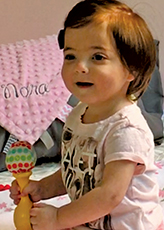
I remember scrolling through Facebook as I sat on the vinyl recliner in the NICU waiting for the nurse to help me hold my daughter, Nora. I remember JUF’s jBaby posts, smiling families enjoying an afternoon at the Little Gym or local synagogue. I felt so sorry for myself. By the time Nora would finally come home, my maternity leave would be long over. And even if I could take Nora to those events, she would be too fragile to be near other children for many months. I thought missing out on the magic of early motherhood was the saddest, loneliest thing I could imagine.
Still, I hoped for brighter days ahead, and at the urging of another Jewish mom of a recent NICU graduate, I reached out to my jBaby ambassador for an introduction while Nora was still in the hospital. The ambassador was wonderful, but the more we talked, the more I realized how difficult it would be for our family to participate in jBaby events.
“Milestones” were not a part of our vernacular. Nora wouldn’t be learning sign language or crawling or transitioning to solid foods. The challenges our family would be facing had more to do with keeping Nora alive-managing a sterile central line, administering carefully timed seizure medications, remembering to plug in apnea monitors and check dextrose levels, and troubleshooting a feeding pump attached to Nora’s G-tube. We were living on a totally different planet from the families my ambassador was describing. I couldn’t imagine how we’d relate.
I took solace in the early months in online support groups, spending hours on Facebook messaging moms near and far whose babies faced challenges like Nora’s. While we certainly shared many experiences and feelings in common, I longed for a mom I could call or have lunch with who could really understand what my family was going through, and whose advice and judgment I could trust as we faced ever-more complicated decisions regarding Nora’s care. I looked for events and in-person support groups in our area, but nothing was conveniently located or timed for a working mother, and nothing seemed targeted at the type of experience I longed for. What I wanted more than anything was to talk with other parents like me about my fears and heartbreak, about how on Earth this could have happened to our families, and how we would all go on.
And then I saw it-“Glickstein.” Another Jewish family, here in Chicago , appeared in one of my Facebook support groups. I messaged them immediately and within days we were crying together at a Freshii restaurant near my office. The conversation was incredible. They were smart, easy to talk to, and so warm. Even though we’d grown up in different places and had never crossed paths before that moment, we immediately shared more in common than I had with anyone else we’d met over the 18 months since Nora was born. I thought back to jBaby, and it dawned on me that we might not be the only two Jewish families in the Chicago area with children with complex medical diagnoses.
I emailed my ambassador. From there it came together like magic. Within weeks, jBaby announced the formation of “Nora and Friends,” a group for families like mine. The Glicksteins joined, and so did several other families I’m so proud to call my friends.
After our very first meeting-just the moms-I knew all those things I’d missed out on weren’t lost to me forever. As we all told our stories, it was clear that we were going to survive this together, and we might even enjoy ourselves in the process.
Just a week after our first meeting, Nora was unexpectedly hospitalized. The jBaby moms brought me a care package only moms who’ve spent time in the hospital could have put together. It was perfect, had something for everyone in the family, and included warm socks for me for the cold hospital floor. Those socks still sit in my “go bag” for emergency hospital trips-warmth for my feet, and more importantly, my heart.
The group has only been together a few months, but man, has it changed my life. Our playdates are so fun, our kids are such champions, and our conversations are so honest and helpful. We have a beautiful community all our own. I am so grateful, and so excited to grow together.
Lauren Schrero Levy, who lives in Chicago, is the founder of Nora & Friends and is one of this year’s JUF ’36 Under 36′ honorees.
Nora & Friends, jBaby Chicago’s medically-complex & special needs group, is for parents of children five and under with cognitive and/or physical impairments impacting early-childhood development. jBaby Chicago recognizes that these children are unlike others their age and that their parents have unique concerns. We want to bring these families together to build community, problem solve, and celebrate special needs childhood within the Jewish community
For more information about jBaby’s Nora & Friends, email Deborah Cooper at [email protected].
jBaby Chicago is part of JUF Young Families, a department of the Jewish United Fund.
Other stories
-
Meet Andrew S. Hochberg, 2021 Julius Rosenwald Memorial Award recipient
Celebrate Andy Hochberg at the virtual Annual Meeting on Sept. 14
Read more -
Two local teens win national recognition
Recipients of the annual Diller Teen Tikkun Olam Awards
Read more -
Celebrating six young award winners cultivating the community
Introducing young adult award winners
Read more
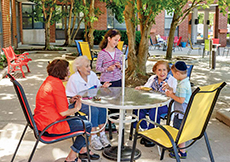
At its peak in the mid-20 th Century, West Rogers Park was home to some 60,000 Jews. Today the number is 24,000, still a major proportion of the 89,000-some Jews in the City of Chicago. This neighborhood holds more JUF agencies, synagogues, and organizations than any other, in the city or suburbs.
Howard Rieger lives in West Rogers Park now, but he was born and raised in the Uptown neighborhood of Chicago and Skokie. After teaching political science on the college level in New York, he went on to serve as director of operations at Cleveland’s Federation, as president of Pittsburgh’s Federation- for a quarter century-and finally as president/CEO of the United Jewish Communities (precursor of the Jewish Federations of North America) in New York City.
Forty years after leaving Chicago, Rieger retired and returned here. Seeing the contradictions in the neighborhood- investments in new and renovated homes, synagogues, day schools, and agencies versus a rundown public face with deteriorating commercial streets-he rolled his sleeves back up and committed to do something about it.
Rieger re-launched the Jewish Community Council of West Rogers Park in 2012. Founded in 1975, the Council had laid dormant for years. Today, it has an activist agenda: upgrading Devon Avenue and other commercial streets, improving and updating public facilities, forming coalitions with other groups, and attracting businesses to the neighborhood.
During a tour of the area this summer, Rieger and his wife, Beverly Siegel-a JCCWRP board member, PR professional, and documentary filmmaker- showed how far the neighborhood has come, and how far they believe it still has to go.
Thanks to an effort spearheaded by JCCWRP with the support of Ald. Debra Silverstein, a blighted site at the corner of Devon and McCormick, abandoned for 12 years, will become a Chicago park in 2017. Another park, with three miles of wooded trails, abuts the former Thillens Stadium. A potential recreational destination with appeal to urban hikers, it is known only as “Park 538.” It has no signage or visible entry points-yet.
New streetlights, benches, and other “street furniture” now adorn the shopping areas thanks to Silverstein’s advocacy.
JCCWRP has sought to leverage this enhanced “streetscape” by matching funds for new signs at Tel Aviv Bakery and (soon) Kol Tuv Kosher Market.
Also on the agenda is renovating their community’s public library. Built in 1962 across the street from The ARK’s Seymour Persky Building, Northtown branch is one of the most well-trafficked in Chicago, with 140,000 patrons a year. Yet it has inadequate technology, meager meeting space, and no special programs. JCCWRP was one of the founding members of the LEARN coalition, a diverse group committed to making a new library happen. As Siegel put it, “LEARN epitomizes our organization’s mission, doing good for the neighborhood and the community.” There are 1,650 names on a petition urging the city to replace the library; a feasibility study for a new library may be implemented during 2017.
Many JUF-supported agencies have built new facilities in the neighborhood, adding to JUF’s social-service infrastructure there: The ARK; the Joy Faith Knapp Children’s Center and the brand-new Abe and Ida Cooper Center, both for Jewish Child and Family Services; the Bernard Horwich JCC; CJE SeniorLife; and the Touhy Health Center, a clinic of Mount Sinai Hospital. There are also many JUF-supported educational facilities, from day school through high school- including schools that focus on children with special needs- up through colleges and rabbinic-ordination programs.
JUF/Federation provides ongoing funding for JCCWRP in the form of an annual allocation plus additional funds from the Dr. Steven B. Nasatir New Directions Fund. The group has a committed board and has engaged hundreds of volunteers in many programs over the last four years.
“Chicago’s Jewish community as a whole has a big stake in preserving West Rogers Park,” said JCCWRP Executive Director Shalom Klein, “because we have an investment in schools and social-service agencies here that would be impossible to re-create.”
One of JCCWRP’s major commercial successes is the Magenta pair; the Magenta Boutique is a clothing store specializing in modest fashions, and the Magenta Bowtique sells accessories to complement them. Located in adjacent storefronts of a strip mall on the corner of Pratt and California, they promote themselves as “sister stores,” sharing a name and even an interior doorway. The Magenta stores attracted 750 shoppers in their first week. Recently, these stores only existed in their owners’ basements.
“It occurred to me that if we could find two complementary home-based businesses to partner in a co-operative storefront venture, that could turn into a win-win for the entrepreneurs as well as for the community,” said Rieger.
Klein also serves as a liaison between the West Ridge Chamber of Commerce and local businesses. He helped the Magenta owners shape a business plan, research accounting systems, identify locations, negotiate with the landlord, and assist with zoning and permitting.
JCCWRP works hard to keep community stakeholders involved. They convene JUF agency professionals quarterly. They went door-to-door along the neighborhood’s shopping corridors, meeting storefront proprietors. They meet with rabbis and Jewish educators, and they build bridges with other religious and ethnic groups.
According to Rieger, enhancing the neighborhood’s appeal to residents, shopkeepers, and shoppers benefits every ethnic and religious group there. In turn, the neighborhood’s diversity attracts visitors to its United Nations-like array of shops and restaurants.
West Rogers Park has a past worth saving-and a future being created right now.
To learn more about JCCWRP, visit www.gowrp.org .
Other stories
-
Meet Andrew S. Hochberg, 2021 Julius Rosenwald Memorial Award recipient
Celebrate Andy Hochberg at the virtual Annual Meeting on Sept. 14
Read more -
Two local teens win national recognition
Recipients of the annual Diller Teen Tikkun Olam Awards
Read more -
Celebrating six young award winners cultivating the community
Introducing young adult award winners
Read more
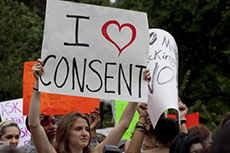
Stepping off the Sidelines: The Jewish Women’s Foundation tackles gender-based violence
ELLEN CARMELL, SARA KALISH, and MARY E. THOMAS
It’s hard to imagine a pair of more unlikely allies than the National Football League and the Jewish Women’s Foundation of Metropolitan Chicago. Two years ago, when America was shocked by the video of Baltimore Ravens running back Ray Rice punching his fiancé and dragging her unconscious body from an elevator, the NFL had to confront the issue of violence against women. Because of the popularity of professional football and its celebrity players, America began to focus its attention on gender-based violence. What had previously been considered a “women’s issue” took center stage in the national conversation.
Though there had been prior incidents of such violence in professional football, this high profile case pressured the NFL to implement an anti-domestic violence initiative. But violence against women in our society continues–in sports, the military, on university campuses, and in homes every day. It has never been clearer that gender-based violence knows no boundaries. Indeed, this crisis pervades every country, community, and culture–including the Jewish community.
For nearly two decades, the Jewish Women’s Foundation has led Chicago’s Jewish community on this issue. As the only local organization using both a gender and Jewish lens in our work, JWF is uniquely positioned to tackle this problem for Jewish women and girls in a long-term, systemic way. Through bold innovative grantmaking and advocacy, our trustees have been directly addressing this and other pressing issues for almost 20 years.
While it is difficult to measure violence against women in the Jewish community, according to the Bureau of Justice Statistics every 52 seconds in America, a woman is victimized by physical or sexual violence. This poses such a devastating barrier to the overall status of women and girls that JWF has dedicated a large portion of our total grant allocations to projects that address gender-based violence.
Together, JWF and The Ellie Fund at the Jewish Women’s Foundation of Chicago* have invested more than $1.3 million in women and girls’ security, safety, and well-being by awarding 113 grants to organizations and programs working to end gender-based violence.
Twenty years ago, when the issue of violence against women was not yet publicized in the media, JWF began forging alliances between two key groups committed to changing the landscape for Jewish women and girls–our trustees, who decide which projects have the biggest potential for impact, and our grantees, who work to end violence against women. In this way, JWF empowers Jewish women as leaders, funders, and decision-makers.
Operating as a large giving circle, JWF’s social change philanthropy focuses on the root causes of problems that lead to inequality. This approach is unlike many traditional charities which work through direct services to ameliorate the symptoms of societal problems. At JWF, we concentrate on systemic change because we believe it’s the most effective way to improve the lives of women and girls today and tomorrow.
Violence against women exists in many forms, so JWF funds organizations and projects that approach the issue on a variety of fronts, both locally and internationally. We’re proud that many of our grantees are creating social change for women and girls right here in the Chicago area.
For example, SHALVA , the oldest independent Jewish domestic violence agency in the United States, addresses domestic abuse in Chicago Jewish homes and families. JWF funds SHALVA’s Legal Liaison Program which provides legal information and support to women who are engaged in lengthy legal battles with the men who abused them, and educates divorce attorneys and judges on the differences between a contentious divorce and a divorce involving an abuser. This crucial post-separation assistance promotes the long-term safety of Jewish women impacted by domestic abuse.
Jewish Community Abuse, Resources, Education & Solutions (JCARES), a program of Jewish Child & Family Services, educates, advocates, and collaborates with Chicago’s Jewish community to address many forms of abuse, including child abuse, domestic abuse, and elder abuse. Partnership for Safer Synagogues , a groundbreaking educational initiative of JCARES, engages clergy, staff, lay leaders, and congregants of local synagogues. Through this partnership, Jewish Child and Family Services helps them recognize and proactively respond to abuse across the lifespan and create safer spaces in our community.
In seeking to create change at a systemic level, JWF trustees understand that violence against women must be viewed as a public policy issue. Along those lines, the Chicago Metropolitan Battered Women’s Network* established the Medical Response Collaborative to shift the medical system’s response to domestic violence. Bringing together service providers in partnership with hospitals, Medical Response Teams advocate for doctors and nurses to treat domestic violence as a public health issue. This gives medical personnel an essential, proactive role in reducing future violence by properly screening and referring victims. The Medical Response Collaborative is currently working with four local hospital systems, including Mt. Sinai.
Policy change is often the result of shifting hearts and minds. Using this principle, Chicago Alliance Against Sexual Exploitation* (CAASE) works to change the way we think about and understand prostitution and domestic sex trafficking by shifting the criminal focus away from the women involved to those who perpetuate the industry (i.e. traffickers and “johns”). CAASE also enlists young men as allies against sexual exploitation through a high school- based prevention program. In a series of workshops, young men gain a personal understanding of how sexual violence affects them and their communities-with the objective of deterring their potential involvement as consumers of the sex industry.
Likewise, University of Chicago’s Center for Interdisciplinary, Inquiry, and Innovation in Sexual and Reproductive Health (Ci3)* is committed to empowering young people. Their Game Changer Chicago Design Lab developed Bystander , a web-based, interactive narrative that allows young people to explore the responsibility of witnesses to sexual harassment and violence. The ultimate goal is to invoke intervening behaviors for sexual assault situations. Response Center , a program of Jewish Child and Family Services, is partnering with Ci3 to implement this intervention. Together they are launching a revolutionary game-based approach to prevention education.
Earlier this year, a real-life bystander intervention captured America’s attention when two bicyclists saved a woman being raped by a Stanford swimmer. The powerful letter written by the brave survivor to her attacker and the controversial sentence handed down by the judge resulted in a proliferation of outrage on social media. And our nation was shocked into awareness of the epidemic of rape on college campuses.
Again, JWF’s trustees were engaged in this issue by funding Jewish Women International’s project with Fiedler Hillel at Northwestern University and Newberger Hillel at University of Chicago. This program empowers Jewish students to change a campus culture of ignorance and victim blaming to one of understanding, intervention, and support; a new paradigm shifts consent from a “no means no” to a “yes means yes” framework.
As pioneers in the Jewish community who began working on the problem of gender-based violence nearly 20 years ago, JWF trustees are pleased that this conversation is gaining more public attention throughout the U.S. We also recognize the ongoing need to leverage our combined resources, form strategic partnerships, and build momentum on this and other key issues impacting Jewish women and girls.
JWF is transforming the lives of individual Jewish women and girls through grantmaking and advocacy to further social change and strengthen families and communities. We are building a future where all Jewish women and girls are equally valued partners in every aspect of the Jewish community in Chicago, Israel, and around the world.
The NFL may not know of our existence, but we consider them an important ally in this work. After all, we are both advancing the quality of life for women and girls by investing in their security, safety and well-being, and overall potential.
In 2017 JWF will celebrate 20 years of bold, innovative grantmaking. We hope you’ll join us to help frame the future for Jewish women and girls.
For more information about JWF and our other funding priorities, visit jwfchicago.org .
Ellen B. Carmell is executive director of Jewish Women’s Foundation of Metropolitan Chicago.
Sara Kalish is senior program officer for Jewish Women’s Foundation of Metropolitan Chicago.
Mary E. Thomas is program associate for Jewish Women’s Foundation of Metropolitan Chicago.
*An Ellie Fund grantee.
The mission of The Ellie Fund is to support causes, issues, initiatives, and programs that promote safety, security, equal rights, equal voice, and equal opportunity for girls and women.
Other stories
-
Meet Andrew S. Hochberg, 2021 Julius Rosenwald Memorial Award recipient
Celebrate Andy Hochberg at the virtual Annual Meeting on Sept. 14
Read more -
Two local teens win national recognition
Recipients of the annual Diller Teen Tikkun Olam Awards
Read more -
Celebrating six young award winners cultivating the community
Introducing young adult award winners
Read more