Imagine you’re a university official in charge of student affairs, and a student comes to you complaining that he or she feels unsafe in class because his or her professor is strongly presenting viewpoints that the student disagrees with and feels are biased. How do you decide whether or not to take action? Are there any grounds for action? What kind of action do you take?
Like most scenarios involving issues of free speech, academic freedom, hate crimes and incidents spurred by bias, the answer is usually, “it depends.”
That’s why the Jewish United Fund/Jewish Federation of Metropolitan Chicago and the Anti-Defamation League brought together 17 student safety, diversity and inclusion and student affairs administrators and Hillel representatives from various Illinois campuses for a symposium on Aug. 16 to talk through approaches to addressing these kinds of nuanced and increasingly prevalent incidents.
Miriam Zeidman, Midwest civil rights counsel for the ADL, presented on and reviewed the contours of free speech, hate crimes, hate crime laws, and manifestations of bias on campus. Shen then put forth a number of real-world examples and hypothetical scenarios to the group, and participants generated ideas and asked questions on how to best handle such incidents.
Attendees discussed how to combat hate crimes; the line between free speech and hate speech and the importance of responding to hateful speech with more, inclusive speech; and how to both prevent and handle disruptive protests of free speech events.
“Given the current climate on campus and the probability that bias rhetoric will escalate during this election season, we thought this would be a timely and important discussion to host,” said Emily Briskman, JUF assistant vice president of campus affairs and the executive director of the Israel Education Center.
Among the many takeaways were the need for education for students about when they are accountable for certain speech or actions; the degree of preparedness necessary for universities and student groups that might bring controversial speakers to campus; and the importance of a swift, direct response to hate speech and bias incidents, even if that speech is protected by the law;
To conclude the symposium, JUF Senior Counselor Richard Herman, former chancellor of the University of Illinois at Urbana-Champaign, said that no one individual at a college or university is responsible for responding to these incidents.
“It’s not enough for the president or chancellor to say something,” he said. “Whatever the university does is part of a team effort.”
JUF and ADL plan to make the presentation available to other groups and campuses to facilitate an ongoing discussion on these issues.
Other stories
-
Engaging students about Israel on campus
Too often we hear about difficulties facing Jewish college students on Illinois campus, but to focus solely on the politics gives only one piece of the complex narrative that is Jewish life on campus.
Read more -
Hillel International launches fellowship initiative to train young Jewish professionals
The Springboard Fellowship will train cohorts of young Jewish professionals in highly-valued skillsets and place them at local Hillel campuses for two years.
Read more -
Anti-Israel protests disrupt, threaten Palestinian human rights speaker on local campuses
Bassam Eid is a Palestinian human rights activist and outspoken critic of the BDS movement against Israel.
Read more
A dozen staff members representing the offices of several Illinois U.S. Congressional delegates spent a full day on Aug. 15 touring JUF/Jewish Federation-affiliated agencies in the Chicago area to get an up-close look at the impact these service providers have on the community.
Representatives from the offices of Sens. Dick Durbin and Mark Kirk and Reps. Cheri Bustos, Danny Davis, Bob Dold, Tammy Duckworth, Bill Foster, Mike Quigley and Jan Schakowsky met with agency executives from CJE SeniorLife’s Lieberman Center, JCFS’ Abe and Ida Cooper Center, and Mount Sinai Hospital.
“Three hundred thousand — that is the number of Chicagoans of all faiths Federation and its affiliated agencies provide critical safety net services to every year,” said David Golder, chair of JUF’s Government Affairs Committee. “Supporting these agencies and providing our exceptional professionals with the tools they need to help those with the greatest needs in our community is at the heart of JUF’s mission.”
CJE SeniorLife President and CEO Mark Weiner echoed this sentiment. “The operative word is partnership,” he said, addressing participants. “We, as service providers, are partners, who rely on legislation and funding streams that government policymakers design with the same goals in mind that we have. The question is how will we work with you, our government partners, and the larger health care system, to improve outcomes for one of the most vulnerable populations in our community?”
The group toured all three facilities and engaged in discussions about the work being done to improve the lives of those most vulnerable, including older adults, people suffering from substance abuse, and adults and children with disabilities.
JCFS President and CEO Howard Sitron discussed programs that focus on maximizing life opportunities for one such group — adults with intellectual and developmental disabilities, a population with a higher unemployment rate than any other demographic group.
“There is so much more that we could do to support people with disabilities in the areas of employment, socialization, housing and full inclusion in our communities,” Sitron said. “People with disabilities are essential members of our community and deserve the same opportunities as anyone else. Not having a voice to advocate for themselves should not result in them getting less than our community’s full support.”
The day concluded at Mount Sinai Hospital, where participants discussed a range of issues from behavioral health services to housing and community development to community violence. Roberta Rakove, senior vice president of government and public affairs at Sinai Health System, summed up what seemed to be the theme of the day. “Our partnership with Federation is very important to Sinai. At Sinai Health System, we devote the vast majority of our resources towards caring for our patients and providing programs and services to our community’s most vulnerable members,” she said. “Federation has been a strong and unwavering partner, critical to our efforts to accomplish this mission.”
These agency visits were the first for the participating congressional district staff, who all expressed deep appreciation for the opportunity to hear first-hand from these agencies which are directly impacted by federal policy.
Throughout the day, JUF leaders were able to draw connections between the work and challenges of its affiliated agencies and many of JUF’s domestic policy priorities. Specific legislative items addressed include the Transition to Independence Act,H.R.5903 / S.1604 ; the Improving Access to Medicare Coverage Act , H.R.1571 ; and Fiscal 2017 funding for the Holocaust Survivors Assistance Program.
“This event gives Federation an opportunity to continue to build and maintain strong relationships with elected officials and their staff both in Washington and in Chicago,” said Lisa Shuger Hublitz, director of Federation’s Washington DC Office. “A crucial part of our advocacy work is to ensure that the program and funding needs of our affiliated agencies are sufficiently addressed by Congress.”
Other stories
-
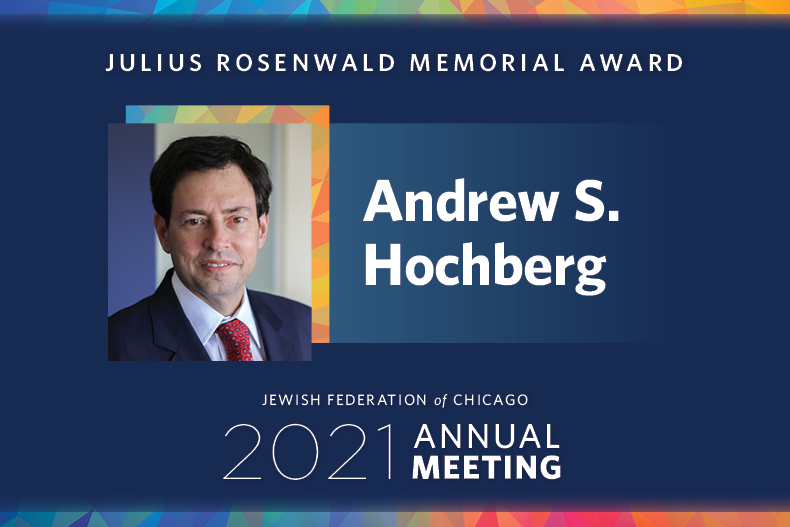
Meet Andrew S. Hochberg, 2021 Julius Rosenwald Memorial Award recipient
Celebrate Andy Hochberg at the virtual Annual Meeting on Sept. 14
Read more -
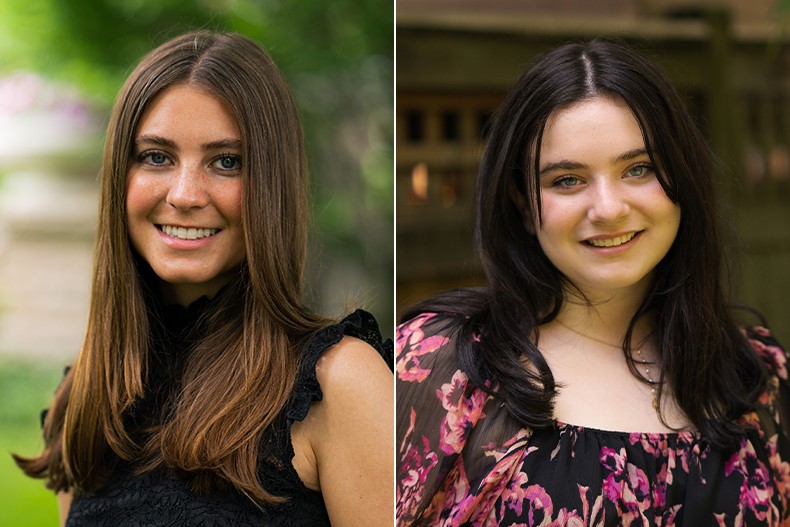
Two local teens win national recognition
Recipients of the annual Diller Teen Tikkun Olam Awards
Read more -
Celebrating six young award winners cultivating the community
Introducing young adult award winners
Read more
How do you help young Jewish teens discover what being Jewish means to them?
Take them to Israel.
The next episode of the public-affairs program “Sanctuary” — which airs at 12:30 p.m. Sunday, Aug. 21, on ABC7-Channel 7 — joins the journey as Ta’am Yisrael, a Community Foundation for Jewish Education program for eighth-graders, does just that.
The week-long trip offers teens a wide-ranging taste of Israel’s rich and diverse culture, while encouraging them to explore their personal relationship to the land and their heritage.
CFJE’s Richard Moline and Ariel Rosen and Rabbi Eitan Weiner-Kaplow of Shir Hadash discuss the program and its impact, as the teens offer glimpses of their experiences on the 2016 trip. Cindy Sher hosts.
Starting Monday, Aug. 22, the program also will be available for viewing on the Jewish United Fund website at www.JUF.org/videos .
“Sanctuary” is a joint production of the Jewish United Fund of Metropolitan Chicago and the Chicago Board of Rabbis, in cooperation with ABC7-Channel 7.
Other stories
-
Meet Andrew S. Hochberg, 2021 Julius Rosenwald Memorial Award recipient
Celebrate Andy Hochberg at the virtual Annual Meeting on Sept. 14
Read more -
Two local teens win national recognition
Recipients of the annual Diller Teen Tikkun Olam Awards
Read more -
Celebrating six young award winners cultivating the community
Introducing young adult award winners
Read more
JUF, ADL host discussion for Jewish state legislators from across the US
SUZANNE STRASSBERGER
A bipartisan group of more than 30 Jewish state legislators from around the country attended a breakfast discussion Wednesday about anti-Boycott, Divestment and Sanctions legislation and other key topics, hosted by JUF and ADL.
Anti-BDS legislation was one of the primary focuses, an area in which Illinois led the way with the creation of last year’s anti-BDS law. Strategies and experience passing such legislation varied from state to state, but participants agreed on the importance of taking a public stand against the BDS movement.
Time was also spent discussing the tone of the current political campaigns and ways to distinguish oneself from the sentiment behind the language.
The discussion was part of the National Conference of State Legislatures, which took place this week in Chicago. More than 25 states were represented at the gathering including Colorado, Florida, Massachusetts, Minnesota, New York, Texas, Utah, Wisconsin and, of course, Illinois.
“We rely on our strong partnership with our Jewish Caucus in the Illinois Legislature to help us advocate on behalf of the social justice goals of our Jewish community, the funding needs of our network of affiliated agencies who receive more than $350 million in government funds annually, and our support for Israel,” said David Golder, chair of the JUF Government Affairs Committee, in his welcome to group.
According to NAJL Executive Director Jeff Wice, there are over 225 Jewish state legislators currently serving in office, and that number keeps growing as Jewish candidates get elected from both urban and rural districts in the majority of states.
“I expect the number to grow after the November elections,” Wice said.
Other stories
-
Meet Andrew S. Hochberg, 2021 Julius Rosenwald Memorial Award recipient
Celebrate Andy Hochberg at the virtual Annual Meeting on Sept. 14
Read more -
Two local teens win national recognition
Recipients of the annual Diller Teen Tikkun Olam Awards
Read more -
Celebrating six young award winners cultivating the community
Introducing young adult award winners
Read more
Monday marked the deadliest day in Chicago in 13 years with a reported 19 people shot and nine killed.
Many of the shootings took place on the West Side near North Lawndale, a community that JUF’s Jewish Community Relations Council works closely with that once had a large Jewish population.
“It is overwhelming to think about the devastating toll this violence is having on the residents of the community and on our partners, including Mt. Sinai Hospital, who are on the front lines working every day to address this crisis,” said JCRC Chair David T. Brown. “As citizens and civic leaders of this city, we cannot turn our backs from what is happening. We must be engaged on this issue.”
JCRC has a longstanding gun safety policy and has been working closely with a variety of community partners, including Fierce Women of Faith, to help raise awareness and identify solutions.
As part of this effort, JCRC and Fierce Women of Faith are bringing women from throughout Chicago together in dialogue and are planning a day of action early this fall.
Other stories
-
Meet Andrew S. Hochberg, 2021 Julius Rosenwald Memorial Award recipient
Celebrate Andy Hochberg at the virtual Annual Meeting on Sept. 14
Read more -
Two local teens win national recognition
Recipients of the annual Diller Teen Tikkun Olam Awards
Read more -
Celebrating six young award winners cultivating the community
Introducing young adult award winners
Read more
Step by step, brick by brick: Interfaith leaders gather for unveiling of new Dr. King monument
PAUL WIEDER
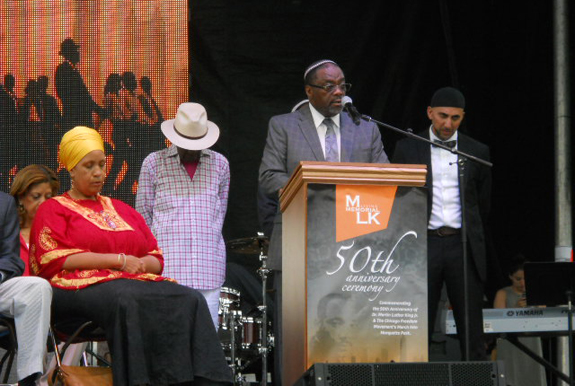
Rabbi Capers Funnye of Beth Shalom B’nai Zaken Ethiopian Hebrew Congregation gives an invocation at the unveiling of the new MLK monument in Marquette Park on Aug. 5
Bricks were thrown at those marching with the Reverend Dr. Martin Luther King, Jr. for fair housing practices in Chicago’s Marquette Park in 1966. And so, half a century later, that event was marked by the installation of a new monument — made of bricks.
The monument was unveiled in the park on Aug. 5, exactly 50 years to the day of the march, near South Kedzie Avenue and 67th Street. It consists of a set of three four-sided pillars, set around a circle in the ground bearing a quote by King.
On all of the pillars’ surfaces are carved images and words of that day: the faces of King and the other civil rights leaders who joined him, and their remarks on the day’s events. Flanking the monument is a bench, set with colorful tiles made by area residents and children reflecting on their idea of “home.”
Some 700 marched with King that day for fair housing practices and were attacked by some 5,000 residents who hurled insults, slurs, bottles, and bricks. King himself was struck in the head with a rock, an image now carved into the monument itself.
What you might not expect to see are the many Jewish references in the monument, including the Tree of Life and the face and words of Rabbi Robert Marx, founder of the Jewish Council on Urban Affairs. And on one face of a pillar, the word for “home” is etched in a dozen languages, including Yiddish.
Rabbi Ellen Dreyfus, spiritual leader of B’nai Yehuda Beth Sholom in Homewood, and former head of the Chicago Board of Rabbis, was very excited to attend the monument’s dedication.
” Rami Nashashibi was influenced by Rabbi Marx, who marched with Dr. King that day, and who was also one of my teachers,” she said. “I remember, as a kid, what happened here, the ugly response the marchers received, and it shaped my view of the world.” Nashashibi is the executive director of the Inner-City Muslim Action Network, the organization that initiated the creation of the monument.
The message of “home” was echoed by Nashashibi, who said in his remarks at the dedication that he wanted to transform the signs that had met the 1966 protesters reading “Go Home” into signs that read “Welcome Home.” He noted that the idea for it originally came from Victor Harbison, who teaches civics and history at Chicago’s Gage Park High School, and who had built a temporary monument earlier.
“This is the first permanent monument to King in the Chicago area,” Nashashibi said, reminding his listeners that King said that the “hatred and bigotry” he had faced was “worse here than in the South.” He also recalled the neo-Nazi marches of the 1970s, and noted that such groups still have offices in Chicago.
Nashashibi addressed a very diverse crowd, with those of many religions, backgrounds, and ethnicities all reveling in a fulfillment of King’s famous “dream” of a day when “all of God’s children, black and white, Jews and Gentiles, Protestants and Catholics, will be able to join hands.”
Those addressing the crowd were diverse as well. Before Rabbi Capers Funnye of the Beth Shalom B’nai Zaken Ethiopian Hebrew Congregation gave his invocation, he reflected on the wide range of the backgrounds of the participants.
“Our community has come a long way in 50 years,” he said. “The diversity is breathtaking. Dr. King couldn’t have imagined … Christians, Muslims, and Jews joining like this. The diversity has special meaning at this special time, as this project has been initiated by our friends in the Muslim community.”
In his invocation, he echoed the “Al Hanisim” prayer Jews offer at Chanukah, saying that here, too, “so few stood against so many.” His words were followed by invocations from Christian and Muslim clerics; all three clergymen who gave invocations were African-American.
Priest and activist Father Michael Pfleger, who was at the march in 1966, offered insights later in the program. He spoke of those who were at the march but did not live to see it memorialized by the monument. “We hear their spirits cry out to us: ‘Will you walk? Will you march?’ Today we take up that march, to fight against the rocks still being thrown,” he said.
Although at one point during the presentation it began to drizzle, the Reverend Jesse Jackson — who also marched with King that day — remarked that if the protesters “did not flinch from rocks and bottles, we will not flinch in the face of a few raindrops.”
Jackson referred to King as “The King of Hope,” and thanked the area’s Butay family, who helped raised tens of thousands of dollars for King’s cause and even housed him during his Chicago stay. He added that he counts the Chicago march among King’s victories, along with the marches in Selma and Birmingham.
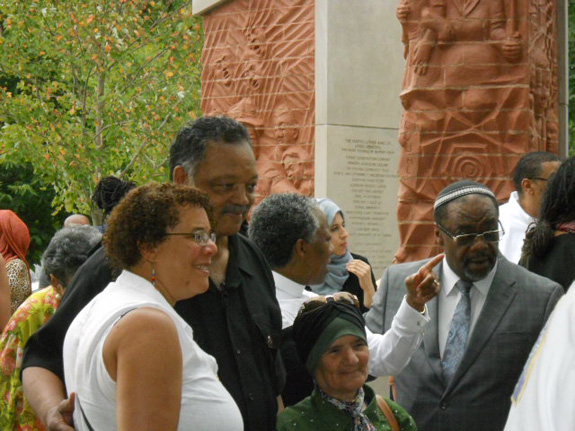
Rev. Jesse Jackson, Rabbi Capers Funnye (right) and others in front of the MLK Monument.
He also spoke of how King did not hate those who attacked his march, as they had been “taught to behave that way.” Such people live on the other side of a “wall,” Jackson said, on the side with “ignorance, fear, hate, and violence.” He lamented that the work is not done, given the number of killings in Chicago each year and the loss of manufacturing to other countries. “The march did not begin 50 years ago,” Jackson said, “and it does not end now.”
Attendees also heard from several government officials, including: Alderman David Moore (17th Ward), Illinois State Senator Jacqueline Y. Collins, Cook County Board President Toni Preckwinkle, U.S. Rep. Robin Kelly, and Chicago Deputy Mayor Andrea Zopp.
There were musical performances, including one by former Ray Charles backup singer Tammy McCann, who sang the Duke Ellington song “Come Sunday,” and a provocative poem read by spoken-word artist Kendria “K Love” Harris. She noted that King “left footprints in Chicago … they hit him with a brick and he built a foundation with it.”
Sonja Henderson, one of the artists who designed the monument itself, explained that the structure was created to be “harmonious” and to channel “positive energy.” The 800-plus bricks that comprise the monument are themselves a reference to the building material common to Chicago’s bungalows and therefore recall the 1966 march’s focus on housing issues.
“Dr. King’s march put a national spotlight on the glaring inequalities that existed in this city,” said Emily Sweet, executive director of JUF’s Jewish Community Relations Council, who attended the dedication. “Unfortunately today, the spotlights are still shining on Chicago, and we know there is much more work to do.”
Standing near the monument, Alderman Michele Smith (43rd Ward), said, “I came to honor the struggle of Dr. King, who was strongly supported by the Jewish community, which took a strong part of the civil rights movement. We should continue to be allies in the ongoing issue facing our community.”
The Dr. Martin Luther King Living Memorial Project was supported by community organizers, corporate and philanthropic partners, public officials, religious leaders, and even high school students. The monument is the result of more than a decade of the project’s efforts.
The following day, Aug. 6, some 1,000 participants retraced the steps of King’s 1966 march in a “1000-Mile March.” This was a reference to King’s statement about the 1966 march, which he called the “first step on a thousand-mile journey.” The community then gathered at the Takin’ It to the Streets Festival, at which citizens and their leaders engaged in a discussion of current issues relevant to King’s work, and celebrated his legacy in music and art.
Even after the monument has become a reality, the project’s work is not done. Reflecting their desire to create a “living” memorial to King’s work, the project helped create the “1,000-Mile Scholars Youth Fellowship Program,” which will place energized youth with local social-justice organizations and the “Beloved Community Studio,” a space for local artists to convene and collaborate.
Some of King’s steps on his “thousand-mile journey” were taken in Chicago. We remember those steps today, and thanks to the monument and the Living Memorial project, we always will.
Other stories
-
Meet Andrew S. Hochberg, 2021 Julius Rosenwald Memorial Award recipient
Celebrate Andy Hochberg at the virtual Annual Meeting on Sept. 14
Read more -
Two local teens win national recognition
Recipients of the annual Diller Teen Tikkun Olam Awards
Read more -
Celebrating six young award winners cultivating the community
Introducing young adult award winners
Read more
JUF’s Metro Chicago Hillel is creating an innovative new model for welcoming urban students and young adults into a diverse, warm and hospitable Jewish family — Silverstein Base Hillel .
Located in Lincoln Park, Silverstein Base Hillel provides a home where a pluralistic rabbinic couple welcomes young Jews to experience and explore their Jewish identity. Bill, Ted, and Tom Silverstein purchased the carefully selected property-deliberately situated in the heart of a vibrant urban community and convenient to several universities-in order to bring to life three core values: hospitality, learning, and service.
“We really have a lot of people to thank — the Crown Family; lots of community support; Joshua Rinkov, Metro Chicago Hillel’s Chair who provided great leadership; an anonymous donor; and of course, Bill Silverstein, JUF/Federation Chairman of the Board, and the Silverstein family,” said John Lowenstein, executive director of the Hillels of Illinois. “Silverstein Base Hillel is all about hospitality, bringing people together, and you can’t do that without a thoughtful, intentional, and truly remarkable space that the brothers gifted to us.”
Silverstein Base Hillel brings Jewish students from campuses across the city of Chicago into a home created specifically to meet the needs of young, urban students. Programming occurs at times that are convenient for students: after classes are out, and before their evening plans.
“We want to fill the house as often as possible,” says Rabbi Megan GoldMarche, rabbi at Silverstein Base Hillel.
Rabbi Megan and Paige GoldMarche are working to create a warm, open Jewish home at Silverstein Base Hillel.
“Living Judaism is an immersive experience,” said Rabbi GoldMarche. “It’s not just teaching; it’s modeling that life. It breaks down barriers. Students have the opportunity to share our excitement and passion for Judaism, and it brings people together… We’ll have learning- Judaism 101, challah baking. We have ideas and will learn more from the students when school starts. We’ll provide study space. We’re here to serve the community and students. Judaism for us is joyful and filled with family and friends.”
Silverstein Base Hillel is also looking forward to partnering with other organizations. “We plan to work with all the Metro Chicago Hillel campuses, the local synagogues, and other organizations that are reaching college students and young adults. We intend to be an active partner in this community,” she said.
For Rabbi GoldMarche, Silverstein Base Hillel is a personal homecoming. “I grew up in Oak Park, I went to Jewish summer camp in Wisconsin (OSRUI), and participated in the Conservative movement’s youth group (USY),” she said. “This is my community. I’m so happy to be back.”
Together, Rabbi Megan and Paige GoldMarche have years of experience on campus. Rabbi GoldMarche has worked at the Hillel at Yale University and served as the Senior Jewish Educator at Columbia/Barnard Hillel. She graduated from Jewish Theological Seminary in 2014. Paige GoldMarche served as Director of Student Activities at the Harvard Hillel. In addition to her work at Silverstein Base Hillel, Paige will be serving as Assistant Director at the Newberger Hillel at the University of Chicago.
Karen Martin is the new assistant director at Metro Chicago Hillel.
Other stories
-
Meet Andrew S. Hochberg, 2021 Julius Rosenwald Memorial Award recipient
Celebrate Andy Hochberg at the virtual Annual Meeting on Sept. 14
Read more -
Two local teens win national recognition
Recipients of the annual Diller Teen Tikkun Olam Awards
Read more -
Celebrating six young award winners cultivating the community
Introducing young adult award winners
Read more
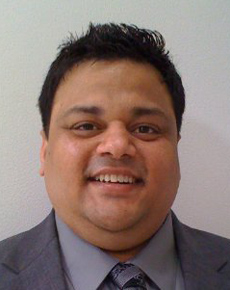
Kedar Potdar has been promoted to Vice President, Technology, of the Jewish United Fund/Jewish Federation of Metropolitan Chicago.
Potdar brings more than 17 years of industry experience in information technology infrastructure, software development and engineering, strategic planning, and project management. Since 2015, he has served as director and most recently as acting manager of JUF Technology.
In his new role, he will implement a new technology strategy for the organization; identify and advance new initiatives to tap the power of knowledge management and data analytics; improve and enhance the core system of donor management, as well as local and mobile applications; and partner with the Marketing Communications and Campaign departments to further refine existing and emerging electronic communication strategies, such as web and social media.
Potdar has been a leader in the digital business consulting and technology services industry at such major companies as Microsoft, Synechron and PegaSystems, and has held pivotal roles at JUF, including Senior Solutions Software Architect for a major revamp of the donor management system.
Potdar’s many achievements include inventing three innovative patent pending products in business process management. He holds a Bachelor of Science degree in Computer Science and a Master of Business Administration from the University of Illinois, has a diploma in Computer Technology from Maharashtra in India, and holds numerous certifications.
Other stories
-
Meet Andrew S. Hochberg, 2021 Julius Rosenwald Memorial Award recipient
Celebrate Andy Hochberg at the virtual Annual Meeting on Sept. 14
Read more -
Two local teens win national recognition
Recipients of the annual Diller Teen Tikkun Olam Awards
Read more -
Celebrating six young award winners cultivating the community
Introducing young adult award winners
Read more
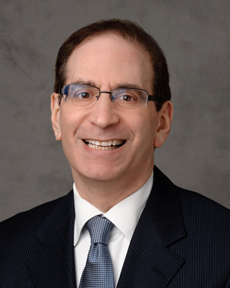
Robert A. Schuckman has been promoted to Vice President, Legal Counsel, of the Jewish United Fund/Jewish Federation of Metropolitan Chicago.
He will continue his role in JUF’s Legacies and Endowments Department, where he leads endowment efforts and has been responsible for the growth of the Professional Advisory Committee, while also handling legal matters throughout the organization, both in-house and through outside firms.
Schuckman joined JUF in 2001 as Assistant Vice President, Gift Planning and Administration, and was appointed Senior Associate Vice President and Counsel, L&E, in 2015. His responsibilities have included oversight of JUF’s gift planning programs and gift administration, and much of the legal work in the endowment field. He also took the lead role in the successful Chicago launch of the Create a Jewish Legacy program, which mentors local Jewish institutions in developing and growing their own endowments.
Schuckman previously was a partner at Jenner & Block, and supervised government and legal affairs at the American Dietetic Association.
He is a Fellow of the Leadership Greater Chicago program, received his Bachelor of Arts degree in History from Indiana University, and graduated as a member of Phi Beta Kappa. He received his Juris Doctor degree from Duke University School of Law.
Other stories
-
Meet Andrew S. Hochberg, 2021 Julius Rosenwald Memorial Award recipient
Celebrate Andy Hochberg at the virtual Annual Meeting on Sept. 14
Read more -
Two local teens win national recognition
Recipients of the annual Diller Teen Tikkun Olam Awards
Read more -
Celebrating six young award winners cultivating the community
Introducing young adult award winners
Read more
Sharon Berger, 65, of London was diagnosed with Acute Myeloid Leukemia in 2012, and was told that the only available cure was a stem cell transplant from an unrelated donor.
A global search was launched-dubbed the #Spit4Mum campaign-and a matching donor was found within weeks which meant Berger had an apparently successful transplant in May 2013. But a routine blood test recently revealed that, despite a successful transplant, the aggressive nature of her illness means the cancer has returned, and she requires a second transplant.
Blood cancer charity Anthony Nolan is now searching the world’s combined stem cell registries for someone whose tissue type matches that of Berger’s. But the search could prove difficult because of Sharon’s combination of rare tissue types. Because of Sharon’s Jewish heritage, her best match is likely to be an Ashkenazi Jew. But her family encourages everyone who is eligible to join the Anthony Nolan Bone Marrow register, as a potential match.
To join up you must be aged 16-30, in good health, and weigh at least approximately 110 lbs. In particular, Berger’s family is searching for people from Jewish and other ethnic minority backgrounds to join, as they are currently underrepresented on the donor register.
Find out more at www.anthonynolan.org .
To register as a stem cell donor in the U.S. or Israel, visit www.giftoflife.org .
To register to donate stem cells, visit www.bmdw.org .
Other stories
-
Meet Andrew S. Hochberg, 2021 Julius Rosenwald Memorial Award recipient
Celebrate Andy Hochberg at the virtual Annual Meeting on Sept. 14
Read more -
Two local teens win national recognition
Recipients of the annual Diller Teen Tikkun Olam Awards
Read more -
Celebrating six young award winners cultivating the community
Introducing young adult award winners
Read more