Sager Solomon Schechter Day School, the K-8 program at Solomon Schechter Day School of Metropolitan Chicago, was awarded National Blue Ribbon School status on Sept. 28, as announced by U.S. Secretary of Education, John B. King, Jr. Schechter is the only Jewish day school of the 50 private schools and 279 public schools across the nation to receive this honor this year.
“Being named as a National Blue Ribbon School is such a monumental achievement for us,” said CEO/Head of School Linda P. Foster. “This Award, combined with our ISACS accreditation, showcases our overall academic excellence and ongoing commitment to educate our students to their highest potential.”
“We are proud to be one of our nation’s highest performing schools,” said Schecter Board President Ethan Budin.
The National Blue Ribbon Schools Program honors public and private elementary, middle, and high schools where students achieve very high learning standards or are making notable improvements in closing the achievement gap. The award affirms the hard work of students, educators, families, and communities in creating safe and welcoming schools where students master challenging content. Now in its 34th year, the National Blue Ribbon Schools Program has bestowed this coveted award on fewer than 8,500 schools.
“National Blue Ribbon Schools are proof that we can prepare every child for college and meaningful careers,” King said in a video message to honorees. “[Blue Ribbon] schools are on the cutting-edge, pioneering innovative educational practices — professional learning communities, project-based learning, social and emotional learning, positive behavior systems — making you the shining examples for your communities, your state and the nation.”
The application process, which began during the 2015-2016 school year, was the collaborative effort of academic and administrative leadership, and representative of the entire K-8 school. Sager Solomon Schechter Day School will receive its National Blue Ribbon School flag and plaque during an Awards Ceremony in Washington D.C. on Tuesday, Nov. 8.
“This honor recognizes the exemplary teaching and learning that takes place at Schechter,” Foster said. “It is a testament of how we’ve strengthened our academic excellence across the board under [former Principal] Dr. Lena Kushnir’s tenure here, and an indicator of where Schechter is going in the future.”
Other stories
-
Two local teens win national recognition
Recipients of the annual Diller Teen Tikkun Olam Awards
Read more -
Celebrating six young award winners cultivating the community
Introducing young adult award winners
Read more -
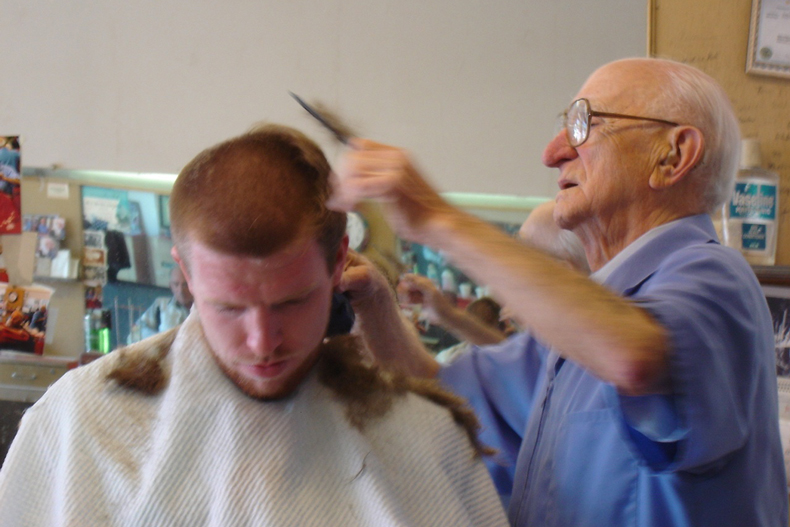
At Auschwitz, Ben Scheinkopf’s hair-cutting skills helped him stay alive. After World War II, they were his ticket to a better life in America.
On Aug. 26, at age 96, the beloved California Avenue barber put away his clippers and shears for good.
For more than 60 years, the Holocaust survivor and owner of Ben’s Barbershop, woke up every day happy to have a job he loved. “If you get up in the morning and nothing hurts you and you can go to work, then you are a lucky man,” he would tell his customers.
He worked six days a week and often served three generations of customers in one family. His shop at Touhy and California, an intersection with an Irish bar and 7-Eleven, was like a time capsule from 1950s; photos with his customers and newspaper clippings decorated the walls. In between customers, he’d read the newspaper or watch the Cubs on a small TV.
Some customers like Chicago author Patrick T. Reardon found inspiration just from sitting in his barber chair. “He’s this bright light in the room,” Reardon said. “When I was down, I’d go see Ben for a haircut.”
In March when 19-year-old Chicagoan and Israel Defense Forces soldier Joshua* needed a barber, there was only one who would make the cut.
“Wouldn’t it be cool if I got my first army buzzcut from Ben?” Joshua told his mom. So they paid a visit to Scheinkopf. As Ben clipped Joshua’s hair, the former Auschwitz barber and young soldier bonded over stories about Scheinkopf’s Israeli Army experiences during the 1948 War of Independence and visits with David Ben-Gurion who came from his town of Plonsk, Poland.
In May 1941, Scheinkopf, then 21, watched as German soldiers turned his town into a ghetto. Within a year, his family was on a train to Auschwitz. “I never thought I’d survive. The crematoriums were burning day and night,” said Scheinkopf, 97, during an interview from his Chicago home. “But I told myself I have to stay alive to tell people what happened.”
Like the numbers tattooed on his arm, some bad memories cannot be erased. “The Nazis brought over these young girls,” he recalled. “We had to cut off all their hair with clippers. It was terrible. How can you forget that?”
After the war, he didn’t speak about the Holocaust. The Nazis killed his father and four of his eight siblings. And older brother Josef was separated from his wife and two young sons, and he never saw them again.
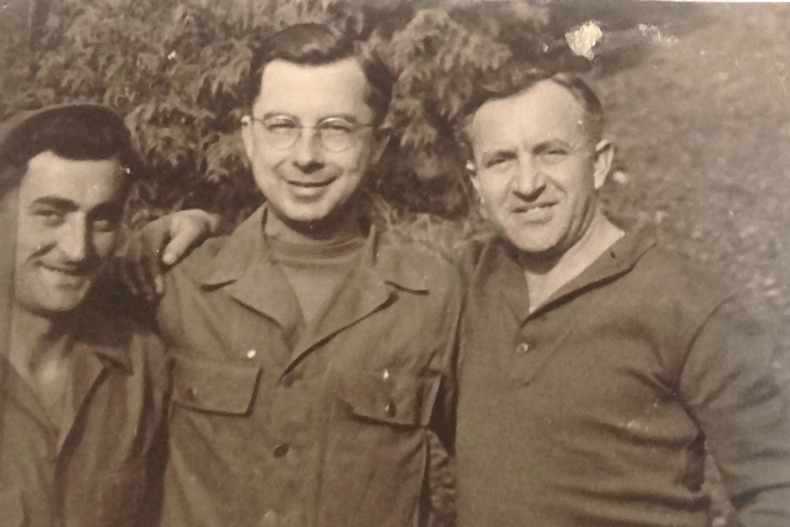
In January 1945, as U.S. forces closed in and the Germans realized they were losing the war, they shipped the remaining prisoners, including Scheinkopf and Josef, to Mauthausen concentration camp.
When American soldiers liberated the camps on May 5, Josef brought them to Scheinkopf who lay on a wagon with dead bodies. He was unconscious and weighed only 60 pounds.
He woke up the next day at a hospital near Bad Ischl, an Austrian resort town, and had no idea where he was. “I see the sun is shining and there are windows,” he recalled.
After that day, other rays of hope appeared in his life.
He and Josef became barbers for American soldiers in Patton’s Third Army. “One day I said to the cook, a Swedish-American fella, ‘You throw away so much food. Why don’t I bring it to my people in the DP camp?'” he said.
Every day, he drove in the jeep to drop off the leftovers until his army unit was transferred to a small town in Bavaria. The brothers opened up a little barbershop, and that’s when Scheinkopf met his future wife, Emily.
By 1954, the couple, along with three-year-old son Danny, had started a new life in Chicago.
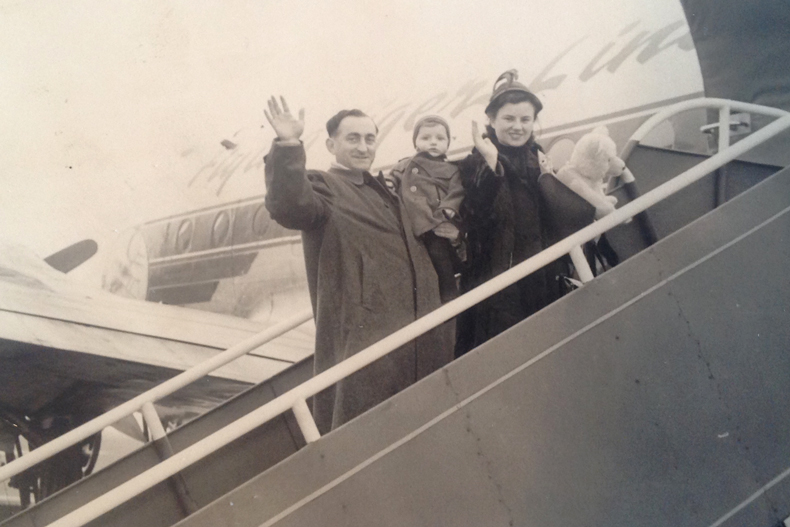
In recent years, Scheinkopf opened up about his past and became somewhat of a celebrity. He has granted interviews to local news stations and Spielberg’s Shoah Foundation, appeared in two documentaries, Barberland and Hillel Torah’s Names, Not Numbers , and spoke to local schools.
His story has moved some kids to tears and others to honor him with handshakes and letters. During a 2014 talk to mostly Latino students, he spoke about the ghettos and gas chambers.
“I told them that, out of 6,000 Jews in my town, only 30 survived. A few friends here survived, but now they are gone. I’m the only one left,” he said. “The kids were crying, they couldn’t believe something like this could happen.”
After the talk, over 100 letters arrived at the shop. “The kids all wrote, ‘Dear Mr. Scheinkopf, we love you.’ I still have that bag of letters,” said Emily.
Sitting in their living room, the Scheinkopfs, who have been together for 65 years, have reasons to be thankful. They were able to afford a home, raise three sons, and put them through college, an opportunity Ben Scheinkopf himself never had.
“We came from a place with nothing to this wonderland America, and we made a beautiful life,” said Emily, 91. “To this day, we think it’s the best country in the world.”
Jennifer Brody is a former associate editor at JUF News and a freelance writer living in Chicago.
*Name changed to protect privacy.
Other stories
-
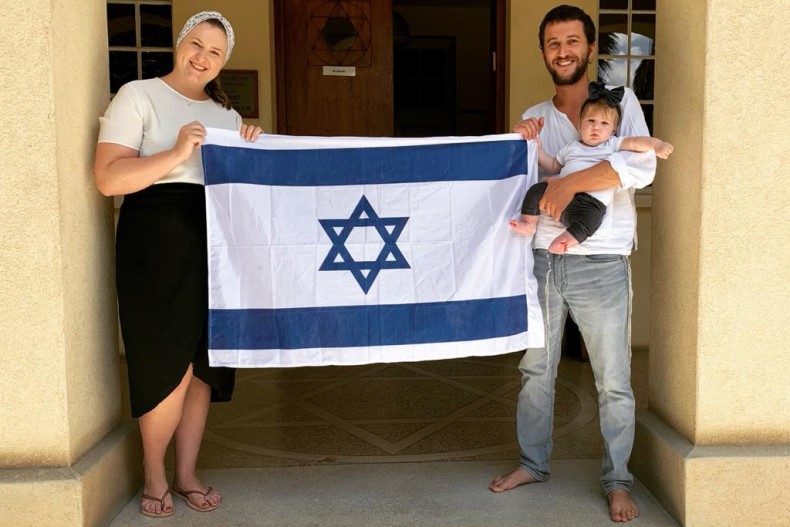
Chicago to Israel to Kenya
A family’s story of living Jewishly on three continents Michelle Cohen World May 28, 2021 Avital, Tzofia, and Netanel Kaszovitz outside their home in Nairobi on Yom HaAtzmaut. When Avital Kaszovitz prepared to be a Modern Orthodox shlicha (emissary) to the Jewish community in Ke
Read more -
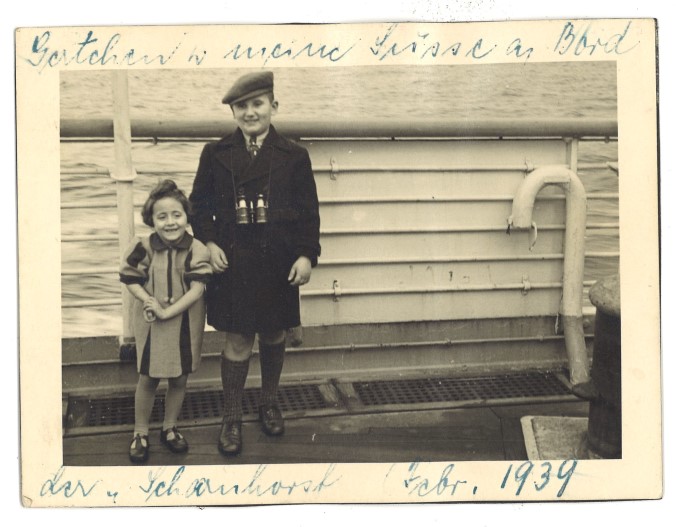
New exhibit spotlights the experience of ‘Shanghai Jews’
Explore a new Illinois Holocaust Museum and Education Center exhibit
Read more -
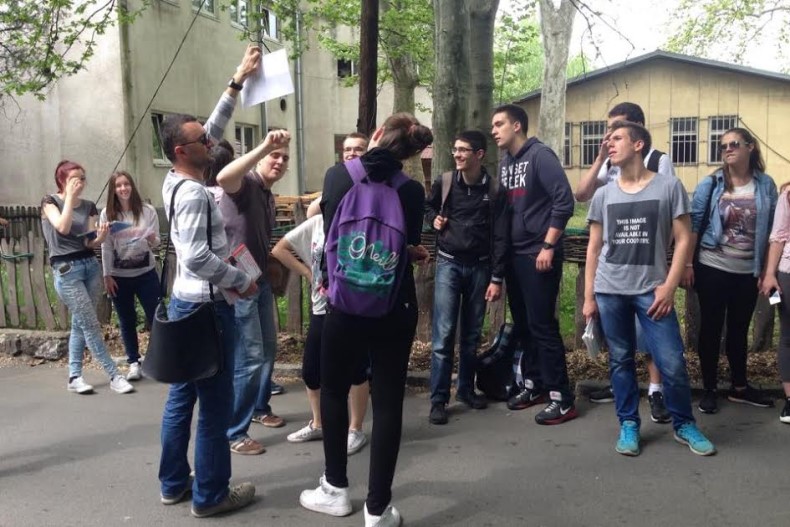
Europe’s brave new teachers of the Holocaust
Teaching the Holocaust in the modern era has its difficulties and rewards.
Read more
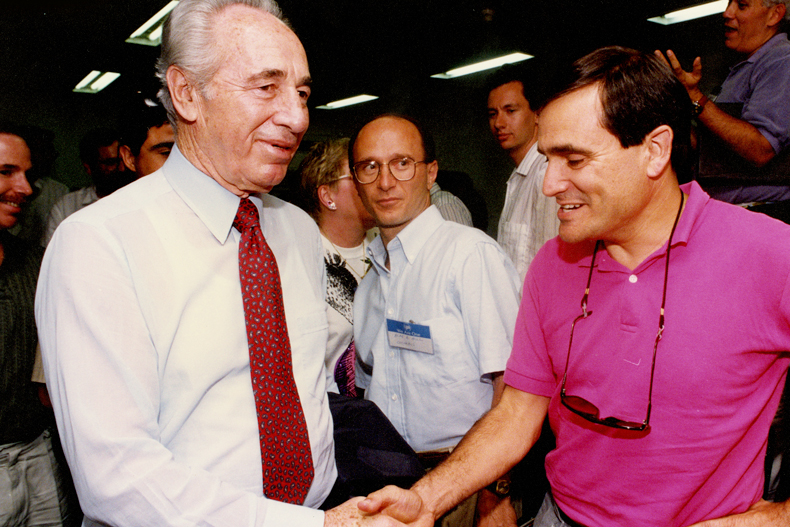
Chicago remembers the life and legacy of Shimon Peres
BEN SALES, JTA and JUF NEWS
Shimon Peres, Nobel Peace Prize winner, former President of Israel, and the last of the country’s founders, died Sept. 27 at age 93.
Peres suffered a massive stroke earlier this month.
Peres continually reinvented himself as the country changed. He began his career in the Defense Ministry and was the architect of Israel’s nuclear program, but in his later years Peres was more closely identified with the quest for peace with the Palestinians. He was instrumental in negotiating the Oslo Accords, the landmark Israeli-Palestinian peace agreement, and was present on the White House lawn for its signing in 1993.
Following the signing of the Oslo Accords, Peres emerged as Israel’s global ambassador for peace, predicting the emergence of a “new Middle East” in which conflict was supplanted by shared prosperity. Elected to the largely ceremonial role of president in 2007, talk of peace pervaded nearly every speech he gave. Well into his 90s, Peres still insisted he would live to see the day when peace would come.
In October 2014, at the age of 91, Peres visited Chicago upon the conclusion of his presidency and spoke at the Jewish United Fund of Metropolitan Chicago’s annual Vanguard and Crown dinners, which raised critical funds for the 2015 JUF Annual Campaign.
“You wouldn’t have any other group of any nation that contributes year in and year out for your own social needs, for the state of Israel — it’s a tradition,” Peres said, speaking to the dedication of JUF and the generosity of its supporters at the JUF Vanguard Dinner on October, 28, 2014.
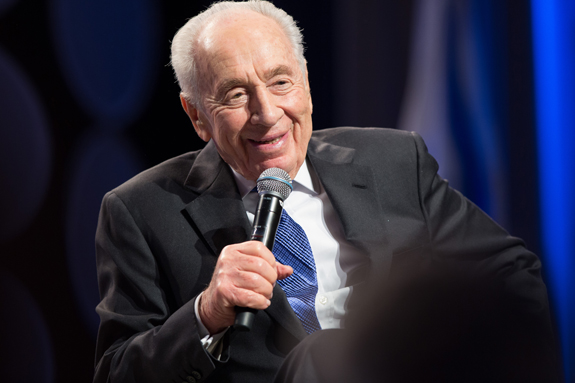
Peres at the JUF Vanguard Dinner on October 28, 2014. (Photo by Steve Donisch)
Peres had a deep admiration for Chicago, calling it an “historic Jewish community” in a video address to JUF supporters at a fundraiser for JUF’s Israel Emergency Campaign during the 2006 Lebanon War between Israel and Hezbollah.
In a statement reacting to the news of Peres’ death, JUF Chairman Michael H. Zaransky and JUF President Steven B. Nasatir said, “With the loss of this man of vision, who never lost faith in humanity or in the possibility of progress, the State of Israel, the Jewish people, the people of Chicago, and the world, all have lost an inspiring leader.”
As president, Peres emerged as Israel’s wise old man. Free to rise above the political fray, Peres trumpeted Israel’s technological achievements and articulated its hopes for a brighter future. More than anything, he became a symbol of the country’s resilience — able to survive, thrive and remain optimistic — no matter the challenges.
“Shimon devoted his life to our nation and to the pursuit of peace,” Israeli Prime Minister Benjamin Netanyahu said in a statement Wednesday. “He set his gaze on the future. He did so much to protect our people. He worked to his last days for peace and a better future for all. As Israel’s President, Shimon did so much to unite the nation. And the nation loved him for it.”
Born Szymon Perski in Wiszniewo, Poland, in 1923, Peres moved with his family to Tel Aviv in 1934. At 20, he became the head of a Labor Zionist youth group, through which he met David Ben-Gurion, who would become Israel’s first prime minister. In 1945, Peres married Sonya Gelman, who had just returned from World War II service in the British Army.
The couple was married for 67 years, though they separated after Peres became a presidential candidate. Sonya Peres had long refused to play the part of political wife, and after Peres moved to the president’s residence in Jerusalem, she changed the name on her Tel Aviv mailbox to Sonya Gal, a Hebraicized version of her maiden name. Sonya Peres died in 2011 at 87.
In 1947, Peres joined the Haganah, managing arms purchases and personnel. After Israel gained independence the following year, he continued working in the Defense Ministry, becoming its youngest-ever director-general in 1952 at 29. In that capacity he expanded Israeli arms purchases from France and later helped manage the 1956 Sinai Campaign. He also founded Israel’s arms production industry and led efforts to develop a nuclear weapon.
Peres was first elected to the Knesset in 1959 with Ben-Gurion’s ruling Mapai party, becoming deputy defense minister. He would serve in the Knesset for an as-yet unmatched total of 48 years. Peres remained a close Ben-Gurion ally, splitting from Mapai with him in 1965 to form a rival party and then rejoining Mapai when it became the Alignment in 1968.
After serving in several minor ministerial positions, Peres became defense minister in 1974 under Prime Minister Yitzhak Rabin. Peres was a territorial hawk, opposing early proposals for West Bank withdrawal and supporting settlement expansion. When Rabin resigned amid scandal in 1977, Peres briefly became acting prime minister, then lost the post when the Alignment was defeated in the 1977 election by Menachem Begin’s Likud party.
Peres headed the Alignment — the precursor to today’s Labor Party — for the next 15 years, contesting three more close elections with Likud. The two parties formed a unity government following the 1984 elections — Peres was prime minister from 1984 to 1986, then foreign minister under Prime Minister Yitzhak Shamir from 1986 to 1988.
As foreign minister in 1987, Peres conducted secret negotiations with King Hussein of Jordan for Israel to withdraw from the West Bank as part of an Israeli-Jordanian peace treaty. But Shamir rejected the proposed agreement, and the following year Jordan unilaterally relinquished its claim to the West Bank.
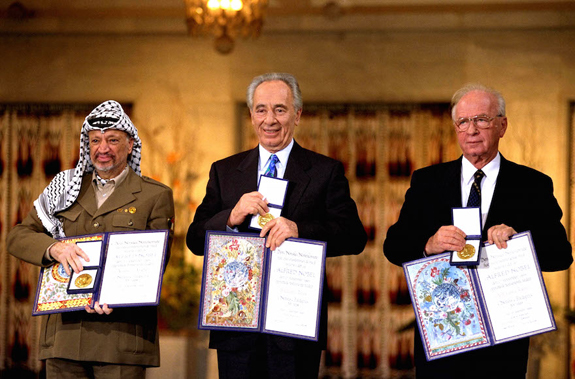
(From left) Yasser Arafat, Peres and Yitzhak Rabin display their Nobel Peace Prizes in Oslo, Norway in 1994. (Photo from Israeli Government Press Office via JTA)
After the Alignment lost the 1988 elections, Peres again joined a Likud-led government as finance minister, but tried to overthrow the government two years later. In what became known as the Dirty Trick, Peres assembled an Alignment-led coalition with leftist and haredi Orthodox parties, only to see it fall apart after he received a mandate to form a governing coalition. He lost his party’s chairmanship to Rabin in 1992, and again became foreign minister when the party, now renamed Labor, won elections that year.
Under Rabin, Peres was the architect of the Oslo Accords, which gave the Palestinians autonomy in parts of the West Bank and Gaza. He shared the Nobel Peace Prize with Rabin and Palestinian leader Yasser Arafat.
“Israel’s role in the Middle East should be to contribute to a great, sustained regional revival,” Peres said upon accepting the prize. “A Middle East without wars, without enemies, without ballistic missiles, without nuclear warheads.”
After Rabin was assassinated in 1995, Peres became acting prime minister, but lost the post again in a close race with Likud’s Netanyahu. Following his defeat in ’96, he founded the Peres Center for Peace, which runs programs aimed at regional reconciliation.
Peres remained in the Labor Party through 2005, twice regaining the chairmanship and serving another stint as foreign minister under Prime Minister Ariel Sharon. In 2006, following the Israeli withdrawal from Gaza, Peres joined Sharon’s new centrist Kadima party.
The next year he won a race for Israel’s largely ceremonial presidency. As president, Peres stayed largely above the political fray, though he conducted secret negotiations with Palestinian Authority President Mahmoud Abbas in 2011, culminating in a peace deal that Netanyahu’s government rejected. After leaving the presidency, Peres remained largely silent on politics.
Peres frequently traveled internationally as president, focusing his speeches and activism on encouraging Middle East peace and touting Israel’s technological achievements.
This was a frequent topic of conversation whenever Peres met with U.S. and Illinois leaders during JUF-led missions to Israel. In fact, when meeting with former Illinois Gov. Pat Quinn and JUF leaders in 2011, Peres had even spoken specifically to Israel’s focus on medical innovations working to combat strokes. “This will be the decade of science and technology,” he said.
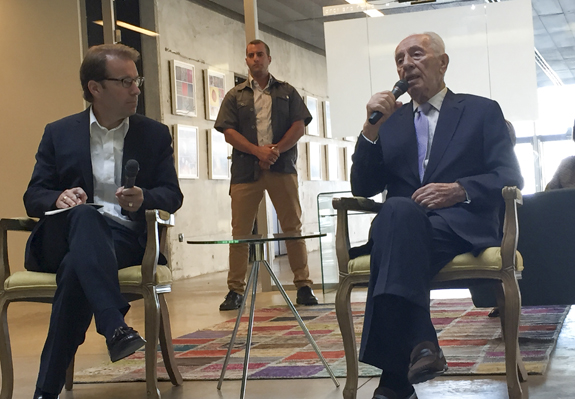
U.S. Rep. Peter Roskam (left) leads a discussion with Peres on a JUF mission to Israel in 2015.
In 2012, President Barack Obama awarded him the Presidential Medal of Freedom, the United States’ highest civilian honor. Peres’ annual Presidential Conference brought together leaders in politics, science and culture. He finished his presidential term in 2014.
He is survived by three children, Tsvia Walden, Yoni Peres and Chemi Peres, eight grandchildren and two great-grandchildren.
“A light has gone out, but the hope he gave us will burn forever,” Obama said Tuesday night in a statement. “Shimon Peres was a soldier for Israel, for the Jewish people, for justice, for peace, and for the belief that we can be true to our best selves — to the very end of our time on Earth, and in the legacy that we leave to others.
Other stories
-
Two local teens win national recognition
Recipients of the annual Diller Teen Tikkun Olam Awards
Read more -
Celebrating six young award winners cultivating the community
Introducing young adult award winners
Read more -
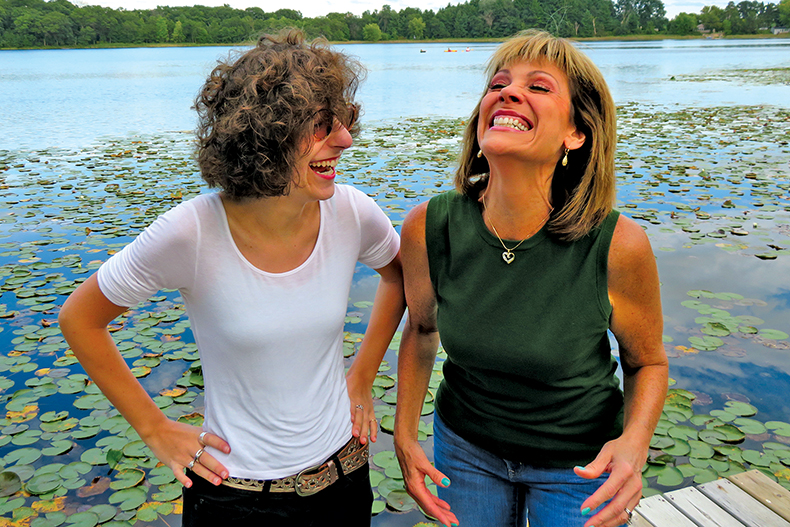
I didn’t need a doctor to tell me something was terribly wrong.
It was the summer of 2006. My husband, 10-year-old daughter, and I had just begun a dream vacation in Greece. I found the lump, under my arm while in the shower. It was a surreal moment-your gut tells you it’s a tumor, yet you pray with all your might it’s anything but. We tried to make the most of our vacation, deciding to see the doctor first thing when we got home.
That week was a blur-from bad news to worse, to the unthinkable. By the end of the week, tests showed I had Stage IV metastatic breast cancer. I was too emotional to go back to work. I prepared a statement the ABC7 morning team read on the air, letting viewers know I was going to fight this disease like a true warrior, promising a quick return!
Getting over the shock of the initial diagnosis is the first hurdle. The most challenging part of dealing with breast cancer was not the chemo, not thoughts of my mortality, but thoughts of my 10-year-old daughter growing up without a mother. It gave me a strength I didn’t know existed to fight the good fight.
Sara is my only child; we’ve always had a special mother-daughter bond. Once my cancer treatments started showing positive results, I started reprioritizing. I hadn’t had a bat mitzvah as a teen-it was something I always wanted to do as an adult, but never seemed to have the time. Now I would MAKE the time! And what better time than 2 years before Sara’s bat mitzvah?! I approached Sara first, to see how she’d feel about a “double!” I didn’t want to take away from her special day. Her response, “I think that would be great, Mom! I know it’s something you’ve always wanted to do, and besides, if I get nervous on the bima (pulpit) and forget something, you’ll be there to help!” I love that kid to the moon and back!
Next step, actually seeing if I could learn everything in two years, from the Aleph Bet to the Haftarah. I met with Rabbi Gary Gerson at Oak Park Temple, who had no doubt I could pull it off! He set me up with congregation member Berit Engen for Hebrew studies and that was the start of reconnecting with my Jewish faith.
I met with Berit once a week for two years, learning to read Hebrew, sing prayers, and chant Torah. The feeling I had during those study sessions was therapeutic. I was so focused on not just learning, but understanding the meaning behind my faith, it put me in a safe space-free of cancer worries. I continued treatment during my studies. Call it what you will, but seven months after diagnosis all tumors were gone; I was in total remission.
On Oct. 11, 2008, Sara and I became B’not Mitzvah, with a lovely ceremony surrounded by family and friends. I was so overcome with emotion, the Rabbi’s joked that I used up all the Kleenex on the bima, and hopefully someone in the congregation had more!
Being a part of the congregation felt like home to me. I wanted to participate more. I joined the amateur choir. Sara and I went to Israel with members of our synagogue several years later. When Rabbi Gerson retired, Sara and I joined synagogue members on a trip organized by our new Rabbi, Max Weiss touring the “Jewish Deep South!”
When I had a new bout of Stage Zero breast cancer in fall of 2013, it was Rabbi Weiss who reached out to me (through Facebook, of all places) offering along with Cantor Julie Yugend-Green to pray for my health on the bima in front of the opened Ark. It was overwhelming, yet comforting.
After a lumpectomy, followed by radiation, I was once again in full remission.
The reconnection with my Jewish community has become a strong part of my identity. While breast cancer is still a part of my life, it does not define me. It’s more of a blessing in disguise.
Roz Varon, a 2006 breast cancer survivor, is an Emmy Award-winning Traffic/Transportation Anchor at ABC7 Chicago, and the first TV traffic anchor in the country to bring rush hour traffic reporting to the morning news.
October is Breast Cancer Awareness Month
The statistics are sobering: In 2016, about 300,000 women in the United States will receive a breast cancer diagnosis. About 1 in 8 Jewish women will receive a breast cancer diagnosis at some point in her lifetime. While the overall breast cancer risk for Jewish women is about the same as the general population, about 1 in 40 Ashkenazi Jewish women carry a BRCA1 or BRCA2 mutation, a rate more than 10 times higher than in the general population. These mutations place them at higher risk for certain hereditary forms of breast cancer (as well as other cancers). Women with those forms of breast cancer may face diagnosis at an earlier age, and a more aggressive form of the disease.
Jewish women seeking support-as a person at-risk, as a current patient, or as a breast cancer survivor-have many resources they can draw upon.
Here in Chicago, the Norton & Elaine Sarnoff Center for Jewish Genetics (formerly the Center for Jewish Genetics) offers educational programming and other resources to educate the Jewish community about the risks associated with the BRCA mutations. The Center also provides community members with access to a genetic counselor who can answer general questions about cancer risk and help community members identify resources for counseling and clinical care. The Norton & Elaine Sarnoff Center is supporting foundation of JUF. (www.jewishgenetics.org)
Nationally, Sharsheret (Hebrew for “chain”) offers a wealth of resources and access to a wide spectrum of support resources for Jewish women with breast or ovarian cancer, as well as their families and caregivers. Sharesheret specializes in providing culturally-appropriate support services to persons of all Jewish backgrounds, and includes a peer support volunteer network with strong representation in Illinois. (www.sharsheret.org)
Bright Pink focuses on early detection of breast and ovarian cancer in young women. While not an explicitly Jewish organization, Bright Pink particularly targets young women in high-risk groups such as those with BRCA1 and BRCA2 mutations. Bright Pink also has strong ties to the Chicago Jewish community through its founder, breast cancer survivor Lindsay Avner. Bright Pink offers a wealth of risk assessment and educational resources, and supports both one-on-one and peer support options in Illinois and around the country. (www.brightpink.org)
Not Just a Women’s Issue
Breast cancer is not a Jewish women’s issue; it is a Jewish community issue. While we often think of Jewish men and breast cancer in the context of caregivers and partners, that doesn’t tell the whole story. While male breast cancer is rare, the risk is somewhat higher for BRCA1 carriers and substantially higher for BRCA2 carriers. Ashkenazi Jewish men, particularly those with a family history of breast or ovarian cancer, should consider taking action to learn more about their risks. More information about BRCA and men is available both through the Norton & Elaine Sarnoff Center for Jewish Genetics and through Sharsheret.
Other stories
-
Two local teens win national recognition
Recipients of the annual Diller Teen Tikkun Olam Awards
Read more -
Celebrating six young award winners cultivating the community
Introducing young adult award winners
Read more -
David T. Brown takes a very hands-on approach to his philanthropy. And to strengthening the Jewish community, as well.
As rockets bombarded Israel’s south and sirens blared before each impending blast in 2012, David was there, assessing first-hand how Chicago’s Jewish community could help, and making sure the people of the region knew they were not alone.
Two years later, he was back again, at the height of Operation Protective Edge.
Early last year, just days after the terrorist massacres at Charlie Hebdo and the kosher supermarket in Paris, David was there, too, carrying a message of the unwavering connection between the French Jewish community and Chicago’s.
In times of war and times of terror, as well as in the heat of legislative battles in Washington and Springfield, and on missions of healing to communities struck by natural or economic disaster, Brown has long been an ambassador and advocate for Chicago’s Jewish community. He has provided emotional support. Brought tangible assistance. Rallied those who can help. And embodied the precept that all Jews are responsible for one another.
On Thursday, Sept. 15, the Jewish Federation of Metropolitan Chicago honored that commitment and energy when it presented Brown with its highest recognition, the Julius Rosenwald Memorial Award. The award goes to present-day leaders who mirror the values and determination of one of Chicago’s, and the world’s, greatest philanthropists and social advocates.
Brown – who chairs the law firm of Much Shelist, is immediate past chair of the Jewish Federation, and leads a broad array of other civic, arts and humanitarian endeavors – says his philanthropic goal is to make the best even better, so those who help can do even more.
He strives, he says, for a community where each donor, volunteer, worker, agency and school has the sense that they are a vital part of the important work being done on behalf of the Jewish people. And he actively reaches out to young leaders, and potential leaders, engaging them, mentoring them, and encouraging them to take on new leadership roles.
“If you know David,” Federation President Steven Nasatir said, “you know how deserving he is – how hard he pushes everyone to do their best. While uncertainty surrounds us, David’s leadership is a sure thing.”
Brown’s involvement dates back to the early ’90s. Ever since he became active in JUF’s Young Leadership Division, he said, “I haven’t stopped raising my hand to lead.”
In 1993, he received the Federation’s Davis, Gidwitz & Glasser Young Leadership Award. He also has played key roles in the Young Leadership Division, the national United Jewish Appeal Young Leadership Cabinet, the Jewish Children’s Bureau, the Hillels of Illinois Governing Commission, the American Jewish Congress Governing Council, AIPAC and the Standard Club.
Today, he chairs JUF’s Jewish Community Relations Council and the Global Operations: Israel and Overseas Council of the Jewish Federations of North America, and is on the board of the Jewish Agency for Israel. He has worked regularly with JFNA’s Washington, D.C., office on health and long-term care issues, care of the aged, disability and tax policies.
Brown also is a major force in the Chicago business and civic arenas. He is a member of the American, Illinois and Chicago bar associations, The Economic Club of Chicago and the Chicago Chapter of the World Presidents’ Organization, and has been honored by the American Liver Foundation, SHALVA and the American Jewish Congress.
He also has run 11 Chicago Marathons – supporting groups such as JUF, the American Cancer Society and the American Liver Foundation.
While humbled to receive the Rosenwald Award for what he has done, Brown said it takes everyone’s commitment to keep the Jewish community strong.
“All of us must continue to raise our hands to lead.”
Other stories
-
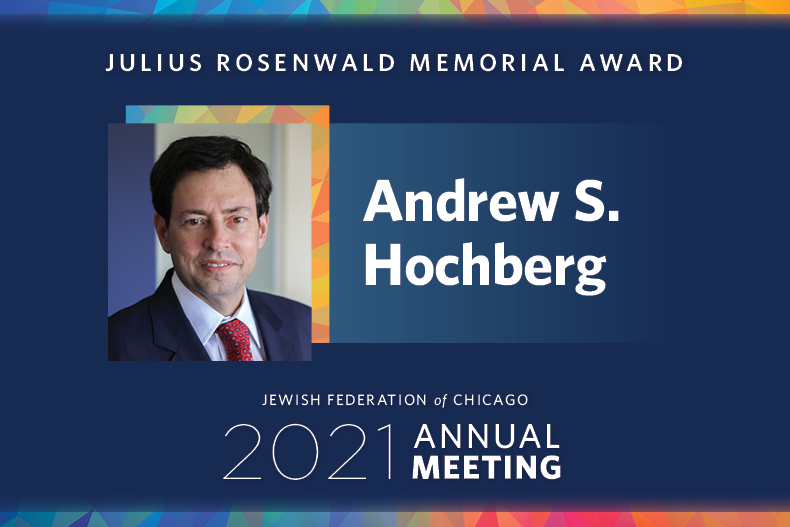
Meet Andrew S. Hochberg, 2021 Julius Rosenwald Memorial Award recipient
Celebrate Andy Hochberg at the virtual Annual Meeting on Sept. 14
Read more -
Two local teens win national recognition
Recipients of the annual Diller Teen Tikkun Olam Awards
Read more -
Celebrating six young award winners cultivating the community
Introducing young adult award winners
Read more
On behalf of the Chicago Jewish community, the leaders of the Jewish Community Relations Council of the Jewish United Fund of Metropolitan Chicago applaud law enforcement in arresting a suspect in the Sept. 12 arson attack against the Islamic Center of Fort Pierce, Fla.
“An attack against any religious institution anywhere in the United States is like an attack against our own religious institutions right here at home,” said David T. Brown, JCRC Chairman. “We are thankful that law enforcement officials have identified a suspect in this hateful attack; further, we believe it is important and appropriate that, if convicted, the suspect be subject to Florida’s hate-crime enhancement.”
“As a Jewish community and people of faith, we well know that attacks that target a community’s sacred space take a heavy toll on individuals, communities, and our society as a whole,” said JCRC Executive Director Emily Sweet. “Our collective challenge as Americans, from all faith communities, is to strongly condemn such acts of violence and build bridges of trust and open channels of communication, and to break down barriers that lead to hate.”
Other stories
-
Chicago to Israel to Kenya
A family’s story of living Jewishly on three continents Michelle Cohen World May 28, 2021 Avital, Tzofia, and Netanel Kaszovitz outside their home in Nairobi on Yom HaAtzmaut. When Avital Kaszovitz prepared to be a Modern Orthodox shlicha (emissary) to the Jewish community in Ke
Read more -
New exhibit spotlights the experience of ‘Shanghai Jews’
Explore a new Illinois Holocaust Museum and Education Center exhibit
Read more -
Europe’s brave new teachers of the Holocaust
Teaching the Holocaust in the modern era has its difficulties and rewards.
Read more
Jewish Federation honors up-and-coming leaders, spotlights Israel Partnership Region
CHRISTINE SIEROCKI LUPELLA
The Jewish Federation of Metropolitan Chicago’s 116th Annual Meeting on Sept. 15 at the Hyatt Regency Chicago featured a keynote address by Hillel C. Neuer, executive director of U.N. Watch, and recognized David T. Brown for his lifetime of service to the Jewish United Fund/Jewish Federation of Metropolitan Chicago and the global Jewish community. ( Read more here )
The noon luncheon was preceded by a morning business that opened with the unanimous election of the 2016-17 JUF/Federation Board, while outgoing directors were honored for their service. ( See photos from the event here )
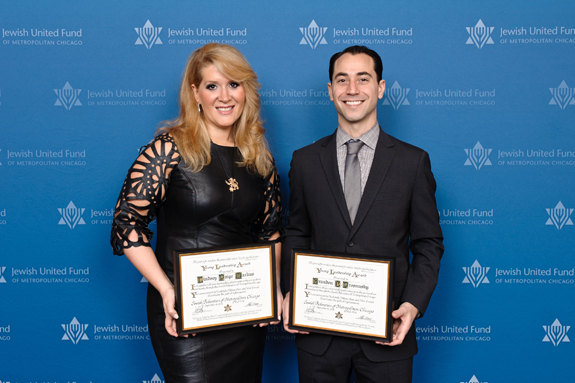
Davis, Gidwitz and Glasser Award winners Lindsey Markus and Brandon Prosansky.
Davis, Gidwitz and Glasser Young Leadership Award
Following the election, several awards were presented to rising community leaders. Jewish Federation Chairman Bill Silverstein presented annual Davis, Gidwitz and Glasser Young Leadership awards to Lindsey Paige Markus and Brandon C. Prosansky. The award honors young volunteers who have demonstrated exemplary dedication and made significant contributions to Chicago’s Jewish community.
Lindsey Markus: Purpose in giving
Markus, 39, of Chicago, is the incoming chair of JUF’s Lawyers Division and currently serves on the JUF Professional Advisory and Legacy and Endowments Committees. She has served on JUF’s Young Leadership Division (YLD) Board of Directors, and was a member of the YLD Executive Committee and has chaired other JUF events. She is a member of the National Young Leadership Cabinet and has served on committees and chaired events for the Standard Club, Chuhak & Tecson’s Women Helping Women Initiative, and other nonprofit organizations. In 2012, she was named to YLD/Oy!Chicago’s first “36 Under 36” list.
In her remarks, Markus said that the importance of philanthropic giving “is part of Jewish DNA,” and that giving produces successful leaders and organizations. She talked about the way making an endowment gift empowered her as a young, single woman.
“Nothing could have prepared me for the sense of purpose I felt,” she said, closing her speech with a quote from Anne Frank: “‘How wonderful it is that nobody need wait a single moment before starting to improve the world.'” ( Watch the video of Markus’ speech )
Professionally, Markus is a principal with Chuhak & Tecson, P.C., heading its Estate Planning group.
Brandon Prosansky: Uplifting by all definitions
Prosansky, 37, of Chicago, has been a YLD Board member since 2012, and has previously served as President, Campaign Vice Chair, and as an ex-officio member of the JUF/Federation Board. He is a past chair and Campaign co-chair of JUF’s Young Lawyers Group, and has served on other JUF committees and commissions. Prosansky is a member of the National Young Leadership Cabinet and was in the second cohort of the Jewish Leaders Institute. He was also named to YLD/Oy!Chicago’s 2012 “36 Under 36” list.
During his remarks, Prosansky said “uplifting” describes Federation’s work-building, supporting, and improving Chicago’s Jewish community. He said he has been inspired to carry on the legacy of his parents and of his mentor, former JUF/Federation Chairman and Rosenwald Awardee, David T. Brown.
“I see it as a challenge in continuing my work to be uplifting in all of its definitions,” he said. ( Watch the video of Prosansky’s speech )
Professionally, Prosansky is a partner at Barack Ferrazzano law firm.
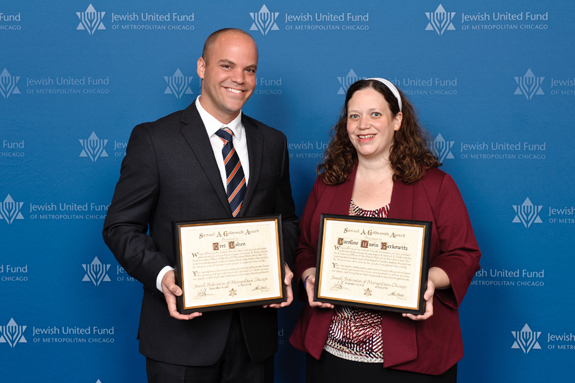
Samuel A. Goldsmith Award winners Erez Cohen and Caroline Musin Berkowitz.
Samuel A. Goldsmith Award
Caroline Musin Berkowitz and Erez Cohen received Samuel A. Goldsmith Awards, given to exceptional young professionals who have shown outstanding performance at a Jewish agency in the Chicago area.
Caroline Musin Berkowitz: Investing in others
Musin Berkowitz, 38, is the Director of Volunteers and Outreach at The ARK, recruiting, screening, placing and retaining over 2,000 volunteers. She oversees The ARK’s food pantry and has streamlined redundancies and introduced multiple technology resources to increase the quality of communication with volunteers, staff and clients. She helped create, fund and implement volunteer opportunities specifically designed for families with young children. She works closely with and formally and informally mentors future leaders and interns according to their needs and abilities.
Accepting her award, Musin Berkowitz said she makes it a priority to invest in others’ learning and growth, whether they are professionals or volunteers.
“Every volunteer experience is an opportunity to educate people about our clients,” she said, noting that one project has involved placing labels on holiday food packages for people in need. “By adjusting the frame through which volunteers see their work…they see it as feeding people, not just putting stickers on bags.”
“I am honored to continue this sacred work,” she said, expressing appreciation for her peers and their contributions to The Ark’s clients and the community. ( Watch the video of Musin Berkowitz’s speech )
Erez Cohen: Building community together
Cohen, 33, is Executive Director of Illini Hillel at University of Illinois Urbana-Champaign, where he manages staff and 25 student interns to engage the 3,500 Jewish students on the campus. He has implemented Hillel International’s Circle of Educational Excellence program to strategically respond to meeting the needs of students from a wide variety of Jewish backgrounds and experiences, and is a core team member of the Hillel International Measuring Excellence program that researches and defines the metrics of success for the Hillel movement. He also spearheaded a five-year strategic planning process with the Illini Hillel board, and reestablished University of Illinois Jewish alumni events in Chicago.
In his remarks, Cohen said he finds inspiration in an art piece displayed in the Margie K. and Louis N. Cohen Center for Jewish Life, Illini Hillel. “It says, ‘A community is too heavy to carry alone.'”
Illini Hillel’s relationship with Federation has invigorated Hillel’s growth and impact on college students. “Together, we make this community thrive,” he said. ( Watch the video of Cohen’s speech )
Partnership Together: A unique relationship with Israel
The business meeting culminated in a showcase of JUF’s Partnership Together program. Twenty years ago, the Partnership program, originally called Partnership 2000, was created by the Jewish Agency for Israel, or JAFI, one of Federation’s primary overseas partners.
The program was originally created to connect diaspora communities with communities in Israel’s periphery. Federation’s participation would help raise the community’s profile, improve the quality of life for the residents, and strengthen the bonds between Americans and Israelis.
“Our Chicago Federation chose Kiryat Gat-Lachish-and Shafir for a variety of reasons,” said Kim Shwachman, Chair of Partnership Together. “Typically there are fewer available resources in the periphery, which means fewer social services, fewer dollars for education, less cultural enrichment programs, and less resources for most other types of interventions.”
The Partnership brings together Israeli and Chicago volunteers who work as a team for the betterment of the region. The volunteers meet twice each year in the region to visit existing programs that receive Partnership funding provided by Federation and visit new programs seeking support.
Over the past 20 years, Federation has provided $30 million to support trauma intervention and emergency response during times of crisis, educational enrichment and social service support, vocational training and economic development services, and physical structures that house programs serving some of the most vulnerable. Nearly 8,000 Israelis living in the Partnership Region are being served annually by Federation-support programs.
The Israel Children’s Zone (ICZ) is Federation’s flagship educational intervention program, serving all 6,500 elementary schoolchildren in the region.
“These kids suffer from substantial gaps in academic performance relative to the national average,” Shwachman said. “The municipalities on their own do not have the resources to provide needed services.
To close this gap, ICZ has introduced a comprehensive program that encompasses wide ranging intervention programs which have proven effective in other areas of Israel. ICZ brings together the national and local governments, the Directors of Education for the three cities, various nonprofit organizations and all 17 school principals and teachers.
“In its first three years of implementation, it has shown very promising results,” she said.
In addition to annual allocations and emergency support that Federation provides, individuals and families have provided supplemental support to launch programs and build physical structures in the region such as the Bob Schrayer Community Garden, Susan Crown Goodman Early Childhood Center, David S. Baitcher Sports Center, Yablon/Seidman Library, Sacks basketball court, and the Alex Brand Learning Center that was dedicated this past summer.
Another Partnership Together goal is to connect Chicagoans and Israelis. Federation funds a number of people-to-people programs, including Kefiada English speaking summer camp, Ta’am Yisrael, JUF Birthright Israel, eighth-grade Jewish day school visits to the region, JUF missions, volunteer opportunities, and visits from non-Jewish Chicago leaders.
“It is the relationship between our two communities…which is so unique, authentic and supportive,” Shwachman said. “It’s about more than just the work. Something special happens over time when you visit the region and you establish personal relationships.”
Photos by Robert F. Kusel.
Other stories
-
Two local teens win national recognition
Recipients of the annual Diller Teen Tikkun Olam Awards
Read more -
Celebrating six young award winners cultivating the community
Introducing young adult award winners
Read more -
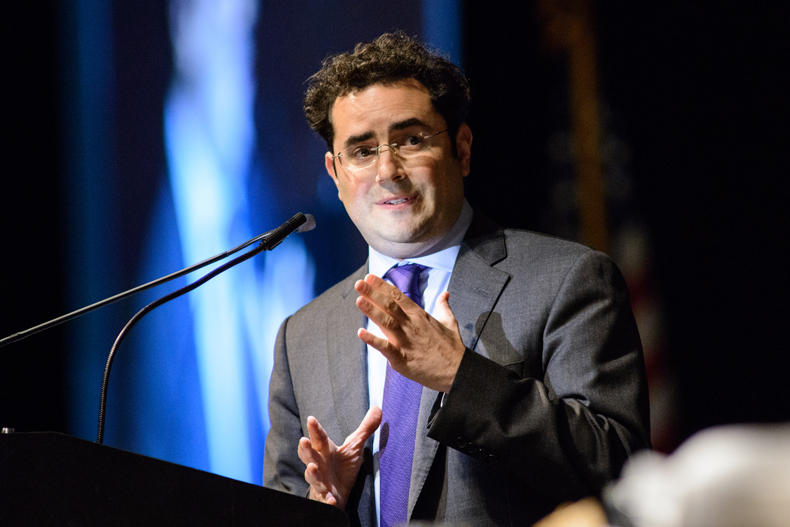
Jewish Federation marks year of challenges and solutions at 116th Annual Meeting
A year of challenges, solutions and celebration of an abiding commitment to Israel and Jewish life was marked Sept. 15 as the Jewish Federation of Metropolitan Chicago held its 116th Annual Meeting at the Hyatt Regency Chicago.
The Federation recognized David T. Brown with its highest honor, the Julius Rosenwald Memorial Award. The luncheon session of the two-part meeting featured the annual State of the Federation address by President Steven B. Nasatir. Linda Schottenstein Fisher chaired the event, saying that Federation helps people “come together across the spectrum of Jewish life to serve those in need.”
Hillel C. Neuer, executive director of UN Watch, delivered the keynote address on what the City of Chicago dubbed “Hillel Neuer Day” in his honor.
Bill Silverstein, the outgoing chairman of the JUF/Federation Board of Directors, passed the gavel to Michael H. Zaransky, the incoming chair, calling him “one of the warmest, most passionate and compassionate people you will ever meet,” adding, “We all remember how he brought such an intensely personal touch to serving as the 2013 JUF Annual Campaign Chair.”
“I am both proud and humbled to follow you in this role,” Zaransky replied. “You build consensus and commitment with your unique charisma and passion.”
In presenting the Shofar Award to Harry Seigle for his work as chairman of the 2016 JUF Annual Campaign, Silverstein called Seigle “tireless,” and “universally gracious. He is always ready to roll up his sleeves,” and he “treats every donor, with sincere respect.” In accepting the award, Seigle said, “All of us are together for good,” adding that, by “prayer and aspiration,” so too will be “the generations that follow us.”
Larry Levy was recognized as the incoming Campaign chair for 2017. Rabbi Michael Siegel, of Anshe Emet Synagogue, gave the invocation, adding, “We are a better, stronger, and more Jewishly fulfilled community because of the work of JUF.”
More than 1,300 people attended the luncheon, including city, state and U.S. officials; members of local law enforcement; representatives from United Way and other human service agencies, and numerous consular officials. Students from area universities, also attended, along with those from Arie Crown Hebrew Day School, Bernard Zell Anshe Emet Day School, Chicago Jewish Day School, Ida Crown Jewish Academy, Rochelle Zell Jewish High School, and Solomon Schechter Day School.
Rosenwald honoree
In recognition of his lifetime of service to the Jewish community in Chicago and around the world, the 53rd annual Julius Rosenwald Memorial Award-JUF’s highest honor-was presented to David T. Brown. Honoring the memory of Chicagoan Julius Rosenwald, one of America’s great philanthropists, the award is presented to an individual who has advanced the goals of the Federation and the welfare of the overall Jewish community.
Brown has served as Chairman of the Board of the Jewish United Fund/Jewish Federation of Metropolitan Chicago and of its Jewish Community Relations Council. He has chaired its Overall Planning and Allocations Committee, and its Government Affairs Committee, where he presented Federation’s positions to officials in Washington, D.C. and Springfield, Ill. He previously received JUF’s Young Leadership Award.
On the national level, Brown is a member of the Board of Trustees of the Jewish Federations of North America (JFNA) and chairs its Human Services and Public Policy Council. In addition, Brown is active in AIPAC and is a regular visitor to Israel.
In his professional life, Brown is Chairman of the law firm, Much Shelist, P.C. He previously served as Chair of the firm’s Management Committee for 13 years. He is a regular speaker and writer on numerous topics, including business planning and succession, and the business aspects of the legal profession. He is a member of the American, Illinois and Chicago bar associations, and of the WPO Chicago Chapter.
In introducing Brown, Silverstein told a story about how Brown had come to the aid of a friend injured while out for a run in Jerusalem. He compared the incident to Brown’s rushing to support Israel during Operation Protective Edge, and to support the Jewish community of Paris after the attack in a kosher supermarket there. No matter where the need was, “David was there,” Silverstein said.
Accepting the award, Brown focused on thanking others for their efforts. He spoke of his admiration for Rosenwald, for those he has shared the dais with over the years, Jewish teachers, and former Rosenwald winners who paved his way.
He then related his own story, growing up in Waukegan and feeling connected to the Jewish community through his congregation and youth group, the B’nai B’rith Youth Organization (BBYO). He participated in the movement to free Soviet Jews.
It was by rising through the ranks of BBYO that he learned what he needed to become a leader, he explained. It’s not where you grew up, how much money you had, or where you went to school, he discovered, but “your role models, your community, and your education.”
The key to success is “many committed individuals working side by side,” he said, concluding. “It takes all of us, all of you, to see that our Jewish community continues.”
Preparing the next generation of leaders
In his State of Federation address, Nasatir reflected on the vital work the Federation and its agencies have done this past year, a year of challenges in Israel and around the world.
“It’s been a painful year- for Chicago, for America, for Israel, for the Jewish people, and for the world,” he began. “We acknowledge the uncertainty and the pain, but we aren’t paralyzed by it. Our Jewish heritage and the 116-year legacy of this Federation teach that inertia is no answer to uncertainty.”
Instead, Nasatir continued, “We channel our anxieties into fixing what’s broken. When others inflict harm, we heal. When others cast shadows of ignorance, we shine light. When others tear down, we build.”
And JUF is able to he said, “thanks to the generosity of Chicago’s Jewish community, which last year contributed $83.2 million to JUF’s Annual Campaign,” part of “a total fundraising effort that generated over $203 million.”
He bemoaned that gridlock in state government is impacting the most vulnerable, including children and the elderly, but outlined Federation’s response: “When the State stopped paying some bills for the entire year, we co-signed lines of credit. Last year alone we increased our loan guarantees by another $100 million. Only a community-wide, community-strong Federation can do that.” Nasatir also mentioned a new way to generate funds to care for Holocaust survivors.
Thanks to its Centennial Campaign, Nasatir continued, Federation has opened high schools and their new buildings, broken ground for a new wellness center, and dedicated new centers for therapy, education and Jewish genetics in Chicago… and a learning center in Israel.
But, Nasatir added, Jewish homes are also essential for Jewish communities. Which is why Federation helps families get Jewish books for free, vouchers for Jewish preschools, scholarships for Jewish summer camps, and volunteers opportunities for teens. “Our young people are our future, and our future is in good hands,” he said.
Nasatir then turned to the issue of violence, especially that fueled by hatred and terrorism. He noted that Federation has been “partnering with law enforcement” for years. Representatives of that field were in attendance, and to them, Nasatir said: “You ‘serve and protect.’ and we are grateful.” He also called for getting “illegal guns off the street and commonsense laws on the books… When one Chicago child is shot none of our children are safe.”
He added that, “We are bringing together Jewish and African American leaders in dialogue to discuss our unique and shared challenges. We are committed to making that relationship even stronger,” mentioning many programs and projects in which Federation partners with its African-American neighbors.
Next Nasatir addressed the “ominous, dramatic rise in anti-Semitism poisoning campus life… ultimately, to rid the world of its only Jewish State.” But Federation’s Israel Education, now on “all 17 of our Illinois Hillel campuses… has now been tasked” to provide its advocacy training on dozens of other campuses across the Midwest. In addition, Federations’ “path-breaking Israel Studies Program brings visiting Israeli scholars to Illinois universities.”
“On our watch, Jewish students will not be vilified or menaced!” Nasatir promised. He praised the many positive ways Hillel supports Jewish life on campus, and congratulated the Silverstein family on the new Hillel they have established in Lincoln Park.
Nasatir closed by noting the deteriorating health of former Israeli President Shimon Peres: “We pray for his recovery.” Nasatir recalled that during the many times he had met him, Peres had always spoken of the next generation. In Chicago, Peres said he answers questions about Israel’s high-tech success by saying, “The Jewish people were born and educated to never be satisfied with the way things are. If you are satisfied, you stop being Jewish. Since you are all the time dissatisfied, you never stop searching for a better world.”
“Mr. Peres,” Nasatir promised, “this Federation pledges that we will never stop working for a better world.
Keeping an eye on the UN
Neuer, an international lawyer, diplomat, writer and activist, runs UN Watch, an organization based in Geneva, Switzerland that monitors and reports on the actions of the United Nations. He was one of the “Top 100 Most Influential Jewish People in the World” listed by Israel’s Ma’ariv newspaper.
In his remarks, Neuer discussed the various ways in which the U.N., and especially its Human Rights Commission, singles out Israel for negative resolutions. The Commission, whose first chairperson was Eleanor Roosevelt, had been “hijacked by dictators,” he said, to the degree that in 2005, it was disbanded and reformed.
However, 10 years on, it is the much the same again, with China, Russia, Cuba, and Saudi Arabia as members. Because they will never investigate themselves, he said, “the worst violators get a free pass.” In that decade the Commission issued 68 resolutions against Israel… and 62 against other nations altogether.
Neuer also spoke of his organization’s efforts to discredit the “experts” the Commission brings to investigate Israel. It has revealed one to be a conspiracy theorist who blamed President Bush for the 9/11 attacks, and another with founding “the Gaddafi International Prize for Human Rights.”
The Islamic states will refuse to put their 56 votes against anyone, on any issue, who sides with Israeli and against them. “Israel is the Jew of the UN,” he said.
However, he insisted that “we can fight back,” concluding “There is intrinsic value in standing up for truth.”
Other stories
-
Two local teens win national recognition
Recipients of the annual Diller Teen Tikkun Olam Awards
Read more -
Celebrating six young award winners cultivating the community
Introducing young adult award winners
Read more -
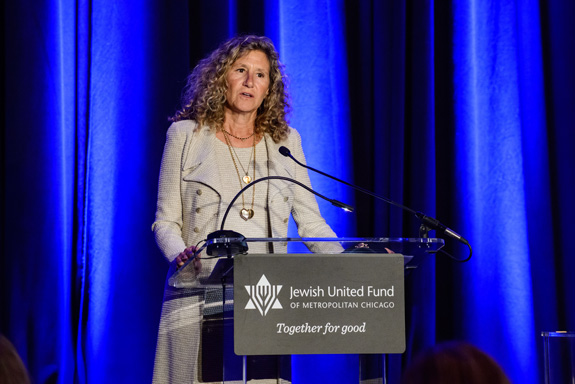
Edie Lutnick speaks at the 2017 Lion Luncheon. (Photo by Robert F. Kusel)
When Edie Lutnick’s brother, Gary, perished during the September 11, 2001 attacks on the World Trade Center, it was not her first experience with loss. Lutnick’s parents both died young from cancer — and as the oldest of three siblings, it fell upon her to raise her younger brothers from youth.
“When 9/11 hit, I didn’t just lose my brother — I [felt like] I lost my child,” said Lutnick, in a moving address to nearly 400 women at the Jewish United Fund’s 2017 Lion Luncheon, which took place Thursday, Sept. 8 at The Standard Club.
Lutnick, who had worked with both her brothers at the New York-based financial services firm Cantor Fitzgerald, also lost over 600 colleagues and friends in the deadly 2001 attacks. But in the aftermath of overwhelming tragedy, she and her surviving brother, Cantor Fitzgerald CEO Howard Lutnick, fought the urge to sink into despair — and instead pooled their resources to create a fund to support survivors.
“I realized everyone else who I thought was more qualified than me to do this was gone,” said Lutnick. “And so on September 14, 2001, The Cantor Fitzgerald Relief Fund was born.” Today, the Fund has distributed more than $292 million since its inception to support victims of terrorism, emergencies and natural disasters worldwide.
“We grew up with the Jewish understanding that you helped others,” said Lutnick, who credited her late parents with instilling in her the Jewish values of charity and repairing the world, and said she felt a kinship with the hundreds of women in the room who had come together to support philanthropy through their involvement with JUF.
“There is a poetic synergy between [the 9/11 first responders] and the women in this room today,” said Jodie Berkman, JUF’s 2017 Women’s Board Vice President of Campaign. “Like them, we are the first ones on the scene when crisis strikes. As leaders of the JUF community, we are also first responders. When a member of our Jewish family is in need, whether she lives across town or across the ocean, we are there for her.”
The luncheon also featured the presentation of the Kipnis-Wilson/Friedland award, given biannually to women who demonstrate exceptional leadership and commitment. The 2017 award was presented to Barbara Kaplan Slutsky by Jane Cadden Lederman, president of the Women’s Board.
Susan Spier Chapman, event chair, and Marilyn Vender, co-chair, also spoke at the event. Other co-chairs included Margie Kulp, Kim Shwachman, Hilary Greenberg, Jennifer Wirth, Liz Geifman, Debra Lewin, Amy Olswang, Lisa Roth, Lili Schwartz, Robyn Tavel, Donna Weichselbaum, and Jennifer Leemis.
JUF’s Women’s Division is a dedicated group of women of all ages who support JUF’s philanthropic and community mission. Their energy is rooted in the spirit of klal yisrael, the belief that all Jews are responsible for one another. Each group serves to educate, inspire and connect women, leveraging the power of the collective. In upholding their Jewish responsibility, they fundraise, develop leadership and perform mitzvot to make a profound impact locally, in Israel and around the world.
Other stories
-
Meet Andrew S. Hochberg, 2021 Julius Rosenwald Memorial Award recipient
Celebrate Andy Hochberg at the virtual Annual Meeting on Sept. 14
Read more -
Two local teens win national recognition
Recipients of the annual Diller Teen Tikkun Olam Awards
Read more -
Celebrating six young award winners cultivating the community
Introducing young adult award winners
Read more
More than 50 women from all over Chicago linked arms for peace in the city during a gathering organized by Fierce Women of Faith, JUF’s Jewish Community Relations Council and the Jewish Women’s Foundation on Sept. 7.
The women, who represented more than 20 Chicago neighborhoods, affirmed that violence in one Chicago community affects the entire city. The event also highlighted the toll community violence exerts on women, families and children.
“We must become stronger than the violence that’s plaguing our communities,” said Rev. Dr. Marcenia Richards, founder of Fierce Women of Faith. “We are given a challenge: to unite amidst violence. We are here to link arms and build a platform for peace.”
As the women stood in Grant Park near the Agora sculpture, they held up cards with the names and ages of victims killed in Chicago in the last year.
Rabbi Shoshanah Conover of Temple Sholom of Chicago, who has served as the JCRC rabbinic vice chair for many years, said Chicago has “hit a grim milestone” — 512 people have been killed since the beginning of the year, already overtaking the total for all of 2015.
“When we are together, we can recognize that each person who died was a living being who had parents, who had promise of a future,” Conover said. “As we now recognize that these people’s lives were lost in this past year, we dedicate ourselves to a better Chicago where people’s lives aren’t senselessly taken.”
Other speakers during the program included Rev. Colleen Vahey from Unity Temple in Oak Park, Ammiel Mateen of the Inner-City Muslim Network, State Rep. Elaine Nekritz, and a mother who lost her son to gun violence, who reminded the crowd that those 500 lives lost represent 15,000 family survivors.
The gathering at Grant Park was part of a series of coalition-building events with Fierce Women of Faith, which organizes women to build more peaceful communities. JCRC has partnered with Fierce Women a few different times in recent months organize conversations on pressing issues impacting the city such as education, healthcare and violence prevention; participating in an On The Table discussion ; and hosting a screening of the film “Pray the Devil Back to Hell.”
“When we link arms together as women together, we understand that we can walk together, we can come to solutions, we can see that there is a better day upon us,” Conover said.
JCRC has a longstanding gun safety policy and has been working closely with a variety of community partners, including Fierce Women of Faith, to help raise awareness and identify solutions.
Other stories
-
Two local teens win national recognition
Recipients of the annual Diller Teen Tikkun Olam Awards
Read more -
Celebrating six young award winners cultivating the community
Introducing young adult award winners
Read more -