The Jewish United Fund of Metropolitan Chicago has announced the fifth annual “Double Chai in the Chi: 36 Under 36” list of young Jewish movers and shakers in Chicago.
(The letters of the Hebrew word “Chai,” which means “life,” also represent the number 18.)
Check out the list online at: www.oychicago.com/36under36
Presented by JUF’s Young Leadership Division (YLD) and Oy!Chicago ( www.oychicago.com )-an outreach website for Chicago 20- and 30-somethings-the list shines a spotlight on the faces of Chicago’s Jewish future and recognizes the amazing contributions of this generation. The young professionals featured are noted for making a difference through their work, giving back in their free time, and earning distinction in the Jewish community and beyond.
“It’s truly amazing that this marks our fifth year of this initiative-and that in that time we have honored and gotten to know 180 of this community’s innovative young leaders,” said Stefanie Pervos Bregman, co-founding editor of Oy!Chicago. “As always, this year’s list confirms for us that the future of Chicago’s Jewish community is incredibly bright.”
This year’s list is replete with entrepreneurs, activists, fundraisers, and more, running the gamut from writers to youth group advisors, attorneys to pediatric neurologists… and, well, the list goes on.
“I get excited when the list comes out every July to see what other young Jewish adults are doing to help make the future of our community better,” said Michael Waitz, incoming YLD board member and a former award winner. “From rabbis to entrepreneurs, the thing that’s really remarkable is that the list includes young Jewish professionals from different backgrounds that are making an impact.”
This year, for the first time ever, donations to JUF of up to $36 in recognition of a 36 under 36 honoree will be matched in full, doubling the impact and benefit to those in need in the community. Learn more and donate at https://donate.juf.org/36Under36 .
Full profiles of each honoree are available on the Oy!Chicago website.
The 36 winners will be honored at YLD’s “WYLD” party at 7 p.m. on Wednesday, August 24 at Joy District, 112 W. Hubbard St, Chicago. The party is open to the public. Tickets are available for $20 in advance or $30 at the door. To register, visit http://www.juf.org/yld/wyld.aspx or e-mail [email protected] . Register early – last year’s party completely sold out!
The 36 named to this year’s list are:
Courtney Anixter , 33, of River North, business owner and YLD board member
Brian Barasch, 29, of Edgewater, communications manager and arts education advocate
Paul Cantz , 34, of Skokie, clinical psychologist and professor of psychology
D’ror Chankin-Gould , 32, of Skokie, Rabbi at Anshe Emet Synagogue and LGBT Jewish leader
Stacey Dembo , 32, of West Town, Chair of JUF’s Community Legal Services clinic
Mayrav Dolgin , 36, of Lakeview, Israel educator and advocate
Jonathan Eisen , 28, of Pulaski Park, expansion and activation manager at OneTable
David Eisenberg , 34, of Wilmette, Attorney and Jewish communal leader
Zev Eleff , 30, of West Ridge, Chief Academic Officer of Hebrew Theological College
Leslie Finkel , 33, of Lakeview, Pediatric neurologist
Noah Frank , 34, of Wicker Park, Attorney and community connector
Kevin Friduss , 33, of Near North Side, BBYO advisor and Marketing and Promotions Coordinator at CBS Radio Chicago
Matt Gaines , 33, of Highland Park, financial advisor and non-profit co-founder
Alan Goodis , 32, of Lincoln Park, National touring Jewish musician
Seth Gruen , 31, of River North, sports writer and personality
Orly Henry , 30, of Lincoln Square, Attorney and YLD Board President
Alan Lagunov , 28, of Gold Coast, President of AJC’s ACCESS
Helee Lev , 33, of Near North Side, Executive VP of Goby Inc.
Pam Mandel , 36, of Glencoe, Associate Rabbi at Am Shalom
Becky Marks , 28, of Wicker Park, Owner/Operator of Be Leaf
Matthew Miller , 28, of Lakeview, chair of YLD Pride committee
Elan Mosbacher , 31, of West Ridge, VP of Marketing at SpotHero
Liz Robbin , 34, of Lincoln Park, Speech language pathologist and director of Camp Firefly
Adam Rogowin , 36, of Lincolnshire, PR Director for the Chicago Blackhawks
Lauren (Jacobson) Rosenberg , 27, of Lincoln Park, Director of Development for Chicago Jewish Day School
Aviva Rosman , 28, of West Town, COO of BallotReady
Joshua Rubenstein , 31, of Lincoln Park, founder of Windy City RE and Windy City Playhouse
Lauren Schrero , 33, of Lakeview, Co-founder of The Nora Project
Tony Shir , 31, of West Ridge, partner at HAN Capital Group
Sara Siegall , 35, of Palatine, Attorney, supporter of the performing arts
Zachary Silver , 33, of Lakeview, Rabbi at Rochelle Zell Jewish High School
Lisa Tarshis , 29, of Fulton River District, Senior Associate Consultant at Giving Tree Associates
Elena Valentine , 30, of Irving Park, Co-founder and CEP of Skill Scout
Sara Wasserteil , 31, of Wicker Park, Consultant at Civic Consulting Alliance
Ayal Weiner-Kaplow , 27, of Skokie, iCenter for Israel Education
Jeremy Wolf , 35, of Near North Side, director of e-commerce and business development at The Great Escape
Other stories
-
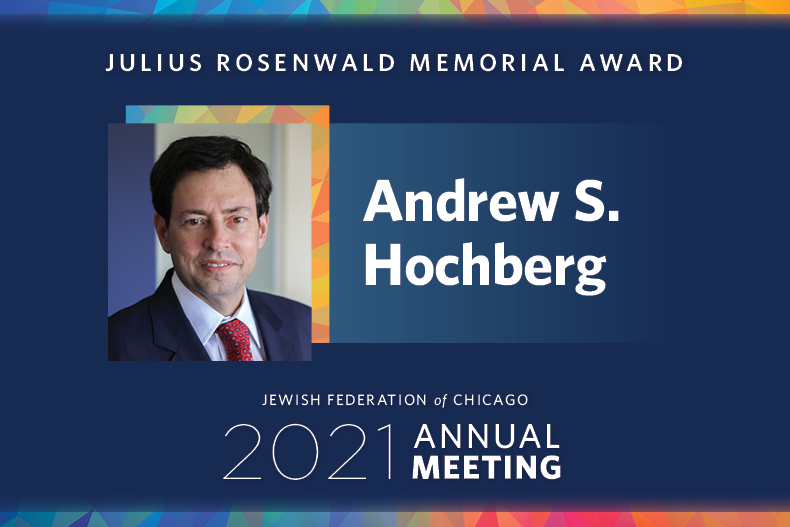
Meet Andrew S. Hochberg, 2021 Julius Rosenwald Memorial Award recipient
Celebrate Andy Hochberg at the virtual Annual Meeting on Sept. 14
Read more -
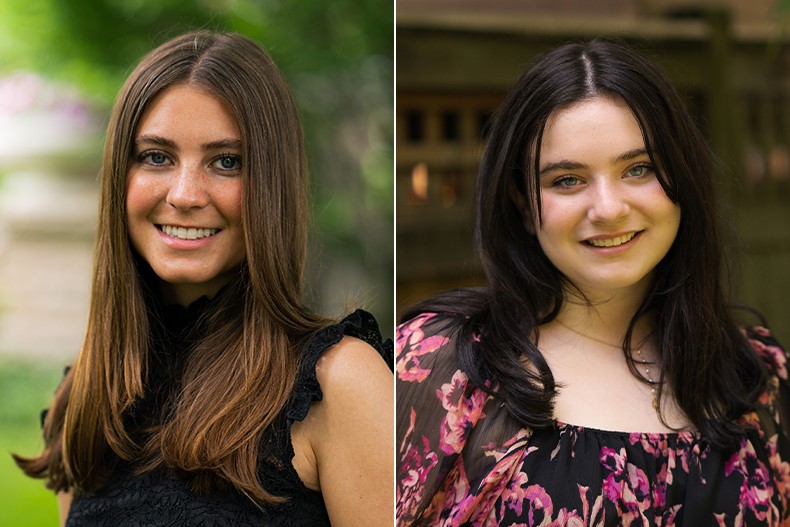
Two local teens win national recognition
Recipients of the annual Diller Teen Tikkun Olam Awards
Read more -

Celebrating six young award winners cultivating the community
Introducing young adult award winners
Read more
With the stock market recently reaching a record high, now is the perfect time to take advantage of the gains and donate appreciated stock.
Donating securities is a great way to make a meaningful gift to the Jewish community, while receiving considerable tax benefits. Gifting appreciated stock (held over a year) has the following benefits:
- Receive a charitable income tax deduction for the full fair market value of the securities
- Bypass capital gains tax on the gift of appreciated securities, enabling you to give a greater gift
- Help the Jewish community in Chicago and abroad
Gifts of stock can be used to:
- pay your JUF commitment
- establish a Donor Advised Fund
- make a Centennial Campaign gift
- establish a planned gift, such as a charitable trust or gift annuity
Donating appreciated stock is easy. The JUF Planned Giving team handles all the administration and paperwork. Contact us for more information at (312) 357-4853 or [email protected] and visit us at http://www.jufplannedgiving.com .
This is not legal advice. Please consult your tax and/or financial advisor before making a gift of stock.
Other stories
-
Meet Andrew S. Hochberg, 2021 Julius Rosenwald Memorial Award recipient
Celebrate Andy Hochberg at the virtual Annual Meeting on Sept. 14
Read more -
Two local teens win national recognition
Recipients of the annual Diller Teen Tikkun Olam Awards
Read more -
Celebrating six young award winners cultivating the community
Introducing young adult award winners
Read more
JCARES Professional Training Institute offers education on domestic violence, abuse and sexual assault
BETSY LAZEROW
JCFS Community Services is committed to offering cross-discipline professionals with a diversity of opportunities for learning, networking and dialoguing at the JCARES Professional Training Institute (PTI).
Since its inception in 2006, the PTI has provided a range of sessions to: Mental health, social service, health care and addiction treatment professionals; rabbis and synagogue leadership; law enforcement and legal advocates; and administrators and educators. The wide range of offerings focuses on giving participants the knowledge, tools and strategies to become more effective and sensitive responders to domestic violence, child abuse and sexual assault.
In collaboration with other JCFS Community Services programs, the PTI has also provided education that addressed the issues of substance abuse (with the Jewish Center for Addiction ), adoption ( Project Esther: The Jewish Adoption Network ) and grief (the Jewish Healing Network ).
Sessions are offered in geographic locations that span the suburbs and the city of Chicago. Presenters are experts in their field and carefully selected because of their knowledge and ability to convey the most enriching and useful information. Participants can earn credits to fill their licensing or credentialing requirements. JCFS offers Continuing Education Credits for social workers, counselors, psychologists, Illinois Certified Domestic Violence Professionals (through a partnership with Between Friends), and certified alcohol and other drug abuse counselors.
JCFS is proud of the success of the JCARES PTI which has welcomed over 400 professionals and lay leader attendees each year. As the demand for quality, convenient and affordable education continues to increase, JCARES and JCFS Community Services are committed to providing an expanded catalog of offerings that focus on a variety of issues that touch Jewish individuals, homes and families across the lifespan.
Upcoming Training Sessions
Tuesday, July 12
Male Survivors of Childhood Sexual Abuse
Presented by Becky Carter from Core Psychotherapy Center
9 -11:30 a.m.
Elaine Kersten Children’s Center
255 Revere Drive, Northbrook
Fee: $15
Wednesday, August 3
Domestic Violence in the Immigrant Community: Legal Remedies and Clinical Considerations
Presented by Susan Schreiber from the Catholic Legal Immigration Network and Ruchi Ray from Apna Ghar, in collaboration with HIAS Chicago
9 a.m. – 12:30 pm
Abe and Ida Cooper Center
6639 North Kedzie Ave., Chicago
Fee: $15
Wednesday, September 14
Addressing the Opioid Epidemic: A Community Coalition Model
Panel
Presentation by Chelsea A. Laliberte Lake County Opioid Initiative, Mundelein Police Chief Eric Guenther, Susan McKnight from the Lake County Health Department, and Lake County State’s Attorney Michael G. Nerheim, in collaboration with the Jewish Center for Addiction
9 a.m. – noon
North Shore Congregation Israel
1185 Sheridan Rd., Glencoe
Fee: $15
Registration to be available soon
CEU’s available. Register for the July 12th and August 3rd training sessions.
To be added to the email list and receive Professional Training Institute announcements or more information, contact Betsy Lazerow, JCARES & Community Services Professional Education Coordinator at [email protected] or (847) 745-5430.
Other stories
-
Meet Andrew S. Hochberg, 2021 Julius Rosenwald Memorial Award recipient
Celebrate Andy Hochberg at the virtual Annual Meeting on Sept. 14
Read more -
Two local teens win national recognition
Recipients of the annual Diller Teen Tikkun Olam Awards
Read more -
Celebrating six young award winners cultivating the community
Introducing young adult award winners
Read more
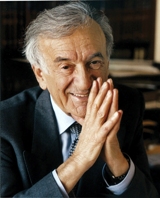
Today, we mourn the death of author, Nobel laureate and treasured friend Elie Wiesel, z”l. His story and accomplishments are well known-a boy from a small town in Romania who survived one of the most horrific events in human history and went on to become a writer, activist and standard-bearer for the meaning of humanity.
Elie Wiesel spent time in the company of presidents and world leaders. We are fortunate to have had him speak at so many JUF events, including our Israel at 60 Gala in 2008.
Watch Elie Wiesel at JUF’s Israel @60 celebration
He stood with us in Washington, D.C. on the National Mall when we campaigned for the freedom of Soviet Jews. His presence transformed every Federation event he spoke at over the decades and across North America, where he reminded us what it means to be a community.
We will never forget him.
The world-and our community-has lost one of its heroes, an inimitable man who confronted the darkest chapter of human history and used that experience to show the world the light of our shared humanity. He is and will forever be a blessing.
Other stories
-
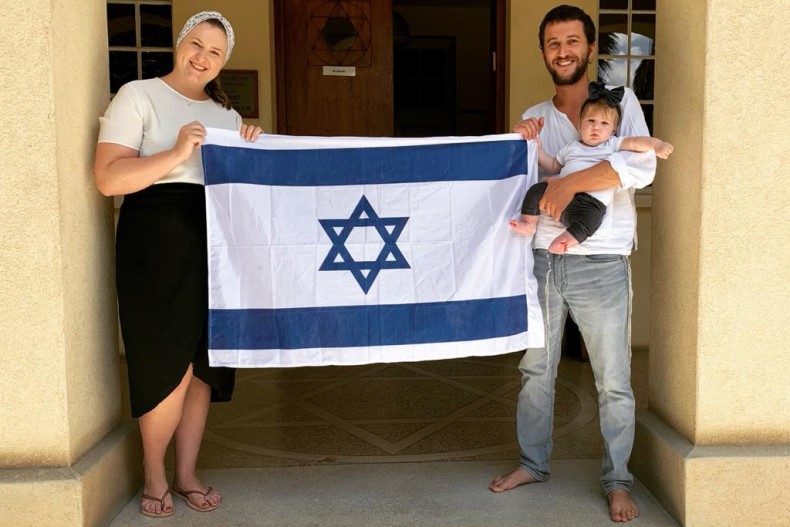
Chicago to Israel to Kenya
A family’s story of living Jewishly on three continents Michelle Cohen World May 28, 2021 Avital, Tzofia, and Netanel Kaszovitz outside their home in Nairobi on Yom HaAtzmaut. When Avital Kaszovitz prepared to be a Modern Orthodox shlicha (emissary) to the Jewish community in Ke
Read more -
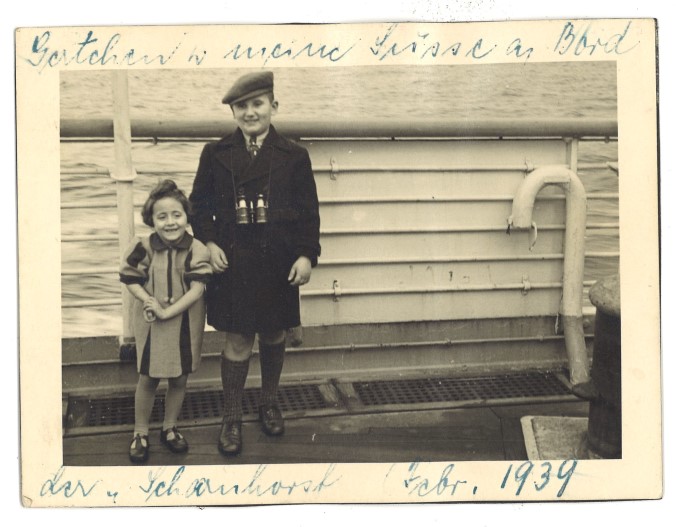
New exhibit spotlights the experience of ‘Shanghai Jews’
Explore a new Illinois Holocaust Museum and Education Center exhibit
Read more -
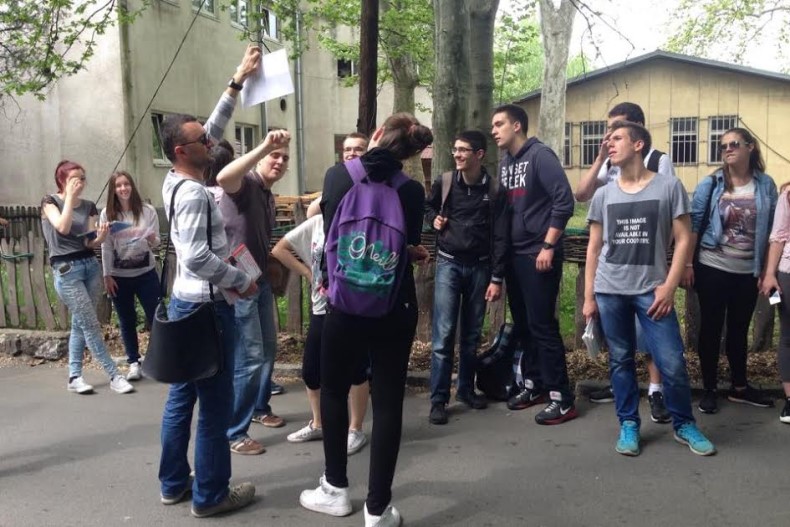
Europe’s brave new teachers of the Holocaust
Teaching the Holocaust in the modern era has its difficulties and rewards.
Read more
Other stories
-
Meet Andrew S. Hochberg, 2021 Julius Rosenwald Memorial Award recipient
Celebrate Andy Hochberg at the virtual Annual Meeting on Sept. 14
Read more -
Two local teens win national recognition
Recipients of the annual Diller Teen Tikkun Olam Awards
Read more -
Celebrating six young award winners cultivating the community
Introducing young adult award winners
Read more
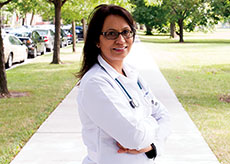
Sinai Health System provides life-saving genetic counseling to communities on Chicago’s West Side
Women with certain genetic mutations have up to a 78 percent increase in breast cancer risk.
By the time Dr. Pam Khosla, chief of Hematology and Oncology at Mount Sinai Hospital, sees women with breast cancer, many have such advanced disease that their odds of survival are slim.
Chances are they’ve never have had a mammogram or regularly see a primary-care physician. The lack of preventative screening for breast cancer is especially worrisome in women of color. There is evidence that Latinas with a family history of breast cancer may have a higher prevalence of the genetic mutations that greatly increase the likelihood of developing breast and ovarian cancer. Other emerging research shows that black women may develop a more aggressive form of breast cancer, necessitating that the cancer is detected and treated very early.
If women are aware that they are at increased risk for breast and other cancers, however, they can do something about it, including preventing it from ever occurring. About 10 percent of breast cancer and 10 percent of ovarian cancer in the general population is hereditary, arising from a genetic mutation passed on by a parent. A woman who has one or more relatives with breast and ovarian cancer, or who is of Ashkenazi Jewish decent, has a much greater risk of carrying a harmful mutation, such as on the BRACA1 or BRACA2 gene. Khosla offers genetic testing to patients at high risk of cancer to determine if they will carry gene mutations that will predispose them to several forms of cancers.
After learning that the lump in her breast was cancerous, Guadalupe Buenrostro, 34, discovered from her mother that three family members also had breast or ovarian cancer. Since Buenrostro was so young and had a strong family history of cancer, Khosla urged her and her 37-year-old sister to have genetic testing. When the tests showed that both Buenrostro women carried a genetic mutation that increased their odds of getting cancer, Khosla helped them sort through their options. “At our comprehensive breast center, we spend a considerable amount of time educating patients about their test results and preparing them psychologically and emotionally so we can make decisions together about managing their risk of cancer,” Khosla said.
Buenrostro decided to have a double mastectomy, to eliminate the tumor in one breast, and to prevent cancer from striking the other breast, as well as removal of her ovaries. Her sister also had surgery to reduce her risk of cancer.
Genetic testing gives women more control over their lives and an opportunity to advocate for their health, said Khosla. Many begin seeing a primary care physician for the first time and getting regular preventative screenings, such as colonoscopies, while convincing their daughters and other relatives to do the same. “In many cases, we’re able to dramatically change women’s individual stories and we become partners for life with them, which is very gratifying,” Khosla said.
This article originally appeared in the Sinai Health System 2015 annual report.
Mount Sinai Hospital is a partner with the Jewish United Fund in serving our community.
Anita Slomski is a freelance medical writer who regularly contributes to journals such as “JAMA” and the biomedical magazine “Proto: Dispatches from the Frontiers of Medicine.”
Other stories
-
Meet Andrew S. Hochberg, 2021 Julius Rosenwald Memorial Award recipient
Celebrate Andy Hochberg at the virtual Annual Meeting on Sept. 14
Read more -
Two local teens win national recognition
Recipients of the annual Diller Teen Tikkun Olam Awards
Read more -
Celebrating six young award winners cultivating the community
Introducing young adult award winners
Read more
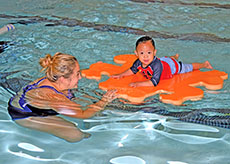
It’s just not summer without a dip in the pool or lake. But for many children and teens with autism, the idea of swimming is either too frightening for them-or for their parents.
Like your friendly neighborhood lifeguard, JCC Chicago is here to help. Last year, the agency recognized the community’s need for a water safety and swim-training program for those with Autism Spectrum Disorder. So they created one, and called it by the inclusive name “All-In Swim.” JUF dove in, too, supporting the program with a grant from its JUF Breakthrough Fund.
Following intensive staff training and a pilot session in late 2015, All-In Swim now has more than 30 participants. The community response has been overwhelmingly positive, and reinforced both the need for such programming-and JCC Chicago’s ability to fill the service gap.
“I wanted to let you know how pleased we are with-the All-In Swim program,” said the mother of one budding swimmer. “We cannot believe Matthew went under (water) during his first class. He doesn’t even like to get his hair washed! Matt cannot stop talking about how he
went swimming.”
It is estimated that Autism Spectrum Disorder affects one out of every 68 children in the United States, a figure that has increased by 30 percent just since 2012, according to the National Autism Association.
Learning to swim can be a life-saving skill. Drowning is among the leading causes of death for children with Autism Spectrum Disorder, in part due to their heightened tendency to wander. In fact, the National Autism Association has reported that in 2009, 2010, and 2011, accidental drowning accounted for 91 percent of the total U.S. deaths reported in children with Autism Spectrum Disorder, ages 14 and younger, after wandering off.
“These unsettling statistics demonstrate the critical importance of providing water safety education and learn-to-swim instruction for children with Autism Spectrum Disorder,” noted Kirsten Conner, director of JCC’s Aquatic Services. “In Chicago and surrounding communities where many families live in close proximity to Lake Michigan, this risk is even greater.”
“The majority of our All-In Swim students are enrolled in private lessons,” Conner said. “When we feel a swimmer is ‘water safe’ and would be successful in a group lesson environment, we then work to transfer them in to a small group lesson, with a 2:1 ratio, with another swimmer who has also taken All-In Swim lessons or with a typically developing peer. Our third step would transition our All-In Swim swimmers into a group lesson with a 4:1 ratio depending on each swimmer’s skills and age.”
“Understanding the unique needs of children with Autism Spectrum Disorder and other special abilities is the first step to realizing the full potential of All-In Swim,” said JCC Vice President Addie Goodman. “The addition of a physical activity such as swimming to an autism intervention program can help mitigate challenges, decrease negative behaviors, and improve the child’s overall quality of life.”
All-In Swim is offered at four JCC Chicago locations across the Chicago metropolitan area at various times. Families can register for a free 30-minute evaluation, and scholarship funds are available through support from Autism Speaks. For more information, contact Kirsten Conner, Director, Aquatic Services at (224) 406- 9224 or [email protected].
Other stories
-
Meet Andrew S. Hochberg, 2021 Julius Rosenwald Memorial Award recipient
Celebrate Andy Hochberg at the virtual Annual Meeting on Sept. 14
Read more -
Two local teens win national recognition
Recipients of the annual Diller Teen Tikkun Olam Awards
Read more -
Celebrating six young award winners cultivating the community
Introducing young adult award winners
Read more
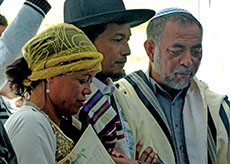
A nascent Jewish community was officially born in Madagascar last month when 121 men, women, and children underwent Orthodox conversions on the remote Indian Ocean island nation better known for lemurs, chameleons, dense rain forests, and vanilla.
The conversions, which took place over a 10-day period, were the climax of a process that arose organically five to six years ago when followers of various messianic Christian sects became disillusioned with their churches and began to study Torah.
Through self-study and with guidance from Jewish internet sources and correspondence with rabbis in Israel, they now pray in Sephardic-accented Hebrew and strictly observe the Sabbath and holidays.
The conversions were facilitated by Kulanu, a New York-based nonprofit that specializes in supporting isolated and emerging Jewish communities, but were initiated by the residents.
“Now that we’ve re-established the State of Israel, it is time to re-establish the Jewish people, especially in the Diaspora,” said Bonita Nathan Sussman, vice president of Kulanu.
Her husband, Rabbi Gerald Sussman, of Staten Island in New York, added: “We are in the process of reconstituting the Jewish people, which would have been more numerous had it not been decimated by the Holocaust and had we not lost millions of Jews in Arab lands.”
In the spring, members of the community came before a beit din , or rabbinical court, convened for the occasion at the Le Pave Hotel in the Madagascar capital. The court comprised three rabbis with Orthodox ordination, all who belong to a group of rabbis who serve far-flung Jewish communities and support converting emergent Jewish groups.
Delouya, whose background is Moroccan, spoke with the converts in their second official language, French, and also provided Sephardic influences for which the Madagascar community feel an affinity.
The conversion process included periods of intensive Torah study, interviews by the beit din and full body immersions in a river located a 90-minute drive away from Antananarivo. A privacy tent was hastily erected beside the river for the occasion, and a festive atmosphere ensued as men, women and children, ranging in age from 3 to 85, lined up to take the ritual plunge.
Additionally, the Madagascar men, who are already circumcised, underwent ” hatafat dam brit ,” or ritual penile bloodletting, to affirm their new faith.
The 10-day period concluded with 12 Jewish weddings and a symposium on Madagascar’s Israelite connections featuring a keynote address by Tudor Parfitt, a British scholar and expert on the Lost Tribes of Israel.
Indeed, many Malagasies, as the islanders are known, believe they are of Jewish or Israelite descent, and that their founders were seafaring members of the Lost Tribes. Belief in the “Malagasy secret” persists despite evidence that most Malagasies are of Indonesian and African origin.
According to local lore, Madagascar is the biblical land of Ophir and played a pivotal role in providing construction materials to King Solomon’s temple. Many also believe that the Ark of the Covenant and other ritualistic temple items are buried on the island.
Even Prince Ndriana Rabarioelina, a descendant of the Merina monarchy of Madagascar, proudly asserts Jewish ancestry. He said that up to 80 percent of Malagasies can claim Jewish roots. He asserts that portions of the tablets, Moses’ rod, and a copy of the Book of Daniel are safeguarded by descendants of Levites in the Vatamasina-Vohipeno region of Madagascar.
Additionally, several Merina tombs, including those of his family, bear Hebrew symbols or letters, he said.
Nevertheless, evidence of a historic Judaic presence in Madagascar is scarce, and what signs can be found could date from the 7th century, when traders from Arab lands sailed to the island, or the 1500s, when conversos may have been among the Portuguese sailors who established trading posts.
Madagascar, a country of 20 million people, is awash with missionaries. Some 50 percent of the population practices some form of Christianity, while most of the other half practices an indigenous animist faith in which ancestor-worship features prominently. Approximately seven percent of the population is Muslim.
While many Malagasies were brought to Judaism through study of the Old Testament and a sincere effort to get closer to God, some see the practice of Judaism as a return to their roots and an overthrowing of the last vestiges of colonialism.
“I was a victim of the colonizers, as you know we had the French here, and then the communists and then the socialists … so I didn’t have any roots anymore,” said Mija Rasolo, an actor who hosts his own late night talk show on Madagascar TV and took the Hebrew name David Mazal. “So I told myself for now I am going to be Jewish, because that works for me. I found Judaism. I found my roots, baruch Hashem … Am Yisrael Chai “-the people of Israel live.
As residents of Antananarivo began to explore Judaism, three leaders emerged to guide the nascent community: Andrianarisao Asarery, known as Ashrey Dayves; Andre Jacque Rabisisoa, known as Peteola, and Ferdinand Jean Andriatovomanana, known as Touvya. All three have set up makeshift synagogues in their living rooms, while some prayer services are also held in a space provided by the English Language Institute. Getting to services can sometimes be problematic because not everyone lives within commuting distance of the home. Most Malagasies do not have cars and rely on their feet or bush taxi (taxi brousse) for transportation.
Inevitable congregational differences have also arisen.
The move toward conversion was spearheaded by Ashrey, who functions as president of the Jewish Community of Madagascar, which is also known as Sefarad Madagascar. Ashrey thought conversions would bring legitimacy to the group as well as greater ties to world Jewry.
Touvya and Petoula were reluctant at first to accept conversion. Touvya in particular felt that conversion was unnecessary because he believed that he was already Jewish, and did not want or need the validation of an outsider to confirm it.
Community members dress modestly and strive to keep kosher in a land lacking the proper infrastructure to do so. Without a kosher butcher, most will eat only fish, dairy, and vegetable products.
Many observe the practice of niddah , avoiding marital relations or even touching while a woman is menstruating.
Only 30 people were originally scheduled to convert when Kulanu arrived on the scene in the spring, but the number ultimately swelled to 121 as family members and Touvya’s congregation joined in. Kulanu estimates that at least 100 more potential converts live among the community .
The conversions are an ironic twist of fate, occurring around the 76th anniversary of the Madagascar Plan. Launched by Nazi Germany on June 3, 1941, it was conceived as an alternative method to achieve the Final Solution by deporting European Jewry to Vichy-controlled Madagascar. Most were expected to die en route, succumb to disease, or be massacred without international oversight. The plan was never implemented.
Instead, decades after the Holocaust took the lives of six million European Jews, one pocket of the African nation has become a place of Jewish rebirth.
Other stories
-
Chicago to Israel to Kenya
A family’s story of living Jewishly on three continents Michelle Cohen World May 28, 2021 Avital, Tzofia, and Netanel Kaszovitz outside their home in Nairobi on Yom HaAtzmaut. When Avital Kaszovitz prepared to be a Modern Orthodox shlicha (emissary) to the Jewish community in Ke
Read more -
New exhibit spotlights the experience of ‘Shanghai Jews’
Explore a new Illinois Holocaust Museum and Education Center exhibit
Read more -
Europe’s brave new teachers of the Holocaust
Teaching the Holocaust in the modern era has its difficulties and rewards.
Read more
Other stories
-
Meet Andrew S. Hochberg, 2021 Julius Rosenwald Memorial Award recipient
Celebrate Andy Hochberg at the virtual Annual Meeting on Sept. 14
Read more -
Two local teens win national recognition
Recipients of the annual Diller Teen Tikkun Olam Awards
Read more -
Celebrating six young award winners cultivating the community
Introducing young adult award winners
Read more
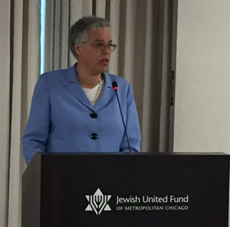
Illinois social service agencies are feeling the impact of the ongoing state budget stalemate in Springfield, but so are local governments and municipalities. Cook County, which includes 80 Federation-supported programs, is no exception. Cook County Board President Toni Preckwinkle made that much clear and more when she addressed more than 60 members of JUF’s Government Affairs Committee on June 14.
“These are difficult times for local governments, including our own,” she said.
Operating the second largest county in the nation, Preckwinkle continues to push forward on the county’s core policy agenda of public health, public safety and economic development.
Currently, the state owes the county $110 million for its public safety and public health programs not protected by court order or supplemental appropriations. Despite the financial burdens, Preckwinkle reported noticeable milestones: More than 160,000 people are enrolled in the County Care program, made possible through a Medicaid expansion waiver in 2012.
“County Care reduced taxpayer allocation to the Health and Hospital System from $400 million in 2010 to $121 million this year,” she said.
Public safety is another top priority for Preckwinkle, who is deeply committed to reforming the county’s criminal justice system. She has worked to lower the jail population by engaging stakeholders in changing how cases are handled in bond court by diverting non-violent offenders, including those who have mental health or substance abuse treatment needs, to appropriate community-based services. Since she took office, the number of general population detainees Cook County Jail has declined from 10,000 to about 7,500. With this reduction, the County hopes to reinvest more of its available funds in much-needed programs services, such as restorative justice, drop-in centers, and other violence prevention initiatives.
The county, like social service agencies, is questioning whether or not to continue its partnership with the state. “Although the county expects payment to its health and hospital systems,” says Preckwinkle, “we are now faced with the question of whether there are programs normally funded by the state that we can continue to support after June 30.”
Preckwinkle was joined by Kathe Dellacecca, vice president of behavioral health at Sinai Health System, who reported on the 10-month old Crisis Stabilization Unit at Holy Cross Hospital, a partner of Sinai Health System. With shrinking government dollars and the closure of city mental health clinics, Illinois has seen a 19 percent increase in emergency department visits for mental health-related issues and roughly 50 percent of the county jail population is diagnosed with a mental illness.
“The difficulties remain once the patient is back in the community with insufficient support to maintain a sustainable recovery,” Dellacecca said.
In response to need, Sinai implemented the CSU to provide immediate, targeted community-based care for people struggling to maintain their behavioral health care at home. Serving 914 patients since its July 2015 debut, the CSU caught the attention of Cook County Sherriff Tom Dart, who will transfer inmates to the CSU for assessment. The CSU was featured in the Chicago Tribune on May 31.
Peter Friedman, Government Affairs Committee vice chair for local government, said, “Although much of our focus this past year has been at the state and federal levels, we recognize the important role that the county plays in our work. “We value our strong relationships with elected officials at the county level, and commend the county and our affiliated partner agency Sinai Health System for their excellent work and continued commitment to serving the most vulnerable during these especially challenging times.”
The meeting concluded with an update from Suzanne Strassberger, JUF’s Springfield liason, who provided an update on the budget impasse. With each day, the state continues to grow deeper in debt, and programs continue to shut down. Although resolution options are in play and negotiations continue, a budget deal does not seem imminent.
Strassberger said she believes there are three things that might force a deal: 1) state employees stop getting paid; 2) K-12 schools do not open in August due to inadequate funding; 3) rank-and-file legislators revolt against the administration.
The Illinois General Assembly is scheduled to reconvene next week.
Other stories
-
Meet Andrew S. Hochberg, 2021 Julius Rosenwald Memorial Award recipient
Celebrate Andy Hochberg at the virtual Annual Meeting on Sept. 14
Read more -
Two local teens win national recognition
Recipients of the annual Diller Teen Tikkun Olam Awards
Read more -
Celebrating six young award winners cultivating the community
Introducing young adult award winners
Read more