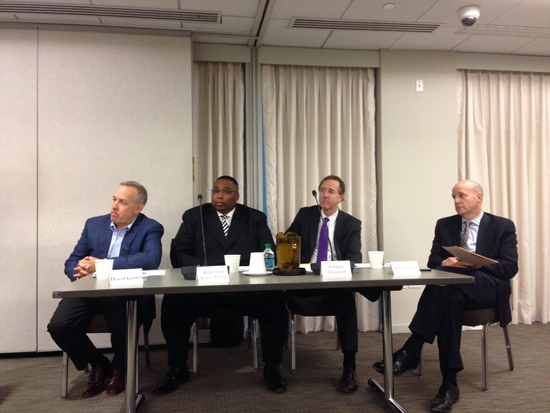
Photo: (Left to right) GAC Chair David Golder, Ald. Jason Ervin, CPS CEO Forrest Claypool and GAC Vice Chair Peter Friedman.
On Thursday, Nov. 19, Chicago Public Schools CEO Forrest Claypool and Ald. Jason Ervin, whose 28th Ward represents Sinai Health System, sat down with JUF’s Government Affairs Committee to discuss the city of Chicago’s 2016 budget and its impact on neighborhoods, public schools and Jewish Federation affiliate agencies.
To open the meeting, Ervin provided an overview of the city budget and highlighted the challenging fee increases, which is one of the reasons he voted no on the budget.
“The implementation of garbage collection fees will have an extremely adverse impact on the residents of the 28th Ward,” he said.
Claypool emphasized that JUF was a fitting venue to promote his agenda to save CPS, given the organization’s work on social justice causes. He talked about his recovery plan to restore funding to city schools.
“We are at a breaking point,” he said, noting that CPS receives 26 percent less in per-pupil state funding than other districts. “Everyone has to be part of the solution.”
Claypool also encouraged committee members to educate their peers on the dire situation at CPS.
Howard Sitron from Jewish Child & Family Services, Abbie Weisberg from Keshet and Alan Sataloff from JCC Chicago ended the meeting by discussing their CPS-funded programs, which include special education and afterschool programs in Chicago schools.
“Federation-city partnerships, such as with CPS, are necessary to sustain vital social services to city residents,” said David Golder, chair of the Government Affairs Committee.
The Jewish Federation spans 15 wards and the majority of Chicago-funded programming is made possible by Community Development Block Grants, the Department of Family & Support Services and Chicago Public Schools.
Other stories
-
Meet Andrew S. Hochberg, 2021 Julius Rosenwald Memorial Award recipient
Celebrate Andy Hochberg at the virtual Annual Meeting on Sept. 14
Read more -
Two local teens win national recognition
Recipients of the annual Diller Teen Tikkun Olam Awards
Read more -

Celebrating six young award winners cultivating the community
Introducing young adult award winners
Read more
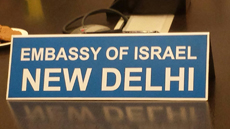
Eighteen JUF donors returned to Chicago on Nov. 20 from a week of meetings in India with political, diplomatic, business and Jewish community leaders.
Chaired by JUF Board member Lee Miller and David Sternberg and accompanied by former U.S. Ambassador and Presidential Special Envoy Marc Grossman, the delegation met with India’s attorney general, secretaries of finance, commerce and foreign affairs, its former ambassador to Israel, members of parliament (including the governing party’s spokeswoman) and senior officials of the country’s leading law firm and global conglomerate, Tata.
“We enjoyed incredible access to Indian leaders,” Miller said, “And, as was the case last year with a similar mission to the U.A.E., our community is indebted to The Cohen Group, who made these arrangements and who made Ambassador Grossman available to us for the week. Marc was an accomplished career diplomat and has become, over the years, a valued friend of JUF.”
Trip highlights also included sessions with Israeli and American Ambassadors at their respective New Delhi embassies, a meeting with the director of JDC-India at the Mumbai JCC and gatherings with recipients of JUF services in their homes.
JUF Chair Bill Silverstein traveled with the delegation and said “it’s always inspiring to connect with fellow Jews all over the globe, and especially so when we can see firsthand the incredible impact our dollars – donated in Chicago – have 8,000 miles away.
“Few of us are aware or often think about the 5,000 Indian Jews who live among India’s 1.2 billion Hindus, Sikhs and Muslims … but we all want to be of whatever help we can to them and it’s gratifying to be able to share with JUF donors that their dollars are being put to extraordinary use,” he said.
Other stories
-
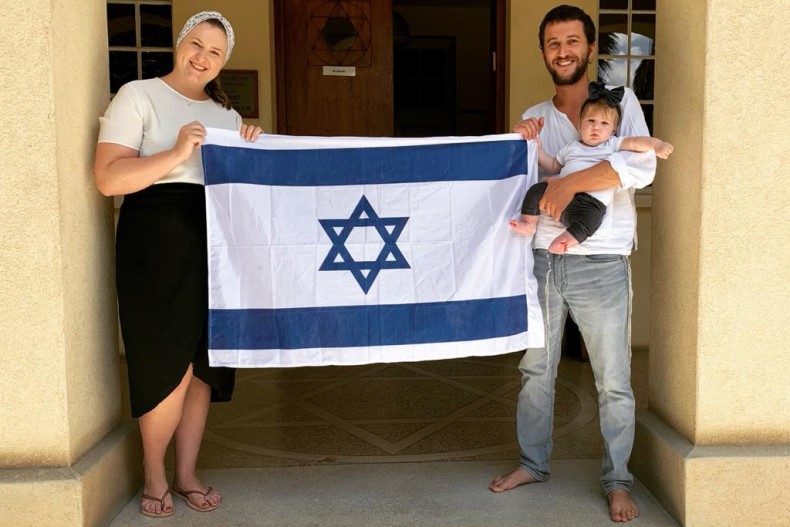
Chicago to Israel to Kenya
A family’s story of living Jewishly on three continents Michelle Cohen World May 28, 2021 Avital, Tzofia, and Netanel Kaszovitz outside their home in Nairobi on Yom HaAtzmaut. When Avital Kaszovitz prepared to be a Modern Orthodox shlicha (emissary) to the Jewish community in Ke
Read more -
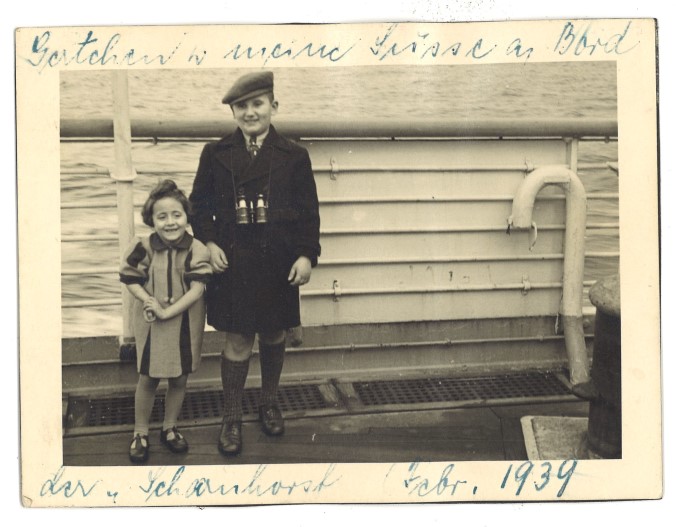
New exhibit spotlights the experience of ‘Shanghai Jews’
Explore a new Illinois Holocaust Museum and Education Center exhibit
Read more -
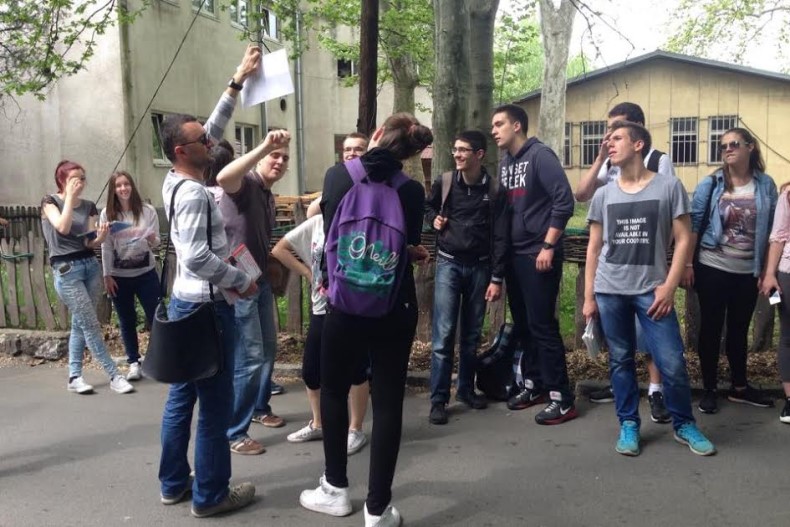
Europe’s brave new teachers of the Holocaust
Teaching the Holocaust in the modern era has its difficulties and rewards.
Read more
Chicagoland Jewish High School changes name to Rochelle Zell Jewish High School (RZJHS)
Chicagoland Jewish High School (CJHS) in Deerfield, Ill. is changing its name to Rochelle Zell Jewish High School (RZJHS) in honor of a naming gift from the Zell Family Foundation, effective November 19, 2015.
The Zell Family Foundation gift is one of three transformative gifts that will enable the school to fulfill its mission: creating a culture of academic excellence that inspires students to think critically and achieve their full potential, while preparing them to live Judaism as responsible and involved citizens in the modern world.
“Thanks to the extraordinary generosity of the Zell Family Foundation, our school is poised to meet the challenges of the future,” said Tony Frank, Head of School. “This will enable us to focus on increasing enrollment and investing in programs that enrich the lives of our students, their families, and the entire Jewish community.”
In February 2015, the school redeemed Series B Bonds in full with a generous gift from the Crown Family specifically for this purpose. The school has also been awarded a significant gift from the Harvey L. Miller Supporting Foundation, to be paid in January.
The Zell Family Foundation gift is in memory of Rochelle Zell, Sam Zell’s mother. The Zell family has been actively involved in the school.
“We are proud to strengthen this vital and essential institution in our community,” said Matthew Zell, one of Rochelle Zell’s grandchildren. “The high quality of education at RZJHS provides students with exceptional college preparation, and promotes the sustainability of Jewish values for new generations. Both of these values were priorities for my grandmother.”
The Jewish United Fund/Jewish Federation of Metropolitan Chicago has supported Chicagoland Jewish High School since its inception through annual allocations, and partnered with the school to obtain these new gifts through JUF/Federation’s Centennial Campaign.
“Our partnership with the school exemplifies the commitment of these donors and of JUF/Federation to a strong Jewish future for our entire community,” said JUF/Federation President Steven B. Nasatir. “We invest heavily in Jewish education across the board, including allocations and contributions from JUF’s Annual Campaign, Centennial Campaign, and Day School Guarantee Trust Fund-because it’s the right thing to do. It pays huge dividends for Jewish life.”
CJHS, now RZJHS, opened its doors fourteen years ago with 25 students. Currently almost 400 students have graduated. Enrollment stands at 159 students at the Deerfield campus, where the school moved in 2007.
“Thanks to these gifts, our school is well-positioned to continue to redefine the meaning of educational excellence in a Jewish context,” said Lynn Schrayer, president of RZJHS. “We can now focus our community outreach and fundraising efforts on initiatives that elevate the experience of students and their families.”
A community celebration of these three gifts and a dedication of Rochelle Zell Jewish High School will take place at the school in the Spring of 2016.
Established in 2001, Rochelle Zell Jewish High School is a co-ed, college-preparatory high school. Its mission is to create a culture of academic excellence. RZJHS offers a comprehensive education, which includes exceptional general and Jewish studies programs, supplemented by strong athletic and fine arts programs, and numerous extracurricular activities and leadership opportunities. After graduating, students are well positioned to be successful in all of their endeavors. Today, RZJHS welcomes students from over 20 different communities in the Chicago area, Arizona, Colorado, Florida, South Carolina and abroad.
Other stories
-
Meet Andrew S. Hochberg, 2021 Julius Rosenwald Memorial Award recipient
Celebrate Andy Hochberg at the virtual Annual Meeting on Sept. 14
Read more -
Two local teens win national recognition
Recipients of the annual Diller Teen Tikkun Olam Awards
Read more -
Celebrating six young award winners cultivating the community
Introducing young adult award winners
Read more
The Jewish United Fund of Metropolitan Chicago and its Jewish Community Relations Council stand with the people of Paris and with all people of conscience who wish to defend the principles of pluralism, freedom, and democracy.
We mourn for those who were savagely murdered at the hands of Islamist terrorists, and pray for the speedy recovery of the injured.
The jihadist attacks in Paris, like those that preceded them, are part of a global onslaught waged by extremists and fanatics, who aim to sow chaos, death and the destruction of social and political order.
We call on elected officials, civil society institutions, and security forces of all nations to fight the scourge of extremism and terrorism at home and abroad. Here in Chicago, we call on the communal representatives of every religion, race, and ethnicity, to work together to defend the fundamental values that form the bedrock of our open, pluralistic American society.
Only through unity will we foil the terrorists’ evil designs.
Bill Silverstein, Chairman
Steven B. Nasatir, President
Jewish United Fund of Metropolitan Chicago
David T. Brown, Chairman
Emily Sweet, Executive Director
JUF’s Jewish Community Relations Council
Other stories
-
Chicago to Israel to Kenya
A family’s story of living Jewishly on three continents Michelle Cohen World May 28, 2021 Avital, Tzofia, and Netanel Kaszovitz outside their home in Nairobi on Yom HaAtzmaut. When Avital Kaszovitz prepared to be a Modern Orthodox shlicha (emissary) to the Jewish community in Ke
Read more -
New exhibit spotlights the experience of ‘Shanghai Jews’
Explore a new Illinois Holocaust Museum and Education Center exhibit
Read more -
Europe’s brave new teachers of the Holocaust
Teaching the Holocaust in the modern era has its difficulties and rewards.
Read more
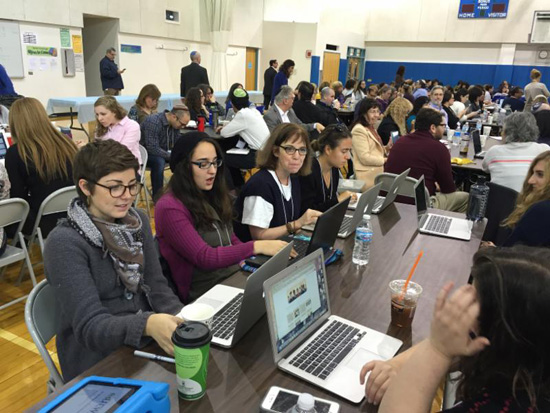
More than 300 Jewish day school educators participated in edJEWcon.
Day school educators from all over the Chicago area participated in edJEWcon , a groundbreaking joint professional development day, on Wednesday, Nov. 11.
Over 300 faculty members representing Akiba Schechter, Solomon Schechter, Chicago Jewish Day School, Chicagoland Jewish High School, Hillel Torah and Bernard Zell Anshe Emet Day School studied the work of noted psychologist Dr. Carol Dweck on Growth Mindset and how they can structure their schools and classrooms to better develop a growth mindset for faculty, administrators and students.
“It was invigorating and inspiring to see the networking and collaboration of ideas between educators from different schools,” said Rabbi Menachem Linzer, principal of Hillel Torah and a member of the day school leadership council that collaborated on the program. “We look forward to building on this exciting opportunity to work together to strengthen Jewish Day School education across Chicago”.
The conference was sponsored by the Schechter Network with funding from the Crown Family Philanthropies and Avi Chai.
Other stories
-
Meet Andrew S. Hochberg, 2021 Julius Rosenwald Memorial Award recipient
Celebrate Andy Hochberg at the virtual Annual Meeting on Sept. 14
Read more -
Two local teens win national recognition
Recipients of the annual Diller Teen Tikkun Olam Awards
Read more -
Celebrating six young award winners cultivating the community
Introducing young adult award winners
Read more
Earlier this month, President Obama signed the Bipartisan Budget Act of 2015, H.R. 1314 , a two-year budget agreement that increased the debt limit and eliminated 90 percent of the automatic budget cuts — known as sequestration — for non-defense discretionary domestic and defense programs in fiscal year 2016, and about 60 percent of the cuts in 2017. This agreement will greatly reduce the potential for government shutdowns over spending levels for the next two years.
The budget agreement also extended the solvency of the Social Security Disability Insurance (SSDI) fund through 2022, thereby avoiding across-the-board cuts of nearly 20 percent in disability benefits starting in late 2016. Sens. Richard Durbin and Mark Kirk both voted in favor of the bill. On the House side, Illinois Reps. Mike Bost, Cheri Bustos, Danny Davis, Rodney Davis, Robert Dold, Tammy Duckworth, Bill Foster, Luis Gutierrez, Robin Kelly, Adam Kinzinger, Daniel Lipinski, Mike Quigley, Bobby Rush and Jan Schakowsky voted in favor of the bill.
“This is great news for people with disabilities,” said David Golder, chair of JUF’s Government Affairs Committee. “JUF is grateful that thousands of people in the Chicago metropolitan area and the state of Illinois will continue to receive the benefits they need.”
Protecting funding for SSDI has been a high priority for JUF and was one of the domestic policy issues that Chicago leaders advocated for with members of the Illinois delegation during a 2015 Mission to Washington D.C.
The extension is in part a result of a short-term reallocation of funds from the main Social Security trust fund to SSDI. The fix also includes enhanced program integrity measures designed to ferret out waste, fraud and abuse in the system. The agreement provides for new demonstration projects to test the viability of approaches to reduce the cost of the program and to help recipients find employment. In addition, the “single decision maker” pilot program underway in 20 states (Illinois does not participate) has been eliminated. The program tested the impact of allowing disability examiners to make disability determinations without a medical consultant’s signature.
“SSDI is a critical safety net for the most vulnerable individuals in our community, many of whom have no other sustainable sources of income,” said Lisa Shuger Hublitz, director of JUF’s Washington D.C. Office. “Ensuring that this program continues is a big win, and we appreciate the support from members of the Illinois delegation.”
SSDI is only available to those who have paid in to the fund and who have the most severe, long-term impairments, which prevent them from earning even a poverty-level wage at any job in the national economy because of their disabilities. Four percent of all Illinois residents aged 18-64 received SSDI benefits in 2013. In Illinois, 291,729 disabled workers, and nearly 5,000 spouses and 60,500 children of disabled workers received vital benefits from SSDI in 2013.
Other stories
-
Meet Andrew S. Hochberg, 2021 Julius Rosenwald Memorial Award recipient
Celebrate Andy Hochberg at the virtual Annual Meeting on Sept. 14
Read more -
Two local teens win national recognition
Recipients of the annual Diller Teen Tikkun Olam Awards
Read more -
Celebrating six young award winners cultivating the community
Introducing young adult award winners
Read more

Jonathan Benartzi and Noa Rothman light candles in memory of their grandfather, Yitzhak Rabin, on the 20th anniversary of his assassination (Photo by Robert F. Kusel).
For the 20th anniversary of his assassination, more than 400 Chicagoans gathered for a memorial service to Israeli Prime Minister Yitzhak Rabin. The Nov. 10 event was held at Chicago Sinai Congregation.
Rabin’s grandchildren, Jonathan Benartzi and Noa Rothman, lit candles and shared their memories of him. They also spoke of the Yitzhak Rabin Center in Tel Aviv established in his honor.
“Thank you for your commitment to the ongoing legacy of my grandfather, a leader, warrior, and peacemaker,” Benartzi said, noting that, for Rabin’s family, “The struggle for Israel was our everything.”
Israeli Consul General to the Midwest Roey Gilad called Rabin’s assassination by a fellow Israeli Jew “the lowest point in Israeli history.” He said he wanted to use the anniversary “for ‘ cheshbon nefesh ,’ for soul-searching.” Gilad then led a brief discussion with Martin Indyk, former U.S. Ambassador to Israel, and Rothman, a lawyer in the Tel Aviv district attorney’s office and now an Israeli television producer.
Indyk said Rabin, who had once served as Israel’s ambassador to the U.S., knew Israel “needed the U.S. to make peace” with its neighbors. Rabin felt that Israelis and Palestinians should be separate out of mutual respect, which would build trust. “Now, there is no trust.”
Rothman compared her grandfather’s assassination to that of President Lincoln. She called Israel’s relationship to the Diaspora “deeper than a bond,” but warned, “When Israel becomes a political issue in the U.S., Israel is in trouble.”
Chicago Mayor Rahm Emanuel told the audience that when he was serving as White House Chief of Staff under President Clinton, he helped arrange the peace-treaty signing between Israel’s Rabin and King Hussein of Jordan, and how he invited his father — a veteran of Israel’s War of Independence — to attend. Rabin “was a fighter for Israel,” Emanuel said, “both on the battlefield and at the negotiating table. We were privileged to call him ‘ chaver ‘ (friend).”
Harry J. Seigle, JUF’s 2016 General Campaign Chairman and a member of Chicago Sinai, spoke of JUF’s continued commitment to a safe and secure Israel.
Two videos were presented. One highlighted Rabin’s life and achievements, both military and political. The other was of his final speech, made moments before his assassination, in which he said, “Peace is the first of all our prayers … The Israeli people want peace.”
The Chicago Sinai choir lead the attendees in the national anthems of Israel and the U.S. and several Israeli songs, including “Shir LaShalom,”(“Song of Peace”), which Rabin sang at the peace rally at which he was killed.
The congregation’s spiritual leader, Rabbi Seth Limmer, led attendees in the Mourner’s Kaddish. Sinai’s Assistant Rabbi Amanda Greene and Anshe Emet Synagogue’s Rabbi Michael Siegel led a Prayer for the State of Israel.
The memorial service was sponsored by the Yitzhak Rabin Center, Chicago Sinai Congregation, Consulate General of Israel to the Midwest and JUF.
Other stories
-
Meet Andrew S. Hochberg, 2021 Julius Rosenwald Memorial Award recipient
Celebrate Andy Hochberg at the virtual Annual Meeting on Sept. 14
Read more -
Two local teens win national recognition
Recipients of the annual Diller Teen Tikkun Olam Awards
Read more -
Celebrating six young award winners cultivating the community
Introducing young adult award winners
Read more
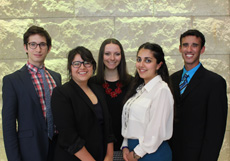
The Harriet and Maurice Lewis Family Summer Intern Program is launching its first full for-profit cohort this year, and JUF is looking for excellent placements and intern candidates. Last year, the Lewis Summer Intern Program developed seven for-profit positions, placing seven interns with for-profit businesses in finance, health care administration, real estate, and marketing positions.
This year, the Lewis Summer Intern Program plans to double the number of for-profit placements available, and create a full scale for-profit track within the Lewis Summer Intern Program to coincide with traditional non-profit track.
Students who participated last year gained valuable career experience, made important career connections, and developed deeper knowledge of Chicago’s Jewish community. They also learned about the important role that lay leaders play in the lives of Jewish organizations, and how the vision of lay leaders helps shape and drive the Jewish Community.
The Lewis Summer Intern Program is one of the JUF’s hidden gems. The 8 week paid summer internship places 30-40 college- aged interns in non-profit jobs at Jewish organizations and Jewish led businesses all over the city of Chicago. The program has more than 30 years of documented success in giving students meaningful Jewish and career experiences, with over 700 alumni around the country, working in nearly every industry. The program offers students a paid internship, guidance on how to conduct a job search, active professional mentoring, and Jewish enrichment.
The program benefits more than just the interns. Organizations and businesses who work with Lewis interns know that they’re receiving a top notch staff person. Interns are interviewed first by Lewis Program staff and only those who have the right combinations of skills and interests are sent to interview with potential placements. The best placements for Lewis interns have a Jewishly engaged professional interested in fostering the career and Jewish growth of a promising young adult, and participating in one-on-one mentoring with that individual.
If your business is interested in hiring a Lewis Summer Intern, contact Karen Martin at 312-357-4889 or [email protected]. If you are a student interested in applying for the Lewis Summer Intern Program, apply on line at www.juf.org/lsip . To help sponsor the Lewis Summer Intern Program, contact John Lowenstein, Vice President of Campus Affairs at 312-673-2385, or [email protected].
Karen Martin is director of JUF’s Lewis Summer Internship Program and development manager for the Hillels of Illinois.
Other stories
-
Local campus administrators convene on hate speech, bias
JUF and ADL brought together 17 student safety, diversity and inclusion and student affairs administrators and Hillel representatives from various Illinois campuses to discusses issues of hate speech and bias.
Read more -
Engaging students about Israel on campus
Too often we hear about difficulties facing Jewish college students on Illinois campus, but to focus solely on the politics gives only one piece of the complex narrative that is Jewish life on campus.
Read more -
Hillel International launches fellowship initiative to train young Jewish professionals
The Springboard Fellowship will train cohorts of young Jewish professionals in highly-valued skillsets and place them at local Hillel campuses for two years.
Read more
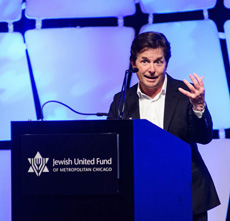
When it comes to celebrities, it’s hard to find one more beloved than Michael J. Fox.
Even when he plays unlikeable characters, he’s just so, well, loveable — from the Wall Street-obsessed smart aleck son on Family Ties to the manipulative lawyer on The Good Wife . But Fox is perhaps most cherished and respected for his off-screen role as courageous humanitarian, who’s transformed his struggles and hardship into something beautiful — into a blessing. In Judaism, we call him — quite simply — a mensch.
Fox headlined the Jewish United Fund of Metropolitan Chicago’s Vanguard Dinner on behalf of the 2016 Jewish United Fund Annual Campaign on Thursday evening, Nov. 5, at the Hyatt Regency Chicago.
‘It is up to us’
The Vanguard Dinner, attended by more than 700 people this year, launched the 2016 JUF Annual Campaign, which helps protect, sustain and enrich the Jewish community, especially at this critical juncture for the Jewish people. Steve Miller, who co-chaired the dinner with his wife Diane, remarked how global Jewry continues to battle many of the perennial threats to Jewish life and Jewish lives, threats like Holocaust denial, escalating global anti-Semitism, and accelerating terror attacks against Israel.
It’s up to the Jewish community, Miller said, to take action. “We have learned that we cannot be complacent. We have learned that if we are not vigilant, history can repeat itself in horrific ways. We have learned that it is up to us,” he said. “One of the lessons of Back to the Future is that if we act now, we can impact the future and make it brighter.”
The 2016 Vanguard dinner was chaired by Diane & Steve Miller, and vice chaired by Erica & Michael Fishman and Devra & Gregg Shutan; Harry J. Seigle is the 2016 General Campaign Chair.
Abby Seitz, JUF’s Hillel/Israel Education Center Intern and a student at Columbia College in Chicago, led the guests in the blessing over the challah.
Devra Shutan, volunteer, donor, and recipient of the benefits of JUF programming, addressed the growing culture of hatred toward Jews around the world–even here at home.
She recounted that recently some boys on an opposing middle school basketball team hurled anti-Jewish epithets at her son and other Jewish players on the Highland Park team. “What can be done? How do we stand up to hatred?” she asked the audience. “…We have to stand together with strength and pride. This is our time to prioritize our Jewish community and utilize all possible resources to keep it strong…We are living in a period of Jewish history that is the most critical my generation has faced, and we are the ones who will determine its course.”
She asked the guests to support JUF and recognized a generous donor who will be matching campaign gift funds in 2016.
‘Why I’m Here’
Then Fox, introduced by Michael Fishman, was greeted to the stage with a standing ovation. He told the audience how comfortable he was, feeling like ” mishpacha ” (family), as his wife of 27 years, actress Tracy Pollan, and their four children (a 26-year-old son, 20-year-old twin daughters, and a 14-year-old daughter) are all Jewish. Fox and Pollan, who met on the set of Family Ties , married under a chuppah (Jewish wedding canopy) and all of their children have celebrated their bar and bat mitzvahs. Fox said he too is “happily” immersed himself in Jewish life.
Fox, who played the beloved Marty McFly in the Back to the Future franchise, made the rounds this fall on the media circuit, via Doc’s DeLorean Time Machine, to celebrate Back to the Future II, set in the fall of 2015. Chicagoans hoped one particular premonition made in the movie — that the Cubs would win the World Series in 2015 — would come true, but, alas, it wasn’t meant to be.
Back in the past, Fox’s life started modestly. A working class, hockey-loving kid from Ontario, Canada, he dropped out of school to try and make it in Hollywood. “Being a poor, starving actor,” Fox recalled, “is a lot more fun in retrospect.” He said his first apartment in Los Angeles was a dump, so tiny that he’d wash the dishes in the shower.
But in the mid-’80s, his career exploded, and suddenly, his face was plastered everywhere — even on a lunchbox.
Fox was living out the lifestyles of the rich and famous, playing celebrity hockey with his idol Bobby Orr, watching the world premiere of Back to the Future alongside Princess Diana, driving fancy cars, and partying hard. “I was Justin Bieber, before he was Bieber,” Fox recalled.
But then, Tracy played him a song as a cautionary tale. She asked him to listen to a James Taylor tune called “That’s Why I’m Here,” which warns not to lose sight of what matters most in life. “She had genuine concerns about my role as life of the party,” Fox said, getting emotional. “Her insight probably saved my life.”
And, in 1991, Fox had yet another wakeup call when, at just 29, he was diagnosed with young-onset Parkinson’s disease (PD)–a chronic degenerative neurological movement disorder. His doctor told Fox he only had 10 years left to act because of the speed of the disease’s progression. Fox said he felt like he was waiting for a bus to hit him, but didn’t know when.
He waited seven years to go public with his illness.
In 2000, he launched The Michael J. Fox Foundation (MJFF) for Parkinson’s Research, the largest nonprofit funder of Parkinson’s drug development in the world–which has funded over half a billion dollars in Parkinson’s research. The Foundation has galvanized the search for a cure to the disease that currently affects at least an estimated five million people worldwide.
Several JUF affiliated agencies including JCC, CJE SeniorLife, and the Center for Jewish Genetics provide programming and services related to Parkinson’s disease. About 10 percent of PD is genetic, and the MJFF is currently sponsoring a landmark study worldwide. The Center for Jewish Genetics and MJFF are collaborating this month to help identify local candidates through a family history initiative, and will discuss connections between Jewish heritage and PD at a program in the spring.
All those years ago, Fox’s doctor made one wrong prediction about the future: the actor’s screen career didn’t end. In fact, in recent years, despite his illness, Fox has reemerged as a TV star, playing memorable characters on hit shows like Boston Legal , Scrubs , Curb Your Enthusiasm , and The Good Wife . “I could play anyone,” he joked, “as long as they have Parkinson’s.”
But it was a role the comedian Dennis Leary asked Fox to play on Leary’s show Rescue Me that stands out most in Fox’s mind. The character was “Dwight,” an alcoholic, pill-popping, sex-addicted misanthrope. And here’s the kicker — he’s a paraplegic. “You want me to play a paraplegic?” Fox asked Leary. “You do understand this guy can’t move … and I can’t stop moving?” But, soon, Fox understood Leary’s motivation. Though their afflictions are different, Fox could relate to Dwight. “I wasn’t Dwight, but I know Dwight,” he said. “I know about loss. I know about life rearranged, purpose reexamined, and the chaos of fate…If I had spent my time wallowing, I could have easily been Dwight. I often say Parkinson’s is a gift and some people are skeptical about that. The truth is it’s the gift that keeps taking, but it’s a gift.”
Even Fox has a rare pessimistic moment. In fact, when he missed a deadline while writing his book, Always Looking Up , he complained to his wife, “I’m never going to finish my book about optimism.”
Maybe not always, but most of the time Fox “looks up,” thanks, in part, to a stranger in Africa. He once read an article about a pregnant woman in Mozambique, whose village was hit by a massive flood. In labor, with the waters flooding past, the woman grabbed for a tree branch in desperation. “She sat in the tree and delivered her baby,” he said. So whenever any of Fox’s children complain to their dad about an “urgent” problem that’s really not so urgent, he tells them, “A lady had a baby in a tree. What do you got?”
The Vanguard Dinner was sponsored in part by a grant from the Manfred & Fern Steinfeld Campaign Events Fund and our generous corporate partners; DLA Piper, Greenberg Traurig, and Kirkland & Ellis, and GCM Grosvenor.
Other stories
-
Meet Andrew S. Hochberg, 2021 Julius Rosenwald Memorial Award recipient
Celebrate Andy Hochberg at the virtual Annual Meeting on Sept. 14
Read more -
Two local teens win national recognition
Recipients of the annual Diller Teen Tikkun Olam Awards
Read more -
Celebrating six young award winners cultivating the community
Introducing young adult award winners
Read more
If you take the bar/bat mitzvah out of the synagogue, what’s the impact?
In the first of a series of research reports, the Community Foundation for Jewish Education of the Jewish United Fund of Metropolitan Chicago looks at the rising trend in families forgoing congregational education and/or membership while preparing and conducting their own bar/bat mitzvah ceremonies for their children.
“CFJE Reports: A Closer Look at Independent B’nai Mitzvah in the Chicagoland Area,” authored by Abigail Pickus, provides a snapshot of this trend, offering a glimpse inside the motivations of families who undertake this process, the tutors and clergy who assist them, and the synagogue professionals who struggle with the loss of these families to the congregational community.
Demographic groups most likely to choose the independent route are unaffiliated, special needs and interfaith families, the study found. But many others, including those actively engaged in Jewish life, also have opted for alternative approaches.
One tutor estimated that 60% to 70% of the families she has worked with “didn’t understand the value of the Jewish community,” but were motivated culturally to have a bar mitzvah. The others “really wanted to be involved in a synagogue and in Jewish life, but finding a perfect fit with a synagogue in today’s world is very hard. It’s a struggle even for a committed Jew who wants to be part of the community.”
The report offers local educators and others insight into the reasoning for, and impact of, this phenomenon so they can better understand and work with b’nai mitzvah families, CFJE Executive Director Rabbi Scott Aaron, Ph.D., said. The do-it-yourself push also reflects the larger challenges congregations face today in maintaining their historic position as central institutions of Jewish communal life.
“Even though (rabbis interviewed for the study) disagree on whether the independent b’nai mitzvah is a rising trend or a passing phase,” Pickus reports, “they all concede that in the face of this phenomenon, it is the congregations – and by association, organized Jewish life – that is the most at risk and therefore has the most to lose.”
“We released the report to educators at an open-invitation gathering,” Aaron said, “and it was telling that half of the non-Orthodox congregations in our community were represented. Some participants were from synagogues more than 30 miles away.”
Going forward, the CFJE Reports research series will chronicle understudied areas of Jewish education in the Chicago area, informing and guiding educators and others throughout the community, Aaron said.
“Rabbi Leo Baeck once said ‘There is no new knowledge without a new problem.’ Our CFJE Reports series attempts to glean new knowledge by looking in-depth at new and emerging issues in Jewish education here in Chicago in order to reframe potential problems into potential challenges,” Aaron said.
“By providing our community professionals, planners and stakeholders with new information, we are able to help them be more strategic in their work as it relates to Jewish education.”
Other stories
-
Meet Andrew S. Hochberg, 2021 Julius Rosenwald Memorial Award recipient
Celebrate Andy Hochberg at the virtual Annual Meeting on Sept. 14
Read more -
Two local teens win national recognition
Recipients of the annual Diller Teen Tikkun Olam Awards
Read more -
Celebrating six young award winners cultivating the community
Introducing young adult award winners
Read more