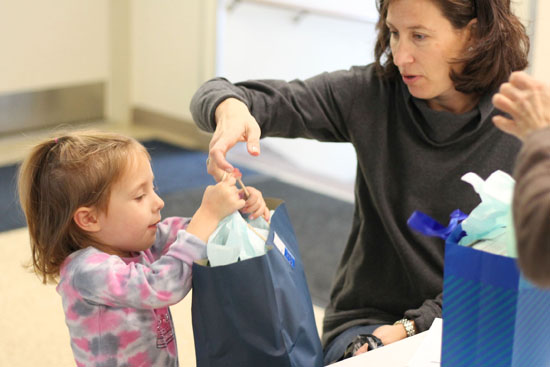
Sheri Greenbaum and her daughter, Jordyn, helping to sort Chanukah gifts.
Tonight, hundreds of Jewish Chicagoans in need will be unwrapping presents of blankets, cookware, new shoes, towels or gift cards, thanks to The ARK’s Chanukah Gift Wishes Program.
For many, these are the only gifts they will receive this season.
“The items our clients wished for — gift cards to grocery stores, gloves, toys for their children — reflect the truly difficult circumstances our clients are in,” said Marc Swatez, executive director of The ARK. “It means so much to our clients, their families, and to all of our staff and volunteers, that we were able to fulfill these small wishes. We are extremely grateful for the community’s support — it is truly the miracle that of our clients need.”
The ARK’s Chanukah Gift Wishes program connects the “wishes” of its clients with donors who provide the gifts. This year, thanks to the generosity of donors and volunteers, 1,300 Chanukah gifts were given to clients. Among the hundreds of donors who participated in The ARK’s Chanukah Gift Wishes Program were families who wanted to give back together.
“This program allows us to engage our children in doing a mitzvah as a family,” said Sheri Greenbaum, a program volunteer who participated with her 4-year-old daughter, Jordyn. “It allows them [my children] to understand the importance of giving, not just receiving on Chanukah.”
Four-year-old Jordyn added, “It makes them feel happy, and that makes me feel good.”
The ARK provides food, medicine, medical care, dental care, eye care and other vital necessities to nearly 4,000 Jewish Chicagoans of all backgrounds year-round.
The ARK is a partner with the Jewish United Fund in serving our community. For more information visit www.arkchicago.org
Other stories
-
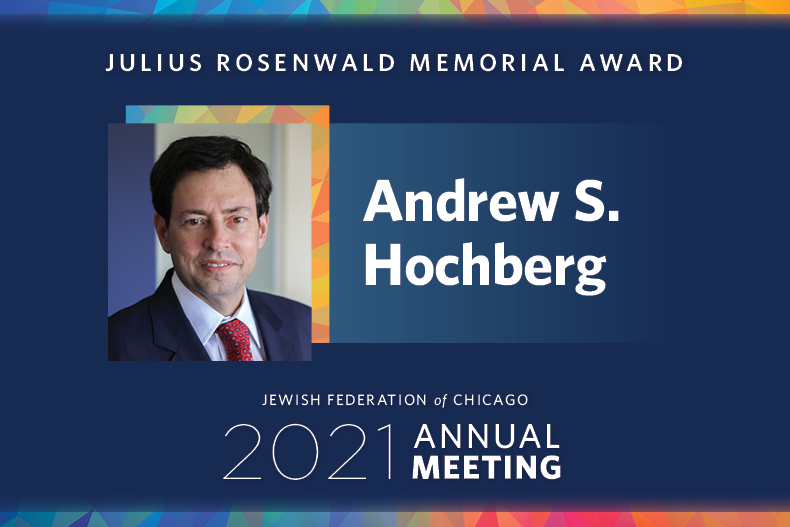
Meet Andrew S. Hochberg, 2021 Julius Rosenwald Memorial Award recipient
Celebrate Andy Hochberg at the virtual Annual Meeting on Sept. 14
Read more -
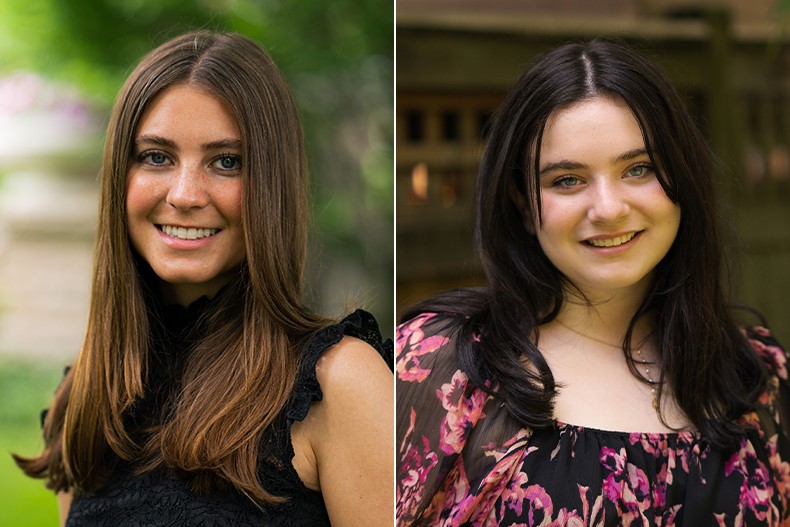
Two local teens win national recognition
Recipients of the annual Diller Teen Tikkun Olam Awards
Read more -
Celebrating six young award winners cultivating the community
Introducing young adult award winners
Read more
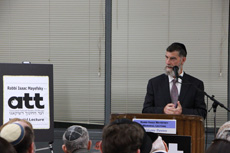
Close to 250 parents of school-age children filled the Associated Talmud Torahs on Saturday night, Dec. 5 to attend the 29th Annual Rabbi Isaac Mayefsky Memorial Lecture.
Sponsored by the Associated Talmud Torahs, this annual parenting program featured the noted educator and international lecturer Rabbi Hanoch Teller.
The presentation, entitled “Honorable Mentschen: The Target of Teaching; The Goal of Parenting,” focused on strategies for effecting parenting. Rabbi Teller presented the importance planning in parenting and cited the following strategies to create self-disciplined children:
Being a proper role model for your child; the importance of character development from a young age and instilling proper manners; specific examples of how to treat and be considerate of others; how to maintain cell phone and driving decorum; how to be careful of another person’s privacy; the importance of doing good things; and making proper decisions, i.e. value the significance of every act, consider what one’s true motivation is when confronted with decision making, have the goal of striving to create ” kavod shomayim ” (respect) and consider what one’s actions might ultimately cause.
Rabbi Isaac Mayefsky was a gifted educator who, in the course of more than 40 years of communal service, developed many key programs within the Associated Talmud Torahs, including the Russian Transitional Program and the Oscar & Bernice Novick P’TACH Learning Disabled Program.
This lecture was part of the ATT’s expanded program designed to address the challenges of creative teaching and rewarding parenting. Over the years, it has become an excellent resource for parents of children of all ages.
Other stories
-
Meet Andrew S. Hochberg, 2021 Julius Rosenwald Memorial Award recipient
Celebrate Andy Hochberg at the virtual Annual Meeting on Sept. 14
Read more -
Two local teens win national recognition
Recipients of the annual Diller Teen Tikkun Olam Awards
Read more -
Celebrating six young award winners cultivating the community
Introducing young adult award winners
Read more
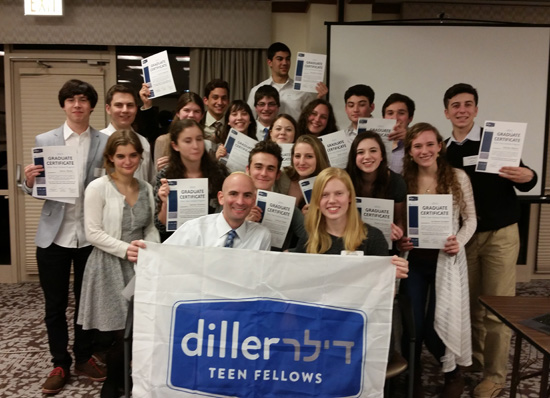
The second cohort of Chicago Diller Teen Fellows at their graduation Dec. 6 .
Eighteen high school students from the second cohort of Chicago’s Diller Teen Fellows program graduated on Sunday, Dec. 6. The 15-month fellowship provides teens with opportunities to explore topics of leadership, Jewish identity, Israel and Tikkun Olam.
The graduating cohort included:
- Colman Adams
- Benjamin Amram
- Lia Bauer-Goulden
- Eden Berke
- Melinda Berman
- Matan Cutler
- Grace Goodman
- Adam Gurin
- Lizzie Janssen
- Brian Schneiderman
- Spencer Schwartz
- Elisha Serotta
- Noah Simon
- Barbara Sodos
- Joshua Super
- Jared Vergotine
- Karen Weiner
- Henry Wolle
The Fellows also participated in two mifgashim (meetings), one in which they hosted their Israeli peers in Chicago for 10 days last spring and another when they visited the same peers in JUF’s Partnership Together region of Kiryat Gat, Lachish and Shafir in Israel as part of their three-week Israel Summer Seminar.
“It is important that we experience each other’s views, beliefs, and cultures,” said Diller graduate Jared Vergotine.
At the graduation ceremony, the fellows presented their Alumni Impact Projects, which will enable them continue their work to affect a positive change in the Chicago are community.
“We learned of our obligation to represent Judaism overseas and become leaders in our community,” said Diller graduate Spencer Schwartz.
The Diller Teen Fellows program is open to sophomores and juniors in high school, and operates in 26 communities worldwide. The international program pairs communities in the diaspora with Israeli communities.
To learn more about Diller Teen Fellows in Chicago, visit http://juf.org/teens/Diller_About.aspx .
Other stories
-
Meet Andrew S. Hochberg, 2021 Julius Rosenwald Memorial Award recipient
Celebrate Andy Hochberg at the virtual Annual Meeting on Sept. 14
Read more -
Two local teens win national recognition
Recipients of the annual Diller Teen Tikkun Olam Awards
Read more -
Celebrating six young award winners cultivating the community
Introducing young adult award winners
Read more
Despite denials and years of obstruction by Iran, the International Atomic Energy Agency (IAEA) confirmed on Dec. 2 that the Islamic Republic was actively working to design a nuclear weapon until 2009. The report detailed a long list of experiments Iran had conducted that were “relevant to a nuclear explosive device.”
In the 15-page report, the agency was blunt in its assessment that Iran had a coordinated program to develop nuclear weapons until 2003, and a less-structured effort until 2009.
“The agency’s overall assessment is that a range of activities relevant to the development of a nuclear explosive device were conducted in Iran prior to the end of 2003 as a coordinated effort, and some activities took place after 2003,” the U.N. agency said. “The agency has no credible indications of activities in Iran relevant to the development of a nuclear explosive device after 2009.”
The completion of the report is one of the steps that Iran had to take — along with dismantling centrifuges and shipping nuclear fuel out of the country — before sanctions could be lifted under the Joint Comprehensive Plan of Action.
The U.N. agency specifically requested access to Iranian scientists, documents and military sites believed to have been part of this clandestine program as mandated by numerous U.N. Security Council resolutions. But despite Iran’s obligation to cooperate with the IAEA, authorities in Teheran failed to give substantive answers to many of the dozen specific questions or documents it was asked about, including alleged work on detonators for a nuclear bomb, leaving open the question of how much progress it had made.
“Iran’s deceit and refusal to cooperate fully with the IAEA investigation, the efforts to ‘sanitize’ critical sites such as the military site in Parchin, raise questions about Iran’s willingness to comply with its obligations under the nuclear agreement,” said Steven Dishler, assistant vice president of JUF’s Jewish Community Relations Council.
Sen. Mark Kirk issued a statement saying, “Today’s IAEA assessment raises more questions about Iran’s nuclear weapons program than it answers. The only clear point is that Iran stonewalled inspectors. It’s critical that the IAEA’s 35-nation Board of Governors continue Agency investigations until Iran comes clean on all activities. Regardless of the Administration’s flip-flops on whether Iran should come clean, international inspectors should uncover the complete truth.”
As of Dec. 4, JUF has not received other statements by the Illinois Congressional delegation.
Other stories
-
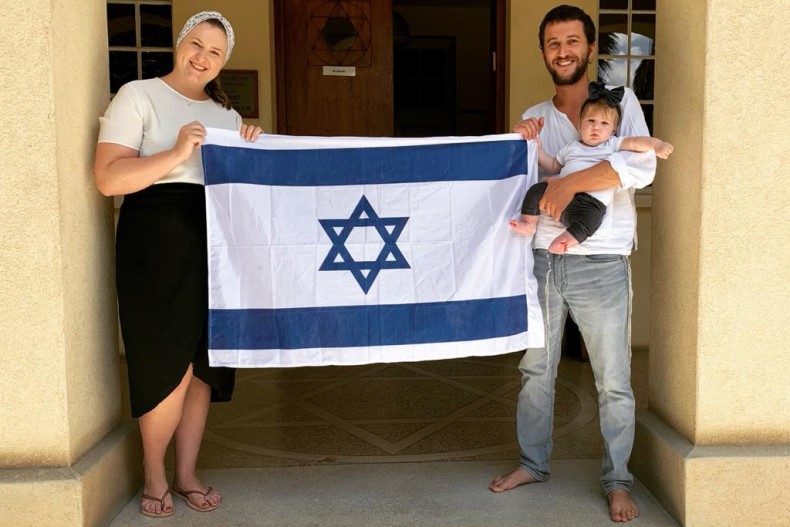
Chicago to Israel to Kenya
A family’s story of living Jewishly on three continents Michelle Cohen World May 28, 2021 Avital, Tzofia, and Netanel Kaszovitz outside their home in Nairobi on Yom HaAtzmaut. When Avital Kaszovitz prepared to be a Modern Orthodox shlicha (emissary) to the Jewish community in Ke
Read more -
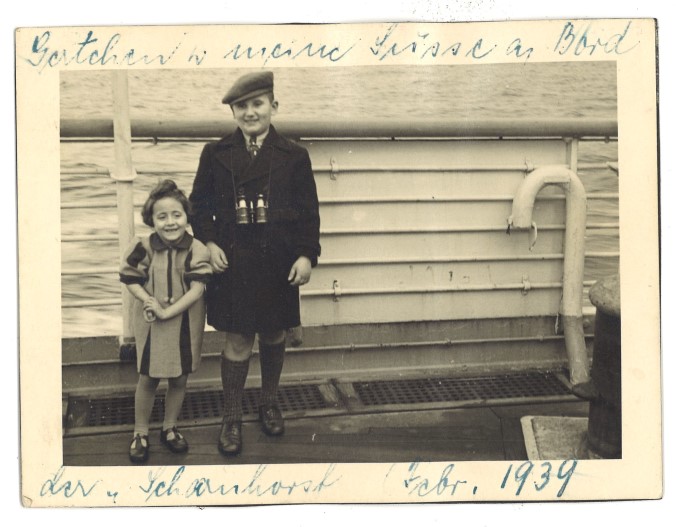
New exhibit spotlights the experience of ‘Shanghai Jews’
Explore a new Illinois Holocaust Museum and Education Center exhibit
Read more -
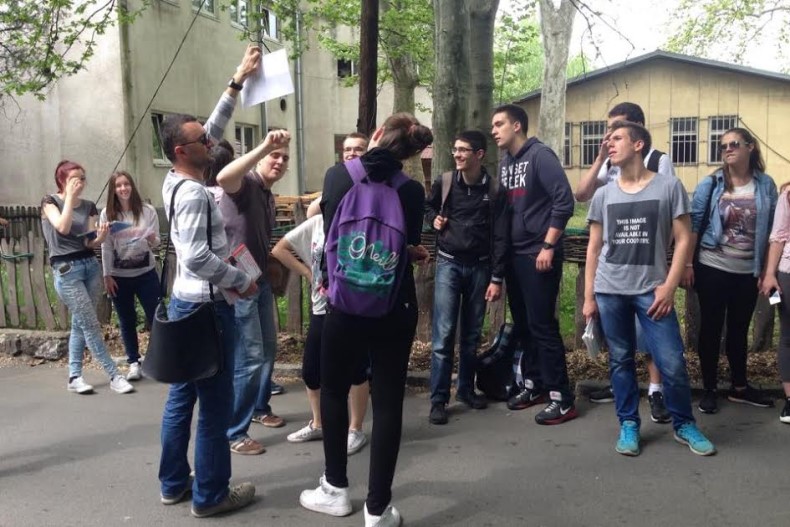
Europe’s brave new teachers of the Holocaust
Teaching the Holocaust in the modern era has its difficulties and rewards.
Read more
House and Senate resolutions aim to affirm states’ rights to maintain Iran sanctions
LISA SHUGER HUBLITZ
Members of the House and Senate introduced concurrent resolutions on Dec. 1 to reaffirm the rights of states to maintain economic sanctions against Iran for its sponsorship of terrorism, human rights violations and other illicit activities.
In the House, Illinois Rep. Peter Roskam along with original cosponsors Reps. Ted Deutch of Florida, Brad Sherman of California, Mike Pompeo of Kansas and Lee Zeldin of New York, introduced H.Con.Res.100 . Illinois Sen. Mark Kirk , along with Senators Marco Rubio of Florida and Joe Manchin of West Virginia introduced S.Con.Res.26 .
“We applaud Senator Kirk, Representative Roskam, and the bipartisan national leadership in making sure that states are able to continue to exercise their authority to impose sanctions on Iran,” said JUF Government Affairs Committee Chair David Golder. “It is important for Congress to support states that seek to ensure taxpayer dollars do not support activities that violate their values.”
Currently, 30 states, including Illinois and the District of Columbia, have divestment laws in place, and 11 states, including Illinois, have contracting prohibition laws in place against Iran.
The Comprehensive Iran Sanctions Accountability Act of 2010 (CISADA) authorized states to impose economic sanctions against Iran due to its illicit behavior which materially threatens the U.S. and its allies. While the sanctions relief granted to Iran a few months ago under the Joint Comprehensive Plan of Action has raised questions regarding whether state sanctions can be invalidated, CISADA clearly authorized states to impose economic sanctions against Iran, and these resolutions are needed to reaffirm Congress’ legislative intent and support for state sanctions against Iran.
Other stories
-
Chicago to Israel to Kenya
A family’s story of living Jewishly on three continents Michelle Cohen World May 28, 2021 Avital, Tzofia, and Netanel Kaszovitz outside their home in Nairobi on Yom HaAtzmaut. When Avital Kaszovitz prepared to be a Modern Orthodox shlicha (emissary) to the Jewish community in Ke
Read more -
New exhibit spotlights the experience of ‘Shanghai Jews’
Explore a new Illinois Holocaust Museum and Education Center exhibit
Read more -
Europe’s brave new teachers of the Holocaust
Teaching the Holocaust in the modern era has its difficulties and rewards.
Read more
The Jewish United Fund of Metropolitan Chicago has issued its 2016 Request for Proposals (RFP) for the Breakthrough Fund, a grant program launched in 2014 to encourage smart, strategic growth and creative program development in Chicago’s Jewish community. Letters of Intent will be accepted through 3 p.m. Tuesday, Jan. 12, 2016.
JUF will award $800,000 in new grants for leading-edge programs; capacity-building efforts; planning, research and development initiatives; and new approaches that address the wide array of needs, interests, individuals and identities that reflect the diverse Jewish community in Chicago, in Israel and other countries overseas.
In addition, JUF will distribute $282,000 in third-year funds for Breakthrough Fund grants committed during its first cycle. All told, the Breakthrough Fund will provide nearly $1.1 million in FY17.
Breakthrough Fund grants will support both established organizations with a legacy of creating and expanding value-added programs and services, and also early-stage organizations and entrepreneurs whose voices, visions and ideas are just emerging.
“A look at these grants offers an exciting snapshot of the Jewish world today, including new initiatives and partners that received JUF funding for the first time,” said JUF Board Chair Bill Silverstein. “The funded programs spotlight our commitment to evolve community services and programs along with community needs.”
Since its launch, JUF’s Breakthrough Fund has awarded $2.3 million in grants to 40 initiatives. Serving a variety of groups within Chicago’s Jewish community, the funded programs cover diverse themes, including inclusion programming for those with disabilities; connecting with diverse Jewish audiences; strengthening schools and students; supporting older adults’ physical, emotional and spiritual well-being; building and healing our community; and fostering intergenerational dialogues.
JUF invites prospective applicants to attend a workshop at 2:30 p.m. Wednesday, Dec. 16, at its headquarters, 30 S. Wells St, Chicago. Attendees will learn more about the Breakthrough Fund’s goals, application process and requirements, and evaluation criteria. To register or for more information, contact Sarah Follmer, Director of Grants, at (312) 357-4547 or [email protected] , or visit www.juf.org/grants/breakthrough.aspx .
Other stories
-
Meet Andrew S. Hochberg, 2021 Julius Rosenwald Memorial Award recipient
Celebrate Andy Hochberg at the virtual Annual Meeting on Sept. 14
Read more -
Two local teens win national recognition
Recipients of the annual Diller Teen Tikkun Olam Awards
Read more -
Celebrating six young award winners cultivating the community
Introducing young adult award winners
Read more
RTI teens to present findings at a community forum on Jewish teenage girls
ABIGAIL PICKUS
How does it feel to be a Jewish teenage girl in Chicago?
The Jewish United Fund is committed to finding out-by asking local Jewish high school girls to design, implement, and analyze the first research project of its kind in the Midwest exploring exactly what Jewish teenage girls feel about everything from Judaism
to relationships.
The Research Training Internship (RTI), hosted by JUF in partnership with Ma’yan and the DePaul University Beck Research Initiative for Women, Gender, and Community, is being piloted in Chicago with the first cohort set to present their findings in a community forum on Jewish teenage girls on Sunday, Dec. 13, at DePaul University from 3:30-5:30 p.m.
“This is a fantastic, explicitly Jewish feminist program that is completely unique,” said Stephanie Goldfarb, director of Youth Philanthropy & Leadership at JUF.
Trained in feminist research methodology by DePaul University faculty, the teens design their own study, collect data from their peers, analyze the results and then create an action project-a series of short videos-to be shared with the community at large.
“This is about Jewish teen girls living in Chicago so the study is done by them,” continued Goldfarb. “They are experts in their own lives. Adults can come in and do all the research, but they’ll never get the inside scoop on what the experiences are really like because they are outsiders.”
For Simone Wallk, 16, a junior at Walter Payton College Prep in Chicago, RTI has been an invaluable experience.
“RTI gave me an opportunity to be with likeminded Jewish women and to think about issues in a frank and a very socially conscious way,” she said. “It was an empowering experience that gives Jewish girls a voice in our community and recognizes that our point of view is valued.”
The experience has sharpened her critical thinking skills, schooled her in advanced academic research tools, and left her with new insight into the diversity of the Chicago Jewish Community, she added.
After receiving a crash course in feminism, social justice and feminist research, the interns-who come from throughout the Chicagoland area and represent a wide range of Jewish backgrounds-developed their own research questions covering everything from anti-Semitism, relationships, mental health, and substance abuse to gender and sexuality.
“We were figuring out how we could marry looking at privilege and access and power-and thinking about how this applies to adolescent Jewish girls,” said Wallk.
The survey yielded some surprising results, such as a large percentage of respondents admitting to having experienced anxiety or depression, but not being aware of available resources. “This is an important concern for the Jewish community,” said Wallk..
Also disconcerting is the high percentage of local Jewish teens who reported either knowing someone in an abusive romantic relationship or having been in one themselves. “These are staggering, shocking statistics. This is not what we think about when we think about Jewish teens,” said Goldfarb.
The report also shares anecdotal responses of teens sharing their feelings about the pressure they face to marry someone Jewish. “Our teens are facing a lot of pressure. These Jewish teens have a lot to contend with and the expectations on them are astronomically high with many feeling their parents don’t understand what it means to be teen today,” said Goldfarb.
The RTI community forum on Jewish teenage girls is a chance for the current cohort of interns to present their findings and share their recommendations with the community at large.
“Everyone in the community is invited to this program,” said Goldfarb. “People who have any stake in the lives Jewish teens regardless of gender. It’s not just to learn from them, but also to celebrate their incredible contribution to
our community.”
The forum also gives invested community members the chance to engage directly with the interns and hear more about their findings, Goldfarb added.
The RTI community forum is open to the public. Kosher refreshments will be served. To RSVP, visit http://tinyurl.com/qeoce5q .
RTI is generously supported by the Jewish Women’s Foundation of Metropolitan Chicago, the Ellie Fund of the Jewish Women’s Foundation of Metropolitan Chicago, the JUF, the Beck Research Initiative for Women, Gender, and Community, and DePaul University.
Abigail Pickus is a writer and editor living in Evanston.
Other stories
-
Meet Andrew S. Hochberg, 2021 Julius Rosenwald Memorial Award recipient
Celebrate Andy Hochberg at the virtual Annual Meeting on Sept. 14
Read more -
Two local teens win national recognition
Recipients of the annual Diller Teen Tikkun Olam Awards
Read more -
Celebrating six young award winners cultivating the community
Introducing young adult award winners
Read more
Given our long history of persecution and dislocation, the Jewish people well understand the plight of refugees fleeing for their lives. For over 115 years, our Jewish Federation has provided services to refugees of all faiths, nationalities, and ethnicities including those from Bosnia, Burma, Iraq, Iran, Russia, Rwanda and elsewhere. We are proud of this work, which is deeply rooted in the Jewish values of empathy and fair treatment of the stranger.
Today, as we find ourselves confronting the worst refugee crisis since World War II, we reassert the need for ethical and secure resettlement policies. These policies must uphold America’s fundamental values while also ensuring the security of our citizens, virtually all of whom are descendants of refugees and immigrants or are so themselves.
We recognize that today’s situation regarding Syria is uniquely complex. The global rise of terrorism has necessarily increased concerns over our country’s security. These concerns should be addressed while also ensuring that America remains a beacon of hope and a safe harbor for those fleeing persecution because of their religion, race, nationality, political opinion or membership in a particular social group.
As Congress seeks to find this balance, we caution against calls to bar or to privilege certain groups of refugees solely because of their religion or country of origin. Such sentiments do not constitute sound refugee policy, and remind us of similar attitudes targeting Jews seeking refuge in the United States during the Nazi reign of terror.
As current refugee resettlement policies are being debated, we will continue to ensure our community has up to date information on existing policies and screening practices, in addition to information on our long-term organizational role in administering the federally funded refugee social services program for the State of Illinois.
Other stories
-
Chicago to Israel to Kenya
A family’s story of living Jewishly on three continents Michelle Cohen World May 28, 2021 Avital, Tzofia, and Netanel Kaszovitz outside their home in Nairobi on Yom HaAtzmaut. When Avital Kaszovitz prepared to be a Modern Orthodox shlicha (emissary) to the Jewish community in Ke
Read more -
New exhibit spotlights the experience of ‘Shanghai Jews’
Explore a new Illinois Holocaust Museum and Education Center exhibit
Read more -
Europe’s brave new teachers of the Holocaust
Teaching the Holocaust in the modern era has its difficulties and rewards.
Read more
I’ve been in Jewish camping for the last 10 years. In that time, the role of idenitity at Jewish overnight camps has been investigated at nearly every Jewish camp I’ve talked to. I’ve seen camps across the board actively work and plan out how to maintain their Jewish identity with a camper population that is diversifying and growing increasingly secular. During the process, we’ve utilized some of the same tools and the same strategies in order to create an atmosphere and culture our campers can relate to and that we can be proud of.
We maintain identity through culture. A growing trend is the focus on Jewish cultural learning rather than, and in addition to, religious practices or Hebrew immersion programs. There are still camps that have these focuses, but what I see in the Midwest is a shift. Hebrew is used to name buildings, activities, or programs. For example, at JCYS Camp Henry Horner, a cabin is a bitka , free time is called chofesh , and the birkat hamazon is done after meals. One of the ways that our camp is incorporating the language without studying it. I call this process, “Hebrew by osmosis.” The campers are surrounded by the language and have no choice but to pick it up in bits and pieces without sitting down and studying it in a classroom.
We hire Israeli summer staff. I’ve seen an increase in Israeli staff and an increase in the same Israeli staff returning from summer to summer. This is due, in part, to the ease of access to Israeli staff as they finish their service in the Israel Defense Forces and the ease of the process through agencies worldwide. JAFI has been a great resource for us and we’ll likely find additional staff by starting to use Jewish Camp America for summer of 2016. The staff we find are young, enthusiastic, and provide campers a much different perspective on Israel and the IDF. The campers’ perspective changes from the images they see on the news or, more likely, on social media. During camp, they have positive role models year after year that they positively associate with Israel, which is a country in constant conflict and ever-growing tensions.
We have an increasingly diverse population. An important distinction is that camps are adjusting rapidly to the changing Jewish community of youth. Most Jews raise children in a very secular world. There is a huge number of mixed marriages and some of us live in communities where observant Judaism is the norm but we all have to constantly find new ways to engage them with Judaism while still being true to ourselves and our religion. This challenge is particularly relevant when we have increasing numbers of campers who are not Jewish. Many Jewish camps have opened doors to all campers. In doing so, we need to make sure that the cultural aspects are still as warm, welcoming, and educational as they are to our Jewish campers. Those of us that are open to all religions have created a space where campers who aren’t Jewish can be educated about Judaism and learn about our culture.
Not all Jewish camps have non-Jewish campers. I think the argument could be made that 100 percent Jewish campership means they’re strengthening the core Jewish network and the Jewish community. I would point out that the world we live in is not 100 percent Jewish and I’ve seen a normalization of Judaism among our non-Jewish campers. They know the prayers, a little language, a little of the culture, and are being invited to bar and bat mitzvahs and, later in life, Jewish weddings. By accepting all campers, we create good will and we are able to showcase our religion and culture to campers that, otherwise, might not have been exposed to it.
It is our responsibility as Jewish camping professionals to create this sense of Jewish identity for all our campers. What that means is different in each camp. JCYS has a different view from URJ, which has a different view from JCCA. And through this alphabet soup of acronyms, we find a common thread: we are finding ways to maintain our Jewish identity within a changing population. Recognizing that there are hundreds of Jewish camps and they address this issue in hundreds of ways, this is the common theme from camp to camp, summer after summer.
Isaac Brubaker is the Day and Overnight Camp Director of Jewish Council for Youth Services (JCYS) Camp Henry Horner.
Other stories
-
Meet Andrew S. Hochberg, 2021 Julius Rosenwald Memorial Award recipient
Celebrate Andy Hochberg at the virtual Annual Meeting on Sept. 14
Read more -
Two local teens win national recognition
Recipients of the annual Diller Teen Tikkun Olam Awards
Read more -
Celebrating six young award winners cultivating the community
Introducing young adult award winners
Read more
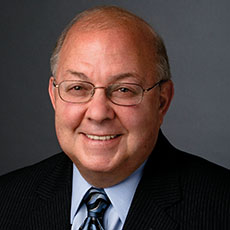
The number of dollars Michael Tarnoff has generated over the years to help the Jewish community may fit on a spreadsheet, but what can never be tabulated is the number of lives his work has impacted.
Tarnoff-now stepping down as executive vice president and chief financial officer of JUF- found new ways to help secure hundreds of millions of dollars. These funds served untold numbers in Chicago, in Israel, and around the world-beyond those dollars brought in by JUF’s fundraising efforts.
And by co-creating JFMC Facilities Corporation, Tarnoff freed dozens of professionals from managing their buildings.
Since 1980, Tarnoff has overseen the accounting, finance, investment real estate, technology, and human resources departments. Many of his innovations have been implemented by other cities’ federations, and by the Federation system nationally.
“Mike provided much of the financial genius that propelled our Federation forward,” JUF President Steven B. Nasatir said. “His initiatives have become the gold standard throughout the Federation system. Equally important was his being a mentor to many, and a friend to many more.”
Bill Silverstein, chairman of the JUF Board of Directors, agreed: “He has been extremely involved in our success. His strategies have been accepted and embraced by all.”
Tarnoff, who earned his MBA at the University of Chicago, began his career as an investment banker. He moved into real-estate development, futures trading, and commercial banking. What he learned at each job and inspired the innovations he would make at JUF.
Tarnoff says that what make Chicago’s JUF special is “the sense of teamwork” he sees in both the organization and in the community itself. “We have also been blessed by a seemingly endless supply of incredible lay leaders,” he added.
When Tarnoff first began working at Federation in 1980, the endowment stood at $39 million. Tarnoff authored a “$100 million challenge plan” to the JUF Board of Directors. That goal, set to be reached in 10 years, was reached in six. Today, the Federation total endowment stands at $1.4 billion-a 36-fold increase in 36 years.
Further, the endowment has been invested, with an average return of 10.8 percent annually. A Guaranteed Earnings Account, another of Tarnoff’s innovations, has resulted in $35 million in gains to the Unrestricted Endowment Fund over 25 years.
Tarnoff help plan the Jewish Federation of Metropolitan Chicago Facilities Corporation in 1985. Now, the JFMC Facilities Corporation saves $2-3 million each year in managing and maintaining offices, schools, JCCs, Hillels, residential facilities, and even summer-camp grounds and ball fields-encompassing some 2 million square feet of real estate.
“There are about 20 buildings that the agencies have programs in that serve people that wouldn’t exist if it weren’t for the Facilities Corporation and the financing with tax exempt bonds and the project endowment fund financing model that we’ve developed.” Tarnoff said. “Both of those things make me feel very proud.”
Tarnoff also created a central bank function for JUF and its affiliate and beneficiary agencies to obtain loans and/or loan guarantees which save the Federation system about $2 million annually.
Tarnoff has also made an impact on the national level. He encouraged Federation to issue bonds, and today Tarnoff said he is pleased to report, “We’re rated AA3 by Moody’s.” The bond initiative has since been adopted by the Federation system nation-wide as its Jewish Federation Bond Program, which can help obtain tax-exempt loans for all Federations across the US. More than $1.5 billion worth of bonds have been issued since the program’s inception in 2002.
Additionally, he spearheaded the idea of federations pooling their endowment portfolio investments. The JFNA’s Jewish Federation Investment Program manages more than $3 billion in endowment portfolio assets for Federations all around the country. “I think the more we do that collectively, the better off the whole Jewish community is,” Tarnoff said. Higher investment returns resulting from greater economies of scale and access to superior opportunities have resulted in an estimated $5-10 million of incremental asset growth.
These funds, Tarnoff emphasizes, are only a means to an end. “Working at JUF has been great for me in what I call ‘psychic income,'” Tarnoff explained. “But doing what I do at JUF, instead of at a for-profit, I have a direct connection with the community. I know that more elderly people get services, more kids go to camp, more families get counseling because I am doing my job. Service to the people is the reason we are in business.”
In addition to JUF, Tarnoff has served on the Nonprofit Advisory Committee of the Financial Accounting and Standards Board. He has served as Chairman of the First Nonprofit Insurance Company, which provided insurance to non-profits. And he continues to serve on many profit and non-profit boards, including Agile HC, the Michael Reese Health Trust, and the Howard Area Community Center.
For his accomplishments, Tarnoff received the Malenkorn Distinguished Service Award in November, 2011, from the Jewish Communal Service Association. He shared it with two of his colleagues, JUF’s Peter Friedman and the late Michael Kotzin. Each of them had served JUF for 25 years or more.
While Tarnoff is no longer CFO himself- he led the worldwide search for his own replacement, Boaz Blumovitz- he will continue to work closely with the new CFO during a transition period. And Tarnoff will continue making an impact at JUF in his own right as Senior Vice President, Project Management. In that capacity, he will lead a variety of existing efforts, focusing on the financing and property development of capital projects, both new and current facilities.
While semi-retired at JUF, Tarnoff will not be spending the rest of his time on the golf course. “I will be consulting, serving on more boards, and travelling,” he said. “But I also plan to set aside some time for doing nothing.”
Time that has been, in so many ways, well-earned.
Other stories
-
Meet Andrew S. Hochberg, 2021 Julius Rosenwald Memorial Award recipient
Celebrate Andy Hochberg at the virtual Annual Meeting on Sept. 14
Read more -
Two local teens win national recognition
Recipients of the annual Diller Teen Tikkun Olam Awards
Read more -
Celebrating six young award winners cultivating the community
Introducing young adult award winners
Read more