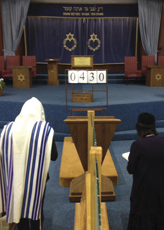
Skokie Valley Agudath Jacob (SVAJ) has seen some changes lately. Over the past two months, the synagogue has attracted 16 new member families, with dozens of additional new faces attending weekly services, events, and Torah classes.
What’s driving this resurgence?
SVAJ President David Rubin said he believes the synagogue is fulfilling an unmet need. “One of our values as a shul is a historic sense of inclusion-we house two minyanim (quorums of 10) one Traditional, the other Orthodox,” Rubin said. “We also host the Skokie Women’s Tefillah Group. So we function as a sort of ‘big tent.’ It became very clear, very quickly, that there is a hunger for a highly inclusive Orthodox synagogue in Skokie that can be a forum for diverse voices and viewpoints, that provides richer opportunities for women to participate, high quality programming for kids, and a commitment to chesed, all within an Orthodox, halachic (Jewish law) framework.”
Recent changes in the composition of the Skokie community have invited this inclusive synagogue model, informing a new approach to prayer and programming. For example, SVAJ’s mechitza -which in Orthodox synagogues separates men and women-is unusual in that it provides equal side-by-side space for both genders. Page numbers are announced and posted during services, SVAJ is becoming more handicap-accessible, vegetarian and dietetic options are available at kiddush , and both men and women share divrei torah (sermons) from the pulpit.
“Making positive change to be inclusive, while not compromising halachic standards is crucial,” said Rachel Amrani, a new member who serves on the ritual committee. “Every Jew should have a place he or she feels welcomed to connect with God.”
SVAJ also cooperates with local organizations to bring unique educational and chesed (loving kindness) opportunities to its congregants. In conjunction with Davar Skokie, an organization that supports intellectually challenging and diverse educational programming, SVAJ has hosted students from Yeshivat Maharat, the first Orthodox institution in the United States to ordain women, and co-sponsored a visit by Rabbi Ysoscher Katz, along with Davar and Yeshivat Chovevei Torah’s new community Beit Midrash, Otzar.
Kayla Avraham is the organizer of Davar Skokie, a group which brings new educational opportunities to the larger Chicago community.
Other stories
-
Meet Andrew S. Hochberg, 2021 Julius Rosenwald Memorial Award recipient
Celebrate Andy Hochberg at the virtual Annual Meeting on Sept. 14
Read more -
Two local teens win national recognition
Recipients of the annual Diller Teen Tikkun Olam Awards
Read more -

Celebrating six young award winners cultivating the community
Introducing young adult award winners
Read more
When Francis Cardinal George returned home to Chicago to become the first native son to serve as archbishop, he was asked his concerns about the future of the Catholic-Jewish relationship. He answered in a way that became the hallmark of his ministry: honest, direct, and visionary. He said, “I worry that it will remain the same and go no deeper.” He proceeded to challenge both Catholics and Jews to find ever greater meaning in the historic Catholic-Jewish encounter.
I had the opportunity to share several Shabbat dinners with His Eminence. While his Hebrew from seminary days was a bit rusty, he delighted in his ability to follow the prayers. As a Catholic priest, he understandably wanted all humanity to believe in Jesus Christ. At the same time, in a public lecture he declared, “I do not want to live in a world in which the Jewish people do not sit down every Friday night to celebrate the Sabbath family dinner.”
He deepened the Jewish-Catholic relationship not only here at home but in Israel and Ukraine as well. Concerned by the emigration of Arab Christians from Israel, the archdiocese and the Jewish United Fund established a historic, unprecedented partnership to fund computer training in Fassouta, a Catholic Arab village in the north of Israel, which created hope and reinvigorated the community. The cardinal also insisted on traveling to Israel with us to visit and support that project, lending his spiritual leadership to Fassouta’s Catholic community. He demonstrated that the Jewish and Catholic communities of Chicago could come together to support an Arab Christian community in Israel.
In Jerusalem he celebrated the Sabbath at the Wall. He visited Yad Vashem, the Holocaust memorial. One of the most important experiences he had was at the Shrine of the Book at the Israel Museum. He went there to see the Aleppo Codex, the 10th-century text written by Jewish scribes that sought to serve as the one authoritative text of the entire Hebrew Bible. He said it was so important to him because it testified to the way the Jewish people have treasured and secured and maintained for all of us the word of God in the Hebrew Bible.
We joined him on a visit to Ukraine. He traveled there in a pastoral visit to Ukraine’s Catholic communities and to witness to the international relief work of both Catholic Relief Services and its Jewish counterpart, the American Jewish Joint Distribution Committee. After surveying the JDC’s work in support of challenged children and frail elderly, he prayed with members of the Jewish community at Babi Yar, the Kyiv ravine where in 1941 the Germans murdered 33,700 Jews. He prayed Psalm 130, “Out of the depths I cry out to you, O Lord.”
Cardinal George was a man who came to Chicago to serve his flock. As he ministered to the Chicago area’s 2.3 million Catholic faithful, he surely deepened the Jewish-Catholic relationship. We were reminded of this when he so graciously gave the keynote address at our annual meeting on Sept. 11. All of us in Chicago are the beneficiaries of this good man and his spiritual leadership.
This commentary is reprinted with permission from Crain’s Chicago Business April 21, 2015. (c) Crain Communications, Inc.
Dr. Steven B. Nasatir is the President of the Jewish United Fund of Metropolitan Chicago.
Other stories
-
Meet Andrew S. Hochberg, 2021 Julius Rosenwald Memorial Award recipient
Celebrate Andy Hochberg at the virtual Annual Meeting on Sept. 14
Read more -
Two local teens win national recognition
Recipients of the annual Diller Teen Tikkun Olam Awards
Read more -
Celebrating six young award winners cultivating the community
Introducing young adult award winners
Read more
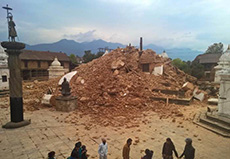
Following the devastating earthquake that struck Nepal and parts of India-which so far has resulted in more than 8,500 deaths and massive destruction-the Jewish Federation of Metropolitan Chicago is collecting funds to help those affected.
Our partners on the ground are consulting Nepalese and Indian authorities to assess the situation and ensure survivors’ immediate needs are addressed.
As always, the Jewish Federation will absorb all administrative costs, so that 100 percent of funds collected will go to meeting needs on the ground.
This emergency assistance will be provided primarily through the American Jewish Joint Distribution Committee, the “911” of the Jewish world, and IsraAID, a non-profit, non-governmental Israeli organization committed to providing life-saving disaster relief.
We’re proud of our Jewish community’s compassion, and honored to serve as the conduit for its generosity.
To donate, visit: https://donate.juf.org/JF_Nepal_Earthquake_Relief
You may also call 312.444.2869 or send a check payable to JF Nepal Earthquake Relief Fund to 30 S. Wells Street. # 3015, Chicago, IL 60606
Other stories
-
Meet Andrew S. Hochberg, 2021 Julius Rosenwald Memorial Award recipient
Celebrate Andy Hochberg at the virtual Annual Meeting on Sept. 14
Read more -
Two local teens win national recognition
Recipients of the annual Diller Teen Tikkun Olam Awards
Read more -
Celebrating six young award winners cultivating the community
Introducing young adult award winners
Read more
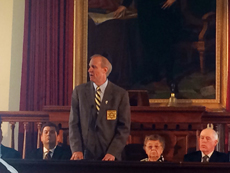
Gov. Rauner joins JUF in commemorating Yom Hashoah in Springfield and Skokie
STEPHANIE SKLAR
State government officials and Jewish community leaders from across Illinois gathered for the 34th annual State of Illinois Holocaust Memorial Observance on Thursday, April 16.
Keynoted by Governor Bruce Rauner , the event included words from Jewish Federation of Metropolitan Chicago Government Affairs Committee Chair David Golder, State Representative Will Guzzardi , Holocaust survivor Magda Brown , and rabbis and other religious leaders from throughout the state. Read remarks from all the speakers.
“Let us take this day of remembrance to reaffirm our conviction to fight for human rights, to fight against anti-Semitism in all its forms, and make good on our generation’s pledge to those that came before us, never again,” Gov. Rauner said. Golder shared a similar reflection, “We hope and pray that anti-Semitism, bigotry and terrorism will one day be things of the past and that we will soon usher in an era of peace and prosperity for all.”
Brown, who survived Auschwitz and a death march, vowed to always speak out about the Holocaust, “so it will never, ever happen again.” Rep. Guzzardi echoed that commitment, “Today, and every day, we demand that the world never forget the horrors that befell our people.”
Students from Wilson School in Pekin, Ill. joined the program to experience “living history” in our state’s capital. Read local news coverage of the event.
Gov. Rauner also joined JUF and Sheérit HaPleitah of Metropolitan Chicago, the umbrella organization for the area’s Holocaust survivor groups, for the Chicago area’s 70th annual collective Holocaust memorial observance. JUF Chairman Bill Silverstein urged attendees, “let us join in remembering the past, in appreciating the present, and in re-dedicating ourselves to building a safe and flourishing future for our children, for our grandchildren, and for the Jewish people.”
Other speakers included Israeli Consul General Roey Gilad, Skokie Mayor George Van Dusen, keynote Prof. Shlomo Resnikoff of DePaul University College of Law, and survivors and their children and grandchildren. Also present were a survivor and staff from Holocaust Community Services, a partnership of the Jewish Federation, CJE SeniorLife, and Jewish Child & Family Services dedicated to providing a range of support services and financial assistance to the most economically vulnerable members of the Chicago survivor community.
Other stories
-
Meet Andrew S. Hochberg, 2021 Julius Rosenwald Memorial Award recipient
Celebrate Andy Hochberg at the virtual Annual Meeting on Sept. 14
Read more -
Two local teens win national recognition
Recipients of the annual Diller Teen Tikkun Olam Awards
Read more -
Celebrating six young award winners cultivating the community
Introducing young adult award winners
Read more
The Annual Holocaust Memorial Service was held in Springfield, Ill. on Thursday, April 16, 2015 and was sponsored by the Office of the Governor and the Jewish Federations of Illinois
Welcome & Introductions – David Golder, Chair, Government Affairs Committee, Jewish Federation of Metropolitan Chicago
Today, we join together as we have for the past three decades, in observing Yom HaShoah, the Day of Remembrance. Every day, but especially on Yom HaShoah, we remember the six million Jews of Europe who were murdered in the Holocaust. But today, we also recommit ourselves to being a “light unto the nations” and making sure that the meaning of “never forget” is never forgotten.
Good morning and thank you for joining us. I am David Golder, Chair of the Government Affairs Committee of the Jewish Federation of Metropolitan Chicago, one of the seven Jewish Federations in Illinois.
The Jewish Federations serve as the central address for Jewish philanthropy and human services in over 200 communities in North America. And we, as the Jewish Federations in Illinois, are pleased to join with the Office of the Governor in co-sponsoring this annual Yom HaShoah commemoration.
Today we observe the 72nd Anniversary of the Warsaw Ghetto Uprising. On this solemn day, we pay tribute to the courageous Jewish fighters who fought valiantly against all odds and gave hope where there was no hope to be found. This year also marks the 70 th Anniversary of the Liberation of the Nazi Concentration Camps.
We pledge to remember, year after year, each man, woman and child murdered as part of the effort to exterminate our people. We also honor the survivors of the Holocaust and rededicate our efforts to making sure that this never happens again. We hope and pray that anti-Semitism, bigotry and terrorism will one day be things of the past and that we will soon usher in an era of peace and prosperity for all.
Invocation – Rabbi Alan Cook, Sinai Temple, Champaign
Our God, and God of our fathers and mothers, more than seventy years have elapsed since that terrible time in our world’s history, which saw the callous slaughter of millions of innocents. They say “time heals all wounds,” but it will never fully heal this one-not in the typical manner of healing, in which the hurt is covered over and forgotten. We have taken a vow: zachor -we will remember.
And so we gather on this day. We mourn, yes. But we also remember. We also reaffirm that eternal vow.
We mourn: families torn apart. Lives cut tragically short. Some of the best and most creative minds of the world never permitted to reach their full potential. Some of the greatest centers of Jewish culture and learning destroyed. Political dissidents silenced; Freemasons and Jehovah’s Witnesses slaughtered; Ethnic Poles, African Germans, Roma and Sinti tortured and murdered for failing to conform to a Germanic ideal. Homosexuals and the mentally and physically disabled callously murdered by those who feared their differences. Humanity’s crushing capacity-some might even say propensity-for unspeakable evil starkly exposed: innocence lost that will never be regained. It is enough to cripple us with sadness. It is enough to make us withdraw from a world that is harsh and unkind, that witnessed these horrors and said nothing.
But we cannot and must not do that, for we have been called to remember. We remember those who went before us. And we remember the words attributed to Edmund Burke, composed in the eighteenth century in a wholly different milieu, but still resonant today: “The only thing necessary for the triumph of evil is for good people to do nothing.” We vow: we will not allow evil and enmity to triumph over kindness and brotherhood. We know: “Injustice anywhere is a threat to justice everywhere.” We commit ourselves to education, to compassion, to activism. When we see strife in our world: in Bosnia, in Rwanda, in Darfur, in Syria, in Nigeria, in our own backyard, we take a stand. When we see social injustices, economic disparities, racism, sexism, and classism, we raise our voices in protest.
And we remember for another reason: though we are blessed to share this commemoration today with those who witnessed and survived these horrors, along with their children and grandchildren, we know that we cannot slow the march of time. We must collectively bear witness to the world so that there can be no denial, no attempts to recast or excuse this chapter of our history. We must consistently educate all the children of the world so that the stories and experiences of the Shoah will not be forgotten.
This is an awesome, and potentially daunting, responsibility, and it often feels depressing to bear such a heavy burden. But intermingled with our remembrance is room for hope. This day that we now commemorate is formally known on the Jewish calendar as “Yom HaZikaron LaShoah ve-la-Gevurah…The Day of Remembrance of the Holocaust and of Heroism.” We celebrate the Chasidei Umot HaOlam -the so-called “Righteous Gentiles” who helped so many to escape the camps and the destruction. We celebrate the continued vibrancy and vitality of the worldwide Jewish community. We celebrate the opportunity to live in a country and a state that affords liberty and freedom to all, regardless of race, religion, gender, physical ability, or sexual orientation. We celebrate that for sixty-seven years, the Jewish people have had a country to call their own. We rejoice at the progress that has been made over the past seventy years in sowing seeds of brotherhood and sisterhood, so that understanding and mutual respect may flourish among all the families of the earth. And we know that the journey to such harmony is not yet complete.
In this hour of memory, we pray:
Baruch Ata Adonai, Eloheinu Melech HaOlam, Shekocho U’g’vurato Malei Olam. Praised is our Eternal God, Whose might and majesty inspire us toward great works in the world.
Baruch Ata Adonai, Eloheinu Melech HaOlam, Shenatan Lanu Hizdamnut L’Taken et HaOlam. Praised is our Eternal God, Who has given us the opportunity and the obligation to bring positive change into our society.
Baruch Ata Adonai, Eloheinu Melech HaOlam, Shehehcheyanu V’kiy’manu V’higiyanu Laz’man HaZeh. Praised is our Eternal God, Who has kept us alive, sustained us, and enabled us to join in this moment of memory.
Remarks – Governor Bruce Rauner
I’m honored and humbled to be here today standing in the presence of survivors to remember the millions who perished in the Shoah. Today’s is a day of remembrance. It’s a day of reflection. It’s a day when we remind ourselves what can happen when evil people do evil things and good people do nothing about it. Today we say never again and we do so in a most uncertain time in our history.
In January a terrorist killed four people in a kosher supermarket in France. That Sabbath the grad synagogue of Paris was closed for the first time since World War II. In February a terrorist killed a Jewish man guarding a synagogue in Denmark. Great Britain reported a huge spike in anti-Semitic acts last year.
In a recent poll more than half of all British Jews said that they believed that Jews may no longer have a long term future in Europe. And all the while the voices in anti-Semitism hide behind a banner of anti-Zionism, calling for boycotts, divestment and sanctions against the only Jewish state on earth. We see it in the Middle East, we see it in Europe and yes we even see it here at home.
Never again must have meaning. Never again must be a call to action today. Let us take this day of remembrance to reaffirm our conviction to fight for human rights to fight against anti-Semitism in all its form, and make good on our generation’s pledge to those that came before us, never again.
Illinois General Assembly – Representative Will Guzzardi
Thank you very much, David, and thank you to Stephanie and the Federation staff for inviting me to speak today.
I understand that I’ve been offered this opportunity as the newest member of the Jewish caucus, a fine group of legislators that I’m proud to join. But I’m also the youngest member of the caucus – don’t be fooled by the grey hair, my 28 th birthday is coming up in two weeks. And I think that gives me a different perspective on today’s events. Let me explain what I mean.
Every year, my parents and brother and sister and I spend Thanksgiving with the Gourvitches, an Israeli family we’ve been friends with for 25 years. It’s Yehuda and Rachel, and their children Daniel and Natalie, their kids’ spouses, and Marisha, their elderly neighbor who speaks only a little bit of English. She has a devilish wit, and when she’s got something to say she’ll tell it to Rachel in Polish, but before you get the translation you can see from the glimmer in her eye that something clever is coming.
In recent years, Marisha’s mind has slowly started to fade, along with her hearing and her wit and the bluish numbers tattooed on her forearm. She no longer remembers us, our names or who we are, and one can only hope that she is also being lifted of some of the horrific memories of her internment 70 years ago.
My family was lucky to be untouched by the Holocaust. My grandparents’ families immigrated to the States a generation before, and if we had relatives who perished, none of our family was close to them.
But also: I’m of a different generation. If I should have children – god willing I’ll meet a nice Jewish girl someday soon – our children will be born into a world where the Holocaust only exists in the faded memories of Marisha’s generation. By the time they’re grown up, there might be no more Holocaust survivors still living.
On Pesach, we’re told that we are to behave as if each of us was himself a slave in the land of Egypt. I’ve always had a hard time with that. The trauma of slavery is so unimaginable to me, and the story so historically remote, that I simply cannot locate myself in it.
So what I wonder as I speak to you on the day of remembrance is this: what will I teach my children, who will grow up in a world where survivors and victims alike live only in history, about how the Holocaust is meaningful and relevant in their lives?
Here’s what I think I’ll tell them. It starts, of course, with the credo of Holocaust remembrance: “Never forget.” Because of course we must never forget the indelible fact, the execution of a generation of our people. Never forget, I’ll tell them.
But then I think I’ll tell the great story of Rabbi Hillel and the gentile. “I’ll convert to Judaism if you can explain to me the whole Torah while I stand on one foot,” the gentile says. Rabbi Shammai, Hillel’s foil in so many of these stories, scoffs at the gentile and chases him off. “The Torah is complex, it takes years of study, you could never learn it standing there on one foot.” But Hillel says this: “The Torah’s simple. Don’t do to others what you wouldn’t want done to you. The rest is commentary. And if you’re interested, stick around and we’ll read some of that.”
Here we have perhaps the greatest sage of our 6,000-year tradition, distilling the 613 mitzvot to their barest essence. Don’t do to others what you wouldn’t want done to you.
What I find beautiful about that distillation, and what I find beautiful about our faith, is that this essential commandment is not inward-facing. It’s not “seek enlightenment” or “be good and you’ll go to heaven.” It’s outward-facing. It’s about how we behave in relation to others.
Today, and every day, we demand that the world never forget the horrors that befell our people. We must continue to do so. There are still those who would deny it. And we must be ever vigilant against the next existential threat we face, as there may always be one.
But we are at our best as Jews when the thousands of years of oppression our people have suffered inspire us not just to turn inward and safeguard our people’s future, but to turn outward, in empathy and love and remembrance for all peoples.
We are at our best as Jews when we join the credo of “never forget” with Rabbi Hillel’s injunction not to do to others what we wouldn’t have done to us, so that we refuse to let the suffering of any nation, of any people, be forgotten.
Indeed, we are at our best as Jews when we are truly an or lagoim , a light unto the nations, when we are shining examples of compassion, when we stand with all those victims of genocide and enslavement and oppression and say, “You will not suffer in the dark. You will not struggle alone. We will fight at your side to lift you from oppression. For we too were slaves in the land of Egypt. We too were massacred at Auschwitz and Birkenau and Bergen-Belsen.”
This is the lesson I hope to teach my children about the Holocaust: a lesson of radical compassion. An unimaginable tragedy happened to our people, I’ll tell them, and God spared us so that we might be stronger allies to all people in their fights for human rights.
My children won’t be able to ask Marisha about the Holocaust. Marisha is forgetting. She can’t help it. Let us, then, never forget, for her sake, for our people’s sake, and for the sake of all people who suffer today.
A Survivor’s Remembrance – Madga Brown*
Magda Brown was 17 years old when her world was destroyed. She went from a happy home in her native Hungary to the place where dozens of Jews would be crammed inside on their way to the concentration camps and gas chambers to die.
During her presentation, Brown described unspeakable horror built upon lies, conspiracy and dehumanization. “It was a premeditated, scientifically coordinated mass murder,” she said.
Brown was taken to Auschwitz in 1944. Her mother and father were killed in gas chambers. Her brother, who also survived, served in Hungary’s military Jewish labor force but was later imprisoned by the Russian Army.
But before going to Auschwitz, she said anti-Jewish laws were prevalent in Hungary. There were laws against intermarrying. Professionals were given “the pink slip,” and the next day they were out of jobs.
“There were so many different angles,” she said. “Each law pushed us lower and lower and lower, taking away our freedom,” she said. “Then, they take away your dignity.” When the Nazis came, they were able to move swiftly as the conditions were ripe, Brown said.
“By the time they enter into Hungary, in 51 days they are able to move people from their home to their death,” she said. “Everybody, including little children, had to have this Star of David sewed into their clothing.” A ghetto was designated, and people from the countryside were given an hour to pack. “These poor souls are herded away to the ghetto,” she said.
Brown’s home was part of the ghetto, where there were severe restrictions against Jews. At first they could come and go to buy food during the day. Before long, no one could leave. Forty people were placed in her home, where before only six lived. All jewelry, cash, bicycles, radios and other items were forfeited. The cash was used to pay the railroad worker employed to send them to their death. The Nazis would lie to them, telling the families they would be able to stay together.
“My very beautiful young mother was holding on to me, and now this officer directed me the other way,” she said. Brown never saw her mother again.
On a train to Auschwitz, she was packed into a box car with 70-80 others. There were two buckets: one, for bodily fluids, the other for water to drink. At her destination, all their hair was shaved off, and stinging disinfectant was applied, she said. A shower was a trickle of water. Nothing more.
Brown was one of only 1,000 prisoners to work in an ammunition factory that produced bombs and rockets. Eventually she would be sent on a three-day death march from the factory. During the march, she stole away with a group to an abandoned barn. “And the next day, two young men in strange uniforms saw us,” she said. They were soldiers of the Sixth Armored Division of the U.S. Army. “They liberated us,” she said.
Brown said she always tells young people to think before they hate. And she said she vows to always speak out about the Holocaust. “So it will never, ever happen again,” she said.
*Taken in part from: http://www.kenoshanews.com/news/survivor_recalls_holocaust_horrors_482295163.html
Benediction – Reverend Hannah Dreitcer, Westminster Presbyterian Church, Springfield
A benediction is literally a good saying, meant to mark the end of our service and send us out into the world. But in the face of unspeakable grief that echoes through generations, it is not easy to find a good saying.
In the face of unspeakable grief and horror it is easy to become paralyzed and to go silent, but silence and inaction do no justice to the too many whom we remember today. So this good saying is also meant to be the seed of whatever response we might make to what we have heard and witnessed to today, the candle flame of action that we light inside our hearts, even if that is the only light we can see.
So no matter how dark it might be, let us go into the world, ready to act, and ready to speak our own good sayings-
Have courage.
Hold onto what is good.
Return no one evil for evil.
Strengthen the faint-hearted, support the weak, help the suffering.
Honor all peoples.
And in the words of a most ancient good saying that has never been silenced:
May God bless you and keep you;
May God be kind and gracious to you;
May God look upon you with favor, and bring you peace. Amen.
Other stories
-
Meet Andrew S. Hochberg, 2021 Julius Rosenwald Memorial Award recipient
Celebrate Andy Hochberg at the virtual Annual Meeting on Sept. 14
Read more -
Two local teens win national recognition
Recipients of the annual Diller Teen Tikkun Olam Awards
Read more -
Celebrating six young award winners cultivating the community
Introducing young adult award winners
Read more
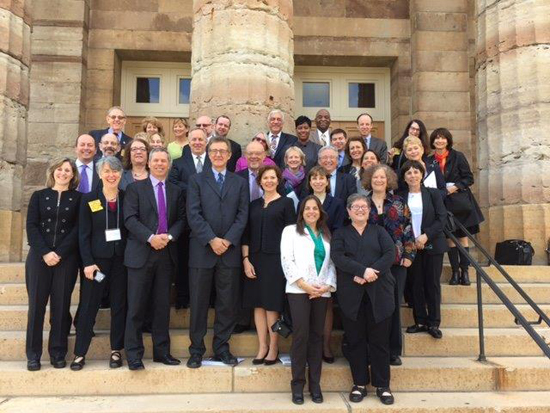
More than fifty leaders from the Chicago Jewish community, including representatives from the Jewish Federation of Metropolitan Chicago and its affiliate agencies participated in the annual Government Affairs Springfield Mission April 15-16.
Representatives from Jewish Child and Family Services, CJE SeniorLife, KESHET, HIAS, and Sinai Health System made their organizations’ needs heard in the capital.
“Throughout our community, there was a very strong interest in bringing our voice to Springfield,” said Steve Greenbaum, state vice chair of the JUF Government Affairs Committee. “With the potential impact proposed budget cuts could have on the Jewish Federation’s network of agencies, people were especially interested in meeting our new governor, key members of his administration, and our elected legislators to express community and agency concerns.”
The Springfield Mission kicked off with lunchtime speakers Richard Goldberg, director of legislative affairs for the governor and Jennifer Hammer, special counsel to the governor and policy advisor to Healthcare and Family Services. Afterward, the Mission divided into five lobbying groups spanning the capital to meet with more than 25 legislators, members of the administration, State Treasurer Michael Frerichs and Assistant Comptroller Josh Potts. This included lengthy meetings with all four leaders: Senate President John Cullerton, Senate Republican Leader Christine Radogno, Speaker of the House Michael Madigan, and House Republican Leader Jim Durkin.
“ Being in Springfield was eye-opening and empowering,” said Pam Szokol, chair of the HHS Commission and JUF Board member. “In our personal conversations with the very political leaders who will decide the fate of state funding for health and human services, we talked about what closing agency programs means.”
Conversations continued into the cocktail hour when legislators stopped by the Sangamo Club. Members of the Jewish caucus, State Senators Daniel Biss, Julie Morrison and Ira Silverstein and State Representatives Kelly Cassidy, Scott Drury, Sara Feigenholtz, Laura Fine, Jack Franks, Robyn Gabel, Will Guzzardi, Lou Lang and Elaine Nekritz were among the visitors.
The trip ended with the statewide Yom HaShoah Commemoration at the Old State Capital with Governor Bruce Rauner and Rep. Guzzardi, the newest Jewish Member of the Illinois State Legislature.
“We had energized participants in front of the right people with the right message,” said David Golder, chair of the Government Affairs Committee and JUF Board Member, reflecting during the bus ride back to Chicago. “As you might expect, the response on both sides of the aisle was one of frustration. The General Assembly is struggling to develop a process to work with the Administration. This is really only a beginning to this conversation. Exceptional energy will be required from JUF community leaders and staff alike between now and when a budget is ultimately approved.”
Other stories
-
Meet Andrew S. Hochberg, 2021 Julius Rosenwald Memorial Award recipient
Celebrate Andy Hochberg at the virtual Annual Meeting on Sept. 14
Read more -
Two local teens win national recognition
Recipients of the annual Diller Teen Tikkun Olam Awards
Read more -
Celebrating six young award winners cultivating the community
Introducing young adult award winners
Read more
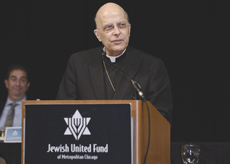
Archbishop Francis Cardinal George died Friday morning, April 17, at his home after battling cancer for a year. He was 78.
Leaders of the Jewish United Fund of Metropolitan Chicago join with the entire Jewish community in remembering with joy, respect and gratitude the faithful friendship of Cardinal George.
“We are all saddened by the passing of Cardinal George. He was a good friend to our community,” said JUF President Steven B. Nasatir. “We mourn his passing together with people of all faiths and affiliations and offer condolences to the Cardinal’s family, to our colleagues at the Archdiocese, and to all Chicago Catholics.”
Cardinal George led by example in the realm of Catholic-Jewish relations, working with the Jewish United Fund from the very outset of his office. He continued the path of his predecessors, Cardinal Cody and Cardinal Bernardin, in building a relationship built on foundations of mutual respect.
Through interactions and joint programs Cardinal George expressed his total commitment to Catholic-Jewish ties.
Cardinal George addressed JUF at its Federation Annual Meeting in September 2014.
“Is our understanding of you your own understanding of yourselves? If it’s not, and in some areas of our lives and beliefs there cannot be a shared understanding, nonetheless, how can we respect that difference and even rejoice in it?” he said, and outlined a number of joint projects of the Archdiocese with JUF that put those words into action. He cited a skills-training program for youth in the Israeli Catholic village of Fassouta (which he visited with JUF leaders in 2008), and social studies curriculum for Catholic schools called “Modern Israel: Holy Land and Jewish State”. He thanked the Jewish community for sending volunteers to work with Catholic Charities during the holidays, and lauded other pursuits, from the Catholic/Jewish Scholars’ Dialogue, to the Joseph Cardinal Bernardin Jerusalem Lecture, to the work of Hillel with Catholic campus ministries and with the Illinois Holocaust Museum.
“As I conclude, let me say that what I have personally learned…is that the new narrative of Catholic/Jewish relations will be written if we write it together”
Jewish leaders met with Archbishop Blase Joseph Cupich, who succeeded Cardinal George last November, at the Jewish United Fund on April 15. Recalling Cardinal George’s legacy, Cupich called on Jews and Catholics “to continue the healing process.”
Other stories
-
Meet Andrew S. Hochberg, 2021 Julius Rosenwald Memorial Award recipient
Celebrate Andy Hochberg at the virtual Annual Meeting on Sept. 14
Read more -
Two local teens win national recognition
Recipients of the annual Diller Teen Tikkun Olam Awards
Read more -
Celebrating six young award winners cultivating the community
Introducing young adult award winners
Read more
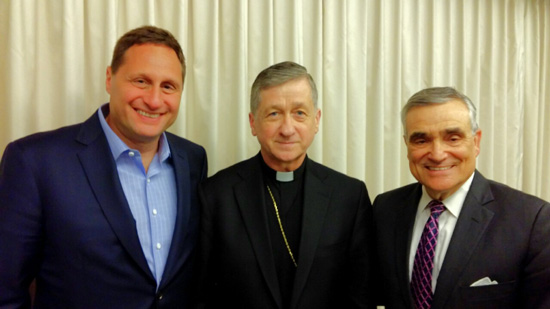
From left: JUF Chairman Bill Silverstein, Archbishop Blase Cupich and JUF President Steven B. Nasatir.
“We need to continue the healing process,” was one of the strong messages leaders of Chicago’s Jewish community received from Archbishop Blase Joseph Cupich in a visit to the Jewish United Fund April 15.
Cupich, who was installed as the ninth Archbishop of Chicago last November, met with lay and professional leaders of JUF’s Jewish Community Relations Council and Rabbinic Action Committee, Chicago Board of Rabbis, American Jewish Committee, Anti-Defamation League, Spertus Institute for Jewish Learning and Leadership, and members of the Catholic Jewish Scholars Dialogue.
“We sometimes get naïve and think that the effort of education, and speaking against anti-Semitism, is kind of a done deal, and it isn’t,” Cupich said. “As we look at the landscape of the world today, we see that there are large numbers of people who have not embraced the changes in Church doctrine and continue to embrace the old narrative [vis a vis Jews].”
He applauded the strong and varied efforts of the Chicago Archdiocese and Jewish organizations, including JUF, ADL and AJC, to strengthen Catholic-Jewish relations. Among those efforts has been a JUF program and curriculum on modern Israel for Catholic schools, which to date has taken 35 teachers on educational visits to Israel.
Another initiative involving JUF, AJC and Spertus is the annual Joseph Cardinal Bernardin Jerusalem Lecture, for which Cupich delivered opening remarks in March.
“Recent events call us to enhance our efforts at mutual understanding and make them more widely known, to develop a positive narrative that will capture the imagination of most people, and to make our positive relationships that which comes first to mind for the majority of people,” Cupich said, in those remarks. “The default position must be positive—friendship, hospitality, mutual concern—precisely those characteristics evident as we come together this evening.”
In his meeting with Jewish leaders, Cupich called on Catholics and Jews to build on the great record of cooperation in Chicago and find new ways to cooperate. “We have a joint responsibility to be servants within the public realm,” he said.
Other stories
-
Meet Andrew S. Hochberg, 2021 Julius Rosenwald Memorial Award recipient
Celebrate Andy Hochberg at the virtual Annual Meeting on Sept. 14
Read more -
Two local teens win national recognition
Recipients of the annual Diller Teen Tikkun Olam Awards
Read more -
Celebrating six young award winners cultivating the community
Introducing young adult award winners
Read more
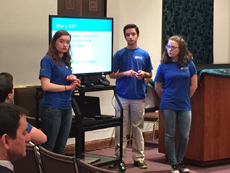
Tuesday evening, 230 parents and high school students gathered at Congregation B’nai Tikvah in Deerfield to learn about the challenges and opportunities facing Jewish college students today. The program was an invitation for families to talk to each other about the college experience and prepare for the future.
“As these students prepare to enter their next phase in life it is important for the entire family to engage in discussions about Israel and understand the landscape of Jewish life on campus,” said Emily Briskman, executive director of JUF’s Israel Education Center.
Freshmen and sophomores heard from teens participating in JUF’s Write On for Israel program to learn both leadership and advocacy skills. Sophomores and Juniors heard from a panel of current campus activists who discussed some of the real implications of the movement to delegitimize Israel.
“Most Chicagoland teens are blessed to have not grown up in that type of toxic environment, which is why their introduction to terms such as BDS, SJP (Students for Justice in Palestine), and apartheid should be in a familiar, supportive and educational setting,” said Rabbi Nate Crane of B’nai Tikvah.
JUF’s IEC and Campus Affairs professionals answered parents’ questions about the Boycott, Divestment and Sanctions movement, what their children can do to advocate for Israel and how they can be effective advocates themselves.
Other stories
-
Local campus administrators convene on hate speech, bias
JUF and ADL brought together 17 student safety, diversity and inclusion and student affairs administrators and Hillel representatives from various Illinois campuses to discusses issues of hate speech and bias.
Read more -
Engaging students about Israel on campus
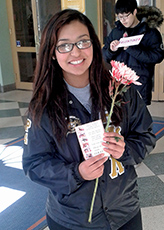
Too often we hear about difficulties facing Jewish college students on Illinois campus, but to focus solely on the politics gives only one piece of the complex narrative that is Jewish life on campus.
Read more -
Hillel International launches fellowship initiative to train young Jewish professionals
The Springboard Fellowship will train cohorts of young Jewish professionals in highly-valued skillsets and place them at local Hillel campuses for two years.
Read more
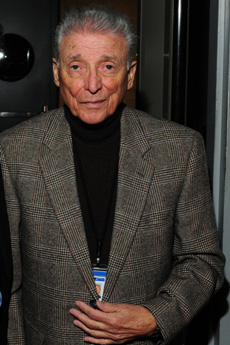
Every man, woman and child has a story. For some it is found in the most unlikely of places, during one of the most horrific of times, where actions of a few meant life versus death. Mine is a story of survival: my own and my family’s. A story that begins over seventy years ago when my world became engulfed by the evils of Nazism, my family torn apart, my life forever changed, and my childhood and innocence ripped away as a nine-year-old boy hiding in a tiny, filthy attic in occupied Poland.
It is this month, during a time of remembrance when the world commemorates seventy years since the end of the Holocaust, that I pause and reflect on my own survival and find myself asking, “Why me? What was so different about me that I had the luck to survive? What drove me to find the courage to escape the ghetto when my entire town was being liquidated? Why did I not give up when a local farmer told me to turn myself in because there was no future for people like me? How did I find the strength, while hungry, cold and filled with fear, as I crawled on bare hands and knees through three feet of snow to arrive at the place that would become my hidden refuge for two years? Why was my sister Sarah discovered, pulled from her hiding place and taken to Treblinka to be murdered? Why did only two children from my town of 2,000 children survive? Why was it my sister Irene and me?”
There are many stories to share, every Survivor with their own unique experience. Every Survivor having confronted the darkest depths of hatred with determination, courage and resilience. Every Survivor grasping to a hope that perhaps they would be saved, believing in their hearts that they were meant to do something greater. Like many Survivors, I have to come to believe that we survived for a reason. Even seventy years later, I don’t take a single moment for granted. Instead of deciding to let hatred consume me and direct my actions in life, I decided early to let hatred go and move forward. I believe that I survived to do what I have been doing for the last 20 years – to tell my story, in memory of my family and the millions of Jews whose own stories were silenced by the Holocaust. I survived to share my pain so that others can connect with a life and history that they will hopefully never have to confront.
Seventy years after the Holocaust, we Survivors face a collapsing window of time in which to tell our stories. But as decades pass, I have also come to believe that we cannot be the only ones to tell our stories. Because this generation will determine our future, Survivors must pass the torch to them today so that they can protect our legacy for future generations.
When I speak to children every day at the Illinois Holocaust Museum & Education Center, I ask that they take away two ideas from my story. First, you must believe in yourself. It is essential to love, appreciate and respect yourself above all. With this, you will discover that you are stronger and smarter than you think you are. Second, I want children to learn that prejudice and indifference will only lead to hatred and violence that will impact innocent lives, including their own. As the decision makers of tomorrow, our children must engage in the creation of new stories that speak to a more hopeful world that doesn’t echo our past.
Other stories
-
Chicago to Israel to Kenya
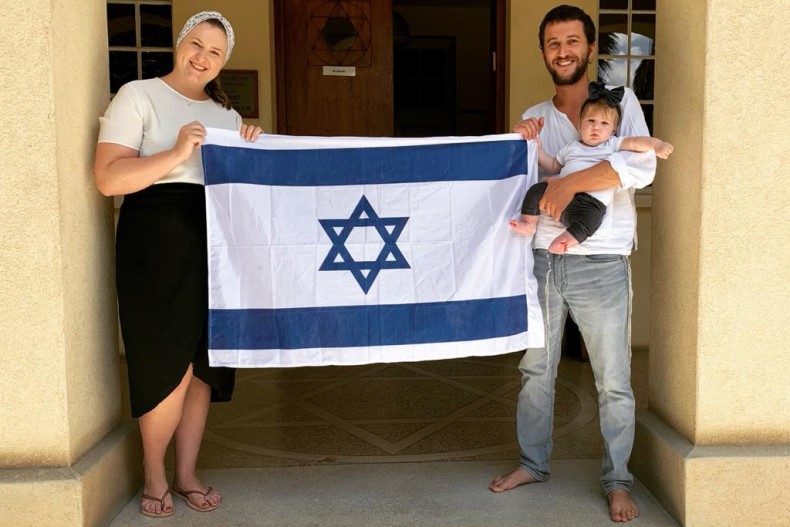
A family’s story of living Jewishly on three continents Michelle Cohen World May 28, 2021 Avital, Tzofia, and Netanel Kaszovitz outside their home in Nairobi on Yom HaAtzmaut. When Avital Kaszovitz prepared to be a Modern Orthodox shlicha (emissary) to the Jewish community in Ke
Read more -
New exhibit spotlights the experience of ‘Shanghai Jews’
Explore a new Illinois Holocaust Museum and Education Center exhibit
Read more -
Europe’s brave new teachers of the Holocaust
Teaching the Holocaust in the modern era has its difficulties and rewards.
Read more