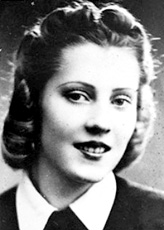
When I was in junior high, my family hosted a woman in our home who was in town for a weekend speaking engagement.
She was in her 70s at the time, blonde, and wore tailored skirt suits. Warm and gentle, yet strong, she reminded me of my grandmothers.
I knew, even back then, that she was special, but I didn’t realize how special until I spotted her name a decade later at Yad Vashem on the list of “Righteous Among the Nations”—or “Righteous Gentiles”—non-Jews who risked their lives to save Jews during the Holocaust.
In addition to her, by the end of 2010, Yad Vashem had recognized 23,788 Righteous Among the Nations from 45 countries.
As we commemorate Yom Hashoah–Holocaust Remembrance Day–this week, it seems fitting to re-tell the story of this incredible woman who in one weekend taught me what it means to be a hero.
Irene Gut was born to a Polish Catholic family, the eldest of five daughters. When Russia and Germany invaded Poland at the start of the war, Irene was a 17-year-old nursing student. She joined the Polish underground to care for the sick and wounded, and she eventually became separated from her family. A group of Russian soldiers discovered her hiding in the forest with other resistance fighters. The soldiers beat and gang-raped Irene and then sent her to a hospital to aid the Russians.
In search of her family, she fled the hospital, but was soon captured by Germans, and sent to a munitions factory in Poland, where she collapsed from hard labor. Irene, a pretty girl with Aryan features, caught the attention of a 70-year-old German officer, Major Eduard Rugemer, who took a liking to her and assigned her to less taxing work in the mess hall. Amid the horrific conditions she saw of the Jews in the ghetto, she witnessed Nazi soldiers throw a baby in the air and shoot the child for sport, an image that haunted Irene her entire life.
Later, Rugemer employed Irene as a housekeeper in his villa in Ukraine, where her duties included supervising laundry service, carried out by a staff of 12 Jews. When she heard of plans to kill the Jewish employees, Irene insisted on hiding them in the cellar of the villa—smuggling them food and clothing—without the officer’s knowledge.
One day, Rugemer came home early and discovered the hidden Jews. Irene pleaded with him not to turn them in, bargaining to become Rugemer’s mistress if he would let them stay. She never told her Jewish friends how she kept them hidden, yet she did confess her secret to a priest, who urged her to turn the Jews in. But Irene refused.
In all, she hid her Jewish friends for nine months. When one of the hidden women became pregnant, Irene convinced the mother-to-be not to have an abortion. In 1944, Irene fled with the Jews to the forest, where the baby was eventually born.
At war’s end, her Jewish friends helped her escape to West Germany, where she briefly met William Opdyke, an American working for the United Nations. Around this time, she also learned the whereabouts of her family: her father had been killed by Germans, while her mother and four sisters survived.
A few years later, aided by a Jewish resettlement organization, Irene immigrated to New York, where she bumped into Opdyke at a café. Only months later, they married and had a daughter, settling in Southern California.
It wasn’t until later in her life—after hearing claims that the Holocaust was an exaggeration—that Irene chose to share her harrowing story, writing a book (with Jennifer Armstrong) called In My Hands: Memories of a Holocaust Rescuer, and speaking for educational groups. In 1982, Irene was recognized as a “Righteous Gentile” by Yad Vashem. It was at that ceremony that Irene met the baby-by then a grown man-she had saved, who owed his life to her.
Irene passed away in 2003 at the age of 86.
There are certain people who come into our lives who are etched in our memory forever. Irene, for me, is one of those people. I only spent one weekend with her all those years ago, but I credit her with teaching me so much about compassion, empathy, and strength.
Irene is no longer here to share her journey, but I pledge to tell her story for her—and other heroes like her—to as many people as I can. I hope you’ll do the same.
Other stories
-
Chicago to Israel to Kenya
A family’s story of living Jewishly on three continents Michelle Cohen World May 28, 2021 Avital, Tzofia, and Netanel Kaszovitz outside their home in Nairobi on Yom HaAtzmaut. When Avital Kaszovitz prepared to be a Modern Orthodox shlicha (emissary) to the Jewish community in Ke
Read more -
New exhibit spotlights the experience of ‘Shanghai Jews’
Explore a new Illinois Holocaust Museum and Education Center exhibit
Read more -
Europe’s brave new teachers of the Holocaust
Teaching the Holocaust in the modern era has its difficulties and rewards.
Read more
For more than a year now, pro-Russian separatists have been battling Ukrainian forces in eastern Ukraine, turning cities into combat zones. Jews in Donetsk, Lugansk and the surrounding areas have either fled the region or remain trapped, cut off from the rest of the country. For the first time since World War II, Jews in Europe are displaced.
For the past 16 years, JUF has had a hand in strengthening the Jewish communities of Ukraine through its Kyiv Kehillah Project, and that hand is now working harder than ever. When the initial crisis in Kyiv broke out in November 2013, our community and our Federation responded immediately by providing emergency assistance through our overseas partners, the American Jewish Joint Distribution Committee (JDC) and the Jewish Agency for Israel (JAFI), supporting basic human services as well as meeting additional security needs at Jewish sites and schools.
Harsh winter conditions and the suspension of benefit payments in some parts of eastern Ukraine are making the situation even more difficult. Food prices are increasing with inflation, which – coupled with bank closures, depleted savings and overall lack of available hard currency – means that access to food is quite difficult. Physical access to food is complicated as well, as markets within or near the fighting zone face ongoing security threats. With the ongoing risk of household food insecurity, it’s likely that individual coping strategies will not be sustainable for the long term. This is especially true for the elderly, the institutionalized, and other vulnerable individuals.
JUF, in partnership with the JDC, continues to provide life-saving services, including food, medicines, home health care and winter relief to Jews living in the regions under fire, for internally displaced Jews living in other parts of Ukraine, and Jews who have gone east and moved to Russia.
There are over 2,000 displaced Jews throughout Ukraine and approximately 5,000 Jews living in the conflict zone. It is our responsibility to help them, and we are. We serve more than 70,000 impoverished Jews in Ukraine. For those who have fled or who remain in the conflict zone, the situation has become much direr. Over 6,900 people in the conflict zone or who have fled their homes are receiving life-sustaining services such as emergency relief assistance (food and medical support), one-time emergency expense support for surgeries, emergency home repairs, or one-time purchases of basic necessities, rental subsidies and assistance in leaving the conflict zone.
The estimated 350,000 Jews living in Ukraine have been profoundly affected by the political and economic instability that have impacted the county since early 2014. Ukraine’s economy is deteriorating. Official inflation has reached almost 25 percent and the local currency, the hryvia, has been devalued by more than 50 percent.
While we know that the majority of Jews will stay in Ukraine, in 2014 close to 6,000 Ukrainian Jews made aliyah to Israel, a 196 percent increase as compared to 2013. Despite the crisis, JAFI offices in Donetsk and Mariupol remain open and continue to provide services. These Jewish communal staff members working both for JDC and for JAFI are the heroes of this story. They are providing uninterrupted services, meeting the everyday needs of our community’s most vulnerable and those in crisis.
Sophia is one of those JDC Hesed workers. Since the violence erupted, she, like many other caretakers and volunteers working for JDC’s Hesed social welfare center network, have risked their lives treating thousands of homebound and frail elderly. In eastern Ukraine today, JDC and the staff of the Hesed network is caring for thousands of Jews who remain. Some have ridden bicycles through active war zones. Others traversed their way past gunmen manning barricades and checkpoints. Although their work saves the lives of countless people, the heroism of these men and women goes largely unsung.
Interest in Jewish Agency programs that prepare individuals and families for aliyah has increased in significant numbers: 28,000 people attended aliyah information events and 180 ulpan classes served more than 1600 students. New ulpan classes continue to open to meet growing needs. In addition, the Jewish Agency continues to shelter those refugees who are in the process of making aliyah. In 2014, 400 Jews lived in the Jewish Agency’s refugee center while they awaited their aliyah to Israel.
While we pray for better days ahead, we prepare for an ongoing crisis. We thank our overseas partners, JDC and JAFI, for the work they do every day. It is because we and our collective federated system were there in Ukraine before the crisis began that we were in a position to respond effectively and efficiently from the onset. Moving forward there will be additional needs, and while no one could have predicted that this crisis would last as long as it has, our commitment to our brothers and sisters living in Ukraine remains strong.
Other stories
-
Chicago to Israel to Kenya
A family’s story of living Jewishly on three continents Michelle Cohen World May 28, 2021 Avital, Tzofia, and Netanel Kaszovitz outside their home in Nairobi on Yom HaAtzmaut. When Avital Kaszovitz prepared to be a Modern Orthodox shlicha (emissary) to the Jewish community in Ke
Read more -
New exhibit spotlights the experience of ‘Shanghai Jews’
Explore a new Illinois Holocaust Museum and Education Center exhibit
Read more -
Europe’s brave new teachers of the Holocaust
Teaching the Holocaust in the modern era has its difficulties and rewards.
Read more
The Jewish United Fund of Metropolitan Chicago has issued the following statement in response to the terrorist attack at a Kenyan university Thursday that claimed 147 lives:
The news from Kenya that an Islamic terrorist organization, al-Shabab, separated Christians from Muslims and then murdered them during Holy Week on Maundy Thursday, on the eve of Good Friday, reaches the Jewish community and the Jewish people on the eve of Passover.
In this season when we celebrate the liberation of the Jewish people from slavery, we extend our profound condolences to the families of the victims and to our Christian friends, neighbors and colleagues in the Metropolitan Chicago area. The selection of those to be murdered from amongst a larger population reminds us of our own recent catastrophe and magnifies both our horror and our compassion.
May this season of hope for Christians and of freedom from tyranny for Jews bring ever-greater resolve for all people of good will to rid this world of the evil of terrorism.
Other stories
-
Chicago to Israel to Kenya
A family’s story of living Jewishly on three continents Michelle Cohen World May 28, 2021 Avital, Tzofia, and Netanel Kaszovitz outside their home in Nairobi on Yom HaAtzmaut. When Avital Kaszovitz prepared to be a Modern Orthodox shlicha (emissary) to the Jewish community in Ke
Read more -
New exhibit spotlights the experience of ‘Shanghai Jews’
Explore a new Illinois Holocaust Museum and Education Center exhibit
Read more -
Europe’s brave new teachers of the Holocaust
Teaching the Holocaust in the modern era has its difficulties and rewards.
Read more
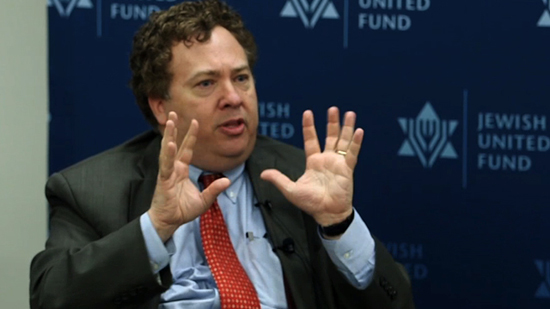
David Makovsky.
What really went on during the U.S.-brokered negotiations between Israel and the Palestinians, which consumed much of Secretary of State John Kerry’s time and President Obama’s political capital during 2014, but ultimately failed to produce an agreement?
What concessions were the parties to the conflict willing to make? And where do they now stand, at a time when the Palestinians—and the American administration—both seem willing to bypass bilateral negotiations and leave the case to international bodies?
Members of JUF’s Jewish Community Relations Council received an insider’s perspective this week when renowned Middle East expert David Makovsky provided a wide-ranging briefing. (Watch the video of Makovsky’s remarks.)
Makovsky, who is the Ziegler distinguished fellow at The Washington Institute and director of the Project on the Middle East Peace Process, offered insights on topics ranging from regional tensions arising from Iran’s hegemonic and nuclear aspirations, to the current state of bilateral relations between the United States and Israel.
Prior to the JCRC briefing, JUF brought together Makovsky and the editorial board of the Chicago Tribune, and arranged presentations at the University of Chicago and DePaul University through JUF’s Israel Education Center.
“There are few cities that care so much about Israel as Chicago. You feel it in your bones here,” Makovsky said to a packed audience of JCRC lay and professional leaders and more than a dozen diplomats from Egypt to Canada.
Referencing the Iran nuclear talks and the Palestinian peace process, Makovsky explained, “You have twin issues that are distinct but both run through US-Israel relations and the Obama-Netanyahu nexus. They’re both coming to a head. A lot of decisions have been deferred; kicked down the road, and now…the rubber is hitting the road this year.”
On a potential agreement to restrict Iran’s nuclear weapons program, Makovsky laid out the shifts in approach the Administration has gone through from a “goal to eliminate their nuclear program, to managing the program.”
“Iran hasn’t come clean with their potential military program, and [it] raises the questions, what was their program like in the past? Will they do no R&D? How good is access to snap inspections? Do they have a full nuclear infrastructure at their disposal? And what are the consequences if they violate the agreement?”
In addition to focusing on the terms laid out in an agreement, Makovsky also reiterated that it is important to view any agreement through the impact it will have throughout the region.
“Israel and the Sunni states will worry that this is becoming a political change of balance in the Middle East. And the biggest concern is, not only are we prepared to help these countries in the wake of an agreement, but [how]? Will it be a containment policy when we say our policy is prevention? The Arab states and Israel will wonder if they can count on us.”
On the stalled Israel-Palestinian peace talks, Makovsky speculated that the Administration might launch an initiative in the UN Security Council.
“It’s going to start getting turbulent because in my view the Administration thinks it has one move left—to go to the Security Council and do a ‘new [Resolution] 242’ (to outline a final status agreement) that gets into specifics about borders, Jerusalem, etc. But this risks blowing past the red lines of both sides. The Israelis don’t want to hear about Jerusalem, and the Palestinians don’t want to hear about the refugee issue or about having to recognize Israel as a Jewish state.”
“Neither side wants this (UN) [resolution]. So what are they willing to do if they don’t want the US to take this to the Security Council?”
“The tie breaker might be for Israel to say it would align its settlement policy with the two state solution, and not build new settlements beyond the separation barrier. The irony is, for the most part Israel is building within the barrier.”
Makovsky gave the audience a look under the hood of the negotiations. “When I was hired by Kerry, they said the Secretary wants to do a deal in nine months. I said just take the core five issues…. Jerusalem, refugees, land, Jewish state/mutual recognition, security arrangements. I said we should focus on these, and if we can get a breakthrough on the core five, we can have the technicians do the details. But if we don’t get anywhere on these five we won’t get anywhere, so we should stay focused like a laser on them.”
“In the end, Netanyahu was much more forthcoming on the territory issue than most Americans would ever imagine. And Abbas was much more forthcoming on the refugee issue. But on the other three issues, we had to close the gap.”
“The hardest issue turned out to be what originally looked like the simplest issue, the security arrangement. What changed was the ‘Arab Spring’; countries have melted away, and Israel feels like it’s on a volcano.”
In closing, Makovsky touched on the importance of Israel remaining a bipartisan issue in the U.S.
“There should always be bipartisanship on the US-Israel relationship,” he said. “That has been genius. That’s been core for Zionism. It’s going to be an uphill struggle. I would beg people in this room, let’s keep a big tent, keep our eyes on the big picture.”
Other stories
-
Chicago to Israel to Kenya
A family’s story of living Jewishly on three continents Michelle Cohen World May 28, 2021 Avital, Tzofia, and Netanel Kaszovitz outside their home in Nairobi on Yom HaAtzmaut. When Avital Kaszovitz prepared to be a Modern Orthodox shlicha (emissary) to the Jewish community in Ke
Read more -
New exhibit spotlights the experience of ‘Shanghai Jews’
Explore a new Illinois Holocaust Museum and Education Center exhibit
Read more -
Europe’s brave new teachers of the Holocaust
Teaching the Holocaust in the modern era has its difficulties and rewards.
Read more

Ambassador from France to the U.S. Gerard Araud (left) meets with JUF leaders on Friday, March 27.
The Government of France is committed to protecting its Jewish citizens: That was the message leaders from the Jewish community heard from Ambassador Gerard Araud at a closed door meeting last Friday.
“French Jews are afraid, some are choosing to leave for Israel, but leaving France because of fear is unacceptable,” Araud said, detailing efforts by the government to confront radicalization within the Muslim community.
During the meeting, JUF Chairman Bill Silverstein shared with the ambassador his impressions from a recent national solidarity mission to Paris. “The Jews we met with expressed to us that they wished to stay in France, but want to feel secure,” he said.
JUF has provided $250,500 in emergency and security funds for France, part of $1.1 million allocated through our national agencies.
During his visit to Chicago, Araud also addressed the Chicago Council on Global Affairs.
Photo: French Ambassador to the U.S. Gerard Araud (left) meets with JUF leaders. (Photo courtesy the French Consulate)
Other stories
-
Chicago to Israel to Kenya
A family’s story of living Jewishly on three continents Michelle Cohen World May 28, 2021 Avital, Tzofia, and Netanel Kaszovitz outside their home in Nairobi on Yom HaAtzmaut. When Avital Kaszovitz prepared to be a Modern Orthodox shlicha (emissary) to the Jewish community in Ke
Read more -
New exhibit spotlights the experience of ‘Shanghai Jews’
Explore a new Illinois Holocaust Museum and Education Center exhibit
Read more -
Europe’s brave new teachers of the Holocaust
Teaching the Holocaust in the modern era has its difficulties and rewards.
Read more
Jewish Flossmoor resident Larry Simon— a husband, father, and grandfather— suffers from polycystic kidney disease and is seeking a donated kidney. His family cannot donate due to the genetic nature of the disease.
While Simon may live for some years on dialysis, a donated kidney would likely double those additional years and certainly improve his overall health. All costs would be borne by his insurance.
“While it is difficult for me to share this information, I realize that part of the healing process requires for me to do so,” he said, noting that, “over 5,000 people die each year waiting for a kidney transplant.”
Interested parties are asked to visit http://larryisimon.wix.com/kidney4larrysimon.
Other stories
-
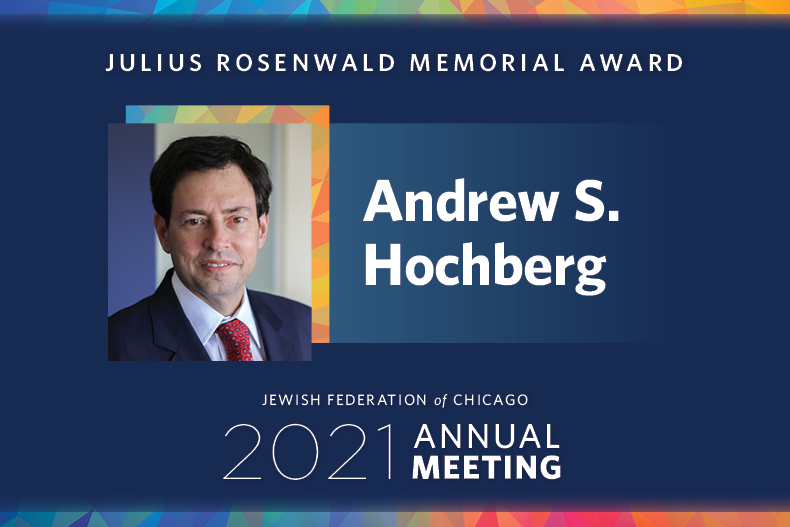
Meet Andrew S. Hochberg, 2021 Julius Rosenwald Memorial Award recipient
Celebrate Andy Hochberg at the virtual Annual Meeting on Sept. 14
Read more -
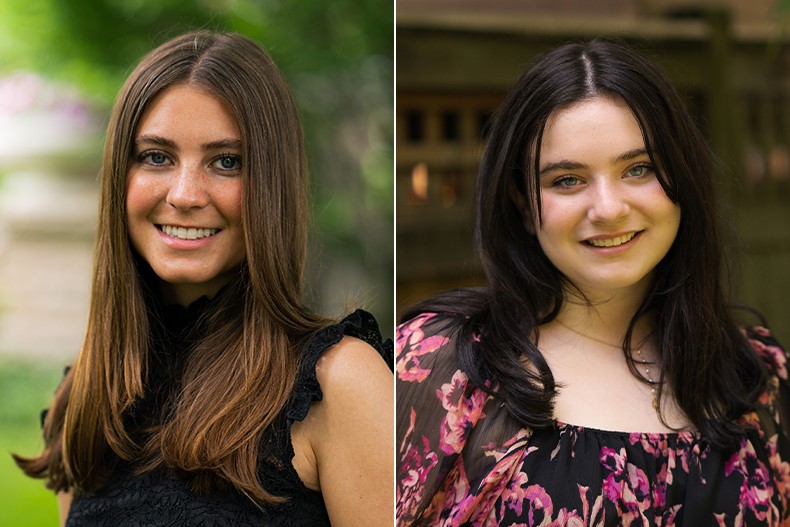
Two local teens win national recognition
Recipients of the annual Diller Teen Tikkun Olam Awards
Read more -

Celebrating six young award winners cultivating the community
Introducing young adult award winners
Read more

Hadag Nahash, a popular Israeli hip hop and funk band, and The Maccabeats, a Jewish a cappella group and YouTube sensation, will headline this year’s Israel Solidarity Day, JUF’s annual community celebration of Israel’s birthday.
Each year, Israel Solidarity Day brings together the Jewish community to celebrate Yom Ha’atzmaut (Israel Independence Day) and stand together in support of Israel. This year we’re back in the park at Ravinia Festival, where we will come together for one big event filled with music, family fun, and Israeli spirit in celebration of Israel’s 67th anniversary.
So don your blue and white and join us at Ravinia Festival, 200 Ravinia Park Road in Highland Park, on Sunday, May 3, for JUF’s 2015 Israel Solidarity Day!
This year’s celebration is co-chaired by Jennifer and Joshua Herz.
“Jen and I both had the opportunity to participate in Israel solidarity day when we were growing up in our respective communities,” Joshua Herz said. “It gives us great pride to have the opportunity to chair JUF’s Israel Solidarity Day this year. It’s going to be a great day of music, food, games, friends, and family topped off with a walk. We hope that the whole Chicago Jewish community will come out and join us in celebrating Israel.”
The fun begins at 10:30 a.m. when the doors will open for registration. In the morning, Rick Recht will perform a special concert for young families (11 a.m). The celebration continues into the afternoon with performances by the Jamman Drum Circle (11:30 a.m. and 2:30 p.m.), The Macccabeats (12 p.m.) and Hadag Nahash (3 p.m.); and all are invited to participate in the three-mile Walk with Israel and one-mile Family Walk (1:15 p.m.).
All performances will take place under the Ravinia Festival Pavilion where seating will be available on a first-come, first-served basis. The lawn will also be open for seating.
Throughout the day, there will be tents with activities for children of all ages and special youth/teen programming including an interactive gaga tournament. Participants are welcome to bring a picnic lunch and kosher food will be available for purchase.
Dollars raised at this year’s Israel Solidarity Day will support Israel Children’s Zone, an innovative program providing critical services to Israel’s most vulnerable children. Located in our Partnership Region, JUF’s Israel Children’s Zone helps disadvantaged students enrich their lives and boost their educational achievement.
Those who raise $100 or more toward Israel Solidarity Day will receive a $100 JUF Israel Experience Voucher or JUF Mission Voucher (limited to one per person per year).
Volunteers are needed for a variety of important positions to make the event run smoothly. All Israel Solidarity Day volunteers will receive a complimentary TOV t-shirt. For more information on volunteer roles, shift times or to sign up to volunteer, call the JUF TOV Volunteer Network at (312) 444-2850 or visit www.juf.org/ISD.
The day’s main programming will take place in the afternoon to accommodate congregational schools. Register online to participate, volunteer and/or donate at www.juf.org/ISD.
Other stories
-
Meet Andrew S. Hochberg, 2021 Julius Rosenwald Memorial Award recipient
Celebrate Andy Hochberg at the virtual Annual Meeting on Sept. 14
Read more -
Two local teens win national recognition
Recipients of the annual Diller Teen Tikkun Olam Awards
Read more -
Celebrating six young award winners cultivating the community
Introducing young adult award winners
Read more
If the Avengers and the X-Men and the Fantastic Four each sent one member to form a new group that connected them all— except instead of superheroes, they were super Jewish teens— that would be JTAC.
JTAC stands for Jewish Teen Alliance of Chicago. They bring together 13 teens representing Jewish youth groups, camps, and other teen-related organizations around the Chicago area for a year of leadership development and community engagement.
Members of JTAC come from JUF, BBYO, Bnei Akiva, CFJE, JCC/Chi-Town Connection, JSC, JSU, Moving Traditions, NCSY, NFTY, Or Tzedek, Shorashim, Response, USY, Yachad, and Young Judaea.
“JTAC’s involvement in the Jewish community is truly empowering,” said JTAC participant Garren Kalter. “While enjoying a vibrant and energetic environment in the group, we productively engage ourselves and the community around us.” Garren represents Jewish Student Connection (JSC), which Helps high school students explore what being Jewish means to them.
These high schoolers act as ambassadors from their groups to each other and the JTAC. But the connections they make and the talents they develop are definitely leadership skills they build.
JTAC participants are nominated for these roles by members of the Teen Professionals Kehillah, which is also comprised of JUF and regional heads of youth groups and other teen/youth-related Jewish community organizations.
JTAC members meet regularly to talk about their groups and their programs. By sharing their stories and best ideas, they can help each other innovate and solve problems… and also make great new friends they would never have otherwise met. “Sometimes, belonging to different organizations makes you forget that you all share a common goal,” noted participant Andrew Gertz, representing JUF’s Shorashim, “but JTAC allows that barrier to fall.” (Shorashim is a nonprofit that connects Israeli and North American Jews and the Taglit-Birthright Israel provider for JUF.)
Together, members of JTAC plan J-Serve, an annual day of Jewish youth service to the community. They plan the teen part of JUF’s Israel Solidarity Day. And JTAC speaks for the Jewish teens of Chicago on issues that concern them.
“Working with teens from all over Chicago to make an impact was one of the most fulfilling things I have done,” said participant Mallory Sherwood, from BBYO. “I think we inspired other teens to make a difference and confirmed our commitment to being instrumental voices in changing our community.”
Founded in 2013, the supergroup evolved out of previous efforts to bring Chicago-area youth groups together.
Now, as JTAC, these teen titans join forces for tikkun olam— or as a good superhero would say, to save the world. Don’t be surprised if they do.
For more information, contact Jennifer Lande, Senior Associate, Youth Initiatives, at 312-444-2876 or [email protected]
Other stories
-
Meet Andrew S. Hochberg, 2021 Julius Rosenwald Memorial Award recipient
Celebrate Andy Hochberg at the virtual Annual Meeting on Sept. 14
Read more -
Two local teens win national recognition
Recipients of the annual Diller Teen Tikkun Olam Awards
Read more -
Celebrating six young award winners cultivating the community
Introducing young adult award winners
Read more
Colin Silverman, 18, was recently elected Grand Aleph Godol (the highest male position) of BBYO, a 90-year-old Jewish youth movement engaging teens in leadership opportunities and other Jewish experiences. As the highest-ranking teen leader, he will oversee more than 50,000 teens in 30 countries in North and South America, Africa, Asia, Australia, and Europe. After graduating from Stevenson High School, he will begin his term as Grand Aleph Godol this summer, taking a gap year before college to travel the world visiting the global BBYO community.
Colin was elected by his peers— other BBYO participants— from among five candidates from all of BBYO, to hold this office, after previously serving as chapter president of Armand Hammer (AZA #2414), Regional Vice President of Programming, and currently Regional President for BBYO Great Midwest Region. Colin was also selected as a BBYO summer experience Coordinator. He is planning Chapter Leadership Training Conference (CLTC) in Bethany, West Virginia. CLTC is designed for BBYO members who want to learn how to build and strengthen their chapters. Colin will plan programming that allows the teen participants to grow as they develop as a leader and explore their Jewish identity.
Celia Livshin, Regional Director of BBYO Great Midwest Region, says, “Colin is a talented and special teen. He consistently works tirelessly to ensure the success of his peers. His two terms on Regional Board has allowed Colin to spend the past years, and then some, teaching younger members the values and skills he has learned. Colin understands the importance of leaving a legacy, but more importantly he understands the importance of teaching others how to leave their own legacy.”
Colin was one of 20 Chicago-area Jewish teens selected for the first cohort of the Diller Teen Fellows program, which graduated in February of this year. Diller is a 15-month international program created to inspire and train future Jewish leaders through 10 North American/Israeli partnerships. Participating in Diller allowed Colin “to form a network with Jewish teens from diverse backgrounds and many different movements of Judaism,” he said. It also brought him to Israel, where he enjoyed spending time with his Israeli peers, relaxing by the Dead Sea, and experiencing an evening at a dinner theater run by blind and deaf actors.
He notes that his experiences in BBYO and Diller have allowed him to explore Jewish values and integrate into his everyday life. “Being involved in the Chicago Jewish community through various youth organizations has impacted me to strive to incorporate Jewish values throughout the rest of my life. Incorporating these values into the college I attend, the major that I study, and my future family is all because of my involvement in Jewish organizations.”
To learn more about BBYO visit www.bbyo.org. Applications are now being accepted for Diller Cohort 3. To learn more visit www.juf.org/teens or email [email protected].
Other stories
-
Meet Andrew S. Hochberg, 2021 Julius Rosenwald Memorial Award recipient
Celebrate Andy Hochberg at the virtual Annual Meeting on Sept. 14
Read more -
Two local teens win national recognition
Recipients of the annual Diller Teen Tikkun Olam Awards
Read more -
Celebrating six young award winners cultivating the community
Introducing young adult award winners
Read more
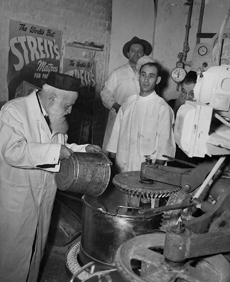
At Streit’s 90-year-old Lower East Side factory, ‘the men’ turn out their last matzoh batch
GABE FRIEDMAN
Seated in his Lower East Side office, in front of a large portrait of company patriarch Aron Streit, Alan Adler avoids becoming too nostalgic.
“It’s like I tell my family members: none of you own a car from 1935, why do you think a matzoh factory from 1935 is what we should be using today?” says Adler, one of Streit’s Matzos’ 11 co-owners.
This is the line of thought behind the imminent closing of the Streit’s matzoh factory, a longtime Jewish fixture in a city neighborhood that once was home to one of the highest concentration of Jews in the country.
Streit’s, the last family-owned matzoh company in the United States, announced late last year that it would be permanently closing its 90-year-old factory after this Passover season because of longstanding mechanical problems and subsequent economic concerns. Sometime in April, the company will shift its matzoh production either to its other factory across the river in northern New Jersey, where several other products such as macaroons and wafers are made, or to another non-Manhattan location.
The greatly gentrified Lower East Side has seen its real estate values skyrocket in recent decades. Although Streit’s has not yet identified a buyer for its landmark building on Rivington Street, the property was estimated to be worth $25 million in 2008, when the company first considered shuttering the factory.
“We should’ve been out of here five or 10 years ago,” said Adler, who oversees the company’s day-to-day operations along with two cousins. “But we feel committed to the men [who work here] and we feel committed to the neighborhood, so we tried to keep this place afloat as long as we could. We probably could’ve stayed here even longer if I could’ve found somebody to work on the ovens.”
The ovens date back to the 1930s. They are 75 feet long and are continuously fed a thin sheet of dough that emerges from the convection heat in perfect crisp form. Streit’s does not disclose its official production numbers, but Adler says the factory churns out millions of pounds of matzoh each year.
However, Adler also estimates that the ovens are now about 25 percent slower than they used to be and he cannot find a mechanic willing to fix them. The slower pace decreases matzoh output and affects the product’s flavor.
But the ovens aren’t the only outdated element of the factory. Except for a few electrical parts added to the machinery over the years, nearly all of the other equipment is more than 70 years old. As a result, employees’ tasks have barely changed in over half a century—from mixing the flour in small batches (in under 18 minutes to satisfy kosher requirements) to separating the matzoh sheets into pieces that then travel up to higher floors on a conveyor belt.
“Nothing changes at Streit’s,” said Rabbi Mayer Kirshner, who oversees the factory’s kosher certification.
However, plenty has changed in the matzoh business since Adler’s childhood in the 1950s and ’60s, when he liked to spend time picking fresh matzoh out of the ovens. Back in the “heyday,” as Adler calls it, of the 1930s through the 1960s, there were four matzoh factories in the New York metropolitan area.
The Streit’s factory also used to boast a vibrant storefront with lines that spilled outside and around the corner. Today there is still a retail counter, but often it is left unmanned.
“Families have moved on, the Lower East Side has changed, so now we’ve sort of transitioned from a local bakery where people would stop by and pick up their matzoh hot out of the oven in 1925 to now where 99.9 percent of our sales are wholesale to distributors who resell,” Adler says.
While his cousins helped at the retail counter, Adler, who joined the company 18 years ago after a law career, says he was always more comfortable working behind the scenes. In the factory’s freight elevator he has clearly ridden in innumerable times, he cracks a rare joke.
“You couldn’t build an elevator like this today,” he says. “It’s passed every safety law from 1925 and not one since.”
Adler says the 30 factory employees were shocked by the news in December but are taking it “surprisingly well.” The company has told them that there are many jobs available at the New Jersey facility, but only three employees have taken the company up on the offer.
Many of “the men,” as Adler calls the employees, live in Queens and take public transportation to work, meaning that a potential commute to New Jersey would be difficult. Streit’s is working with the New York Department of Labor to help them find new jobs.
Anthony Zapata, who has worked at Streit’s for 33 years, and who Adler says does everything from packing matzoh to putting out fires (“literally, not figuratively”), tells JTA that he is very depressed about the factory’s closing. He says the increased transportation costs of traveling to New Jersey would be too much for him.
“I’m going to miss this place, and I’m going to miss everyone in it,” Zapata says. “I’ve never had a modern job to know what’s old, and what’s different between modern and old.”
Adler does not betray many emotions on the matter, but he offers a bittersweet anecdote on the neighborhood’s evolution. Shortly before the company first thought of selling the property in 2008, a man living in one of the condos adjacent to the factory complained to Adler about the noise and flour dust coming out of the building. Adler responded to his requests by blocking in and sealing several factory walls, and when he saw the man months later, he told him what he thought would be “good news” about the factory’s potential closing.
“He said, ‘Oh, God, I don’t want condos—there won’t be enough parking on this street!’” Adler recalls. “All of a sudden he liked my noise and my flour dust.
“I don’t know what they’ll do with this building now,” he adds, “but people don’t like change.”
Other stories
-
Chicago to Israel to Kenya
A family’s story of living Jewishly on three continents Michelle Cohen World May 28, 2021 Avital, Tzofia, and Netanel Kaszovitz outside their home in Nairobi on Yom HaAtzmaut. When Avital Kaszovitz prepared to be a Modern Orthodox shlicha (emissary) to the Jewish community in Ke
Read more -
New exhibit spotlights the experience of ‘Shanghai Jews’
Explore a new Illinois Holocaust Museum and Education Center exhibit
Read more -
Europe’s brave new teachers of the Holocaust
Teaching the Holocaust in the modern era has its difficulties and rewards.
Read more