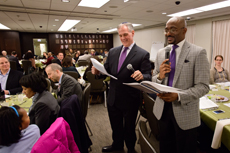
African-Americans and Jews celebrate and discuss modern plagues at JCRC Freedom Seder
MIKE GREENSTONE
Nearly 100 members of Chicago’s African-American and Jewish communities, including more than a dozen pastors and rabbis, took part in JUF’s Jewish Community Relations Council’s Freedom Seder in late March, where they discussed “modern plagues” including poverty, violence, anti-Semitism, racism and genocide.
For the second year in a row, the Passover Seder was hosted by JCRC in partnership with Rabbi Michael Siegel, of Anshe Emet Synagogue in Lakeview, and Pastor Chris Harris, of Bright Star Church in Bronzeville.
A traditional Seder asks, “Why is this night different from all other nights?” as different symbols such as matzoh, bitter herbs, and a roasted shank bone are discussed. However, attendees at the Freedom Seder experienced a mixture of traditions through the symbols of the Seder, including a traditional Passover Seder meal. Harris remarked, “While we come from different communities, on different sides of the city, events like this one build our relationships.” Siegel similarly implored attendees to “commit ourselves to build a stronger bond to go forward and fight for a new day of freedom, equality and acceptance for all people.”
Harris and his daughter, Chrystal, a music teacher, led the community in traditional African-American spirituals such as “Glory Hallelujah,” “Go Down Moses,” and “We Shall Overcome.” There was no shortage of traditional Jewish music either, as Siegel and fellow rabbis led the community in “Dayenu,” “Kol Ha’Olam Kulo (The Whole World),” and “Oseh Shalom,” as well the Hebrew blessings over the food and symbols.
Following along in the Haggadah, participants pledged to “hear and respond to those who suffer” from modern plagues. At each table, participants read statistics about global terrorism, hunger, economic inequality, among other plagues, and participants shared their thoughts on how to work together toward solutions. The Seder, supported in part by a generous grant from the Jewish Council on Public Affairs, provided an opportunity for meaningful dialogue between the African-American and Jewish communities.
While attendees grappled with difficult issues, the program demonstrated the power of our communities working together. Yvette Stone, who attended the event for the first time, said, “It was truly a privilege for us to participate in such a forward thinking project.” Pastor Torrey Barrett, Executive Director of KLEO Community Family Life Center, remarked that this event was “the start of something great…I can feel it in my soul!” Barrett’s participation in the Seder was especially meaningful, since his organization has taken groups of African-American youth to visit Israel.
Participants also heard from Safari Bahanuzi, a refugee from the Democratic Republic of Congo, who shared his story of survival, comparing it to the Jews’ exodus from Egypt. He stated, “Freedom means not having to worry and being able to do something on your own,” referring to his solo journey across several countries in Africa to find a safe place and reunite with his wife. Bahanuzi was resettled with the help of RefugeeOne, one of 10 partner agencies funded through the statewide Refugee Social Services Program administered by the Jewish United Fund, and now works for RefugeeOne as an Intensive Case Manager.
Rabbi Capers Funnye of Beth Shalom B’nai Zaken Ethiopian Hebrew Congregation said that this event is an opportunity to give “a face to Israel’s message and give a broader perspective.” Rabbi Funnye treated participants to a special blowing of the shofar by members of his congregation.
As for the future, Harris hopes that events like this are “not just once a year pleasantries, but taking it to the next level.” Siegel urged attendees rather than resting on the 50 year old history of African Americans and Jews working together, to continue that work today. Emily Sweet, Executive Director of the JCRC, remarked that “events like this Seder are what the JCRC is all about-bringing people of different backgrounds together seeking social justice.”
Harris, Siegel, and the JCRC are dedicated to strengthening these relationships and invite all community members to join in this effort.
For more information about similar programs, please call 312-357-4770 or email [email protected]. For more frequent updates, follow @ChicagoJCRC on Twitter.
Mike Greenstone is a 2014-15 Masa-Israel Action Network Fellow.
Other stories
-
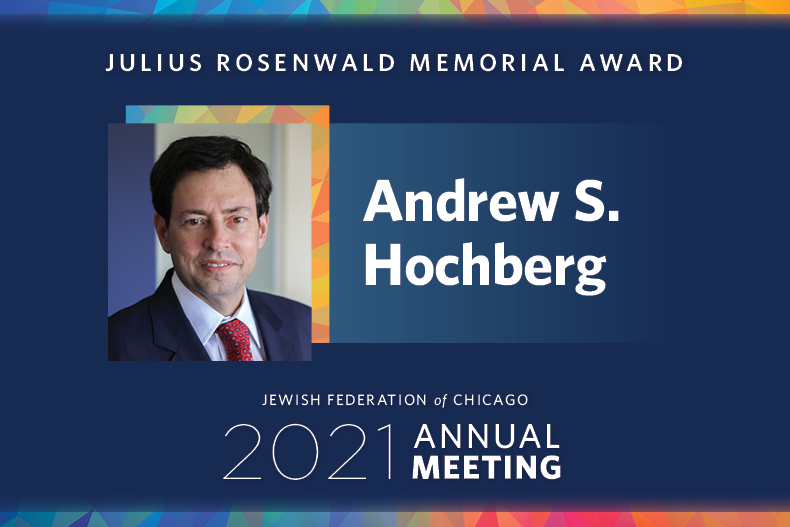
Meet Andrew S. Hochberg, 2021 Julius Rosenwald Memorial Award recipient
Celebrate Andy Hochberg at the virtual Annual Meeting on Sept. 14
Read more -
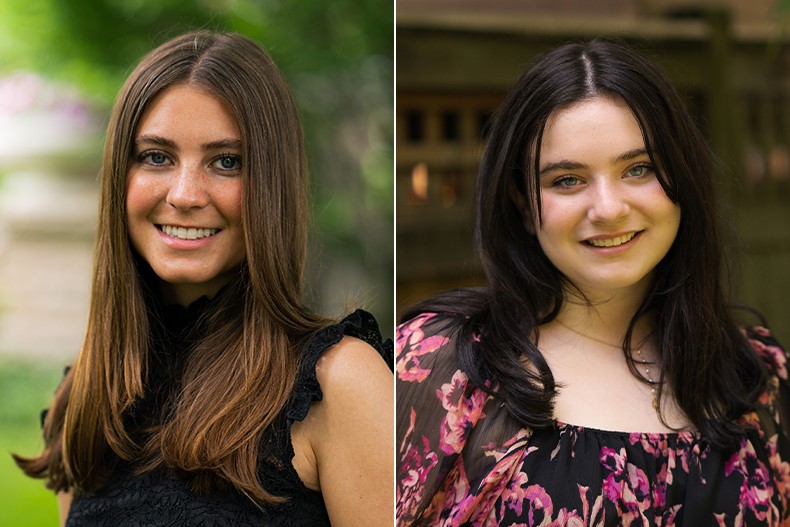
Two local teens win national recognition
Recipients of the annual Diller Teen Tikkun Olam Awards
Read more -
Celebrating six young award winners cultivating the community
Introducing young adult award winners
Read more
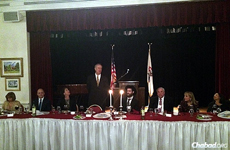
Governor Bruce Rauner and first lady Diana Rauner hosted a model Seder at the Governor’s Mansion Tuesday night. About 75 legislators and executive branch officials as well as Jewish Federation leaders from across the state participated.
The evening’s co-host committee included JUF board members Keith (Marci) Shapiro and Morrie Silverman (Lori Komisar) and former JUF Annual Campaign Chairman Andy (Diane) Lappin as well as Kelly and Jeff Brincat. The service was led by Rabbi Avraham Kagan of Lubavitch Chabad of Illinois.
Each of the 10 tables took turns leading the Seder, the first ever for several of the legislators present.
Governor Rauner welcomed the attendees – not to his and his wife’s governor’s mansion, but to “the house of the people of Illinois … your house,” indicating a desire to have many more such events in the future. He also stressed the eternal lessons that are central to the Passover story, and their enduring relevance to the challenges our world and community still face.
Talking about nefarious efforts to impose boycotts, divestments and sanctions (BDS) on Israel, the governor stressed how disingenuous and dangerous such efforts are in general and especially on college campuses, pledging not only his opposition to such campaigns but that Illinois will be a national leader in the battle against BDS.
The first lady added, “It was very meaningful for us to celebrate this very important holiday in our new home with representatives of the Jewish community throughout the state.”
JUF Executive Vice President Jay Tcath, who attended Tuesday night’s Seder as well as ones hosted by previous governors, welcomed the re-launching of the tradition, saying, “it’s a treat to take time off from the usual business of pressing state governmental affairs and to share, with the Governor, Diana, state senators and reps and Jewish Federation colleagues from across Illinois, something as enjoyable and meaningful as a model Seder.
“The chance to schmooze in such an informal, beautiful, historic setting is always special, and many thanks are due to the Rauners and the four co-host families, all great supporters of JUF and our Jewish community. And thanks also to Richard Goldberg, Rauner’s deputy chief of staff for legislative affairs for his partnership on this and on the many issues of concern to our community.”
Other stories
-
Meet Andrew S. Hochberg, 2021 Julius Rosenwald Memorial Award recipient
Celebrate Andy Hochberg at the virtual Annual Meeting on Sept. 14
Read more -
Two local teens win national recognition
Recipients of the annual Diller Teen Tikkun Olam Awards
Read more -
Celebrating six young award winners cultivating the community
Introducing young adult award winners
Read more
Goverment Affairs Committee discusses Israel Bonds, impact of proposed state budget
MARA RUFF
Fifty Government Affairs Committee members gathered on March 16 to learn about the state’s most recent investment in Israeli bonds and discuss the human service cuts proposed in Governor Bruce Rauner’s FY16 budget. Speakers included, newly elected State Treasurer Michael Frerichs; Judith Gethner, the Executive Director of IL Partners for Human Service; State Representative Robyn Gabel, vice-chair of the Human Service Appropriations Committee; and State Representative David Harris, Appropriations-General Service Committee member.
Opening the meeting, Frerichs highlighted the state’s most recent investment in Israel Bonds. Frerichs said his goals as the state’s chief investment officer are threefold: to make safe investments for the state, make good returns for the state, and diversify the state’s portfolio. “By investing $10 million dollars in I-Bonds, not only is the state diversifying its investments, but promising a solid return,” he said.
Israel Bonds have never defaulted on a payment and been a valued investment for several decades. The most recent investment will mature in 2018.
Setting the stage for the discussion on the state budget, Gethner painted a very real picture of the human service landscape in Illinois. “We find ourselves now at a fiscal cliff,” Gethner said, as she outlined how the proposed FY16 budget reflects an overall cut of $6 billion.
She stressed the importance of working with members of the general assembly to understand the impact that the proposed FY16 proposed budget would have on Illinois residents and service providers.
Next, Rep. Gabel, reminded members that the current budget crisis did not happen overnight.
“The system as a whole needs to be looked at and cannot be fixed with budget cuts alone,” she said. “We must look at new revenue streams.”
Gabel highlighted some significant programs on the chopping block that include cuts to the community care program, home care services, higher education, early invention services, and Medicaid.
Although a challenge, Gabel views the current state fiscal crisis as an opportunity to develop a long term strategic plan to have a much healthier state.
Rep. Harris then spoke on the impact of the proposed budget. As an example, he mentioned a residential facility in his district. Clearkbrook, which houses people with disabilities, is facing severe cuts that may force the facility to close some of its homes.
Harris also spoke about the greater impact on the hospitals. If the proposed budget passes, hospitals that participate in the Accountable Care Entity program may have to re-evaluate their participation.
Harris indicated that it is Governor Rauner’s intention to re-make state government, and the budget is one of the steps the governor is taking in that direction.
Passing a budget by June 1 will not be easy. Harris, like many other members of the general assembly, anticipates budget negotiations will spill over the deadline to end of June.
Harris and Gabel encouraged committee members to educate legislators of the genuine impacts of these cuts on their respective programs.
Other stories
-
Meet Andrew S. Hochberg, 2021 Julius Rosenwald Memorial Award recipient
Celebrate Andy Hochberg at the virtual Annual Meeting on Sept. 14
Read more -
Two local teens win national recognition
Recipients of the annual Diller Teen Tikkun Olam Awards
Read more -
Celebrating six young award winners cultivating the community
Introducing young adult award winners
Read more
In response to the terrorist attacks in February in Copenhagen, which left two people dead including Dan Uzan, a Jewish man who was part of the security patrol guarding a synagogue, Chicago’s Jewish Community Relations Council reach out to the Danish Jewish community in a show of solidarity. JUF pledged its support denouncing the accelerating rise in global anti-Semitic activity and its violent manifestations in Europe, and called for all world leaders to take immediate action to avert the terrorist attacks on Jewish individuals, communities, and institutions.
The Chicago Jewish community received a response from Dan Rosenberg Asmussen and Rabbi Jair Melchior, expressing the Danish community’s deep gratitude and appreciation. Although shaken by the recent tragedy, the community is committed to building “a vibrant Jewish life in Denmark” and ensuring that Uzan’s memory continues to serve as a reminder of “justice, human, kindness, and hope for the entire country.”
Other stories
-
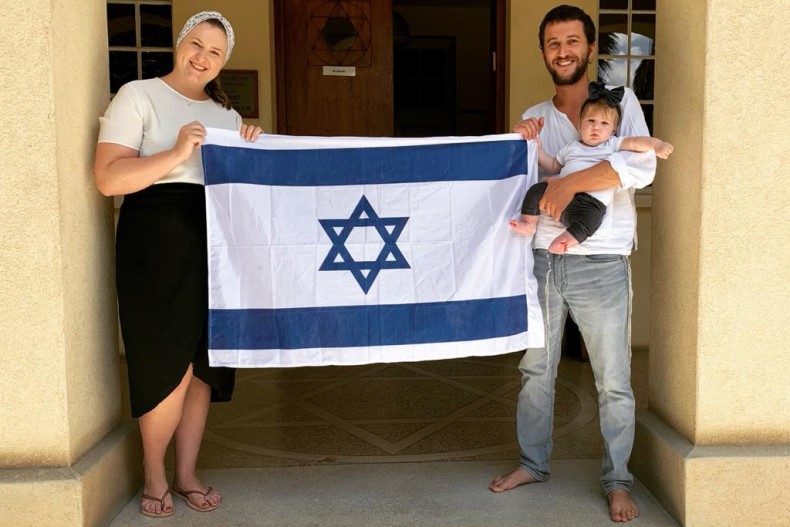
Chicago to Israel to Kenya
A family’s story of living Jewishly on three continents Michelle Cohen World May 28, 2021 Avital, Tzofia, and Netanel Kaszovitz outside their home in Nairobi on Yom HaAtzmaut. When Avital Kaszovitz prepared to be a Modern Orthodox shlicha (emissary) to the Jewish community in Ke
Read more -
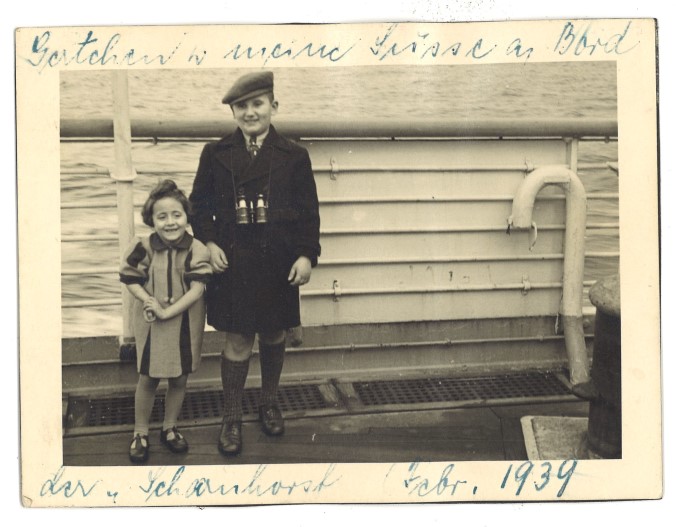
New exhibit spotlights the experience of ‘Shanghai Jews’
Explore a new Illinois Holocaust Museum and Education Center exhibit
Read more -
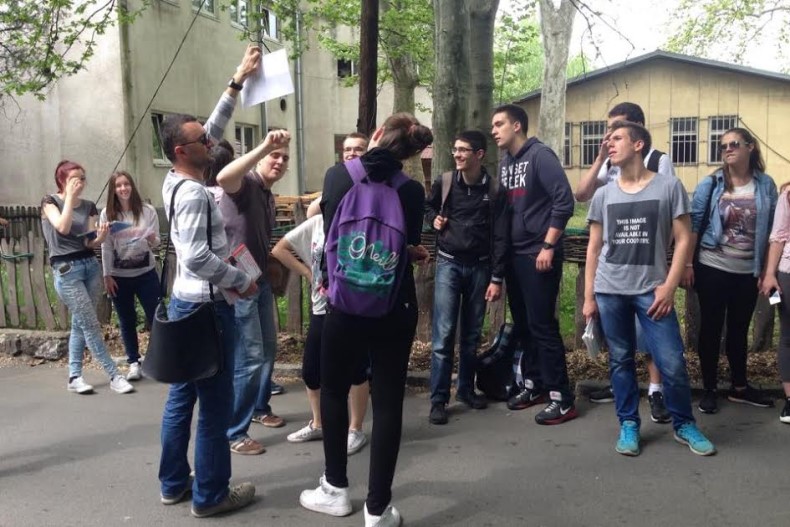
Europe’s brave new teachers of the Holocaust
Teaching the Holocaust in the modern era has its difficulties and rewards.
Read more
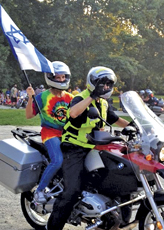
“Jews don’t ride motorcycles.” At least that’s what my Bubbe would say. Well, my Bubbe was right on almost everything, except when it came to motorcycling.
Jews do ride motorcycles. In fact, they ride all kinds of bikes, from scooters to Harleys and everything in between. I know because I’m a member of a Chicago Jewish motorcycle club called Spirits of the Wind and I’ve been riding for over
45 years.
Spirits of the Wind is a club under the umbrella organization, Jewish Motorcycle Alliance (JMA). The JMA, with approximately 4,000 members worldwide, is an international organization of Jewish motorcyclists with clubs throughout the United States, Canada, Australia, South Africa, and of course Israel. Some of the names of the clubs play off our Jewish theme: There’s Hillel’s Angels, Shalom & Chrome, King David Riders of South Florida, and Chaiway Riders, which is a Chicago-based Jewish motorcycle touring club.
Every year JMA members get together in a different city throughout the United States to honor Holocaust Remembrance Day at a rally called “The Ride to Remember” (R2R). There, we donate to a local institution that funds Holocaust education programs, honor the memory of the Holocaust victims, and promote religious tolerance. In 2010, the Ride to Remember was held in Chicago and benefited the Illinois Holocaust Museum and Education Center. Four hundred bikers flocked from all over the world to gather for the ride from Skokie to Chicago, all led by a police escort.
Locally, every Sunday morning, The Spirits get together in the suburbs to eat, talk, and ride, and then eat again—notice the emphasis on the eating. Most of the breakfast conversation is centered on where to have lunch. The rest of the conversation focuses on the latest bling for our bikes or planned summer trips.
Our membership, consisting of men and women of all ages, focuses on recruiting riders that have excellent riding skills, commits to rider education, and believes in the philosophy of using basic safety gear when riding. Our members’ riding styles vary from riding either solo or with a passenger, spending a couple of hours in the saddle, or even traveling for two months on the road visiting all of the lower 48 states. We also maintain a database of members willing to open up their homes to fellow Jewish motorcycle travelers passing through on a motorcycle adventure.
I’ve been involved in a number of motorcycle clubs and believe there’s something special about being able to ride and socialize with other Jewish riders. There is nothing better than riding into a city or town, making a connection with another Jewish biker, and having that connection grow into a friend for life. The diaspora is alive and well in the Jewish motorcycling community, but we are slowly closing the loop as we travel on two wheels to everyone’s hometown.
For more information on The Spirits of the Wind, e-mail Steven Goode at [email protected].
Steven Goode, who lives in Deerfield. worked in commercial real estate for 35 years.
Other stories
-
Chicago to Israel to Kenya
A family’s story of living Jewishly on three continents Michelle Cohen World May 28, 2021 Avital, Tzofia, and Netanel Kaszovitz outside their home in Nairobi on Yom HaAtzmaut. When Avital Kaszovitz prepared to be a Modern Orthodox shlicha (emissary) to the Jewish community in Ke
Read more -
New exhibit spotlights the experience of ‘Shanghai Jews’
Explore a new Illinois Holocaust Museum and Education Center exhibit
Read more -
Europe’s brave new teachers of the Holocaust
Teaching the Holocaust in the modern era has its difficulties and rewards.
Read more

When JUF Young Leadership Division (YLD) board members recognized an unmet need in the community, they set to work, ensuring that all Jewish young professionals feel welcome and engaged through JUF. Over the past year, YLD initiated events and programs targeted specifically to the Jewish LGBTQ community.
“We’re trying to do a better job bringing everybody into the greater JUF community,” said Michael Oxman, YLD Board and Outreach Committee member and leader of the LGBTQ Committee. “The ‘typical’ gay Jewish person had the perception that there wasn’t a place for them. While some events are more targeted for the LGBTQ community, everyone needs to feel welcome (at any event), to let them know that JUF is the place for them.”
YLD hosted its first LGBTQ Happy Hour at Sidetrack last spring, with nearly 90 people attending. This year’s event, held at Sidetrack on March 9, drew 100 people.
“We’ve definitely proven that there is an interest,” said Alex Entratter, LGBTQ Committee member. “JUF has been very supportive in continuing to expand our committee and organize more events.” He said he appreciates YLD’s flexibility and experimentation with different types of events and programs. “We’ve been able to build our own framework in terms of how we want to reach out to the LGBTQ community.”
An LGBTQ LEADS group was established in the fall. Through YLD, the LEADS program provides hundreds of young professionals each year with an introductory exploration of the Jewish community and contemporary issues over eight weeks, in a relaxed social setting. Eighteen people participated in the LGBTQ group, using a specifically adapted LEADS curriculum. “It brought up a lot of great conversations about how we see ourselves fitting into the JUF community,” Entratter said.
“These events are not limited to the LGBTQ community,” said Orly Henry, a second year YLD Board and Outreach Committee member.
Emily Berman, a first-year YLD Board and Outreach Committee member, said, “When I moved to Chicago, I was looking for ways to get involved with the Jewish young professional community. I quickly realized that JUF is the place for young Jewish professionals to connect.
“JUF really is the essential hub of Jewish life in Chicago,” she said. “I appreciate as a young person that JUF truly values the next generation. JUF puts you to work beyond your pocketbook…through volunteering, LEADS, and social and educational programming. I respect the organization for reaching out to everyone.”
“What resonated with me is that there are so many things that JUF, through its agencies, supports across the globe,” Oxman said. “My thought was to engage gay Jews, and JUF is the best place (to do this) because it’s not a one-dimensional organization. It’s a place where you can get involved in anything-and you know your support is helping hundreds of thousands of people.
“There are lots of things behind the scenes that maybe a lot of people don’t know about,” Oxman said, noting that several of JUF’s Breakthrough Fund allocations went to specific LGBTQ projects. Also, JUF funds Response, a teen outreach program through Jewish Child and Family Services. Response’s Parent-Family Connection is a support and education group for parents and family members of Jewish LGBTQ individuals.
Berman said she is impressed with JUF’s outreach to the LGBTQ community. “I don’t think as many Jewish organizations are jumping on board as quickly as I’d like to see,” she said. “I’m really happy JUF is making it a priority. I respect that a lot-and I think it’s smart.”
For information on YLD and LGBTQ programs, call YLD at (312) 357-4880 or email [email protected].
Other stories
-
Meet Andrew S. Hochberg, 2021 Julius Rosenwald Memorial Award recipient
Celebrate Andy Hochberg at the virtual Annual Meeting on Sept. 14
Read more -
Two local teens win national recognition
Recipients of the annual Diller Teen Tikkun Olam Awards
Read more -
Celebrating six young award winners cultivating the community
Introducing young adult award winners
Read more
Other stories
-
Meet Andrew S. Hochberg, 2021 Julius Rosenwald Memorial Award recipient
Celebrate Andy Hochberg at the virtual Annual Meeting on Sept. 14
Read more -
Two local teens win national recognition
Recipients of the annual Diller Teen Tikkun Olam Awards
Read more -
Celebrating six young award winners cultivating the community
Introducing young adult award winners
Read more
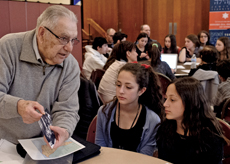
They came to share their stories, six local Holocaust survivors who wanted to ensure that their vital history would live on. In partnership with Holocaust Community Services (HCF), 44 Bernard Zell Anshe Emet Day School students met with them, eager to hear about their lives in Europe before and during the Holocaust, as well as how the experiences impacted the rest of their lives.
The students sat with rapt attention at small tables and listened to the poignant words of Leonid Spivak; Sura and Matvey Vaysman; Matux Stolov; Ida Kersz; Agnes Schwartz and Alice Fink-each group hearing the complex history of one survivor. From those old enough to remember, there were words of life before the Holocaust: “We spoke Yiddish in our home. My grandfather had a shofar and liked to make the sounds.” “My father was a tailor and could sew anything.”
And from them all, the harrowing words of life during the Holocaust: “There was no electricity, no food, anything you can find, you can keep-if you didn’t find anything, you were out of luck.” “I was 2 years old when I was put into the ghetto.” “We would cut a potato and put oil on it, and that was our light source.” “My youngest brother died from starvation at age 2 and we stopped to bury him.”
Students then heard how these unthinkable experiences influenced the remainder of their lives, bringing both uncertainty and trauma, “For 36 years, I didn’t know if any of my siblings had survived.” “When the war ended, our home and city was destroyed. There was no one left.” And, importantly, stories of resilience and hope for a new life: “In England, I trained to be a nurse.” “I met my husband at the DP camp.” “I received an engineering diploma in 1967.” “My brother helped us start a new life. Now I have five grandchildren.”
After their conversations with the survivors, the students stood in front of the entire group and conveyed the story of the survivor with whom they had met. In doing so, the students became more than listeners-they became ambassadors for this sacred history, able to share not just the story of six million, but of the individuals who lived through this tragic chapter-and to help ensure that it never happens again.
This Bernard Zell Anshe Emet Day School program was created in collaboration with JUF and is part of Dr. Jeff Ellison’s eighth grade project, The Other. Too often, individuals or groups are labeled as “the other.” The effect of this label can be disastrous for the individual or group as it may lead to ridicule, ostracism, or in its most radical and virulent form, genocide. As part of this project, students will be exploring many essential questions including why individuals, communities and nations create “the other” and exclude them from their moral universe of obligation.
Holocaust Communit Services is a collaborative effort of Jewish Child and Family Services, CJE SeniorLife, and the Jewish United Fund of Metropolitan Chicago, in partnership with HIAS Chicago.
Karen Goodman Minter is Director of Marketing and Communications for Bernard Zell Anshe Emet Day School.
To learn more, visit www.bzaeds.org.
My conversation with Ida: What an 8th grader learned from a survivor
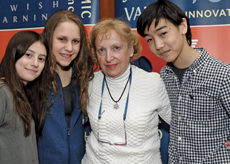
Holocaust survivor, Ida Kersz, with 8th Grade BZAEDS students Hannah Korach, Clara Aeder, and Inbo Gottlieb Fenves.
By INBO GOTTLIEB FENVES
Ida Kersz is quite different from my grandfather. I mention this because both Ida Kersz and my grandfather, Steven Fenves, are both survivors of the Holocaust. My grandfather and his family were rounded up by Hungarian Nazi collaborators and deported to Auschwitz.
Ida’s story is different. She was smuggled out of the ghetto in Sosnowiec and raised by a Polish Catholic family. Although she was herself Jewish, had been in a ghetto, and had parents who spoke out against persecution, Ida was influenced by the Nazi culture and propaganda that wanted to kill people like her and her parents. So, ironically, as a young girl, Ida herself hated Jews. Hearing this made me realize how malleable people are, especially at a young age.
Survivors have all had different experiences and tell different stories. I think it is important to pay attention to these differences. While the Holocaust changed people, it did not erase their personalities or the core of who they are.
Sometimes TV shows and movies present Holocaust survivors in ways that seem more about the idea of the Holocaust than about the actual individuals who survived it. Instead of people with very different characters and interests, we see a type: someone who is brooding, quiet-spoken, and sad.
While I think it is important to recognize and remember the awful history of the Holocaust, it is equally important to remember that the survivors are also individuals with unique personalities who have been affected differently by what they went through. For example, as an adult, my grandfather avoided Hungary and disliked speaking Hungarian, while his sister enjoyed traveling there and speaking the language.
I loved speaking with Ida and learned a lot. Besides the obvious things you would draw from meeting with someone who has been through so much—be grateful for what you have and speak out against injustice (you’d have to be pretty apathetic in order to not think about these things when meeting with a survivor)—I think I learned a lot about how humans cope with both grief and the pressures around them.
Ida saw her mother commit suicide, lost her family and everything she knew, and lived with an abusive Catholic step-grandfather. Yet when I met her, she shared not only her experiences of the Holocaust, but also a number of fun and happy memories. In our conversation, I learned some of the details of her life, but I also started to get to know her through her laughter and her humor. Her story also made me think about how people who are good at heart can be easily influenced by the people and culture around them.
Inbo Gottlieb Fenves is an 8th grader at Bernard Zell Anshe Emet Day School.

The name ‘Trump’ has been a household name for decades. But lately Donald is sharing the spotlight with the younger generation of Trumps—his sons and his daughter, Ivanka.
Ivanka Trump will speak at JUF’s Women’s Division’s 2015 Spring Event on Tuesday, May 12.
Ivanka, who has a business degree from Wharton, is charged with the domestic and global expansion of her dad’s company’s real estate interests and she’s the founder of Ivanka Trump Fine Jewelry and Ivanka Trump Footwear. She has launched #WomenWhoWork, which celebrates the multidimensional lives of modern women. After meeting her husband, who is Jewish, Ivanka converted to Judaism, and the couple has a young daughter and son.
She recently conducted an email interview with JUF News, where she talked about her entrepreneurial pursuits, the balancing act of the modern woman, and who she admires most.
JUF News: You do so much professionally—in the Trump Organization, in real estate and hotel management, in jewelry, in your lifestyle collection. What are you most passionate about in the professional world?
Ivanka Trump: Real estate has always been my passion. I grew up touring construction sites, visiting our properties and hotels with my father and could not get enough… I ingested everything I could get my hands on, observed my peers and supervisors, and experienced as much as possible. I always felt l had something to prove and, in some ways, I guess I did. Eventually I started making my own deals and managing my own team and projects.
I’m an entrepreneur at heart, and I saw a great opportunity to dress young, professional women in a stylish yet attainable way and decided to enter the marketplace with accessories… Our brand is targeted to millennials in the early stages of their careers. [Our customer] is a woman who leads with smarts, but is able to transition quickly between her various roles in professional and personal capacities.
What are the challenges that come with having such a famous father, when you’re trying to make your own way in the world?
I’m incredibly grateful for my family and both of my parents. I think time has debunked some of the criticisms that people might throw at me. There will always be those who will say I wouldn’t be in this position if not for my father and they very well may be right, but I also know I work very hard and have a lot to be proud of. One thing that I know for sure is that I could have chosen to do far less!
My brothers and I are so incredibly fortunate to work alongside our father and it has been an amazing experience, especially in these early stages of our careers. Family businesses tend to be very binary; they are either a total disaster or incredibly successful. Thankfully we represent the latter and that is due, in part, to how well we work as a collective and separately, but regardless we are always working towards a common goal.
Who are your biggest role models?
My mother has always been a great source of inspiration for me. She is incredibly smart, passionate and wickedly funny. I’m also inspired by the young women today who are working to build lives that they want to live. My father has also had an enormous impact on me. I certainly learned a lot about deal making, building, developing—generally he’s taught me what it means to be a great leader and a great parent. Both of my parents were the biggest influence on me and I’m so fortunate to work alongside my father and continue to learn from him every day.
Studies continue to show that women still earn less money than their male counterparts doing the same work. How can we encourage women to keep “leaning in” and be confident and brave at work?
It’s a proven fact that having women in the boardroom is an asset and I think companies are beginning to recognize the value of this more and more. It’s amazing to see women holding the high level positions once reserved for men.
Do you think a lot of these challenges will be gone by the time your daughter enters the workforce?
I tend to think stereotypes and assumptions are growing increasingly irrelevant—in fact, shedding light on what it actually looks like to be a professional woman was one of our goals in originally launching the #WomenWhoWork initiative on my website IvankaTrump.com.
How do you define modern women today?
Women today are working hard at all aspects of their lives…[They] embody the realities of life and works at everything [they] do: being a mother, nurturing her career, her marriage, or relationships. They are smart, ambitious and passionate about their careers—but not defined by them. These women, myself included, are multidimensional. We are doing work we love, work that inspires us, and we’re also pursuing our personal passions and making them priorities. There really aren’t many accurate depictions of working women today in advertisements and pop culture. Companies are still featuring these one-dimensional caricatures of women, usually outfitted in boring pant suits, striding up 5th Avenue. It’s comical. I wanted to illustrate what women who work really look like and create a platform from which to tell their stories.
As a successful young woman in business and as a mother of two, what is your advice to other young women trying to pursue their dreams in life—both personal and professional?
Seek out opportunities you are truly passionate about, work extremely hard, and never stop evolving and improving.
For more information on the Spring Event 2015, contact the Women’s Division Office at (312) 357-4821 or [email protected].
Other stories
-
Meet Andrew S. Hochberg, 2021 Julius Rosenwald Memorial Award recipient
Celebrate Andy Hochberg at the virtual Annual Meeting on Sept. 14
Read more -
Two local teens win national recognition
Recipients of the annual Diller Teen Tikkun Olam Awards
Read more -
Celebrating six young award winners cultivating the community
Introducing young adult award winners
Read more

Having families with young children participate in Jewish learning benefits the future of the Jewish community.
The good news is that it’s also one of the best ways to engage their whole families in lifelong participation in Jewish life. The other news is that reaching out to such families and encouraging them to “choose Jewish” when considering preschools is an ongoing challenge.
The Chicago Early Engagement Learning Initiative (CEELI) is a groundbreaking early engagement leadership project for the Chicago Jewish community. With support from the Chicago-based Crown Family Philanthropies, the Union for Reform Judaism (URJ) is deepening its commitment to expand Jewish engagement by creating a pilot for 12 early childhood education centers. Susan Zukrow, in her role as Project Director, is supporting leadership teams as they work together to strengthen their work of engaging young children and their families.
CEELI leadership teams are learning with one another and from subject matter experts. CEELI is focusing on outcomes including program and teacher excellence, family engagement, enrollment, marketing, and operational flexibility.
“The URJ is proud to bring together a vibrant, cross-denominational cohort to collaborate and network,” said Cathy Rolland, URJ Director – Engaging Families With Young Children.
Fern Katz is the Early Childhood Education Director of the Sinai Preschool Chicago at Sinai Congregation, and a CEELI participant. “This particular team approach has been critical to the work that we are doing,” she said. “By bringing together a lay leader, teacher, and director, I am developing a deeper understanding of the different perspectives of each person as well as each role. I am discovering new insights into our school and organization that I believe will not only help us achieve our goals, but strengthen me as a director.”
“I have gained so much from my experience with CEELI,” said Stacey Reingold, a teacher at the Paul S. and Sylvia Steinberg Pre-School of North Suburban Synagogue Beth El in Highland Park. “Continuing to create an environment in which children and their families are integrated with high levels of teacher excellence has been very rewarding. I am excited to be part of this initiative to continue building awareness and ensuring the future growth of Jewish early childhood education within our community.”
By strengthening Chicago’s Jewish early-childhood offerings, CEELI aims to bolster the Jewish identities of Chicago’s children and their families, with more children attending more and better Jewish early-childhood activities.
Deborah Cooper, JUF Assistant Vice President of Young Family Engagement sits on the advisory board of CEELI and has been working closely with the program to ensure their work is integrated with JUF efforts in this area.
For more information and insights into the work of our cohort teams, email Susan Zukrow at [email protected] or call (312) 259-4493.
Other stories
-
Meet Andrew S. Hochberg, 2021 Julius Rosenwald Memorial Award recipient
Celebrate Andy Hochberg at the virtual Annual Meeting on Sept. 14
Read more -
Two local teens win national recognition
Recipients of the annual Diller Teen Tikkun Olam Awards
Read more -
Celebrating six young award winners cultivating the community
Introducing young adult award winners
Read more