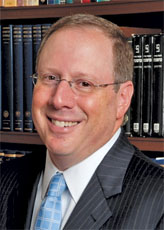
He has studied biomedical engineering and piloted a glider over the Rockies, but the experience that has guided Rabbi Aaron Panken’s career the most, he says, was running Jewish youth groups. Today, he is the 12th President in the 139-year history of Hebrew Union College-Jewish Institute of Religion (HUC-JIR).
HUC-JIR’s campuses in Cincinnati, Jerusalem, Los Angeles, and New York teach Reform Movement’s rabbis and other professionals, and offer graduate programs for scholars of all faiths. HUC-JIR’s 4,000 active alumni serve the Reform Movement’s 1.5 million members and nearly 900 congregations, representing the largest Jewish denomination in North America.
“I believe very strongly in Reform Judaism,” he says. “It is highly suited for the North American context, as it stresses egalitarianism and equality, and has been a leader in civil rights. Its values and America’s are aligned.”
In college, Panken-a New York native-first studied electrical and biomedical engineering in classrooms and labs, graduating from Johns Hopkins University’s Electrical Engineering program. While there, Panken also found he enjoyed working with Jewish teens and young adults.
While Panken’s scientific work was forward-thinking, his Jewish scholarly interests are steeped in the past-rabbinic and Second Temple Literature, and the history of legal concepts, Jewish narrative, and holiday observances. “There are similarities between the Talmud and a laboratory as far as logic playing very strongly, and having to prove your assertions,” Panken allows. “However, the rules for acceptable evidence are different.”
Panken earned his doctorate in Hebrew and Judaic Studies at New York University. But most of his Jewish professional life has revolved around HUC-JIR, where he studied and was ordained. After serving as a congregational rabbi in New York, he returned to HUC-JIR to teach, then serve as dean and vice president, and now as president.
In this position, Panken is charged with what he calls “thought leadership,” including overseeing the curriculum. He is in charge of the faculty, including hiring. And he is tasked with fundraising. “As an engineer,” he laughs, “I am not afraid of numbers.”
Panken is also concerned with extending HUC-JIR beyond its walls, through its professors teaching at other campuses, and even- through the Internet- in non-campus settings. Some classes are even MOOCs, or “Massively Open Online Courses” with hundreds of students. Given his background, it is not surprising that Panken sees technology as a “tool with positive uses” for education.
Panken extends his own energies outside of HUC-JIR as well, serving on the faculty for the Wexner Foundation, of which he is an alumnus, and as visiting faculty at universities in Australia and China. He also serves on the Editorial Board of Reform Judaism magazine and holds other leadership roles within the Reform Movement and greater Jewish community.
Panken’s other passion is flying. He has been a commercially licensed pilot for 20 years, flying both single-engine planes and gliders, in which he has flown for hundreds of miles at a time with no engine. “Gliding a spiritual experience,” he says, “You are focused on the natural beauty and splendor of God’s world. Of course, you still have to remain aware of potential landing fields.”
Other stories
-
Meet Andrew S. Hochberg, 2021 Julius Rosenwald Memorial Award recipient
Celebrate Andy Hochberg at the virtual Annual Meeting on Sept. 14
Read more -
Two local teens win national recognition
Recipients of the annual Diller Teen Tikkun Olam Awards
Read more -

Celebrating six young award winners cultivating the community
Introducing young adult award winners
Read more
Would you like to bring Jewish identity and history to life for your child? Plan ahead and enroll your son/daughter in the Gift of Israel program now. This Israel Experience Savings program will enable your relatives and friends to help your child save for a future Israel Experience program during high school, college or beyond (to age 26). Making an Israel Experience part of your child’s future is a great idea-schools encourage it, employers value it and they get the opportunity to do something outrageous and fulfilling while exploring their roots.
There are so many programs available that one is bound to match your child’s needs. While the price tag for an Israel Experience might seem out of reach, by opening a special interest-bearing savings account in your child’s name within six months of the Bar/Bat Mitzvah, you will be able to start saving early. Then, over the years, additional gifts can be added to mark birthdays, holidays, graduations and other special occasions. The Jewish Federation of Metropolitan Chicago offers a variety of Israel Experience savings and incentive programs in addition to the Gift of Israel, including SKIP (The Send-a-Kid-to-Israel Partnership), Bar/Bat Mitzvah Israel Experience Certificates and Walk with Israel Vouchers, as well as financial need- and merit-based Israel Experience scholarships, all of which may be used in conjunction with one another.
For more information about this unique program, including the enrollment packet, visit www.juf.org/israel_experience.
Other stories
-
Meet Andrew S. Hochberg, 2021 Julius Rosenwald Memorial Award recipient
Celebrate Andy Hochberg at the virtual Annual Meeting on Sept. 14
Read more -
Two local teens win national recognition
Recipients of the annual Diller Teen Tikkun Olam Awards
Read more -
Celebrating six young award winners cultivating the community
Introducing young adult award winners
Read more
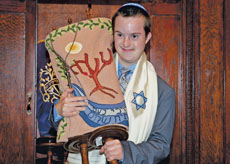
In many ways, Miles Evans’ bar mitzvah was like many others. At his ceremony last year, he helped lead the morning service in both English and Hebrew. He carried and read from the Torah, then delivered a speech about what he’d read.
But in another way, Miles’ bar mitzvah was different. Miles was born with Down syndrome. For him to become a bar mitzvah was extraordinary!
Miles was already a pretty accomplished guy. He went to Keshet’s Overnight Program at JCC’s Camp Chi… and plays in Keshet’s Buddy Baseball program.
His synagogue-Congregation Etz Chaim in Lombard, Illinois-is dedicated to educating every Jewish child and committed to doing what it takes to make that happen. With the support of his family and the synagogue “team,” Miles hit a home run on his bar mitzvah day.
Miles began his bar mitzvah studies more than three years ago. What sparked his quest was seeing his older brother Nate’s bar mitzvah, way back in 2005.
For several years at Sunday school, Miles was matched with a young adult tutor to learn the prayers. During his final year of study, Miles worked with the congregation’s bar mitzvah tutor to learn and practice everything he needed to know. He attended services, then rehearsed with recordings, flashcards, and actually saying the prayers in the sanctuary.
All this practice made perfect. “On his big day, Miles delighted in greeting his guests and made everyone feel welcome with no nervousness,” his mother, Julie, said. “He exuded confidence and connected with the congregation. Several people reported tears of joy during the service.”
Also rooting for Miles were his Camp Chi friends, who were behind him all the way. Literally, they sat behind him during the service! Of course, they were “behind him” the other way, too-they encouraged him, patted him on the back, and made toasts to him at his party. And by “all the way,” we mean that they had even helped Miles practice back in summer camp months before.
While most bar mitzvahs spend a few days writing thank-you cards for the gifts they got, Miles also got letters, calls, and e-mails from people who thanked him for being so inspirational.
Miles had a great time, too. In fact, his parents saw him practicing again a few days after his ceremony. When they asked him why, he smiled and said he wanted to have another
bar mitzvah!
Other stories
-
Meet Andrew S. Hochberg, 2021 Julius Rosenwald Memorial Award recipient
Celebrate Andy Hochberg at the virtual Annual Meeting on Sept. 14
Read more -
Two local teens win national recognition
Recipients of the annual Diller Teen Tikkun Olam Awards
Read more -
Celebrating six young award winners cultivating the community
Introducing young adult award winners
Read more
YLD and Oy!Chicago announce third annual Chicago Jewish '36 Under 36' list
JESSICA LEVING
The Jewish United Fund/Jewish Federation of Metropolitan Chicago has announced the third annual “Double Chai in the Chi: 36 Under 36” list of young Jewish movers and shakers in Chicago.
(The letters of the Hebrew word “Chai,” which means “life,” also represent the number 18.)
Check out the list online at: http://www.oychicago.com/double-chai/default.aspx
Presented by the JUF/Federation’s Young Leadership Division (YLD) and Oy!Chicago (www.oychicago.com)—an outreach website for Chicago 20- and 30-somethings—the list shines a spotlight on the faces of Chicago’s Jewish future and recognizes the amazing contributions of this generation. The young professionals featured are noted for making a difference through their work, giving back in their free time, and earning notoriety in the Jewish community and beyond.
“We were overwhelmed by both the volume and exceptionally high quality of the nominations this year,” said Stefanie Pervos Bregman, Founding Editor and Blogger-in-Chief for Oy!Chicago. “If this list is any indication, the future of Chicago’s Jewish community is incredibly bright.”
This year’s list is replete with entrepreneurs, activists, researchers, and more, including a chemist researching a cure for Hepatitis C, a camp director bringing Judaism to life for the next generation, and a young woman with Cerebral Palsy who started a playgroup for kids with physical disabilities – just to name a few.
“This is not just a list honoring those who have had tremendous professional, monetary, or business success – nor is it a reflection of observance or participation in Judaism,” said Joe Seigle, former YLD president and one of last year’s winners. “This list reflects people who, through both their professional and philanthropic endeavors, make the Jewish community stronger and more vibrant.”
Full profiles of each honoree are available on the Oy!Chicago website.
The 36 winners will be honored at YLD’s “WYLD in Paris” party at 7 p.m., Thursday, Aug. 7 at Studio Paris, 59 W. Hubbard St., Chicago. The party is open to the public. Tickets are available for $20 in advance or $30 at the door. To register, visit http://www.juf.org/yld/wyld_paris.aspx or e-mail [email protected]. Register early – last year’s party completely sold out!
The 36 named to this year’s list are:
Joel Bennett, 31, Director of Operations at B’nai Brith Beber Camp
Sara Block, 31, Advocate for victims of domestic violence
Adam Braun, 32, Member of the Illinois Holocaust and Genocide Commission
Daniel Caspi, 34, Chemist researching a cure for Hepatitis C
Claire Denton-Spalding, 26, Immigration Reform Advocate
Abe Friedman, 34, Rabbi reinvigorating Judaism for young adults
Aaron Galvin, 34, Real estate broker
Jonathan Glick, 35, Founder of the Chicago Real Estate Private Equity Network
Vicky Glikin, 35, Cantor at Congregation Solel
Asha Goldstein, 33, Jewish communal leader
Daniel Gorlin, 35, Chairman of the Board of MyJewishLearning
Aimee Halstuk, 26, Founder of ‘Just Give Me a Chance’ playgroup for children with physical disabilities
Julie Hochstadter, 35, Urban biking activist
Tristan Hummel, 27, Curator and Project Manager at Chicago Loop Alliance
Benjamin Lachman, 32, Deaf Education advocate
Alyssa Latala, 34, “Big Tent” Judaism concierge
Avraham Mor, 34, Top Chicago lighting designer
Bob Morgan, 34, General Counsel for the Illinois Department of Public Health
Diana Peters, 33, Advocate for women’s equality in manufacturing
Mandee Polonsky, 35, Education advocate
Abby Reiss-Carnow, 29, Mentor to adolescent refugee girls
Zvi Rhine, 34, Principal at Sabra Capital Partners
Shayla Rosen, 35, Founder of annual ‘Soiree for Success: A Fundraiser to Fight MS’
Benji Rubin, 29, Special needs attorney
Tiger Safarov, 29, Entrepreneur
Daliah Saper, 33, Media and entertainment lawyer
Yoni Sarason, 29, Senior Director, Midwest Region for NEXT: A Division of Birthright Israel Foundation
Jackie Shiff, 31, Working to reduce youth violence
Jeremy Smith, 27, Entrepreneur
Sarah Sobotka, 31, Advocate for children with disabilities
Brian Taylor, 35, Entrepreneur
Alex Turik, 35, Leader in Chicago’s Russian Jewish community
Katie Vogel, 28, Healthcare advocate and American Jewish World Service Global Justice Fellow
Eli Wald, 29, AIPAC Chicago Area Director
Annie Warshaw, 27, CEO and Founder, Smarty Pants Yoga Inc.
Rachel Zimmerman, 33, Coordinator of Project Shield at Jewish Child and Family Services
Other stories
-
Meet Andrew S. Hochberg, 2021 Julius Rosenwald Memorial Award recipient
Celebrate Andy Hochberg at the virtual Annual Meeting on Sept. 14
Read more -
Two local teens win national recognition
Recipients of the annual Diller Teen Tikkun Olam Awards
Read more -
Celebrating six young award winners cultivating the community
Introducing young adult award winners
Read more
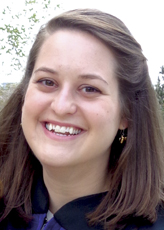
At the end of my internship at the Center for Jewish Genetics, I feel empowered to move forward. My next step is graduation, and I’m lucky to be leaving the Center with a much expanded grasp of genetic health issues and a collaborative public health project under my belt.
The Center was established as a cooperative effort by its parent organizations, the Jewish Federation of Metropolitan Chicago and the Ann & Robert H. Lurie Children’s Hospital of Chicago, after a 1997 symposium on Jewish genetic disorders. The symposium was organized by the Children’s Hospital, the Federation, and the Illinois Jewish Genetic Disorders Committee. All of these organizations decided it was important to gather and disseminate knowledge about genetic disorders, and so the Center was founded.
Committed to reducing genetic disorders and health disparities in the Jewish community, the Center for Jewish Genetics fills in gaps in knowledge, both professional and public, and promotes genetic health for everyone. The Center provides culturally relevant education, prevention, and outreach, empowering community members to seek out information and prevention strategies.
Serving both the Jewish community and the general population of Metropolitan Chicago, the Center’s reach is ever-expanding, because we recognize it is important for all of us to be aware of our heritage and genetic health! Along with regular genetic screening programs, the Center creates innovative activities to promote their message, such as visiting local health clubs with information on genetic health, and giving out water bottles and the project I worked to design, coordinate, and implement, DNA Day Illinois. The Center has collaborated with the Illinois Department of Public Health for several years to put together educational materials and activities for public health departments across the state, culminating every spring with DNA Day, a celebration of developments in genetic health.
The Center’s mission is impressive, and it hasn’t failed to impress me. I hope to continue to work promoting public health.
Cassie Harris was the 2013-2014 Sattinger Intern for the Center for Jewish Genetics. She recently graduated from Loyola University Chicago’s School of Social Work.
The Center for Jewish Genetics is a cooperative effort of the Jewish United Fund/Jewish Federation of Metropolitan Chicago and the Ann & Robert H. Lurie Children’s Hospital of Chicago. The Center is a support foundation of the Jewish Federation of Metropolitan Chicago and is funded in part by the Michael Reese Health Trust.
Other stories
-
Meet Andrew S. Hochberg, 2021 Julius Rosenwald Memorial Award recipient
Celebrate Andy Hochberg at the virtual Annual Meeting on Sept. 14
Read more -
Two local teens win national recognition
Recipients of the annual Diller Teen Tikkun Olam Awards
Read more -
Celebrating six young award winners cultivating the community
Introducing young adult award winners
Read more
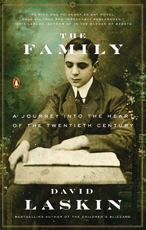
David Laskin’s The Family selected for this year’s Jewish Community ‘One Book’ initiative
For the fourth year in a row, JUF News is proud to be the media sponsor for One Book/One Community, in which a single Jewish book is selected as the focus of discussions and programs for the Greater Chicago Jewish community. Spearheaded by Spertus Institute for Jewish Learning and Leadership, the One Book initiative is our community’s celebration of Jewish Book Month. This year, Jewish Book Month, which takes place the month before Chanukah, runs from mid-November through mid-December.
The 2014 book is David Laskin’s The Family, a fascinating memoir that follows the author’s rather amazing ancestors across the tumultuous sweep of the 20th century. Characters include a Torah scribe on the fringe of the Russian empire, the brilliant woman who founded Maidenform bras, and a young risk-taking couple fighting for the birth of the State of Israel. The Family was selected as a best book of the year by the Seattle Times, Kirkus Review, and the New York Public Library. The Jewish Journal called it ” [a] family chronicle with all of the depth and detail of a great novel.”
A Readers’ Guide, prepared specifically for Chicago-area book groups, will be available this fall. Activities begin in November with a special kick-off event and a series of book discussions, and then culminate in December with Chicago-area appearances by the author. Visit spertus.edu/TheFamily to sign up for information.
Spertus Institute is a partner in serving the community, supported by the Jewish Federation of Metropolitan Chicago.
Other stories
-
Meet Andrew S. Hochberg, 2021 Julius Rosenwald Memorial Award recipient
Celebrate Andy Hochberg at the virtual Annual Meeting on Sept. 14
Read more -
Two local teens win national recognition
Recipients of the annual Diller Teen Tikkun Olam Awards
Read more -
Celebrating six young award winners cultivating the community
Introducing young adult award winners
Read more
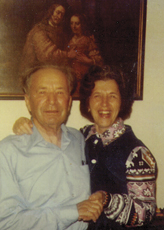
It’s hard to believe that if my maternal grandma Tessie Luck were alive today, she would have turned 100 this month. If you are fortunate to still have your grandparents with you—I’m lucky to have both of my paternal grandparents—I urge you to interview them, and record them so you have their words of wisdom with you and your family for always. I interviewed my grandmother back in 2000, seven years before her death. What follows are excerpts from what I wrote about my grandma after our conversation in 2000.
“Can I tell you about our specials?” our waitress at a Milwaukee restaurant asks my grandma Tessie Luck and me. Tessie looks regal in her navy blue skirt-suit, and her silver curls stand perfectly still, only hours after her weekly beauty
parlor rendezvous.
“Dear,” says Tessie, more concerned with showing off photos of her family members than with the menu. “I want to introduce you to my granddaughter.”
“Great,” the waitress interrupts politely. “We have a lobster special this evening…”
Tessie steers clear of the lobster. She has never eaten shellfish or pork in all her 85 years. Raised in an Orthodox Jewish home, she keeps remnants of her kosher lifestyle to this day. So Tessie, content with simplicity, opts for the fresh salmon with lemon juice.
The gourmet salmon is a far cry from Tessie’s days of eating fried onions and not much else. During famine in Russia, after World War I and around the time of the Russian Revolution, her family could scrounge up little more than onions, which they ate for months on end. Despite their ubiquity back then, Tessie always loved onions.
Her love for something as measly as onions illustrates how Tessie has always seen her world through rose-colored glasses. The same Tessie who never met her father until she was 9, who lived through czarist Russia as a persecuted Jew, who lived until adulthood in poverty, and who has seen countless loved ones die, including her beloved husband and son—that same Tessie has never once complained about her life.
Ironically, Tessie describes her dirt-poor upbringing in a Russian shtetl called Davidivkah as “elite.” “We were considered a very fine family,” she said. Born on the eve of World War I, the fourth and last child, Tessie began life in a most precarious corner of the world-Russia.
She was a Jew at a time and place where it was unacceptable to be Jewish. During her mother’s pregnancy, relatives in Brooklyn urged Tessie’s father to emigrate to the United States. As a poor Jew in Russia, her father had to seize this opportunity to get out, but he would send for his family as soon as resources became available.
Illiterate, because no Jewish girls or women were taught to read and write in Russia, Tessie’s only contact with her father until she was nine came through letters and stories her family shared with her.
Once, she recalls, the Cossacks invaded her family’s small home in search of grain. To protect little Tessie, her brothers propped her up on a shelf and told her to hold as still as her rag doll. Storming past the shelf, the Cossacks found the grain and left Tessie unharmed.
Forbidden by the czar to attend school or synagogue, Tessie spent her time watching and learning from her tight-knit family. Although Tessie’s world held few material possessions, music and dancing abounded in her home.
In 1923, word finally came that 9-year-old Tessie and her family could join her father in the United States. Tessie was elated with the idea of leaving the “dreadful place” and coming to a land she envisioned paved with gold. Tessie vowed never to return to Russia.
Her family arrived in July, unversed in English. By September, after only two months of playing with American children, Tessie was practically fluent in the new language.
Meanwhile, Harry Luck immigrated from Russia to America in 1924, shortly after Tessie. On the way, Harry’s family awaited visas in London, where Harry was befriended by an Englishman who wanted to learn Russian. A member of the Fabian
Society, he often took Harry to meetings where George Bernard Shaw, H.G. Wells, and George Orwell would also attend. To make a living, Harry picked strawberries.
After Harry arrived in the States, he fulfilled a life-long dream of buying a farm, thus becoming one of the first Jewish farmers in Wisconsin. Soon, Harry and Tessie were introduced in New York. When she speaks of Harry, she glows: They courted for only three weeks, just long enough for Harry to “realize he couldn’t live without me,” she laughs. One evening, while watching the opera “La Traviata,” Harry popped the question.
Early in their marriage, Tessie and Harry moved to a 200-acre dairy farm in Mapleton, Wisc. There, they raised cattle, corn, two sons, and a daughter—my mother. There were no other Jews for miles around, but Tessie kept a strictly kosher kitchen. Every few months, a Yeshiva scholar would come to live with the family, to learn about farming before moving to a kibbutz in Israel. In turn, he would teach the two small Luck sons Hebrew and Talmud.
As the kids grew older, the Luck family moved back to the city, where Tessie became active in Jewish causes. When Israel was born, Tessie and Harry would buy bonds, investing in Israel even though it was a gamble on an uncertain future. “If this is worth nothing,” Harry would say, “then our lives are worth nothing.”
After a full life together, Tessie lost Harry to a heart attack. “I loved him for his kindness and his brilliance, and his love of all things beautiful,” she says. Two years after Harry died, her younger son, Max, died unexpectedly.
Despite the dark times in Tessie’s life, she’s always emanated light. “Darling,” she says, “I am the luckiest woman in the whole wide world.”
Note: I’ve launched an online project with my sister to record the wonderful words, wit, and wisdom of grandparents. Share the best advice you’ve received at Ofthewise.tumblr.com or email [email protected].
Other stories
-
Chicago to Israel to Kenya
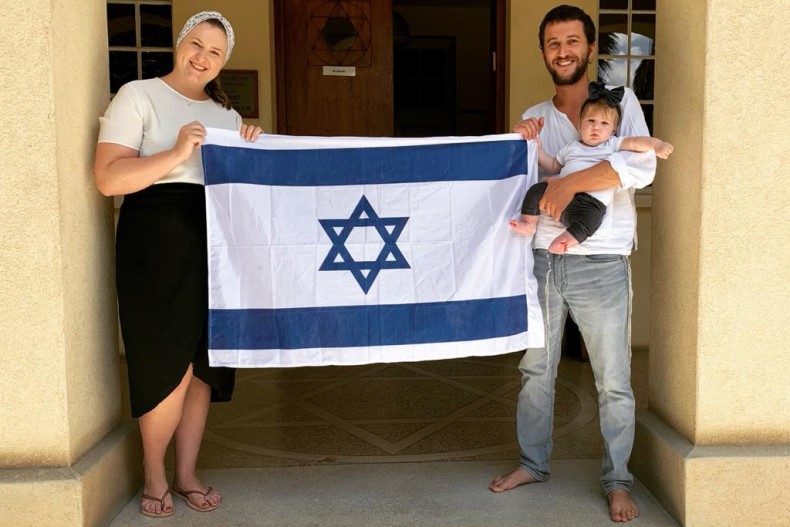
A family’s story of living Jewishly on three continents Michelle Cohen World May 28, 2021 Avital, Tzofia, and Netanel Kaszovitz outside their home in Nairobi on Yom HaAtzmaut. When Avital Kaszovitz prepared to be a Modern Orthodox shlicha (emissary) to the Jewish community in Ke
Read more -
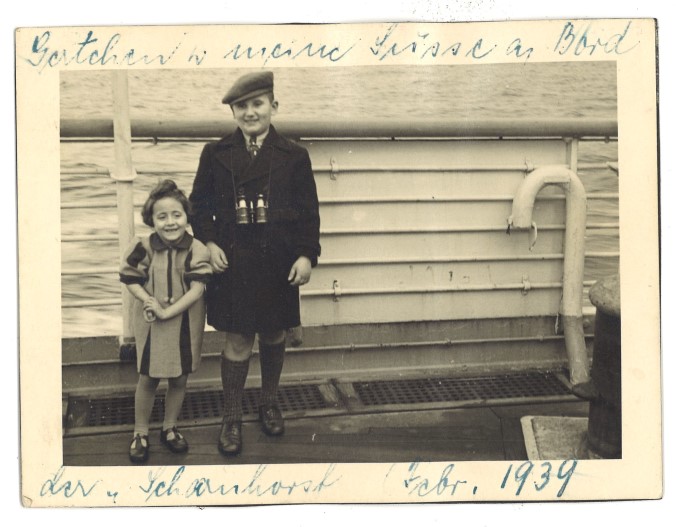
New exhibit spotlights the experience of ‘Shanghai Jews’
Explore a new Illinois Holocaust Museum and Education Center exhibit
Read more -
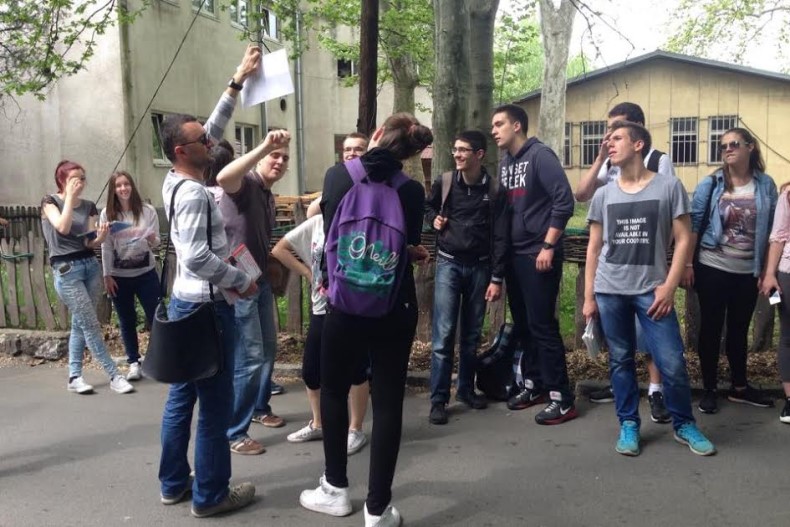
Europe’s brave new teachers of the Holocaust
Teaching the Holocaust in the modern era has its difficulties and rewards.
Read more
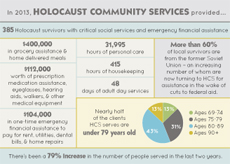
In the wake of reductions in government aid that previously supported Holocaust survivors, Diane and Steve N. Miller will provide $1 million this year to the Jewish United Fund/Jewish Federation of Metropolitan Chicago to help meet the pressing needs of this vulnerable population.
“When I learned about the immense needs of the several thousand survivors living in our community, I knew this was a cause I wanted to support,” said Steve Miller, principal and co-founder of Origin Ventures. “These people have suffered so much in their lives-it’s imperative that we provide for them and let them age with dignity. My wife and I sincerely hope that our fellow community members will also step up to support this important work.”
Miller, a longtime leader in Chicago’s Jewish community who serves on JUF’s Board of Directors and has been involved with numerous JUF committees, made this gift as part of JUF’s Centennial Campaign.
“We are deeply grateful to the Millers for their incredible generosity, and cannot thank them enough for their ongoing support of our work,” said Steven B. Nasatir, JUF/Federation President.
The Millers’ generous gift will benefit Holocaust Community Services (HCS), a program formed in 1999 to advance the Jewish Federation’s commitment to prioritizing the needs of Holocaust survivors. They were an aging group-proud, independent, and reluctant to ask for help-but living without some assistance was becoming problematic for many. To meet their needs, the Federation stepped in to form the HCS program, enlisting its affiliated agencies, Jewish Child and Family Services (JCFS) and CJE SeniorLife to provide necessary, specialized services.
Since that time, as entitlements have shrunk, and the population has aged, displaying all the usual problems of aging plus some only exhibited by survivors, resulting in a dramatically increased call for service. The Federation is committed to seeing that survivors live out their lives with dignity and as comfortably as possible. The Millers’ generous gift will be used over the next 10 years to support the needs of this youngest cohort of survivors.
“There’s a major misconception that the needs of the survivor community are dwindling, but in actuality, the reverse is true,” said Yonit Hoffman, Manager of HCS at JCFS. “The complex needs of many survivors in our community are just beginning to emerge.”
Funds from the Millers’ gift will be used to help HCS provide for clients’ basic needs, expand staff capacity, and enhance socialization opportunities, support, and education groups in order to improve clients’ emotional well-being.
Last year, HCS provided services to 385 clients-and the requests keep on coming. In the last five months alone, the organization has received over 200 new requests-a figure particularly staggering considering it is almost double the 215 total clients HCS served in 2011.
“Words cannot express our gratitude to the Millers for helping us respond to these constantly growing needs,” said Hoffman. “We are so thankful for this major boost to our efforts as we prepare to confront our increased client load moving forward.”
To make a gift to support Holocaust survivors, please contact Donna Kahan at (312) 357-4853 or [email protected]. To learn more about Holocaust Community Services, please contact Yonit Hoffman at 847-745-5409 or [email protected].
Other stories
-
Meet Andrew S. Hochberg, 2021 Julius Rosenwald Memorial Award recipient
Celebrate Andy Hochberg at the virtual Annual Meeting on Sept. 14
Read more -
Two local teens win national recognition
Recipients of the annual Diller Teen Tikkun Olam Awards
Read more -
Celebrating six young award winners cultivating the community
Introducing young adult award winners
Read more

When I had my restaurant in New York, I would take a break outside on 55th Street and Madison Avenue. I watched, day after day, two hot dog carts at lunch time. One cart was kosher and one was not. I saw long lines form at the kosher cart as people would wait traffic light changes just to get to it.
I almost felt bad for the non-kosher cart as its lines were miniscule compared to the kosher cart’s.
I asked a cook in my kitchen who was a native NY’er and he told me that the perception was that the kosher dog was better/healthier.
Better? Maybe! Healthier? Probably not! Unless those dogs are nitrate and coloring free, they are basically the same other than the whole kosher part.
Observant Jews know that keeping kosher does not necessarily equate with healthy eating and living.
Indeed, the Jewish calendar is a minefield of dietary disasters waiting to happen. Jewish holidays are food-centric and let’s face it, we are food people! With cheesecake and dairy goodies on Shavuot, fried potato pancakes during Chanukah, an eight-day eating fest during Pesach and Shabbat with its long leisurely meals and some Jews even feeding their neshama yeterah (extra soul on Shabbat), it’s no wonder many Jews are loosening their waistbands and are concerned about their health.
Eating to excess and high-cholesterol foods are unhealthy regardless of whether they are kosher. Jewish dietary laws are not laid down as health laws, but religious laws, yet there is no law for the quality of the food, nor for the amount eaten-just that it be kosher.
As a chef, I cannot offer advice on diets and weight loss; I can, however, tell you that the quality of food does matter. I work with food all day long. I read labels and understand ingredient function and I can tell you that the best tasting and most satisfying food is that food made from whole ingredients.
We hear over and over again to limit processed foods. Most packaged food products are made from inferior ingredients, loaded with salt and sugar and cheap fats. Unfortunately, many of them are kosher and widely purchased and served. As a chef, I am going to say that everything you make from a box, jar or package can be made better at home.
We are also told to eat seasonally. Seasonal food is cheaper, better-tasting, and easier on the environment. I am going to go one step further and tell you that seasonal food is exactly what your body needs at the time it is in season. Ever notice how citrus fruit season peaks at cold season? Here in the Midwest, we don’t grow citrus but we do have long-storing hard shell squash such as acorn squash, butternut, and pumpkin. These versatile fruits (yes they are fruit) are loaded with vitamin C, folate, and other vitamins just at the peak of cold season and just what your body needs to make it through the winter.
But how do you know what is in season? My best advice is to visit a farmers market. Get to know the farmer, visit their farm, and learn to cook with local and seasonal foods. It is exactly what your body needs.
I have been cooking professionally for a long time and I still get excited when I see gorgeous ingredients at the peak of their season. I spend hours cooking and experimenting with delicious foodstuffs only to watch people SNARF up their meal in minutes.
Hey! I want you to enjoy the food, but maybe enjoy each bite. Slowly and carefully, really enjoy the food I just made. Doctors and nutritionists are right when they say that our stomachs need time to signal the brain when they are full. If you eat slowly, you will be in sync with your body. I will never forget my first dinner service at my former restaurant. I was sitting at the bar (resting my weary body) when a customer came up to me and gave me a thumbs up for what she said were nice portions!
Maybe if she ate slower and more mindfully, the flavor and perfectly seasoned food would have been the thumbs up?
Eat well my friends and enjoy your food.
Abi gezunt!
Cumin-Brown Sugar Dusted Sock-Eye Salmon, Harissa Spiked Coconut Yogurt, Toasted Farro and Mustard Seed Roasted Carrots
This easy to prepare but flavor packed salmon dish takes advantage of wild salmon. Sustainable and heart healthy salmon has natural sweet brininess that is enhanced with a brown sugar and cumin crust.
Sock-eye Salmon
4 6-ounce wild sock-eye salmon filets,
skinned and boned
EVOO (extra virgin olive oil)
2 tablespoons light brown sugar
3 teaspoons ground cumin
Kosher salt
Freshly cracked pepper
1. Lightly pat dry the salmon filets. Season the salmon with kosher salt and pepper.
2. Heat a sauté pan, lightly coated with EVOO, over medium high heat. Place the salmon filets, presentation side down (non-skin side) in the pan. DON’T FUSS WITH THE FISH!! Allow the fish to caramelize and brown.
3. Turn the salmon, remove from heat and cover the pan to finish the cooking process.
Harissa-Spiked Coconut Yogurt
Coconut yogurt is lightly coconut flavored and has a lusciously decadent texture. Zesty harissa adds a toasty heat with complex spices and garlic.
1 cup coconut yogurt
3 tablespoons purchased or homemade harissa (or favorite hot sauce)
2 teaspoons lemon juice
½ teaspoon kosher salt
Pinch of freshly cracked pepper
Toasted Farro
My new favorite old grain! Farro has been farmed since Neolithic times and is grown almost exclusively in Italy. The chewy, nutty flavored nuggets are perfect with meat, fish, and veggies. High in fiber, protein and vitamin B3, farro packs a nutrition and flavor punch with undertones of cashew and earthy cinnamon.
1 cup farro
2 cups water
½ teaspoon kosher salt
¼ teaspoon freshly cracked pepper
2 teaspoons lemon juice
2 tablespoons chopped flat leaf parsley
1 tablespoon chopped cilantro
1 tablespoon chopped basil
3 tablespoons EVOO
1. Toast 1/3 cup of farro in a sauté pan, lightly coated with olive oil, over medium heat. Toast the grains until they are medium brown and smell like popped corn.
2. Simmer the water and all the farro, covered, over medium heat until the water has been absorbed and the farro is tender (about 20 minutes).
3. Add the remaining ingredients to the farro and combine. Adjust seasoning with salt and pepper.
Mustard Seed Roasted Carrots
1 pound baby carrots, peeled
EVOO
2 teaspoons mustard seeds
1 teaspoon fennel seeds
Kosher salt
Freshly cracked pepper
Preheat oven to 350 degrees or grill to medium
1. Toss the baby carrots with the oil, spices and saltand pepper.
2. Spread the carrots on a parchment lined sheet pan or on an oiled grill.
3.Cook the carrots until they are fork tender (about 15 minutes).
Homemade Harissa
Like everything else, homemade is always best! Harissa is quick to whirl up in a blender or food processor.
This recipe is only a guideline. Make it your own by adding roasted garlic, fresh herbs, additional spices and even fresh
hot peppers.
½ cup crushed red pepper flakes
½ cup boiling water
2 roasted red peppers
3 cloves of garlic
1 large lemon, zested and juiced
1 teaspoon cumin powder
1/3 cup EVOO
½ teaspoon kosher salt
1. Rehydrate the crushed red chili flakes in the boiling water until they are quite mushy (about 10 minutes). Drain the water and discard.
2. Process all the ingredients in a blender or food processor until the sauce is smooth. Adjust seasoning with salt
and pepper
To serve:
Place the farro on a serving platter, arrange the salmon on top of the grains. Place the carrots on the platter and drizzle with harissa spiked coconut yogurt.
Garnish with chopped fresh herbs and lemon slices.
Laura Frankel is the Executive Chef at Wolfgang Puck Kosher Catering at the Spertus Institute for Jewish Learning and Leadership in Chicago.
Other stories
-
Meet Andrew S. Hochberg, 2021 Julius Rosenwald Memorial Award recipient
Celebrate Andy Hochberg at the virtual Annual Meeting on Sept. 14
Read more -
Two local teens win national recognition
Recipients of the annual Diller Teen Tikkun Olam Awards
Read more -
Celebrating six young award winners cultivating the community
Introducing young adult award winners
Read more
Marketing terms like, “beach body ready,” start popping up in April, making everyone feel guilty for their winter indiscretions. The moment t-shirt and short weather hit, people are hounding me for advice and sessions. The good news? Summer is the best time to get in shape. The excuse, it’s too cold out, does not apply, and days are longer!
There are a few warnings about working out, outside during the summer. The general rules are below:
- Speak with your doctor before starting a new routine
- Apply sunscreen
- Avoid extreme heat
- Drink lots of water
- Avoid peak times of day when sun is the hottest
- If you feel faint, light headed, dizzy-stop immediately and seek medical attention
The cheapest and easiest form of exercise is walking. Walk before or after work, so you avoid the heat. I love working out at lunch but combining the hot weather and dress clothes does not make for a comfortable afternoon. Make sure you have comfortable and supportive shoes and bring a water bowl with you. You can make your walk more intense by walking up hills or simply increase your pace for a minute every several minutes.
Other obvious summer workouts are biking, swimming, and running. My favorite thing to do in summer, are bootcamp workouts. If you cannot find one you in your area, create your own! Look for a park where you can place a band on a swing set or other jungle gym equipment. With a few bands that you can buy at any sporting goods store or online (I buy www.resistancebandtraining.com bands) you can create a great full body workout. Here’s a sample routine, mixing in running, body weight moves, and bands:
- Run side to side for 20 yards.
- Attempt as many pushups as you can in 45 seconds (if a regular push up is too hard, try them on your knees).
- Squat down like you are sitting on a chair, then stand up quickly, aim for 20 squats.
- Bicep curls with your band, place a band under your feet, hold the handles, and bring the handles towards your body. Curl the band 15-20 times.
- Run for 20 yards.
- Row with your band. Attach the band to a piece of sturdy equipment. Stand facing your band with the handles in each hand, pull bringing your elbows straight back. Picture is below. Do 15-20 rows.

Repeat this circuit 4-5 times taking breaks only when you need them. To make this workout harder you can add in exercises like jumping jacks, or use heavier bands and keep your repetitions between 8-12. If you have trouble figuring out an exercise, YouTube is a great resource. If you want to join a bootcamp in the North Shore, contact me at [email protected].
My last summer fitness suggestion: enlist friends and family. You are more likely to continue exercising if you have a friend holding you accountable. I’m not suggesting you join a softball league, although that is fun and a great social outlet; it’s not going to change your physique. Find a buddy to run with, golf, basketball… With a few cheap cones or other equipment, you can set up a fun obstacle course for the family to use. If your children are hesitant to participate, allow them to set up the course.
Ron Krit, a JUF/JF employee and contributor to Oy!Chicago, is a Wellness Consultant. Email him at [email protected].
Other stories
-
Meet Andrew S. Hochberg, 2021 Julius Rosenwald Memorial Award recipient
Celebrate Andy Hochberg at the virtual Annual Meeting on Sept. 14
Read more -
Two local teens win national recognition
Recipients of the annual Diller Teen Tikkun Olam Awards
Read more -
Celebrating six young award winners cultivating the community
Introducing young adult award winners
Read more