With support provided by a generous outside donor, Spertus Institute for Jewish Learning and Leadership is able to provide scholarships—through Midcareer Fellowships—to qualified students who begin the innovative Master of Arts in Jewish Professional Studies (MAJPS) program this fall.
Fellowships are available for employees of Jewish agencies and organizationswho have at least three years of experience and a commitment to continuing their work in the Jewish community. Fellowship funds are limited and will be awarded to qualified applicants on a first-come, first-served basis.
The Master of Arts in Jewish Professional Studies program brings together Jewish professionals from a wide range of organizations to study the issues most important for those who work with and for the Jewish community. Participants are able to both advance their careers and enhance the contributions they bring to Jewish agencies and institutions.
The program’s cohort-based learning model fosters the development of a network of professional colleagues. Mentoring by local Jewish leaders allows opportunities for one-on-one advisement on areas of personal strength and fosters the integration of theory and practice. Participants graduate having grown personally and professionally, having cultivated critical leadership skills, built strong communal links, and gained real insight into how to meet Jewish community needs.
Dr. Dean P. Bell, Spertus Institute dean and chief academic officer, says the fellowships address a critical need. “The experience of our graduates proves that committed professionals working in today’s Jewish community benefit greatly from the relevant leadership training provided by this program,” he said, “but in the current economy, the nonprofit agencies and organizations for which they work just don’t have the funds available to subsidize this kind of high-level, individualized professional development.”
This opportunity comes at a time when trained Jewish professionals are in high demand. A recent report by the Bridgespan Group estimates that 75-90% of Jewish nonprofits will need new executive leadership in the next five to seven years. The study cautions that without field-wide professional development programs committed to educating Jewish leaders, the demand for new executives will be difficult to meet. (For summary see Cultivating the Next Generation of Leaders for Jewish Nonprofits, April 22, 2014, ejewishphilanthropy.com.)
“The participants in today’s Spertus Master of Arts in Jewish Professional Studies program will be driving the kind of vibrant Jewish organizations needed for our community’s future” said Dr. Bell.
The full cost of the two-year-long program is $16,500. Midcareer Fellows will receive a tuition reduction of 45 percent ($7,425) bringing the cost of the entire program to just over $9,000. Additional scholarship support may also be available. Full information can be found at spertus.edu.majps. The deadline for priority consideration is July 15, 2014.
Other stories
-
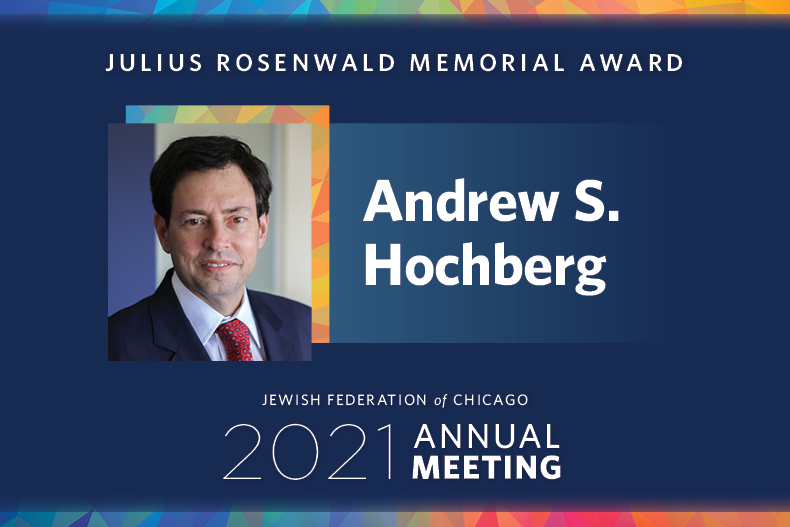
Meet Andrew S. Hochberg, 2021 Julius Rosenwald Memorial Award recipient
Celebrate Andy Hochberg at the virtual Annual Meeting on Sept. 14
Read more -
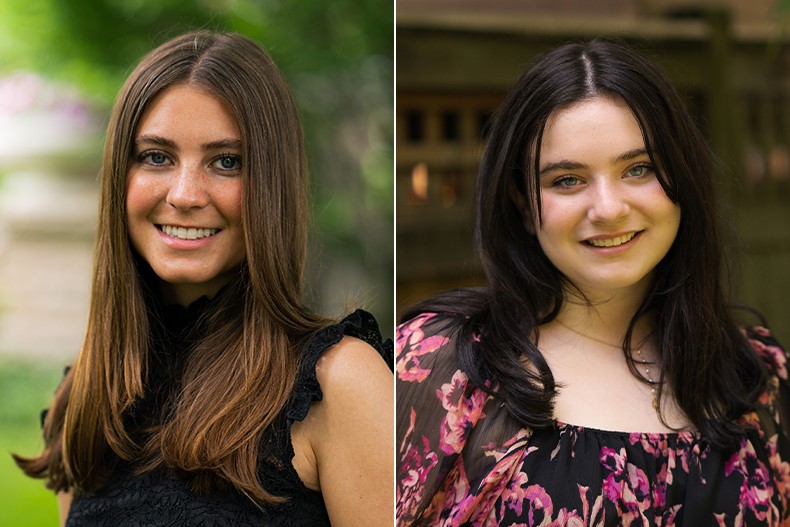
Two local teens win national recognition
Recipients of the annual Diller Teen Tikkun Olam Awards
Read more -
Celebrating six young award winners cultivating the community
Introducing young adult award winners
Read more
2014 Lewis Summer Intern Program Orientation: Building community and Jewish identity
SHIR AVINADAV
In June, the interns of JUF’s 2014 Lewis Summer Intern Program, an eight-week work/study internship program created by The Hillels of Illinois and funded by the Harriet and Maurice Lewis Family, began their first day of orientation. The 2014 cohort was given the morning to become acquainted with one another before being introduced to several speakers, including JUF Chief of Staff Jim Rosenberg and Andrea Hoffman, executive director of Newberger Hillel.
Although the topics varied, one theme was common throughout the presentations: the strength of the Jewish community and the interns’ role as part of it. Rosenberg identified the two fundamental goals of the Federation as “building community and helping people” and encouraged the interns to contribute to this mission in their own way throughout the summer. Hoffman’s discussion of Jewish meaning centered around teaching the interns the recipe to a meaningful Jewish experience by building relationships, gaining knowledge, creating meaningful memories, and building community.
The first day also addressed professional development through activities such as speed networking, where the interns had one minute to introduce themselves to one another and identify a common interest or skill. Aleen Bayard, of MarketZing, gave a presentation about varying communication methods in the workplace and how to tailor their own communication styles to complement their supervisors.
The second day of orientation took place at Pushing the Envelope Farm in Geneva, Illinois. The community farm and education center, rooted in Jewish tradition, gave the interns a chance to put Hoffman’s recipe for a meaningful Jewish experience to the test by introducing them to sustainable farming practices that not only uphold Jewish tradition, but also contribute to the local community, just as the JUF does.
The interns were taken around the farm where they saw a sukkah tucked away in a wooded area of the 14-acre site and interacted with goats and hens on the farm. Later in the day, the interns learned to make pita, hummus, and candles and enjoyed a farm-fresh meal prepared by the incredible staff at the farm. The final activity before boarding the train back to the city involved teaching the interns what it means to build and sustain a community based on Jewish traditions and values. The interns were divided into groups in which they had to make decisions on how to construct and maintain their cities in accordance with Jewish values, while given a budget and limited options.
The third and final day of the LSIP orientation had a more somber tone. The cohort met at the Illinois Holocaust Museum and Education Center where they were gifted an entire day, including a tour of the museum and a presentation by George Brent, a Holocaust survivor originating from Hungary. The interns also learned more about the museum’s role in the Jewish community and in helping survivors pass on their legacy to educate younger generations.
Despite the inherent solemnity of reliving the events of the Holocaust, the tour contained an important message of hope: to defend those in our community to ensure that such events never take place again, impressing upon the interns that they have a responsibility to the Jewish community. Once the day neared its end, the interns were given the opportunity to reflect on their day and on their overall orientation experience.
With orientation behind them, the interns prepare to take on the summer and make their experience at JUF not only meaningful for themselves, but for the Jewish community as well.
Shir Avinadav is a Lewis Summer Intern.The Harriet & Maurice Lewis Summer Intern Program is part of the department of Campus Affairs and Student Engagement at Jewish Federation of Metropolitan Chicago/Jewish United Fund.
Big Tent Judaism-Chicago and nine area organizations are hosting “Sunday in the Park with Bagels,” a free, family-friendly event on Sunday, June 29, that takes participants on a tour of the Jewish calendar through food and activities. This interactive program for families with young children will take place from 10 a.m.-1 p.m. at Deerpath Park, 299 Onwentsia Road, Vernon Hills.
Children and parents alike will learn about Jewish holidays in a creative and fun way; event-goers will have the opportunity to experience various Jewish holidays through food samples and hands-on activities at booths set up south of the main parking lot at the park.
Big Tent Judaism-Chicago is teaming up with area Jewish organizations to bring this program to Vernon Hills. Volunteers from Congregation Beth Judea, Congregation Or Shalom, InterfaithFamily Chicago, Jewish Community Center of Chicago, Jewish Child & Family Services, Jewish United Fund, and Reform Jewish Chicago will host the holiday booths. Some of the holidays highlighted include Chanukah, Rosh Hashanah (the Jewish new year), and Passover, which will be hosted by Pushing the Envelope Farm.
A community farm and education center rooted in Jewish tradition, Pushing the Envelope will be offering participants a hands-on charoset (apple and nut salad eaten at Passover)-making experience using a bicycle-powered blender. Other booths will have activities such as face-painting, clay pot-decorating with a seed packet giveaway, as well as other crafts. In addition, witty and family-friendly puppeteer Marilyn Price will perform a fun-filled show at 11 a.m.
Alyssa Latala, Big Tent Judaism Coordinator for Chicago, has been preparing for this event for several months. “I’m so excited to bring Sunday in the Park with Bagels to the Chicago area. It is a fun, hands-on, approachable way for families with young children to experience a taste of Jewish culture. Between the food, the music, and the crafts, there’s something for everybody,” Latala said.
Sunday in the Park with Bagels was developed by, and is offered in partnership with, Big Tent Judaism/Jewish Outreach Institute. Big Tent Judaism is an independent, national, trans-denominational organization that reaches out to unaffiliated and intermarried families, and helps the Jewish community better welcome them in. Sunday in the Park with Bagels is one of several Public Space JudaismSM programs, a series of free programs developed by Big Tent Judaism to help Jewish communities engage newcomers by meeting them where they are in public secular spaces.
Other stories
-
Meet Andrew S. Hochberg, 2021 Julius Rosenwald Memorial Award recipient
Celebrate Andy Hochberg at the virtual Annual Meeting on Sept. 14
Read more -
Two local teens win national recognition
Recipients of the annual Diller Teen Tikkun Olam Awards
Read more -
Celebrating six young award winners cultivating the community
Introducing young adult award winners
Read more
Francis Cardinal George, Rabbi Herman Schaalman and Ilene Shaw to receive Interreligious Leadership Award
The Council of Religious Leaders of Metropolitan Chicago will present the Interreligious Leadership Award to three distinguished individuals: His Eminence Francis Cardinal George, Rabbi Herman Schaalman, and Ilene Shaw, in recognition of their unique contributions to interreligious relations in the Chicago area.
This inaugural event will take place on Thursday, June 19 with a reception from 4:30-6:30 p.m. at the law firm of Jenner & Block, 353 N. Clark Street, Chicago.
His Eminence Francis Cardinal George, Archbishop of Chicago, has actively served as a member of the CRLMC since 1997. During his ministry he has emphasized the positive role of religion in American life, service to the community and promoted interreligious dialogue.
Rabbi Herman Schaalman, a long-standing and dedicated member of the CRLMC, has devoted his life to promoting interfaith understanding and dialogue. Through his work in educational, civic and religious organizations, he has become one of the most respected rabbis to serve Chicago’s Jewish community.
Ilene Shaw, under the auspices of the CRLMC, has made possible the production of an InterFaith Calendar featuring 17 different faith traditions describing their basic tenets, beliefs and observances. The calendar is recognized nationally as an excellent vehicle to promote interfaith understanding and respect.
CRLMC, a non-profit organization, is comprised of the head religious leadership of practically every religious tradition in the broader Chicago area, representing nearly six million people. Through its work, the CRLMC speaks with a unified moral voice on the issues of the day, creates a climate of better interfaith understanding and cooperation, and participates in programs which advance its work.
Other stories
-
Meet Andrew S. Hochberg, 2021 Julius Rosenwald Memorial Award recipient
Celebrate Andy Hochberg at the virtual Annual Meeting on Sept. 14
Read more -
Two local teens win national recognition
Recipients of the annual Diller Teen Tikkun Olam Awards
Read more -
Celebrating six young award winners cultivating the community
Introducing young adult award winners
Read more
Give a bunch of teens $25,000 and remarkable things can happen.
That’s exactly what Voices: The Chicago Jewish Teen Foundation has been doing each year for the past decade. The Jewish United Fund of Metropolitan Chicago project puts high school students in full control of their own charitable foundation, teaching them the ins and outs of philanthropy and opening their eyes to needs they never imagined, all while confronting them with the challenges that build leaders.
The latest cohorts just allocated $53,114 in grants to local and international causes, bringing the total to more than $336,000 and nearly 250 teen funders over the past 10 years.
“Through our grants, we helped hundreds of people in need, and helped promote causes that will have a huge impact in Chicago and around the world,” said Quincy Hirt, a freshman at the city’s Whitney M. Young Magnet High School. “Voices helped me see how much of a difference a 15-year-old kid can really make.”
“This accomplishment is not only remarkable for a group of Jewish philanthropists at any age,” said Stephanie Goldfarb, Senior Associate of Youth Initiatives at JUF, “but it also signifies our community’s increasing commitment to pluralistic teen engagement, and investment in our future leaders. I could not be more proud. Mark my words, you will be seeing some of these teens in JUF board rooms in the coming years!”
The Voices program is made up of two independent foundations. Through the Voices 101 Foundation, a group of 25 high school students from around the Chicago area learn the nitty gritty of grant making. They begin with $25,000 in seed money – an annual gift from an anonymous JUF donor – and raise additional funds throughout the year. Then, as a team, they conduct community needs research, perform due diligence, write grant guidelines and Requests for Proposals, take part in site visits, and learn to advocate, negotiate and collaborate to make strategic allocations at the completion of the program year.
The following year, the teens have the option to participate in the Voices Alumni Foundation, where they translate what they’ve learned into more specialized and focused philanthropic work – including raising every dollar they allocate, and mentoring the Voices 101 teens.
“This program has taught me all the nuts and bolts about grant giving,” said Mari Hattenbach, a junior at Deerfield High School. “Before this program, I can’t say that I knew much about the process of funding an organization, but now, I feel like a pro!”
Even as adults, alums of the program credit Voices with shaping their career paths and helping them develop a lifelong commitment to philanthropy.
“Ten years later, my Voices experience resonates with me,” said Xani Pollakoff, now 26, who participated in the first cohort of Voices when she was a student at Highland Park High School. “I just finished my third year as a facilitator for a teen philanthropy program through the Jewish Federation of Greater Washington. Voices helped guide my Jewish path and my impact on our greater community.”
A full list of this year’s grantees is below:
Voices 101 Foundation 2014 Grants (Total: $31,749)
$5,974 to Keshet for the Giving Adults Daily Opportunities for Living Healthy Lifestyles (GADOL) Program:
Keshet offers a wide range of educational, vocational and recreational services for individuals with developmental and intellectual disabilities. The Voices grant will support a healthy living program for adults over the age of 22.
$8,000 to Tel Aviv Cinematheque for The Cinema as an Agent of Change Program:
The Tel Aviv Cinematheque increases awareness of cinema as an art among the general public. The Voices award will support an educational program for 15 Arab and 15 Jewish Israeli teenagers to work together to create a film promoting the values of tolerance, coexistence and mutual understanding.
$5,615 to Maot Chitim for the Holiday Food Delivery Program:
Maot Chitim delivers close to 5,000 food boxes (serving nearly 12,000 people) to needy Chicago-area Jews just before the High Holidays and Passover. Support from Voices will provide chicken for 1,000 food packages or eggs for 2,500 packages.
$5,060 to the Chicago Chesed Fund for the Expansion of Clothing Basics for Low-Income Children Program:
The Chicago Chesed Fund provides immediate assistance to Jewish families in need throughout metropolitan Chicago. Funding from Voices will help the organization provide critical items such as undergarments, socks and shoes for hundreds of local children.
$6,100 to the EZRA Multi-Service Center for the JUF Uptown Café and Food Pantry Program:
EZRA meets the needs of economically disadvantaged individuals living on the north side of Chicago. It is the only Jewish social service agency in the Uptown neighborhood, and aims to restore the dignity and quality of life of individuals and families of all faiths living below or at the margins of poverty. Support from Voices will provide around 300 pounds of frozen and canned food and around 400 hot kosher meals for clients of the Uptown Café.
$1,000 to the Jewish United Fund Annual Campaign:
The Jewish United Fund’s Annual Campaign focuses on helping people in need, rescuing people in danger, and keeping Jewish life strong. Voices dollars will go to JUF programs that care for 300,000 Chicagoans of all faiths, and 2 million Jews in Israel and around the world.
Voices Alumni Foundation 2014 Grants (Total: $21,365)
$3,806 to Jewish Child & Family Services for the JCFS Group Respite Program:
JCFS provides help, healing and caring services infused with Jewish values to Chicago’s diverse community. Support from the Voices Alumni Foundation will provide respite services to families caring for members with special needs.
$5,171 to Hand in Hand for the Scholarships for Jewish and Arab Students in Jerusalem Program:
Hand in Hand builds coexistence and partnership between Jewish and Arab citizens of Israel through the creation of integrated, bilingual schools. Voices support will provide scholarships to many students who otherwise would be unable to attend.
$4,700 to Temple Sholom for Eco Chavura’s Composting Program:
Temple Sholom is a leading center for Reform Jews who seek to develop and enhance their Jewish identity through worship, education, cultural heritage, social interaction, concern for the state of Israel, and community involvement. Voices funding will help the temple pilot a new composting program aimed at reducing waste and raising environmental awareness.
$6,688 to Jewish Vocational Services for the Ready…Set…WORK Program:
JVS improves life through employment and productivity for Jews living in Chicago. Voices funding will allow five chronically ill youth from Ann and Robert H. Lurie Children’s Hospital to explore their career aspirations and enjoy a paid work experience in a career path that meets their interests and abilities.
$1,000 to the Jewish United Fund Annual Campaign:
The Jewish United Fund’s Annual Campaign focuses on helping people in need, rescuing people in danger, and keeping Jewish life strong. Voices dollars will go to JUF programs that care for 300,000 Chicagoans of all faiths, and 2 million Jews in Israel and around the world.
For more information about the Voices program, please visit http://www.juf.org/teens/voices.aspx or contact Stephanie Goldfarb at 312-444-2802 or [email protected].
Other stories
-
Meet Andrew S. Hochberg, 2021 Julius Rosenwald Memorial Award recipient
Celebrate Andy Hochberg at the virtual Annual Meeting on Sept. 14
Read more -
Two local teens win national recognition
Recipients of the annual Diller Teen Tikkun Olam Awards
Read more -
Celebrating six young award winners cultivating the community
Introducing young adult award winners
Read more
Words and pictures, lyrics and silence – oh, and puppets, too – all will be part of the next season of cultural programming getting a boost from the Jewish Federation of Metropolitan Chicago’s South Suburban Mini-Grant Program.
This fourth round of funding, which will provide a total of $16,000 to 13 widely varied projects, continues the Federation’s three-year-old effort to kick-start expanded cultural, religious and educational opportunities in Southland communities. Proposals from area Jewish organizations were reviewed by a group of local residents – the South Suburban Kehillah – who awarded the small grants that will help make the projects happen.
The newest programs range from biblical to contemporary, and include events on the Song of Songs, modern Israeli filmmaking, the opening of a new community school, Jewish law in the 21st century, and Jewish war veterans.
The full list of programs, which begin this summer, includes:
- Biblical Literature Series – Focusing on the Book of Proverbs, Book of Daniel and the History of Bible Translations. Presented by: Congregation Am Echad
- Halacha (Jewish law) in the 21st Century – A weekend exploration of the development of Jewish law over time, and Jews’ contemporary relationship with it. Presented by: Congregation Am Echad, B’nai Yehuda Beth Sholom, Temple Anshe Sholom
- Lazarus Straus Family History and the Straus’ Relationship with Anne Frank’s Family – From Germany to Georgia, then New York City. Through the generations. Presented by: B’nai Yehuda Beth Sholom, Congregation Am Echad
- Isaiah: A Prophet of the Past & Future. Presented by: B’nai Yehuda Beth Sholom
- Israeli Film/Discussion – Featuring three films by Israeli graduate film students. Presented by: Jewish Community Center
- The Song of Songs – A four-session text study. Presented by: Jewish Community Center
- In Other Words: Miriam Talks Back – A fresh look at scriptures through poetry. Presented by: National Council of Jewish Women South Cook Section
- Do Not Stand Idly By – A program on practices that could be employed by government and manufacturers to reduce gun violence. Presented by: National Council of Jewish Women South Cook Section, 7:30 p.m. Wednesday, July 9, B’nai Yehuda Beth Sholom/Congregation Am Echad
- The Sounds of Silence – A Shabbat evening service offering new understanding of the prayers, through music coupled with silent prayer. Presented by: Temple Anshe Sholom
- Marilyn Price Puppets and Chanukah. Presented by: Beit AmiChai Community School
- Beit AmiChai Community School Opening Day – A first-day program engaging families and students in the opening of the new school. Presented by: Beit AmiChai Community School
- Jewish War Memorial Trip – Visits to a large Jewish memorial in Hillside and a museum in Winfield devoted to an infantry division that historically had many Jewish soldiers. Presented by: Jewish War Veterans
- Purim Party – An expanded regional teen event celebrating the Jewish holiday. Presented by: BBYO
Mini-grant proposals are reviewed and selected by Janet Herbstman (co-chair), Gayla Cahan (co-chair), Mark Fine, David Lebowitz, Bonnie Ribet and Dr. David Gottlieb. The Kehillah is staffed by Alene Rutzky, Jewish Federation South Suburban Office coordinator.
For more information, contact Alene Rutzky at (708) 798-1884 or [email protected].
Other stories
-
Meet Andrew S. Hochberg, 2021 Julius Rosenwald Memorial Award recipient
Celebrate Andy Hochberg at the virtual Annual Meeting on Sept. 14
Read more -
Two local teens win national recognition
Recipients of the annual Diller Teen Tikkun Olam Awards
Read more -
Celebrating six young award winners cultivating the community
Introducing young adult award winners
Read more
After six months of fellowship and training, 15 JCC PresenTense Chicago entrepreneurs will showcase their business ventures at “Launch Night” this Thursday, June 12, at Mayne Stage, 1330 W. Morse Avenue. The doors open at 6:15 p.m. for networking. At 7 p.m., the fellows will pitch their ventures. From 8-9 p.m., a business expo will be held where attendees can review projects more closely. The public is invited to this free event. Kosher appetizers and a drink ticket are included. To register, visit: www.gojcc.org/PresenTense.
The 15 JCC PresenTense Chicago entrepreneurs are Sarah Abbott, Miriam Ament, Cassandra Dara-Abrams, Laurel Grauer, Assaf Grumberg, Aimee Halstuk, Alex Isaacson, Beth Jacobson, Marnie Kalfen, Jessica Katz, Alexey Kudashev, Elisa Lupovitch, Devorah Richards, Keri Rosenbloom and Wendy Singer.
“As both Manager of the program and a 2012 Fellow, I know that a supportive community of bold thinkers can change the status quo, improve the quality of life in Chicago and impact the world,” said Becky Adelberg JCC PresenTense Chicago manager, 20-30s. “If you are inspired by our Fellows’ ideas, visit our Web site to learn more, volunteer as part of our team, or join us at an upcoming event.”
JCC PresenTense Chicago is a largely volunteer-run community of local innovators and entrepreneurs, creators and educators, investing their talent and energy to foster the next generation of social entrepreneurs and revitalize the Jewish community. Volunteers are needed for next year’s Advisory Board, mentors and coaches. Applications for the 2015 JCC PresenTense Chicago fellowship will be available in mid-August.
Other stories
-
Meet Andrew S. Hochberg, 2021 Julius Rosenwald Memorial Award recipient
Celebrate Andy Hochberg at the virtual Annual Meeting on Sept. 14
Read more -
Two local teens win national recognition
Recipients of the annual Diller Teen Tikkun Olam Awards
Read more -
Celebrating six young award winners cultivating the community
Introducing young adult award winners
Read more
The Board of Directors of Sinai Health System last week announced that Karen Teitelbaum will become president and CEO, effective July 1. Teitelbaum takes the helm at the 695-bed hospital group following a decade of leadership from Alan Channing who announced his retirement this spring.
Teitelbaum has served as executive vice president and chief operating officer at Sinai for nearly seven years, where she has focused on strengthening operations, quality, safety and business development for the health system, which includes Mount Sinai Hospital, Sinai Children’s Hospital, Schwab Rehabilitation Hospital, Holy Cross Hospital, Sinai Urban Health Institute, Sinai Community Institute, and Sinai Medical Group. During her tenure, Sinai has received national and statewide recognition for clinical excellence as well as its innovative urban health programs, which translate research in social, economic and health disparities into holistic prevention and wellness programs that improve health as well as quality of life.
“We are very fortunate to have a proven leader in Karen, already profoundly invested in Sinai and the community,” said Gary Niederpruem, chairman of the Board of Sinai Health System. “Her strong health care experience and business acumen, coupled with a deep passion for making a difference in the communities we serve, make her the right person to lead Sinai forward during this dynamic period of change and transformation in health care delivery. As health care in the United States begins to more closely resemble the type of care Sinai has always delivered, Karen is uniquely qualified to guide our organization forward to continue changing lives for the better.”
Serving Chicago’s west and south side communities for nearly 100 years, Sinai has been expanding its service area and now reaches almost 1.5 million people annually. Its recent merger with Holy Cross Hospital created a unique Jewish-Catholic partnership united in a mission to bring quality, compassionate health care and social services to some of Chicago’s most economically challenged communities.
“We know that quality health care has the power to transform communities. What distinguishes Sinai is our work to make lives better by also addressing the non-clinical issues that impact health care disparities like access to jobs, interrupting violence and improving neighborhood safety,” said Teitelbaum. “Through our Sinai Community Institute and our Urban Health Institute, we never stop working to better understand the needs of our community, provide beneficial community programs, and turn urban epidemiological findings at the neighborhood level into innovative treatment.”
While Sinai is known for its expertise in trauma care, Sinai’s expansive network also provides top specialty services at its hospitals and clinics, from neonatal intensive care to advanced oncology programs. System wide, Sinai has 4,000 caregivers, including 800 physicians, 695 licensed beds, 100,000-plus annual emergency department visits, and eight physician training programs.
In fact, Teitelbaum receives her health care from providers and hospitals throughout Sinai Health System.
Teitelbaum, 57, came to Sinai with deep and broad leadership experience in nearly every sector of health care. She began as a clinician, a speech language pathologist, and went on to own and sell her own physical rehabilitation agency. Teitelbaum’s career has included strategic planning, medical staff development and managed care contracting at both teaching and community hospitals. She was a senior executive for a network of 12 Catholic hospitals, directed channel and customer marketing for a major pharmaceutical company, and led business development and operations for a number of Chicagoland hospitals.
Teitelbaum earned her Bachelor of Arts degree from the State University of New York, and a Master of Arts in Speech and Language Pathology and a Master of Management degree from Northwestern University. A native of New York, she has made Chicago her home ever since graduate school.
Teitelbaum is active in many civic and health organizations nationally and locally. She is an immediate-past member of the Maternal and Child Health Committee of the American Hospital Association. She was the chair of the Building Committee for the Lawndale Christian Health Center, and serves on the boards of the Lawndale Business Renaissance Association and the Metropolitan Chicago Healthcare Council.
Other stories
-
Meet Andrew S. Hochberg, 2021 Julius Rosenwald Memorial Award recipient
Celebrate Andy Hochberg at the virtual Annual Meeting on Sept. 14
Read more -
Two local teens win national recognition
Recipients of the annual Diller Teen Tikkun Olam Awards
Read more -
Celebrating six young award winners cultivating the community
Introducing young adult award winners
Read more
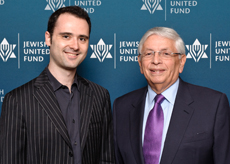
David Stern, former NBA commissioner, speaks to TIP dinner of 1,600 JUF supporters
CINDY SHER
David Stern, the recent former commissioner of the NBA, regaled a crowd Monday of 1,600 people at the JUF’s Lawyers & Government Officials, Foods & Hospitality and Wholesalers, Retailers & Manufacturers Divisions Dinner, the last trade dinner of the season.
As commissioner for 30 years until stepping down in February, Stern helped shape American basketball into the highly profitable sport it is today, with broad national and global appeal. After Stern spoke to the crowd, he answered questions by Jerry Reinsdorf, the owner of the Chicago Bulls and White Sox.
Violinist David Lisker also spoke at the event about the many ways his family was helped through the network of JUF agencies when they emigrated to the States from Russia when he was a boy.
In Stern’s remarks, he said he had the greatest job in the world as NBA commissioner because he had so many opportunities, including traveling the world, and befriending people like the late Nelson Mandela.
Stern expressed his love for sports, and the basketball in particular, pointing to a few aspects:
First, sports level the playing field. “Sports are egalitarian,” Stern said. “It doesn’t matter where you come from and who you are, only that you have game.”
Second, he loves that every single NBA team in America plays in beautiful, newly renovated stadiums, all built since 1987, he said.
Finally, he said he’s impressed by the phenomenon of sports marketing. “Michael Jordan exploded the notion,” Stern said, “that great athletes of color couldn’t be a…spokesperson.”
On the negative side, he said, sports still suffer from racism and anti-Semitism. For instance, after the professional basketball team Maccabi Tel Aviv won the Euroleague championship earlier this month, Stern read all kinds of anti-Semtic comments in the Twitterverse.
His worst moment in his career, he said, was when his friend Magic Johnson revealed he was HIV-positive. “We thought he was going to die,” Stern said. Instead, though, Johnson “changed the debate…through sports” in a positive way.
As for the elephant in the room–banned Los Angeles Clippers owner Donald Sterling–a cautious Stern read what seemed to be his only prepared notes of the night: “[Regarding] the LA Clippers affair, where secretly recorded tapes were released, that let to censure, banishment, sale, and litigation,” Stern said. “…I guess I would say don’t judge a league by any of its problems. Judge it by their reactions to them.”
He told the room full of lawyers that that’s all he wanted to say on the matter since “I used to be a lawyer.”
Other stories
-
Meet Andrew S. Hochberg, 2021 Julius Rosenwald Memorial Award recipient
Celebrate Andy Hochberg at the virtual Annual Meeting on Sept. 14
Read more -
Two local teens win national recognition
Recipients of the annual Diller Teen Tikkun Olam Awards
Read more -
Celebrating six young award winners cultivating the community
Introducing young adult award winners
Read more
At Shavuot, celebrating the giving of the law — and the mother-in-law?
EDMON J. RODMAN
In the Ten Commandments, the Torah tells us to “Honor your father and your mother,” but on mothers-in-law, it’s mum. That is until we come to the two-day holiday of Shavuot and read the Book of Ruth, which records the relationship between Ruth and her mother-in-law Naomi.
Since Shavuot celebrates the giving of the Torah, and in Ruth we can observe another form of giving — that of loving familial support — we can use the holiday to explore the give-and-take of the mother-in-law/daughter-in-law relationship. It’s a relationship often marked in our times by tension, hackneyed jokes and even cartoon strips such as Mell Lazarus’ “Momma.” Sons-in-law, of which I am one, don’t feel left out, as there is much for them to take away, too.
An in-law bond is knit when Ruth (whose husband has just died) says to Naomi, who has just tried to convince her to return to her homeland, “Do not urge me to leave you, to turn back and not follow you. For wherever you lodge, I will lodge, your people shall be my people, and your God my God.”
Though beautiful in sentiment, for some — myself included — it also seems like a size-too-small sweater, leaving little room for movement.
“What about the freedom to live the life my spouse and I want?” I can remember thinking soon after tying the knot 32 years ago. “What does my mother-in-law have to do with that?” I foolishly thought.
Apparently it’s a question many of us have failed to examine carefully, as websites are filled with tales of mother-in-law woe about intrusive and too frequent visits, and unasked-for advice, especially about child rearing.
“She comes over four to five times a day which started right after we got married,” begins a letter in an advice column tagged “Mother-in-Law from Hell” on the Aish.com from a woman who has been married for eight years. Another letter in the “Dear Rachel” column on Chabad.org begins, “My mother-in-law is constantly criticizing me and my ability to parent.”
Marilyn Kagan, a Los Angeles therapist with over 30 years of experience counseling individuals and couples, as well as teaching a groundbreaking course at the American Jewish University here called “Marriage for Life” (formerly “Making Marriage Work”) has seen her share of tumultuous relationships whose discord is rooted in in-law issues.
“How can you be more compassionate?” is a question Kagan counsels wives to ask when they are having differences with their mothers-in-law. “Put yourself in your mother-in-law’s shoes,” she advises, “she’s losing the definition of what she’s been doing much of her adult life.” Kagan says she also wants the daughter-in-law to realize that she’s the one who “sets the home life and that has to be respected.”
When problems begin to build, Kagan says, “sometimes you need to say, ‘Mom, let’s get together and talk.’ ” For a script she suggests beginning with something like, “I know you love your son and I am grateful for this human being, and I know that you and I want the best for our family,” before speaking about a specific problem.
As for the husband, who is often caught between his wife and mother, Kagan suggests that “men need to take a deep breath. They can’t withdraw like a turtle.”
For a husband to choose between a wife and a mother “makes them feel like bad boy,” says Kagan, who hosted a Los Angeles radio call-in counseling show and a television show on the Disney affiliate here in the 1990s. Instead, she says, “a husband needs to be a big boy.”
“I got into the middle of things when my mother was critical of how we were raising our kids,” I respond, suddenly feeling defensive about my mother, who of course was perfect.
Jewish men who are first generation in the United States can “get stuck in both worlds,” Kagen says. In such cases, she suggests a team approach: The husband must go to his wife “for guidance” on how to approach the mother-in-law.
“Be a united front,” says Kagan, who with therapist Neil Einbund wrote the book “Defenders of the Heart.”
Too many visits to the in-laws? For those who go to the mother-in-law’s every week, she wonders, “Why not set up your own rituals and invite her over?”
As to conflicts over in-laws giving stuff to your kids on your do-not-serve list, Kagan observes, “If grandma is going to give their grandchild some ice cream, it’s not going to kill them. Yours is the house in which the fire burns, why the power struggle?”
And as if asking us all to be a little more Ruth-like in our responses to what might seem like potential mother-in-law conflict, Kagan counsels first thinking, “Let’s see if we can find a way to make this work.”
(Edmon J. Rodman is a JTA columnist who writes on Jewish life from Los Angeles. Contact him at [email protected].)
Other stories
-
Meet Andrew S. Hochberg, 2021 Julius Rosenwald Memorial Award recipient
Celebrate Andy Hochberg at the virtual Annual Meeting on Sept. 14
Read more -
Two local teens win national recognition
Recipients of the annual Diller Teen Tikkun Olam Awards
Read more -
Celebrating six young award winners cultivating the community
Introducing young adult award winners
Read more