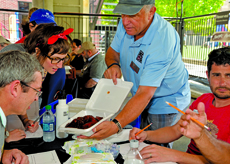
I am from the Southeastern part of Arkansas known as the Delta. This area of the South is famous for a lot of reasons. It is home to the world’s largest rice mills, the World Championship Duck Calling Contest, and just about all of the blues music you’ve ever heard. While the reasons for paying attention to this little corner of the South are endless there is one fact that should be noted above all others: we are very serious about BBQ.
Like many of the people where I’m from, some of my earliest memories involve gorging myself on enough BBQ to end up wearing it. BBQ sandwiches with a layer of coleslaw (it’s a Delta thing) were among some of the first solid foods I remember putting in my mouth. With this sort of personal history, you can see where I might have been a bit skeptical to attend a kosher BBQ festival all the way up here in Chicago.
Once I got my judge-y little Southern taste buds to Anshe Emet’s fabulous bricked-in parking lot on June 1 for the first ever Chicago Kosher BBQ Festival and Competition, my focus quickly turned from food to people. With more than 1,500 people in attendance the festival on June 1, the real magic of the event was how it brought all sorts of Jews and non-Jews together. We were all represented. I saw everyone from Orthodox Jews to Jews with tattoos and everyone else along the Jewish spectrum.
There was a fascinatingly diverse mix of people represented and that made me feel like the event was a success before a piece of brisket crossed my lips. The old saying, “two Jews, three opinions” was clearly not dreamed up at a Kosher food festival. Jews might have a lot of opinions, but when it comes to food we have only one thought, “Let’s eat!”
The event, hosted by Milt’s Barbecue for the Perplexed, Anshe Emet Synagogue, and the Barnard Zell Anshe Emet Day School-and media sponsor JUF News-was supervised by the Chicago Rabbinical Council. Ingredients were provided for the teams and a mashgiach (kashruth supervisor) who was present throughout the process. The fourteen teams competing for trophies for Best Brisket, Best Ribs, Best Chicken, Most Original Team Name, Best Booth Decoration, and Grand Champion (so many categories!) met at Milt’s on Friday afternoon to prepare their meats and then again after Shabbat in the Anshe Emet parking lot to smoke their food overnight. The JUF News team “Meat the Press” received third place for Best Chicken and second place for Best Brisket. Team “Farbreng It” was the overall festival champion having placed first in Best Ribs and Best Brisket.
Once the gates were open on Sunday morning, festival-goers were able to visit the various team booths and cast their votes for best team name and best booth decoration. And what fun that was! Though, if you’re like me, you might have been expecting to eat your weight in brisket, chicken and beans and then vote for your favorites. Apparently health rules and regulations forbid competitors from sharing food with the public. Disappointing news for sure, but once I saw the list of judges included Stephanie Goldfarb, winner of the Food Network’s “America’s Best Cook” I felt like the competition was in capable enough hands.
Not to worry, there were other delicious food options to keep me and the other festival attendees busy. Milt’s Barbecue for the Perplexed, named Joy of Kosher’s Restaurant of the Year and listed as one of UrbanSpoon’s Best New Restaurants, was on hand with a food truck. Their brisket sandwiches are to die for and they even offered a coleslaw side so I could calm my inner Southerner. BBQ isn’t your thing? (What’s wrong with you?) Milt’s was prepared. They offered other choices including burgers, hotdogs and even
seitan sandwiches.
If you’re not part of the multitudes obsessed with food and cooking competitions you weren’t hurting for entertainment. There was a merry-go-round powered by bicycles and manned by two men cooking on 10 grills, which was surely enough to keep you enthralled. If you needed something a little more stimulating the festival offered a basketball skills competition, kids’ play zone, face painters, a magician, various music acts and my personal favorite – food eating competitions. I saw a grown man eat pickles as if his life depended on it. I’m not sure I’ve ever laughed so hard.
Mazel tov to the organizers of this event. What a brilliant way to bring our very diverse communities together-there might not be a better way than food. I certainly hope that the first annual Chicago Kosher BBQ Festival and Competition will not be the last. I’ve already started following them on Facebook so that I can put next year’s date on my calendar as soon as it’s picked. You should do the same!
Jeremy Owens, a proud barbecue connoisseur, is the curator and host of You’re Being Ridiculous (yourebeingridiculous.com) and a writer for Oy!Chicago and Gapers Block.
Other stories
-
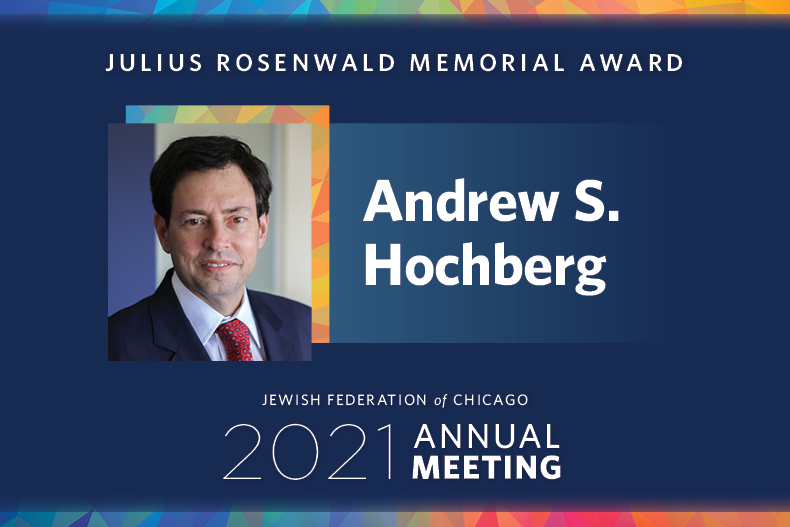
Meet Andrew S. Hochberg, 2021 Julius Rosenwald Memorial Award recipient
Celebrate Andy Hochberg at the virtual Annual Meeting on Sept. 14
Read more -
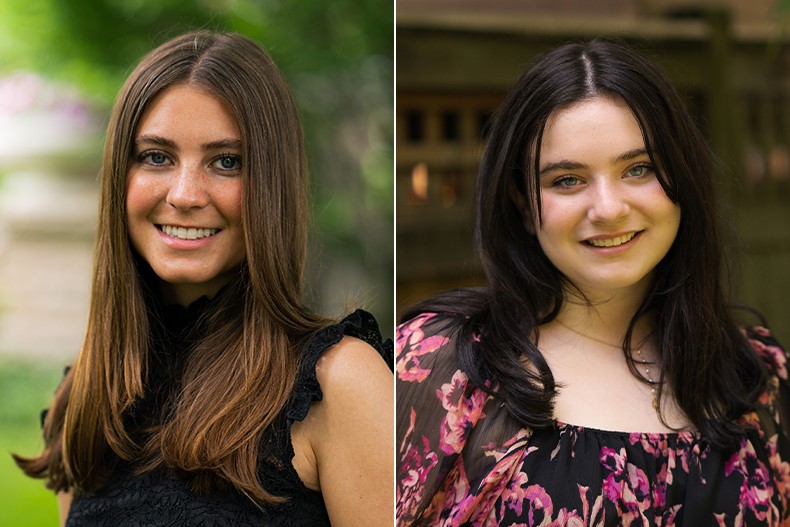
Two local teens win national recognition
Recipients of the annual Diller Teen Tikkun Olam Awards
Read more -
Celebrating six young award winners cultivating the community
Introducing young adult award winners
Read more
Chicago’s Center for Jewish Genetics pioneers new era in community genetics screening
ALYSSA COHEN
The test to detect genetic risks in future children has been transformed. And Chicago’s Center for Jewish Genetics is the first and only community screening program in the nation to offer it exclusively.
The new Counsyl 2.0 test uses the advanced technology of DNA sequencing, along with the widely used technique of genotyping, to identify whether a person carries any of a wide range of genetic mutations that could put their offspring at risk of major disorders. And, unlike traditional tests that have required a blood sample, Counsyl 2.0 uses only saliva.
As a result, testing is now more accessible, convenient and confidential. The Center now can offer individuals and couples at-home education and genetic counseling prior to the subsidized screening, via live webinars and one-on-one phone calls with a genetic counselor. Participants then receive their saliva test at home, along with a pre-addressed box for sending it back. Once the sample has been analyzed, the Center’s genetic counselor will follow-up to discuss the results.
“Carrier screening for high-risk groups provides individuals and couples with potentially life-saving information, but it typically is very expensive,” said Dr. Joel Charrow, Center for Jewish Genetics Board of Directors member and head of the Division of Genetics, Birth Defects and Metabolism at Ann & Robert H. Lurie Children’s Hospital of Chicago. “Now, the Center is able to offer education, counseling and subsidized screening to individuals throughout the state with the use of DNA sequencing on saliva, at a cost that puts it within financial reach of many more people.”
There are two types of genetic tests, genotyping and sequencing. Genotyping looks for known mutations that are common in a certain population. Sequencing looks at the entire gene and identifies every mutation. The change to sequencing is increasingly important in a melting-pot society where family backgrounds vary and genotyping may not be as successful in identifying a carrier. Counsyl 2.0 offers both genotyping and with sequencing.
With the change to Counsyl 2.0, the Center leads community screening programs by offering participants the most advanced screening option available, in the convenience and privacy of their own home-all with a small sample of spit.
One in four individuals of Jewish descent is a carrier of one of the 19 genetic disorders that are significantly more common in the Jewish population-including Tay-Sachs disease, Gaucher, and Canavan, among others. Carriers typically are healthy, but their future children could be at risk for being affected by the disorder. The Center screens individuals and couples so they have the necessary tools to make informed family planning decisions. With the change to live-webinars and sequencing, the Center is now able to offer its subsidized service to those across the state of Illinois.
The Center for Jewish Genetics is a cooperative effort of the Jewish United Fund/Jewish Federation of Metropolitan Chicago and the Ann & Robert H. Lurie Children’s Hospital of Chicago.
Alyssa Cohen is the Strategic Communications Coordinator for the Center for Jewish Genetics.
Other stories
-
Meet Andrew S. Hochberg, 2021 Julius Rosenwald Memorial Award recipient
Celebrate Andy Hochberg at the virtual Annual Meeting on Sept. 14
Read more -
Two local teens win national recognition
Recipients of the annual Diller Teen Tikkun Olam Awards
Read more -
Celebrating six young award winners cultivating the community
Introducing young adult award winners
Read more
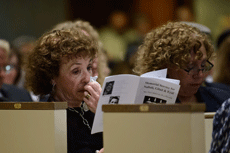
As Jews all over the world grieve and reflect on the murder of Israeli teenagers Eyal Yifrach, Gilad Shaar and Naftali Frenkel, an overflow crowd of more than 700 Chicagoans gathered at Chicago Loop Synagogue Wednesday afternoon for a memorial service to pray for the boys and their families. (Watch a video of the full service here.)
Organized by the Jewish United Fund/Jewish Federation of Metropolitan Chicago, the service came just nine days after Chicago supporters of Israel rallied together and prayed for the boys’ safe return at a community vigil held June 23 at the Thompson Center. Although decidedly more somber in tone, the memorial still carried a message of fortitude and hope.
“Our hearts and prayers go out to the families of these young victims of heinous terrorism and to all our brothers and sisters in Israel who share our outrage and sorrow,” said Skip Schrayer, chair of JUF’s Jewish Community Relations Council, who led the service. “But we come together again today as a united community amidst tremendous diversity. That unity binds us.”
Joining Schrayer were clergy from the Chicago area sharing words and leading the community in prayer, including Rabbi Stanley Kroll of Chicago Loop Synagogue, Rabbi Michael Schwab of North Suburban Synagogue Beth El in Highland Park; Rabbi Andrea London of Beth Emet in Evanston; and Cantor Ross Wolman of Congregation BJBE in Deerfield.
“It is with deep pain, searing anguish, stunning disbelief that we gather as one people, as am echad, linked to our fellow Jews throughout the world as we gather to mourn and remember the lives of three of our children, whose lives were tragically and brutally ended by terrorists,” Kroll said.
Congressmen from the Illinois delegation in attendance, Rep. Jan Schakowsky and Rep. Robin Kelly, likened this act of hate-driven violence to the kidnapping and murder of three Mississippi Civil Rights workers, which occurred almost 50 years ago to the day that Eyal, Gilad and Naftali were taken and killed.
Statements from other elected officials condemning the violence and expressing sympathy for the teens and their families were read aloud from Governor Pat Quinn, Mayor Rahm Emanuel, Senators Dick Durbin and Mark Kirk and Representatives Cheri Bustos, Danny Davis, Rodney Davis, Tammy Duckworth, Bill Enyart, Luis Gutierrez, Dan Lipinski, Mike Quigley, Peter Roskam, Bobby Rush, Aaron Schock and Brad Schneider.
JUF/Jewish Federation President Steven B. Nasatir also shared his reflections.
“After 66 years of Israel’s statehood, our people still face the scourge of hatred and terror,” he said. “It will never deter us. It could not deter Gilad, Naftali, and Eyal or any of Israel’s youth from living vibrant lives filled with joy and hope.”
In addition to prayers and remarks, JCRC Vice Chair Ellen Hattenbach read a poem and Alex Goldman-Shayman, Deputy Consul General of Israel to the Midwest, shared lyrics. Instrumentalist Shmulik Bassin also performed two songs in Hebrew that captured the emotions words alone could not convey.
Although their connection to the young men is distant, community members still had personal reasons for attending the service. Cynthia Levin of West Rogers Park said she came both as a religious Zionist and as a mother who knows the pain of losing a child.
“In Hebrew they say kol Yisrael areivim zeh bazeh (all Jews are responsible for each other), so I feel these three teenagers were members of my family just as if they were my own flesh and blood,” she said.
Mazel Kohanziadeh and her 21-month-old son, Aviram Israel, had just returned to Chicago from a trip to Israel. They were tired and jet-lagged, but Mazel said she felt compelled to attend the memorial service with her toddler. “I felt that he had to be here,” she said. “I felt he had to be here to see the beauty of his people and how they come together in tragedy.”
Those wishing to express their sympathies to the families of Eyal, Gilad and Naftali may sign a national letter of condolence.
Other stories
-
Meet Andrew S. Hochberg, 2021 Julius Rosenwald Memorial Award recipient
Celebrate Andy Hochberg at the virtual Annual Meeting on Sept. 14
Read more -
Two local teens win national recognition
Recipients of the annual Diller Teen Tikkun Olam Awards
Read more -
Celebrating six young award winners cultivating the community
Introducing young adult award winners
Read more
We invite you to join with the Chicago Jewish community, and with the entire people of Israel, in praying for Gilad, Naftali, and Eyal at a special memorial at noon on Wednesday, July 2, at Chicago Loop Synagogue, 16 S. Clark St., Chicago.
Following the discovery of the murders of Gilad Shaar, Naftali Frenkel, and Eyal Yifrach, Jewish United Fund Chairman David T. Brown and President Steven B. Nasatir issued the following statement.
Today, we, the Jewish people, the State of Israel, and all people of conscience, mourn with the parents and loved ones of Gilad Shaar (16), Naftali Frenkel (16), and Eyal Yifrach (19), the three Israeli teenagers who were kidnapped on June 12 and subsequently murdered by terrorists.
These youngsters were the victims of those who have contempt for human life, and who see young students as choice targets for their boundless hatred of Israel and Jews.
In a world and a region threatened by growing fanaticism and unspeakable brutality, there must be no place for those who seek to destroy individuals, communities, and nations based on religion, ethnicity, or any other grounds.
May the families of Gilad, Naftali, and Eyal be comforted among the mourners of Zion and Jerusalem.
Other stories
-
Meet Andrew S. Hochberg, 2021 Julius Rosenwald Memorial Award recipient
Celebrate Andy Hochberg at the virtual Annual Meeting on Sept. 14
Read more -
Two local teens win national recognition
Recipients of the annual Diller Teen Tikkun Olam Awards
Read more -
Celebrating six young award winners cultivating the community
Introducing young adult award winners
Read more
Can reality TV help Chicago-area teens learn Hebrew?
It can, and it did.
Last December, nearly 600 students studying Hebrew in public high schools throughout the city and suburbs practiced their skills with contestants from Israel’s version of the hit TV show The Voice. The free concert and cultural exchange luncheon, coordinated by Shorashim and the iCenter, gave them a chance to hear songs sung live in Hebrew and to converse with the Israeli performers.
“I like to experience the language outside of the classroom,” said Elliot Gross, an Evanston Township High School student. “Hearing Israeli music makes the language come alive.”
The concert, part of a much broader effort to promote Hebrew-language classes in public high schools, was one of many projects funded last year by the Jewish United Fund/Jewish Federation of Metropolitan Chicago and the Community Foundation for Jewish Education. JUF and CFJE provide millions of dollars annually to support a wide range of Jewish educational programming at all levels.
This year, beyond the broader funding, JUF/Federation is awarding $250,000 in expanded grants to boost participation and inspire excellence in targeted priority areas.
Eleven Chicago-area groups will get grants of $3,800 to $65,000. Programs funded range from dynamic Israeli cultural excursions for Hebrew students – like the concert above – to expanded staff support for middle-school youth group programming, to peer-led educational outreach to Jewish 20-somethings.
“We hope these grants will stimulate innovation and focus our priorities in the areas of early childhood, supplementary education, teen programming and adult education,” said Andrea Yablon, JUF/Federation board member and chair of the Community Foundation for Jewish Education’s Board of Directors.
Beneficiary organizations say grants like these help them ramp up efforts to provide unique and engaging programming.
“We’re grateful that, through this grant, we can try things and see what works,” said Abby Ashkenazi, a Jewish educator at JCC Chicago, which received special funding to launch its “Say it in Hebrew” adult education program last year.
This year’s funded projects include:
Temple Anshe Sholom of Olympia Fields will create a new Southern Suburbs Community Religious School, which also will serve students from Congregation Am Echad and Temple B’nai Yehuda Beth Sholom in Homewood.
BBYO Connect, the 6th-8th grade program of pluralistic youth movement BBYO, will hire a professional to create high-quality informal Jewish education experiences for Jewish middle schoolers.
BEYACHAD, a combined community Jewish high school for the northwest suburbs coordinated by Temple Chai, Beth Judea, and Beth Am – will expand curriculum offerings and outreach for 8th-12th grade students.
Program support will continue for the Board of Jewish Education of Metropolitan Chicago’s Florence Melton School of Adult Jewish Learning, a nondenominational adult education program serving congregation members across Chicagoland.
The iCenter will continue to widen and deepen the impact of local public high school Hebrew programs through its Public High School Engagement program.
Jewish Child & Family Services’Response Center will create a professional training curriculum for individuals who work with adolescents, through its pilot Helping Professionals Help Teens program, part of the Chicago Teen Professionals Kehillah.
The Jewish Community Center of Chicago will continue offering its popular Say It in Hebrew community ulpan program of adult Hebrew language classes.
The Jewish Community Center of Chicago and CFJE’s Ta’am Yisrael program will develop plans for a Teen Hebrew Immersion Weekend for 8th graders at Camp Chi’s Perlstein Resort.
Moishe House will expand efforts to connect Jewish 20-somethings in Chicago to the Jewish community through peer-led outreach and home-based events.
Moving Traditions aims to run its Rosh Hodesh and Shevet Achim Jewish learning and discussion programs for teens with over 20 Chicago institutions by 2017-18.
Solomon Schechter Day School of Metropolitan Chicago will sponsor another Midwest JEDCamp to convene congregation and day school educators throughout the region.
For more information, contact Michelle Lawner, JUF’s assistant vice president for planning and allocations, at 312-357-4875 or [email protected].
Other stories
-
Meet Andrew S. Hochberg, 2021 Julius Rosenwald Memorial Award recipient
Celebrate Andy Hochberg at the virtual Annual Meeting on Sept. 14
Read more -
Two local teens win national recognition
Recipients of the annual Diller Teen Tikkun Olam Awards
Read more -
Celebrating six young award winners cultivating the community
Introducing young adult award winners
Read more
Ten outstanding Chicago-area students have been chosen to receive 2014 Israel Experience merit scholarships from the Jewish Federation of Metropolitan Chicago.
The awards, which go to high school, college and graduate students to age 23 who demonstrate significant leadership skills, are designed to encourage the development of Jewish identity, nourish greater commitment to Israel and the Chicago Jewish community, and recognize future leaders.
Eight of the students will receive Jewish Federation Naftali Steinfeld Israel Experience Merit Scholarships, and two others will get the Women’s Board Presidential Israel Experience Merit Scholarship.
The Naftali Steinfeld Merit Scholarship recipients are:
- Kevin Clair, Chicago/West Rogers Park, Fasman Yeshiva High School
- Paul Dolmon, Woodstock , University of Illinois at Urbana-Champaign
- Rivka Goldmeier, Chicago/West Rogers Park, Hanna Sacks Bais Yaakov High School
- David Goldshmidt, Skokie, Ida Crown Jewish Academy
- Nechama Neren, Skokie, Ida Crown Jewish Academy
- Tali Pelts, Niles, Ida Crown Jewish Academy
- Gavriel Schankerman, Evanston, Chicagoland Jewish High School
- Yvette Smith, Chicago/Albany Park, Lane Tech College Prep High School
The Women’s Board Presidential Merit Scholarship recipients are:
- Leah Karchmer, Highland Park, DePaul University
- Avital Stein, Skokie, Ida Crown Jewish Academy
The winners were selected from more than 40 outstanding, dedicated teens and young adults for their involvement in multiple activities (Jewish and secular), their leadership roles, and their ability to be role models for their peers.
“These recipients exemplify an outstanding commitment to our community through their leadership, accomplishments and dedication to Israel,” said Jodie Berkman, chair of the Academic Scholarship Committee. “Our community is so very fortunate to have such accomplished young adults who will continue to model leadership for future generations.”
Each recipient will receive $1,000 toward his or her upcoming approved Israel Experience program.
For more information about the Jewish Federation Israel Experience Merit Scholarship Program, visit www.juf.org/israel_experience/merit_scholarship.aspx.
Other stories
-
Meet Andrew S. Hochberg, 2021 Julius Rosenwald Memorial Award recipient
Celebrate Andy Hochberg at the virtual Annual Meeting on Sept. 14
Read more -
Two local teens win national recognition
Recipients of the annual Diller Teen Tikkun Olam Awards
Read more -
Celebrating six young award winners cultivating the community
Introducing young adult award winners
Read more
.jpg "vigil2")
JUF Chairman David T. Brown addresses hundreds gathered downtown at the Thompson Center for a vigil for the kidnapped teens.
The mood at Chicago’s Thompson center downtown on Monday was solemn, as over 500 Chicagoans gathered to show their support for the kidnapped Israeli teens and their families and to pray for their safe return. The peaceful vigil—organized by the Jewish United Fund and held at the James R. Thompson Center—gave members of the community, saddened by the shocking abduction of the three teens, an opportunity to join together in prayer and to show their sympathy for the teens’ families. The JUF Lewis Summer Interns, most of whom are only a few years older than the three kidnapped teens, helped organize the vigil.
Three Israeli teenagers were kidnapped on Thursday, June 12 by Palestinian terrorists near Gush Etzion. The three youths—Gilad Shaar (16), Naftali Frenkel (16), and Eyal Yifrach (19)—were on their way home from Mekor Chaim, a yeshiva high school in Kfar Etzion when they were abducted. Israeli Prime Minister Benjamin Netanyahu has accused Hamas of kidnapping the teens and holds the Palestinian Authority responsible for the kidnappings. Netanyahu has also called for the disbandment of the Palestinian Authority’s unity government with Hamas, according to the JTA.
The Israeli military has exercised extensive resources in their effort to locate the boys, while the boys’ families pray for their safe return home. Among American Jews, the focus has been on supporting the teens’ families, largely through prayer (JTA). A media campaign, #BringBackOurBoys—inspired by the hashtag #BringBackOurGirls that was sparked by the abduction of over 200 Nigerian girls by an Islamist terrorist group—has gained momentum as Jews around the globe show their solidarity with the boys and their families.
Opening remarks at the vigil were delivered by David T. Brown, chairman of the Jewish United Fund/Jewish Federation of Metropolitan Chicago. Brown expressed his and the Federation’s solidarity with Israel and cited the kidnapping as an example of “the obstacles that remain to achieving the peace and security for Israelis and Palestinians that we all seek.” He also welcomed public officials in attendance—Julie Hamos, director of the Illinois Department of Healthcare and Family Services; Ill. State Sen. Ira Silverstein; Ill. Rep. Scott Drury; and Ald. Debra Silverstein.
Statements of support for Israel, the teens and the vigil came from U.S. Senators Dick Durbin and Mark Kirk, as well as Illinois Congressmen Rep. Cheri Bustos, Rep. Rodney Davis, Rep. Bill Foster, Rep. Dan Lipinski, Rep. Jan Schakowsky, Rep. Brad Schneider, and Rep. Aaron Schock. On Wednesday, Rep. Schneider introduced a resolution calling for the immediate, unconditional release of the captured teens.
Other speakers included Rabbi Yona Reiss, Av Beth Din (chief of rabbinic court) of the Chicago Rabbinical Council; Presbyterian Reverend Robert Cathey, Professor of Theology at the McCormick Seminary; Roey Gilad, Consul General of Israel to the Midwest; and Endy Zemenides, executive director of the Hellenic American Leadership Council.
In a letter written by Mayor Rahm Emanuel and read at the vigil, the mayor condemned the kidnapping and stated: “I see my children in the faces of these three Israeli boys, and like any parent, my heart goes out to their families. No child should have to live in fear that one day they may not return home and I offer my full support to Israel and its search for these missing teens.”
Lewis Summer Interns read short biographies of each of the kidnapped boys. The interns also shared their own sentiments regarding the kidnapping of their Israeli peers. They asked the audience to think of their own children, their own friends and siblings, and to imagine if they were the families of Eyal, Naftali, and Gilad. “I came as a mother. I came as a Jew. I came as an Israeli. I came to support the families and to let the kids know that they have not been forgotten,” attendee Hadassa Dekalo said emotionally.
Many members of the Israeli community also attended the vigil, including a group of Israeli Defense Forces veterans who had been wounded in combat. Ishay Halen, a former soldier, said, “I came to support our brothers here. We are a big family in Israel, [although not literally]. Everyone around the world, every Jewish person, every Israeli person, we all support each other.” He also voiced Israel’s desire for peace and considered the vigil a sign of this desire to the Palestinians. “We don’t want a war…we just want to speak to [the Palestinians],” he said.
The families of Gilad, Eyal, and Naftali ask that you continue to pray for the safe return of their sons. To further show your support, you can like the #BringOurBoysBack Facebook page or sign a national letter addressed to the families of the teens at www.bringbackourboys.net.
Other stories
-
Meet Andrew S. Hochberg, 2021 Julius Rosenwald Memorial Award recipient
Celebrate Andy Hochberg at the virtual Annual Meeting on Sept. 14
Read more -
Two local teens win national recognition
Recipients of the annual Diller Teen Tikkun Olam Awards
Read more -
Celebrating six young award winners cultivating the community
Introducing young adult award winners
Read more
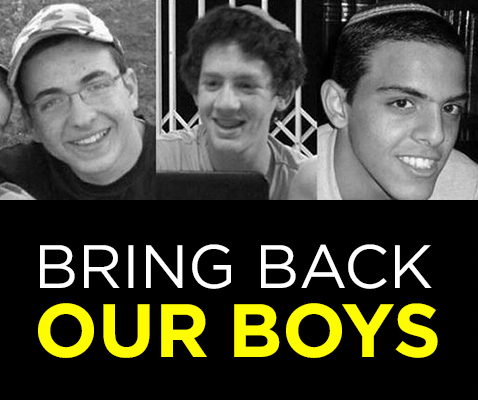
A vigil in solidarity with Israel and the families of the three kidnapped teens will be held at 12 p.m. noon this Monday, June 23, in downtown Chicago.
The event, organized by the Jewish United Fund, will rally the community and other friends of Israel at the James R. Thompson Center, 100 W. Randolph Street. Chicagoans will show their support and pray for the return of the captive teens.
Eyal Yifrach, 19, Gilad Shaar, 16, and Naftali Frenkel, 16, were abducted a week ago while hitchhiking home.
Those wishing to attend should RSVP to the event on Facebook and are encouraged to invite others in their social networks.
Also, read JUF Vice President of Communications Aaron Cohen’s blog for JUF News about why Chicago Jews are praying for the kidnapped teens.
Other stories
-
Meet Andrew S. Hochberg, 2021 Julius Rosenwald Memorial Award recipient
Celebrate Andy Hochberg at the virtual Annual Meeting on Sept. 14
Read more -
Two local teens win national recognition
Recipients of the annual Diller Teen Tikkun Olam Awards
Read more -
Celebrating six young award winners cultivating the community
Introducing young adult award winners
Read more
Breaking through: Jewish United Fund awards $1 million in grants to innovative programs
STEFANIE PERVOS BREGMAN
The Jewish United Fund/Jewish Federation of Metropolitan Chicago is breaking new ground in Chicago’s Jewish community this summer, awarding $1 million in grants to 17 local initiatives through its forward-looking Breakthrough Fund.
Encouraging smart growth and innovation in the Jewish nonprofit sector are the goals of the Breakthrough Fund, which launched in Fall 2013 by awarding $5,000 mini-grants to 10 local programs.
The 17 recipients of this first full-scale cycle of this program, selected from 80 applications, will be awarded grants ranging from $25,000 to $150,000. All told, including the $50,000 in mini-grants, over $1 million was awarded this year to leading-edge local programs and initiatives that meet local Jewish needs and engage community members Jewishly throughout their lifespans.
Of the 17 recipients, 11 will be awarded grants to help start new programs or to make strategic short-term investments that will yield long-term impact, while the other six will receive funding to help proven existing programs flourish and expand.
“The Breakthrough Fund reminds us that innovation is taking place right here in Chicago’s Jewish community,” said David Sherman, chairman of the Breakthrough Fund review committee. “The passion and vision of this community is inspiring and we are so proud and grateful to award grants to these 17 initiatives so that they can take necessary and strategic risks that will ultimately impact Chicago’s Jewish future in remarkable ways.”
JUF has focused on supporting innovation for many years, highlighted by the 15-year-long Priority Grants program. But when the recession hit in 2008, the organization’s priority shifted to taking care of the community through the J-HELP initiative. Today, JUF has the opportunity to again focus on innovation – this time expanding the grant fund to also support programs outside of JUF agencies. Several of the initiatives funded this year represent partnerships and collaborations among numerous community organizations, many of which do not currently receive funding from JUF.
Serving a range of populations, the programs cover a broad array of activities, including: creating an online community resource for families with young children; educating day school students about how to respond to bullying and anti-Semitism; helping LGBTQ Jews to explore their Jewish heritage; and providing grandparents with tools to connect with their grandchildren around Jewish values.
“An organization like JUF that now allocates more than $150 million per year must have a capacity for R & D—the Breakthrough Fund fulfills that objective.” said JUF/JF president Steven B. Nasatir. “We hope to have the capacity to eventually endow the Breakthrough Fund and keep the creative and crucial work it inspires going for many years to come.”
Ten of the programs receiving funding focus on enhancing opportunities for engagement in Jewish life:
Anti-Defamation League: World of Difference Institute, pilots this ADL program (previously offered in secular schools) in Jewish day schools to give students the knowledge and skills to thrive in the increasingly diverse and multi-cultural environments they will encounter in the world outside day schools.
Evanston’s Bayit Afterschool, will research and invest in immersive conversational Hebrew curriculum training for staff and will work with a consultant to assess their current curricula and staffing for special needs inclusion.
Congregation Or Chadash: Journey to Freedom, guides 15-20 LGBTQ Jews through professionally-facilitated art, music, and writing workshops that link stages of the coming out process with steps of the Exodus; the work produced in these workshops will be used to develop a Haggadah to be used at a community-wide Seder celebrating Passover and LGBTQ liberation.
Continuum Theater: Chicago Jewish Play Reading Festival, will produce eight plays and post-performance talk-backs across the Chicago area to engage audiences with Jewish performing arts.
GIFTS(Gratitude, Inspiration, Family, Tzedakah, and Service), a program administered by the Jewish United Fund/Jewish Federation of Metropolitan Chicago, provides grandparents with tools to connect with their grandchildren around Jewish values and philanthropy, including access to a donor advised philanthropic fund they can manage jointly.
InterfaithFamily, will launch a local mentoring program for 10 interfaith couples who are making Jewish choices for their families and futures to share their experiences with 30 others, encouraging these mentee couples to think together about how to make Jewish choices and how to access welcoming Jewish organizations, programs, professionals, and services.
Kveller, a national online portal for Jewish families with young children, will engage in a planning process for Kveller Chicago, a local microsite for the Chicago metropolitan area, increasing access to Jewish community programs and resources for families with young children.
Mishkan Chicago, Going Broad Going Deep, supports expansion of lay and professional leadership opportunities, creates the Neighborhood Captain program, increases programming outside the Lakeview neighborhood, and expands worship opportunities, volunteer involvement, classes, and workshops.
UpStart Lab: Chicago, will establish a network of support for approximately 20 local Jewish project leaders; provide R&D assistance to 6-10 emerging Jewish social entrepreneurs; and model “intrapraneurship” opportunities in Chicago’s mature Jewish communal organizations.
URJ NFTY, willpilot a collaborative leadership training weekend retreat that brings together high school leaders and youth workers from USY, BBYO, NCSY, JSC, and NFTY to grow leadership skills and knowledge of relational Judaism, community organizing, and experiential and Israel education.
The remaining seven programs focus on local human needs:
CJE Senior Life: A Medication Abuse and Misuse Measure, will create the first ever validated assessment tool to identify medication abuse and misuse by older adults.
CJE Senior Life: Art in the Moment, creates four Jewish-themed Art in the Moment modules for CJE’s existing mobile app, increasing opportunities for older adults with dementia and their caregivers to engage around Jewish holidays and culture.
Hire U, a collaboration between the Jewish United Fund/Jewish Federation of Metropolitan Chicago’s Campus Affairs & Student Engagement department and Jewish Vocational Service, plans and pilots a career curriculum geared toward metro Chicago and University of Illinois college students, including workshops and one-on-one counseling, focus groups, research, and analysis.
Jewish Child and Family Services: Synagogue-Community Partnership, expands JCFS’ successful model to the Lakeview neighborhood and west suburban Naperville, deploying JCFS staff to local Jewish sites and bringing social and support services, consultation, information/referral, and educational programming to community members.
Jewish Child and Family Services: Jewish Center for Addiction will work with Response to implement youth prevention and support programs in a Jewish context, including educational programs, individualized case management and referral, support groups, and recovery retreats for youth and young adults in recovery.
Jewish Vocational Service: Customized Employment Planning Initiative, provides training, program design, community engagement, resource development, and evaluation to create a pilot program to offer customized employment assistance to individuals with intellectual/developmental disabilities.
Yozma: A Gap Year in Israel, provides support for this nascent gap year program in Israel for young adults with neurobehavioral differences (including learning disabilities, autism spectrum disorders, depression, etc.), to finish developing its business plan and launch a pilot with Nativ in Fall 2015 for 5-8 participants.
For more information about the Breakthrough Fund or to learn how you can apply to be a future recipient of a Breakthrough Fund grant, contact Sarah Follmer, Senior Planning Associate, Strategic Partnerships at (312) 357-4547, email [email protected] or visit www.juf.org/grants/breakthrough.aspx.
Other stories
-
Meet Andrew S. Hochberg, 2021 Julius Rosenwald Memorial Award recipient
Celebrate Andy Hochberg at the virtual Annual Meeting on Sept. 14
Read more -
Two local teens win national recognition
Recipients of the annual Diller Teen Tikkun Olam Awards
Read more -
Celebrating six young award winners cultivating the community
Introducing young adult award winners
Read more
How do you innovate, educate and create a dynamic future for Chicago’s Jewish community, while still maintaining the essential services that keep it vibrant today?
That may not be the first question that comes to mind when diving into the long, laborious, number-intense task of budget-crunching. But for the hundreds of community leaders who collectively spent thousands of hours crafting the plan for how the Jewish United Fund/Jewish Federation of Metropolitan Chicago will allocate $150.5 million over the next year, that mission was the essence of their efforts.
“We set that as our challenge,” said David T. Brown, chairman of the JUF/Federation Board. “The broad web of social service agencies and programs JUF supports does an amazing job caring for those in need, and the future of those services needed to be assured. But we also must be alert to emerging and future needs, and create effective responses to them. That’s what this budget is all about.”
Case in point is the Breakthrough Fund. Created last year as a pilot project, this year the fund will award $1 million in grants to spur exciting new responses to needs throughout the Chicago Jewish community. The 17 grants – awarded to agencies both within and beyond JUF’s network – will support efforts ranging from creating an online resource for families with young children and educating day school students about how to respond to bullying and anti-Semitism, to establishing an incubator for Jewish social entrepreneurs and providing grandparents with tools to connect with their grandchildren around Jewish values.
In another area, the more than $26 million the FY15 budget allocates for Jewish education and continuity includes expanded grants designed to stimulate innovation and broaden programming in priority areas, including early childhood, supplementary education, teen programming and adult education.
At its core, JUF’s overall FY15 allocations plan, which provides funding to some 70 agencies and programs, provides the lifeblood for critical human services, community-building efforts and advocacy throughout Chicago, in Israel and around the world. Each year, those services aid 300,000 Chicagoans of all faiths, and 2 million Jews in need in Israel and around the world.
The largest share of funding for the allocations comes from JUF’s Annual Campaign, which raised $81.5 million last year. Beyond that, JUF also distributes funds it receives from government agencies, foundations, endowments, donor-advised funds, the United Way and other sources. Although the Annual Campaign continues to grow, revenues from some of those other sources are down.
Under the new budget, $25,044,913 will go to core Chicago-area social service agencies and programs, including Jewish Child & Family Services, CJE SeniorLife, Jewish Vocational Services, Sinai Health System, and The Ark. An additional $6.8 million is targeted for health care, family services, vocational programs, refugee services, academic scholarships and other areas.
Programs and initiatives promoting Jewish education and continuity will receive $26 million. Of that, $17,673,759, will be used by the Jewish Community Center of Chicago, the Community Foundation for Jewish Education, Associated Talmud Torahs, 16 Chicago-area Jewish day schools, Spertus Institute for Jewish Learning and Leadership, Hebrew Theological College and other programs. Another $8.4 million will be used for other education and continuity efforts locally and nationally.
Another $4,505,309 will go for national efforts to combat anti-Israel campaigns and a nuclear Iran, Israel studies programs on campuses, cultural agencies such as the Illinois Holocaust Museum and Education Center, and programs that promote outreach, advocacy and Israel connections at the local and national levels, such as JUF-sponsored Birthright trips.
To care for Jews in need in Israel and other parts of the world, $34,477,315 will help fund JUF’s international partners – the Jewish Agency for Israel, the American Jewish Joint Distribution Committee and World ORT – as well as other agencies that provide vital services to Jews around the globe.
Most of the remaining allocations in the FY15 budget cover distributions from donor-advised funds, community programs and services provided directly by JUF and the Federation, support services to affiliated agencies, and operational expenses.
Critical to the entire allocations process is the broad base of communal leaders who assure funds are distributed in the most effective way.
“These allocation decisions are not only made for the community; they’re made by the community,” said Bill Silverstein, who chairs JUF’s Overall Planning and Allocations Committee. “Serving on OPAC and on our commissions are people from every part of our community, reflecting its diversity socio-economically, denominationally and demographically. A large number of people have a hand in making these very important decisions, which impact the lives of everyone in our community and beyond.”
Other stories
-
Meet Andrew S. Hochberg, 2021 Julius Rosenwald Memorial Award recipient
Celebrate Andy Hochberg at the virtual Annual Meeting on Sept. 14
Read more -
Two local teens win national recognition
Recipients of the annual Diller Teen Tikkun Olam Awards
Read more -
Celebrating six young award winners cultivating the community
Introducing young adult award winners
Read more