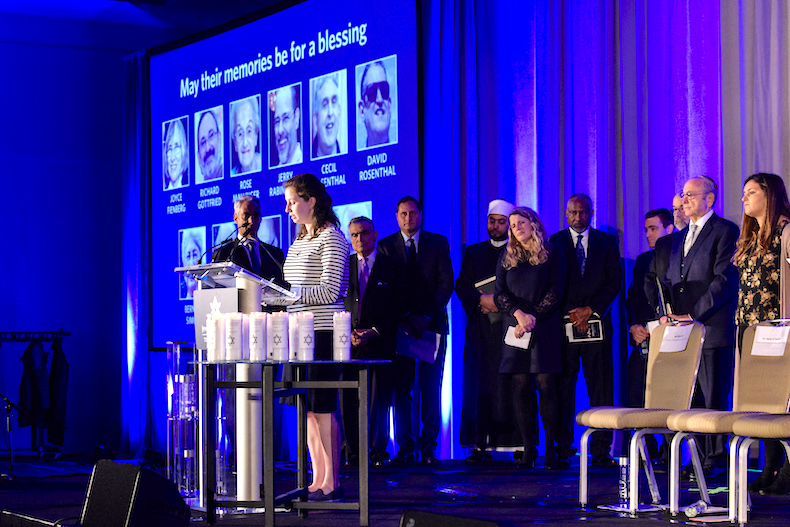
A standing-room only crowd of 1,800 Chicagoans of all faiths came together in response to the Shabbat massacre at the Pittsburgh’s Tree of Life*Or L’Simcha Congregation, drawing strength and healing from one another and honoring the 11 lives lost and eight injured in the attack.
JUF’s Jewish Community Relations Council sponsored the Nov. 1 gathering, held at the Swissôtel Chicago, where leaders of the Jewish, Christian, and Muslim faith communities — along with Chicago Mayor Rahm Emanuel — spoke to a rapt lunchtime crowd. (Watch the full video)
Those in attendance included local elected officials at every level of government, along with students from Chicago Jewish Day School and Ida Crown Jewish Academy. An additional 1,800 community members live-streamed the event on Facebook.
In his remarks, JUF President Dr. Steven B. Nasatir recounted a series of recent hate-fueled attacks, asking, “How many times must we gather in solidarity, in protest, to mourn? Do the horrors never end?” He decried how “our nation has slid backward when it comes to anti-Semitism and other hatreds…toxic strains of this old disease.
“We gather as people of goodwill from all faith communities to raise our voices,” Nasatir said. “No more silence in the face of hate! We will not indulge or ignore those sowing seeds of division.”
Cardinal Blase Cupich of the Chicago Archdiocese said that he shared “deep sorrow” with his “Jewish brothers and sisters in faith. “We grieve, weep, and pray with you. A line has been crossed,” he said.
“We must name the evil of anti-Semitism,” Cupich continued. “It is an affront to dignity and a threat to peace. No one should live in fear. We must never demean or devalue those deemed different.”
Sheikh Hassan Aly of Willowbrook’s Mecca Center promised to stand “shoulder to shoulder” with the Jewish community for the safety of all houses of worship, saying: “We stand with all who seek to practice faith in peace. There is no place for hate in our country. Respect, mercy, and love are what we need today.”
He then related the Jewish concept that saving a life is like saving a world to a similar passage in the Quran, concluding, “We are with you. Your pain is my pain.”
JCRC Chair Bill Silverstein, who moderated the gathering, expressed gratitude to the American Muslim community, which raised over $200,000 to help defray the funeral costs of those killed.
Mayor Emanuel spoke about the recent pattern of attacks on worshippers of different faiths. He noted that HIAS — the Jewish agency that settles refugees and which was singled out in the Pittsburgh’s gunman’s rants against the Jewish people — had helped the families of many in the room. “To be Jewish,” he said, “is to extend a hand to other refugees,” he said. He added that he himself is a descendant of immigrants.
“Hatred grows only in silence,” Emanuel cautioned. “We must confront it with love, compassion, and opportunity.” He urged the audience to “find our common humanity… our moral center.”
Rabbi Wendi Geffen of North Shore Congregation Israel lamented that the killer had “breached the walls of a Jewish sacred space and time” with a Shabbat attack on a synagogue. “Words matter,” she said, and when words are cruel, “violence always follows.”
Lonnie Nasatir, regional director of the Anti-Defamation League, shared compelling data about the rising tide of anti-Semitism; in 2017, the ADL recorded a 57 percent increase in anti-Semitic incidents nationwide, and a 103 percent increase in the Midwest .
Rev. Dr. Myron McCoy of the First United Methodist Church at The Chicago Temple, recounted a legend of Roman warriors who, losing their bearings in a time when the world was largely unknown, said they had “marched off the map.” Today, we too are in uncharted territory, McCoy said. “We have lost trust in our institutions … we are closer to chaos than community.”
In such straits, McCoy concluded, we must remember Psalm 23, in which King David writes that he survived even the shadow of death because God was with him. He called upon God “to unite us all, no matter how we pray.”
Rabbi Leonard Matanky, dean of the Ida Crown Jewish Academy, led a reading of the 23rd Psalm and his students read the names and shared poignant information about each of the 11 people killed.
Cantor Alberto Mizrahi of Anshe Emet Synagogue led prayers for the healing of the wounded and in memory of the fallen.
One person in attendance at the solidarity gathering was retired judge and Holocaust survivor Milt Black, who immigrated to the United States when he was young. He stressed the importance of people of all faiths “not allowing evil to stop us from living our good lives.
“I’ve had wonderful non-Jewish people — I call them ‘Righteous Gentiles’ like the ones in Yad Vashem — contact me [since the shooting], and this is what I tell them: “We will prevail so long as we remember that there is more good that binds us together than bad that drives us apart,” Black said.
“Remember the lesson taught to us by Abraham and Moses,” Silverstein said. “When God called upon them, they answered, ‘Hineini, here I am.’ In our fight against anti-Semitism and hatred in all of its forms … I implore all of us to call out: ‘Hineini, here I am.'”
JUF has sent an initial grant of $25,000 to the Jewish Federation of Greater Pittsburgh’s Victims of Terror Fund earmarked for the wide variety of personal and communal needs arising from this tragedy. Donations can be made to The Jewish Federation Pittsburgh Solidarity Fund at donate.juf.org/Pittsburgh.
This Shabbat, North American Jewish communities across the denominations will observe a Solidarity Shabbat, organized by the Jewish Federations of North America in partnership with the American Jewish Committee and the Anti-Defamation League. For a listing of Chicago area synagogues, visit juf.org/guide . Young adults are invited to participate in a Shabbat dinner through OneTable; for listings, visit onetable.org .
Other stories
-
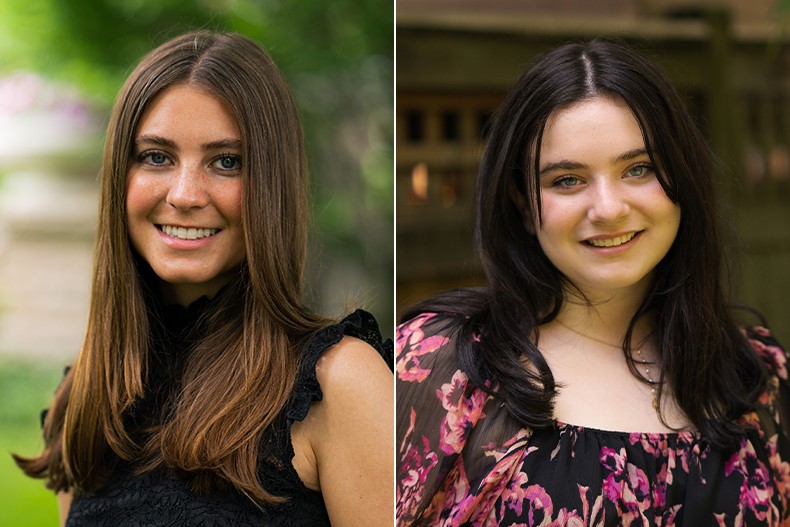
Two local teens win national recognition
Recipients of the annual Diller Teen Tikkun Olam Awards
Read more -

Celebrating six young award winners cultivating the community
Introducing young adult award winners
Read more -
Tree of Life Synagogue victims: Remembering who they were and how they lived
We remember the 11 slain victims of the Shabbat massacre on Pittsburgh’s Tree of Life Synagogue. The fallen includes two inseparable brothers, a couple married for 62 years, and a family doctor who assisted patients in the early days of the AIDS crisis. May their memory be for a blessing.
Joyce Feinberg, 75
“She was a very petite woman but lit up a room with her huge personality,” said Jason Connor, a Ph.D. student of her late husband, Stephen, a professor emeritus at Carnegie Mellon University. Joyce and Stephen would open their homes to Stephen’s students, and treat them like family, Jason explained. A mother and a grandmother, Joyce retired in 2008 from her job as a researcher at the University of Pittsburgh’s Learning Research and Development Center looking at learning in the classroom and in museums. Her colleagues called her a “cherished friend.”
Richard Gottfried, 65
A dentist, Richard worked a couple days a week at Squirrel Hill Health Center, a non-profit health center that counts immigrants and refugees as half of its patients. Health Center CEO Susan Friedberg Kalson said this of Richard: “As Jews, we work to heal the world,” she said. “He lived that.” Richard was Jewish and his wife, Peg, was Catholic. The couple–who ran a dental practice together–would help prepare interfaith couples for marriage. Richard’s nephew Jacob Gottfried honored his uncle in a tweet. “Today I lost an important person in my life. My uncle was murdered doing what he loved, praying to G-D…”
Rose Mallinger, 97
Rose came to pray at the synagogue every Shabbat. A retired school secretary, Rose had two children and three grandchildren. Her daughter, Andrea Wedner, 61, was among those wounded in the attack and is expected to recover. “To Bubbe, family was everything,” Rose’s family said in a statement. “She knew her children, her grandchildren, and her great-grandchildren better than they knew themselves. She retained her sharp wit, humor, and intelligence until the very last day.” Chuck Diamond, a former rabbi at Tree of Life, said, that despite her age, Rose was “one of the younger among us, I have to tell you, in terms of her spirit.”
Jerry Rabinowitz, 66
Jerry, a family physician, was known for wearing bowties that made people smile and putting his his patients at ease, described his nephew Avishai Ostrin. Jerry’s former patient recalled that in the early days of the AIDS crisis, Jerry was among a handful of doctors treating patients with dignity and respect. “Basically, before there was effective treatment for fighting HIV itself, he was known in the community for keeping us alive the longest,” Michael Kerr recalled. “He often held our hands (without rubber gloves) and always hugged us as we left his office.” Jerry found a second home at Dor Hadash, the Reconstructionist congregation that was housed in the Tree of Life synagogue. Though he wasn’t initially in the service when the shooting began, when he heard shots, he ran toward the victims to see if anyone needed a doctor. As Avishai said, “That was Uncle Jerry, that’s just what he did.”
David Rosenthal, 54, and Cecil Rosenthal, 59
David and Cecil weren’t just brothers–they were best friends. They were even roommates at a residential home operated by ACHIEVA, which provides services for people with intellectual disabilities. “Cecil’s laugh was infectious. David was so kind and had such a gentle spirit. Together they looked out for each other,” said Chris Schopf of ACHIEVA. At synagogue, Cecil and David were often the first faces congregants saw as they arrived for services. Their middle sister, Diane, said in her eulogy that her brothers served as role models. “[They] remind us of how we should try to live our lives,” she said. “Embracing joy or love or happiness without making judgments or resenting people or hate.”
Bernice Simon, 84, and Sylvan Simon, 86
Bernice and Sylvan’s three children and six grandchildren described them as the quintessential bubbe and zayde. The couple married at the Tree of Life synagogue 62 years and have been attending services almost every Shabbat since. It was hard to reach them on their home phone, said their eldest son, Marc, because they were always running around, so active in their community. “Our parents did everything together as a married couple,” he said. “They were deeply in love with each other.” As their neighbor Heather Graham said : “They held hands and they always smiled, and he would open the door for her, all those things that you want from another person.”
Daniel Stein, 71
Daniel once served as president of the New Light Congregation, one of the three congregations that were housed in the synagogue building . His wife, Sharyn, works for the local chapter of Hadassah. “He was always willing to help anybody,” said his nephew, Steven Halle. “He was somebody that everybody liked, [with] a very dry sense of humor and [he] recently had [had] a grandson who loved him.”
Melvin Wax, 88
A retired accountant, a grandfather, and a devoted Pittsburgh Pirates fan, Melvin was described by fellow congregants as a “pillar” of the congregation. He was a leader of Or Chadash, or New Light Congregation, which moved into the Tree of Life Congregation building last year. Synagogue was “as important to him as breakfast is to most people,” said Melvin’s family friend, Bill Cartiff. In fact, Melvin was leading his congregation’s services at the time of the attack . Myron Snider, a friend and fellow congregant, described Melvin as generous and kind. He added that they shared mostly clean jokes at the end of each service. “If you look in the dictionary under the word unselfish, you’ll see the name Melvin Wax because he was one of the most unselfish people I’ve known in my entire life,” said Melvin’s cousin, Rabbi Harvey Brotsky. “If anyone on this earth walked humbly with their God, it was Mel Wax. He did not have a conceited bone in his body.”
Irving Younger, 69
Irving would greet Tree of Life members with a big smile and a handshake. “He was a guy that, when you walked in, he was the first person [who] would meet you and help you find a seat,” said Irving’s friend and former synagogue president Barton Schachter. Irving was a father, a grandfather, and a former Little League coach. His neighbor, Tina Prizner, said this of Irving: “He was a beautiful person, a beautiful soul.”
Eight other people were also injured in the attack: congregants Andrea Wedner and Daniel Leger; and police officers–Anthony Burke, Timothy Matson, Daniel Mead, Tyler Pashel, John Persin, and Michael Smidga. We pray for their healing.
~This piece was compiled with reporting from JTA’s Ben Sales and Arielle Kaplan; as well as information from CNN , Time Magazine, the Associated Press , the Toronto-City News , the Pittsburgh Post-Gazette , and the Pittsburgh Tribune-Review .
Other stories
-
Two local teens win national recognition
Recipients of the annual Diller Teen Tikkun Olam Awards
Read more -
Celebrating six young award winners cultivating the community
Introducing young adult award winners
Read more -
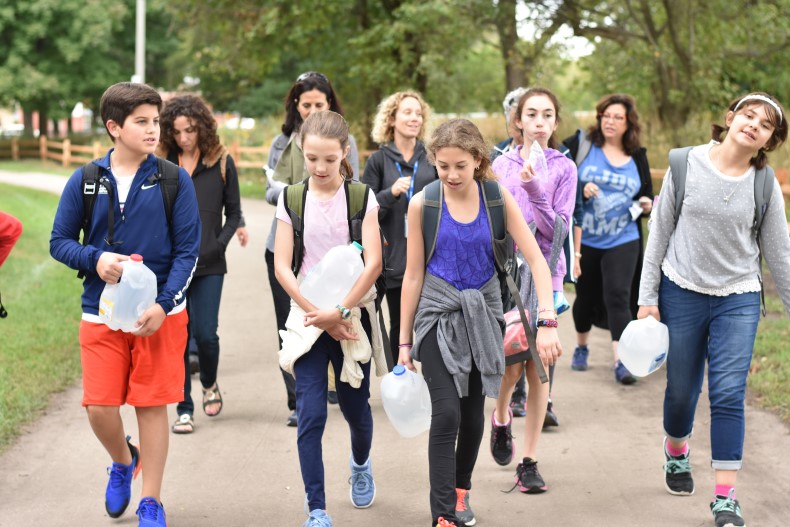
How does it feel to walk three miles-lugging a jug of water?
Seventh graders at Chicago Jewish Day School (CJDS) wanted to know. They had learned that, in South Sudan, villagers often must walk more than three miles, sometimes several times a day, just to get clean water-leaving little time for education.
To help, the class is raising money toward building a well in South Sudan. They started with a walkathon during Succot, symbolically recreating the South Sudanese experience by walking more than three miles carrying water jugs.
The story caught the ear of WBEZ 91.5, whose Jerome McDonnell interviewed students Lilly Cope, Isabelle Goldberg, and Noam Wolkenfeld on air.
Their former sixth grade teacher, Lindsay Teeples-Mitchell, listened to the broadcast with pride. She had introduced the students to A Long Walk to Water , written by Linda Sue Park. The novel tells the story of Nya, an 11-year-old girl who must walk over three miles twice a day for water.
The money the students raise will fund Water for South Sudan, founded by South Sudanese native Salva Dut, whose childhood flight from Sudanese civil war is also recounted in the book.
Teeples-Mitchell, who has since moved to Japan, wrote that she “woke up at 2:20 in the morning to listen to their interview and was filled to the brim with pride.”
Rachel Pickus, the director of the middle school and the class’ current seventh grade teacher, and Tamar Cytryn, director of Jewish Studies and Campus Life, picked up the project’s baton.
The class hopes to raise $5,000, enough for one-third of the cost to create a well. At press time, the students had raised almost $2,400.
Seventh grader Noam Heinreich noted, “It’s not fair that we have access to a water fountain and they have to walk for miles.”
After filling empty jugs they’d brought from home, the students set out on their hike. Each gallon weighed some eight and a half pounds; the students carried them by hand or in backpacks.
“We did this project to make others’ lives easier,” said student Toren Strauss. “People don’t have clean water, and we’re people who can help change that.”
They marched from their school, near the corner of Addison and California, along Horner Park. Along the way, they spontaneously devised a chant: “We have really got to fight! Water is a human right!”
They turned east and walked around Welles Park, where they rested for a moment to discuss what they had learned.
“Carrying that water hurt so much,” said student Isabelle Rosenberg. “But it helps me feel what those young girls feel.”
Arriving back at school, the students were welcomed by their cheering friends. Student Evan Cohen agreed that the walk helped him appreciate the situation of those in South Sudan-and his own: “I’m going to be more thankful after drinking water,” he said. “I understand a little how they feel.”
To donate to the Walk for Water effort through CJDS, make out a check to the school with “Water Walk” written on the memo line, or give directly to Water for South Sudan waterforsouthsudan.org, noting Chicago Jewish Day School.
Other stories
-
Two local teens win national recognition
Recipients of the annual Diller Teen Tikkun Olam Awards
Read more -
Celebrating six young award winners cultivating the community
Introducing young adult award winners
Read more -
Temple Sholom’s upcoming lecture series inspired by a call for civility
Robert Nagler Miller
On the opening page of Gabriel William Friedlander’s siddur, or prayer book, published in 1914, is the young Polish Jewish immigrant’s address in Chicago: 1332 South Kedzie Avenue.
More notable, said his son, Dr. Arnold Friedlander, is a punctuation-less note that his father, who grew up in the then heavily Jewish North Lawndale neighborhood of the 1920s, added below the address: “If lost return no backtalk.”
“We conjecture,” said Friedlander, “that my father was occasionally chased down and beaten up by non-Jewish gangs. This was his way of saying, ‘If you steal my book, please just return it to me. No questions asked.'”
This story resonates with Dr. James Barrett, Professor Emeritus of History at the University of Illinois at Urbana-Champaign and an authority on the Irish-American experience, who was raised not far from Gabriel William Friedlander three decades later. Barrett, whose books include The Irish Way: Becoming American in the Multi-Ethnic City (Penguin, 2012), said that there “was a history of conflict and anti-Semitism” in Chicago, particularly directed by the Irish Americans toward the Jews.
Much of the animosity, Barrett said, arose out of a battle over “urban spaces.” Chicago’s Irish community felt increasingly encroached upon by Jews in its traditional neighborhoods, particularly on Maxwell Street, on the city’s old West Side, in the late 19th and early 20th centuries. A generation later, the Irish felt pushed out as Jews began migrating south and west to North Lawndale, South Lawndale, Humboldt Park, and South Shore.
Politics, too, were a point of contention, said Barrett. The Irish were diehard machine Democrats. Many of their Jewish neighbors were to the left of them ideologically, supporting Socialists and radical trade unionists in the early part of the 20th century.
Barrett will be talking about the interactions between Chicago’s Irish and Jewish American communities at Temple Sholom in the city’s Lakeview neighborhood on Sunday, March 10, as part of the synagogue’s 2018-2019 Guest Scholar Series, which features a roster of distinguished experts addressing issues of concern to the Jewish community.
Not all of Barrett’s talk will focus on conflict. There were, he said, many instances of “intimate contact and collaboration” between the Irish and the Jews. Think, he said, of the 1922 Broadway hit play, Abie’s Irish Rose, about the love between a Jewish man and a Catholic Irish American woman. That type of relationship, even 90 years ago, was not so uncommon-in Chicago and other American cities in which the Jewish and Irish communities commingled.
More common, though, he added, were collaborations between the Irish and the Jews in the entertainment field. There were many comedy duos in the early part of the 20th century in which Jewish and Irish partners good-naturedly made fun of each other and found common ground. Barrett also pointed out that Tin Pan Alley produced Irish and Jewish composers who worked together. As he writes in The Irish Way, the 1912 Flannery-Schwartz song “If It Wasn’t for the Irish and the Jews” says it all. The ditty includes these lyrics:
There’s a sympathetic feeling,between the Blooms and McAdoos, Why Tammany would sure fall, There’d really be no hall at all, If it wasn’t for the Irish and the Jews.
That’s the point of this year’s Sholom Guest Lecture Series, said Jay Rapoport, the congregation’s Director of Lifelong Learning: how people from divergent backgrounds and perspectives can respectfully listen to and learn from each other.
Rapoport said the synagogue took as its inspiration Senior Rabbi Edwin Goldberg’s Rosh Hashanah sermon, “The Dynamics of Dispute,” in which he urged for civility in the airing of conflicting points of view.
The series will also include a Sunday, Oct. 28 talk by DePaul University’s Dr. Jason Hill, Professor of Philosophy, author of Becoming a Cosmopolitan: What It Means to Be a Human Being in the New Millennium (Rowman and Littlefield 2000), in which he calls for an end to tribalism based on race, ethnicity, and nationality and a new understanding of identity.
Hill’s Cosmopolitan book and books by Rabbi John Rosove, Senior Rabbi of Los Angeles’ Temple Israel of Hollywood, and James Loeffler make up the synagogue’s “Three Books, One Sholom: Book Discussion” series, a subset of the Guest Lecture Series.
Rosove will talk about his book Why Judaism Matters: Letters of a Liberal Rabbi to his Children and the Millennial Generation on Sunday, Nov. 18; Loeffler will talk about Rooted Cosmopolitans: Jews and Human Rights in the Twentieth Century on Sunday, Jan. 27.
To learn more about the lecture series and to register, go to sholomchicago.org.
Other stories
-
Two local teens win national recognition
Recipients of the annual Diller Teen Tikkun Olam Awards
Read more -
Celebrating six young award winners cultivating the community
Introducing young adult award winners
Read more -
‘Super sleuther’ and Jewish geography help solve case of mysterious bar mitzvah album
ROCHELLE NEWMAN RUBINOFF
How does handing out free liquor samples in the Andersonville Jewel lead to finding a treasured family heirloom? For freelance writer Jenni Spinner, it goes something like this:
“It was a Thursday night, and there wasn’t a lot of foot traffic in the liquor department,” Spinner said. She supplements her freelance career with a couple of side gigs, and this is one of them. “It was really slow and I was straightening bottles.
“And not too terribly far away is a stack of Lagunitas beer. It was enough that I could see there was something brown; I thought maybe it was mouse pads-or maybe a stack of seasonal football calendars. But I got closer and I noticed that it was a photo album-and not just any old photo album-it was huge,” she said.
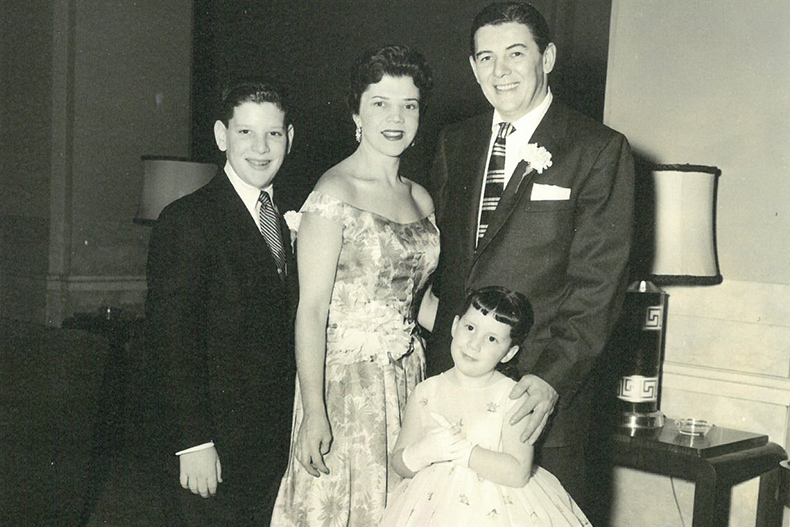
“It was old and well cared for. All of these nice black and white prints mounted on heavy cardboard, with pages in between. There was a nice plastic cover on it and it says ‘My Bar Mitzvah.'”
Although Spinner is not Jewish, she said that she knows how important a bar or bat mitzvah is in the life of a young Jewish man or woman.
So Spinner went home and posted the story on Facebook. She really wanted to find the family and was asking her Facebook community for help.
While looking through the album, there were a few, but not many, clues. There was no name on the inside cover.
But Spinner said from the photos it was obvious that the event took place in the 50s or 60s.
One of the biggest clues was a black letter-board with white letters saying “Shoreland Hotel, November 20, 1955.”
Another clue: the bar mitzvah cake read ‘Happy Bar Mitzvah William.’
Once Spinner posted those facts on Facebook, it was reposted “all over the place.” And reporters from “The Block Club” were the first to pick up the story.
But what brought in the first answers were responders to Spinner’s wife, Rachel Kell.
“She’s big on ancestry.com and genealogy sites-and she tapped into a couple of Jewish genealogy groups on Facebook,” Spinner said. “And that is quite a global network of people who are always on top of things,” Spinner said.
Kell posted the mystery in a couple of places and, within 36 hours, she received a Facebook message, saying, yeah, that’s my cousin.
The post seemed to have gone from Chicago to someone in Israel to a friend in New York-the New Yorker knew the Londons.
But Spinner said that even before they got the final connection to the family, they found a yearbook picture from 1958, and in the second to the last row there was a kid who was clearly the bar mitzvah boy, William (Bill) London, from the album.
And just a couple of hours after that Facebook message, she got a message from Gail London, Bill’s sister who lives in Lincoln Square.
Gail was thrilled to learn that this treasured family heirloom had been found.
“It’s such a wild story,” she said, referring to how the news literally traveled all over the world and the London family was identified in only 36 hours.
The solving of this mystery takes the notion of Jewish geography to a whole new level.
While it’s still a little unclear as to exactly how the album ended up at Jewel, it almost seems beside the point right now.
“It’s such a serendipitous event that someone in my neighborhood Jewel found it,” Gail said.
And how fortunate it was that the person who found it was Spinner-a woman with curiosity, caring, and initiative. She has been recognized as a type of local hero for her “super sleuthing” skills and has been featured in several news stories, online, in print, and on the radio. In fact, Steve Cochran picked up on the story and interviewed Spinner on his WGN radio news program, presenting her with the MVPP “(Most Valuable Person on the Planet)” award.
Gail helps care for her brother, who now suffers with some memory issues. “However, all of the details of childhood are very clear, so this is going to be very meaningful to him,” she said.
“There’s really some divine order to this,” she said.
Rochelle Newman Rubinoff is a freelance writer living in the northern suburbs of Chicago.
Other stories
-
Two local teens win national recognition
Recipients of the annual Diller Teen Tikkun Olam Awards
Read more -
Celebrating six young award winners cultivating the community
Introducing young adult award winners
Read more -
From Andrew S. Hochberg, Chairman of the Board, and Steven B. Nasatir, President
Words are insufficient to convey our community’s heartbreak, horror and pain at yesterday’s heinous, anti-Semitic shooting at Tree of Life*Or L’Simcha Congregation in Pittsburgh. This constitutes the worst attack on members of the American Jewish community in the history of our country.
Our hearts are in Pittsburgh as we mourn the loss of 11 innocent lives and pray for a refua shleima for the injured, including the brave police officers who are among the wounded. We are thankful for their courage, and our hearts ache for them and their families.
We remain grateful to every level of law enforcement, from the FBI and Homeland Security to our first responders and local police departments, from whom our community continues to receive such invaluable support.
For all Americans, this deadly assault-committed on Shabbat, at a synagogue-is a terrible reminder of the persistence and lethal danger of anti-Semitism. We join together with our fellow Americans across faith communities in condemning the rising tide of anti-Semitism, white nationalism, racism and hatred directed at Jews and other vulnerable minorities. An attack on one community is an attack on all Americans, and the ideals for which our diverse nation stands. We call upon our elected officials and all people of good will to have zero tolerance for anti-Semitism-and all forms of hatred-denouncing it and calling it out whenever and wherever it takes place.
JUF is delivering multi-faceted support in response to this tragedy, starting with bringing our community together to stand as one with our brothers and sisters in Pittsburgh.
- On Thursday, Nov. 1 at noon we will convene an Interfaith Solidarity Gathering at Swissotel Chicago, 323 E. Upper Wacker Drive, through our Jewish Community Relations Council, an opportunity for us to express our collective grief and hope.
- Next Shabbat, Nov. 2-3 , at the initiative of JUF’s Rabbinic Action Committee and our Chicago Board of Rabbis, synagogues across the nation will observe a special Solidarity Shabbat, coming together across denominations to pray, to mourn, and to strengthen one another. Shabbat was taken from us in the name of hate; we must reclaim Shabbat in the name of love. We hope you will find it meaningful to participate with local congregations.
- We have opened a Pittsburgh Solidarity Fund —https://donate.juf.org/pittsburgh — to help provide psychological services, support for families, medical bills for all those involved, reconstruction, and security. This is in addition to the $25,000 sent as an initial grant to the Jewish Federation of Greater Pittsburgh’s Victims of Terror Fund earmarked for the wide variety of personal and communal needs arising from this tragedy. We will continue to assess the needs in that community on an ongoing basis.
- Building upon JUF’s $2.9 million Matching Security Grant program in 2017, we will be providing additional support for local synagogues in need of security enhancements.
This murderous, hateful attack at Tree of Life*Or L’Simcha Congregation underscores the critical importance of continuous and vigilant security, and JUF remains committed to doing everything we can to foster the safety of our community members. As always, we are working in partnership with our local synagogues, Jewish schools, preschools and agencies, providing individual security consultations and linking them to the resources of the Department of Homeland Security, the FBI and local law enforcement.
In addition, we are planning a follow-up Security Summit, building on the Security Summit held in March 2017, to further enhance security at our local Jewish institutions. These trainings and assessments complement the many millions of dollars made available through our own JUF Security Grant program and allocations supporting local security programs, as well as JUF’s assistance with the U.S. Homeland Security grant program, helping to make Jewish buildings safer.
As Jews, we are commanded in the Torah to “Choose Life,” even in the face of tragedy. That is what our brothers and sisters in Pittsburgh will do, and we in Chicago will join with Jewish communities around the world in supporting them, and through our actions further secure our collective future as Americans and as Jews.
Other stories
-
Two local teens win national recognition
Recipients of the annual Diller Teen Tikkun Olam Awards
Read more -
Celebrating six young award winners cultivating the community
Introducing young adult award winners
Read more -
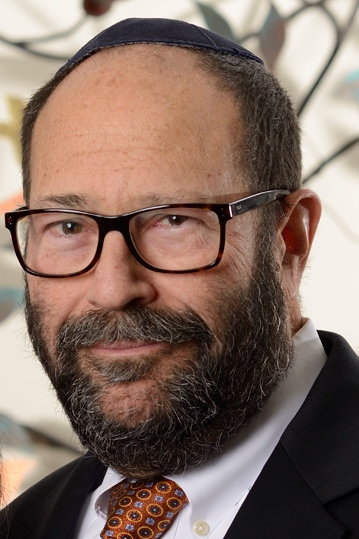
It was over dinner in the dining hall of Camp Ramah during counselor training week when Rabbi Sam Fraint first met his future wife, Deena Segal.
When Fraint spotted another young woman he knew from the United Synagogue Youth (USY) movement sitting with Deena, he sat down with both of them and tried to make them laugh.
Later that evening, he, Deena, and a couple of his pals, including his best friend who also had a crush on Deena, drove outside the campgrounds for ice cream. On their way back to camp, they got a flat tire and Fraint’s good humor and patience won Deena over as his girlfriend — and eventually his wife, whom he married in 1975.
The longtime spiritual leader of Moriah Congregation in Deerfield, Fraint passed away on Oct. 6 after an extended illness. He was 68.
It seems fitting that Camp Ramah and USY played a role in the spark that brought Fraint and Deena together. After all, Fraint was a champion of traditional Jewish life and believed in the importance of Conservative Jewish institutions like Camp Ramah, the United Synagogue Youth movement, and Solomon Schechter Jewish Day School for young Jews.
“Rabbi Fraint and I knew each other well and, over the many years of his leadership, met one-on-one to exchange ideas on how to expand Jewish education opportunities for young people in our community,” said JUF President Steven B. Nasatir. “He led his congregation with full commitment, was an inspiring teacher of Torah, and a strong defender of Israel and the Jewish people. His passing leaves a sad void in our Jewish community and in the Conservative rabbinate.”
Fraint was born and raised in Brooklyn to first-generation American Jews from Russia. In his early years, he received a secular Jewish upbringing with little formal Jewish education.
Eventually, though, he embraced Jewish education and attended Camp Ramah, joined USY, and traveled on youth trips to Israel, all inspiring his love for engagement in traditional Jewish life — and his entry into rabbinical school at the Jewish Theological Seminary of America, affiliated with the Conservative movement.
He and Deena started a family in New Jersey — a daughter and two sons. Then, the family moved to Chicago in 1983 for what was supposed to be a temporary break from the East Coast. But, they ended up staying in Chicago indefinitely.
After a brief stint at North Suburban Synagogue Beth El in Highland Park, Fraint became Moriah Congregation’s rabbi in 1987, succeeding the late founder of Moriah, Rabbi Samuel Dresner.
Under Fraint’s bold leadership, the congregation grew to become a vibrant and prominent Chicago-area Jewish institution, drawing congregants from near and far.
During his 30-year tenure at Moriah, he helped grow the membership from 80 families to more than 400.
Merle and Larry Cohen were longtime friends and congregants of Fraint. “We saw real brilliance in Sam,” Merle said. “When he spoke, it was poetry. His sermons were always controversial — half the shul loved them and half didn’t — but they always made you think.”
In an era when many Conservative synagogues have moved left, Fraint stuck to his convictions when it came to traditional Jewish principles such as Shabbat observance.
Rabbi Jeremy Fine, who grew up at Moriah and considered Fraint a great mentor, wrote a tribute to the late rabbi in the days after his passing. “Rabbi Fraint has done what almost no other Conservative rabbi in the country has been able to do; entice modern, traditional, and pluralistic Jews to sacrifice everything else American values have taught us in order to move walking distance to synagogue and make Shabbat Jewish priority number one,” Fine said. “…Shabbat was special because he was a magnificent rabbi. No quirky gimmicks, no flashy High Holiday guests, and certainly no special music; just Shabbat with your family, and he truly believed everything else would work itself out.”
In 2015, Fraint retired and became Moriah’s rabbi emeritus, and in 2016, he was succeeded by Rabbi Ben Kramer. Kramer said his predecessor leaves a legacy of inspiring so many people on a path to greater Jewish engagement. If he had to sum up the greatest lesson he learned from Fraint, it would be the way the late rabbi challenged people: “You don’t have to be afraid,” said Kramer, “to set the bar high for people, and people will respond and try to reach it.”
Rabbi Fraint is survived by his wife, Deena, nee Segal; children Hannah, Zeke (Laura) and Avram (Jodi); and granddaughter Sophia Ruth; brother Eric (Kathy); brother-in-laws Eric (Karen) Segal and Danny Segal (Susan Kitzen); and many nieces and nephews.
In lieu of flowers, donations may be made to Moriah Congregation, Camp Ramah in the Berkshires, Camp Ramah in Wisconsin, and National Ramah-Seminar Scholarships.
The reward for information leading to the arrest of the killer or killers of two men in Rogers Park has risen to more than $20,000, after several groups joined the Jewish United Fund/Jewish Federation’s initial commitment of $10,000 to aid the investigation.
Douglass Watts was shot to death Sept. 30 on the 1200 block of W. Sherwin, and Eliyahu Moscowitz was killed 36 hours later, just a few blocks away in Loyola Park.
The JUF/Federation commitment was announced at an Oct. 4 Chicago Police Department community meeting, co-convened with Ald. Deborah Silverstein and attended by hundreds.
“These murderous attacks are reverberating throughout the Jewish, LGBTQ and the broader communities,” JUF Executive Vice President Jay Tcath said, “and your Federation is determined to do whatever we can to aid the community as well as law enforcement’s efforts to apprehend whoever is responsible.”
The JUF/Jewish Federation reward is being made via Cook County Crime Stoppers, which will offer $5,000 for each case for information that leads to the arrest of the person or persons responsible for the murders. Anyone with information can call their hotline number at 1-800-535-STOP . All calls to Cook County Crime Stoppers will remain anonymous.
Other stories
-
Two local teens win national recognition
Recipients of the annual Diller Teen Tikkun Olam Awards
Read more -
Celebrating six young award winners cultivating the community
Introducing young adult award winners
Read more -
I travel the world. When someone mentions Asia, I immediately conjure up mystical India.
Falling in love with “Incredible India,” as the its own ministry of tourism puts it, is not difficult, even though the country often bewilders the visitor who quickly discovers that traversing this ancient land becomes a soul-searching journey.
Hard to believe that India stretches from the tropics right up to the temperate regions, from near the equator to the base of the Himalayas; a vast country, indeed.
“India is history,” wrote the late Jawaharlal Nehru- leader for Indian independence from Britain and the country’s first prime minister- adding that the country “has a long memory.” Indeed; its history reaches back five millennia. And the Jewish people are part of that memory. For more than 2,000 years, pluralist India has been a peaceful home to Jews and has played a significant role in Jewish consciousness.
To reach the India of my people, I flew non-stop, 8,000 miles in 16 hours. As I toured India- the birthplace of three great faiths: Hinduism, Buddhism and Jainism- I could not help but see and sense the tumult, the hustle, the poverty and yes, the inequality that exists in wide segments of the population. Yet, progress moves society forward; now, discrimination on the basis of caste remains illegal.
American visitors usually begin their journey in Delhi, the capital. This is one “corner” of the “golden triangle” of India tourism. Another is Agra, site of the world marvel, the Taj Mahal, and the deserted city of evanescent red sandstone, Fatehpur Sikri, cited as among “the most evocative ruins in India.” The other corner of the “triangle” is Jaipur, home to the Amber Fort, best reached by riding an elephant up a steep road.
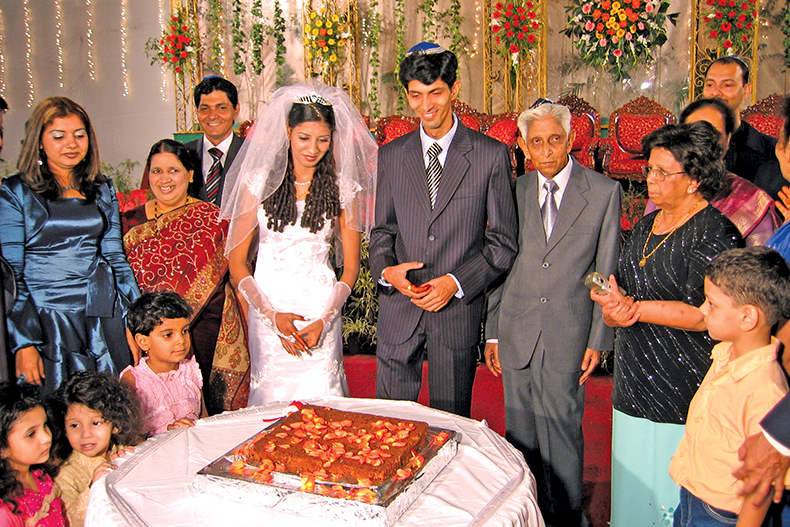
Arriving first in Delhi, one of the world’s historic cities, I quickly sought out my people and learned that there are three distinct groups: The Bene Israel trace their roots in India back to the destruction of the First Temple in 586 BCE; today they are the largest group of Indian Jews-most reside in Mumbai. The Cochin Jews, another ancient community, living in Kochi, in southwest India, is another group. Most recent are the Baghdadi Jews who descended from 19th century immigrants from Iraq and other Arab lands.
I stop at the Judah Hyam Synagogue in New Delhi- opposite the Taj Mahal Hotel and near the Christian cemetery- which serves about 100 Jews who live in the capital. Chabad House also sponsors a restaurant at Main Bazaar, Pahar Ganj, New Delhi.
Delhi is only one of India’s showcases. A several-hour drive takes me to Agra to visit the Taj Mahal. There is nothing like it anywhere else in the world. Some people come to India just to see the Taj Mahal. The beautiful and well-kept gardens are astounding; this is perhaps the most beautiful building ever constructed.
A journey to India is not complete without visiting the first city in India, where 22 official languages and 200 dialects are spoken every day: Mumbai, formerly called Bombay.
An old adage: “As long as Bombay exists, there will be Jews in town.” In enormous, diverse, mystic Mumbai- the nation’s transportation hub, the business capital, the economic powerhouse- stands an active Jewish community of about 5,000.
Most Indian Jews reside in Greater Mumbai with its metropolitan population of about 22.5 million people. They can visit the Evelyn Peters JCC at D.G. Ruparel College in Matunga. Nine Sephardic Orthodox synagogues and a Reform group thrive in the city. Its Chabad House was the one victimized in the 2008 terrorist attack which took the lives of 174 city residents, including six Jews at Chabad House itself.
Mumbai is a good place to ponder the Jewish presence in India. Throughout the ages and on into the 21st century, the largest number of Jews in any country east of Iran resided in India. The Book of Esther mentions India, and the Talmud contains several references to the country. Saadia Gaon mentions great profit to be had in Indian trade. During the 12th century, Jewish travelers visited India. Benjamin of Tudela described the Jews of southwest India. Maimonides wrote that his Mishne Torah was studied there.
The early history of the Jews in India remains shrouded in legend. The traditional belief is that refugees left Israel by boat and ultimately reached the Konkan coast before the time of King Solomon, whose own ships plied the waters between the Gulf of Aqaba and the west coast of India.
As I flew to Kochi (Cochin) in Kerala, I recalled that India is seen as a country without anti-Semitism. As Professor Nathan Katz wrote: “the Indian chapter [in Jewish history] remains one of the happiest of the Jewish diaspora.” Cochin Jews are best known to the outside world, though only about a dozen reside here. The outstanding Jewish site remains the whitewashed, rectangular Paradesi Synagogue, part of the ” Living Legend of India .” It is well worth a visit.
In Kochi-“the Queen of the Arabian Sea,” and the epitome of long-ago India-small, kiosk-type shops dot Synagogue Lane in “Jew Town,” located in the Mattancherry district.
So, to travelers everywhere: India- with its vast plains, huge mountains, mighty rivers, great forests, long history, mixed culture, and infinite charm- awaits you.
Ben G. Frank, journalist, travel writer, is the author of The Scattered Tribe: Traveling the Diaspora from Cuba to India to Tahiti & Beyond (Globe Pequot Press); the historical novel Klara’s Journey , (Marion Street Press), and the up-to-date A Travel Guide to Jewish Europe , 4th Edition , (Pelican Publishing).
JUF is a partner with the American Jewish Joint Distribution Committee in providing services to people in more than 70 countries, including India. Learn more at jdc.org.
Other stories
-
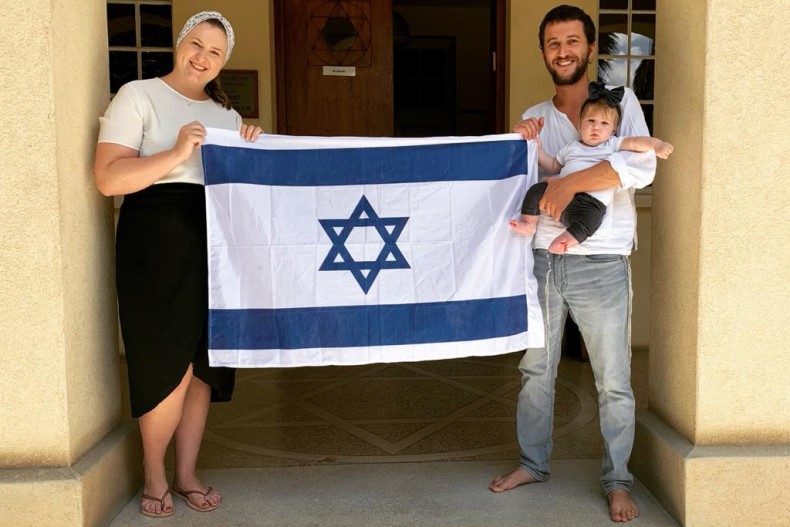
Chicago to Israel to Kenya
A family’s story of living Jewishly on three continents Michelle Cohen World May 28, 2021 Avital, Tzofia, and Netanel Kaszovitz outside their home in Nairobi on Yom HaAtzmaut. When Avital Kaszovitz prepared to be a Modern Orthodox shlicha (emissary) to the Jewish community in Ke
Read more -
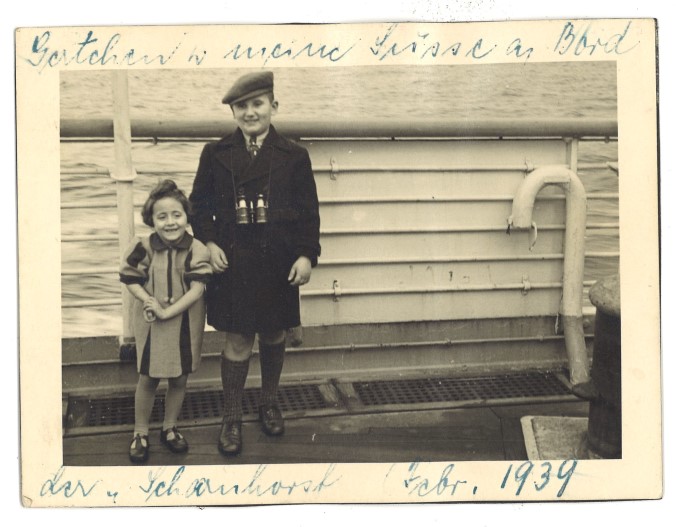
New exhibit spotlights the experience of ‘Shanghai Jews’
Explore a new Illinois Holocaust Museum and Education Center exhibit
Read more -
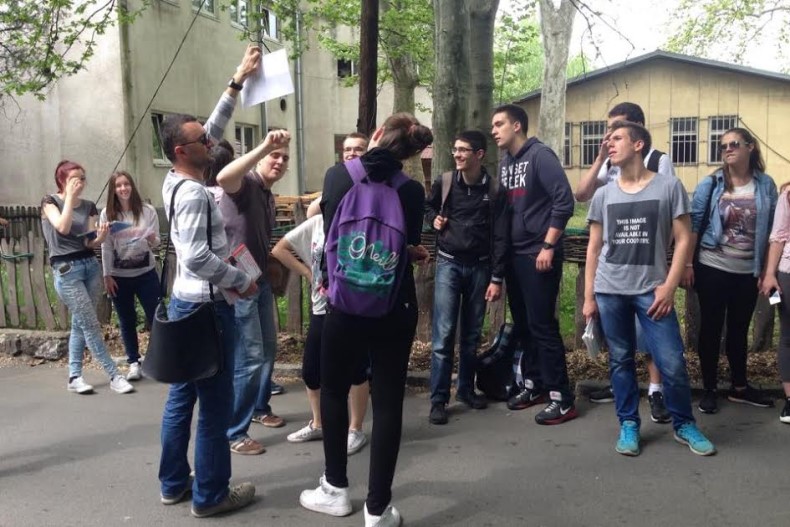
Europe’s brave new teachers of the Holocaust
Teaching the Holocaust in the modern era has its difficulties and rewards.
Read more
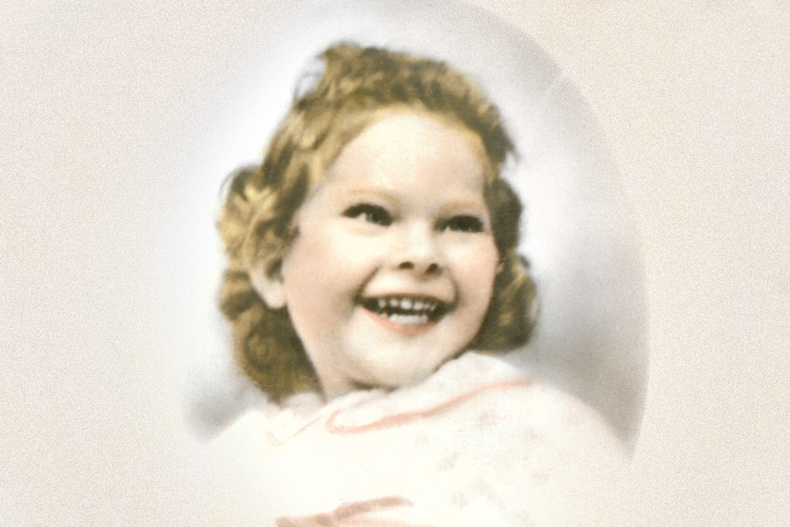
The baby was born after a long, grueling labor, and emerged with the umbilical cord wrapped around her neck. Few expected the tiny infant to survive. But she did.
Marcia Kalman was a beautiful child, with cornflower blue eyes, light brown curls, and dimples in her cheeks and hands. She couldn’t speak, but she was quick to laugh — and she was the apple of her parents’ eye.
Her father, Al, rigged a harness to hold Marcia’s limp limbs in place, allowing her to sit upright in a chair. Sonya, her mother, spent untold hours caring for her daughter as the years went by, painstakingly massaging her throat to help the little girl swallow food.
But as Marcia grew, it became harder for her parents to manage. Just 5 feet tall, Sonya had an increasingly difficult time lifting Marcia. With all the energy they devoted to their firstborn, Sonya and Al had little time to attend to her younger sister, Joanie, let alone have time to themselves.
Finally, the extended family intervened. Joanie was failing to thrive, they said; she was nearly 5 years old and did not yet speak. It was time, they said, to put Marcia in a home. Sonya and Al felt they had no choice.
A few months after she was placed in the institution, my Aunt Marcia died at age 8.
My grandparents never, ever got over the loss.
When I was a young adult, I asked my grandparents to tell me more about Marcia. My grandfather left the room, but my grandmother smiled. She told me Marcia had had such a sunny personality and wonderful sense of humor; how she often giggled as my grandmother joked through their daily routine.
Gently I asked how, exactly, she had died.
“They said she died of pneumonia,” Sonya said. “But that’s not true. I killed her. I broke her heart.”
My grandmother’s words haunt me.
Little wonder that she was not the most affectionate grandparent or parent. What a labyrinth of emotions she must have felt towards her surviving child, and upon the birth of her third daughter, Marjorie, who arrived several years after Marcia’s death and was named for her older sister.
I imagine how all of their lives would have been different, had Marcia lived.
Were she born today, I believe Marcia would have survived — and even thrived. Beyond the medical advances and technology that would have helped manage her cerebral palsy, Marcia and my family would have been supported by life-transforming services provided by JUF’s partner agencies.
From Jewish Child & Family Services (JCFS), Marcia would have gotten physical therapy, occupational therapy, and speech therapy through the Integrated Pediatric Interventions program — and the JCFS Legal Advocacy program would have helped ensure Marcia got the appropriate public school education.
Through Keshet, she could have participated in inclusive sports, buddy programs, and other recreational opportunities that would have given her a sense of community. She could have gone to an inclusive JCC summer camp, a partnership between Keshet and JCC Chicago.
As she grew to adulthood, JUF’s Encompass program would have helped Marcia access supports for housing, community involvement, and meaningful volunteer work or employment.
Perhaps most important of all — especially during those early years — a couple of hours a week, Marcia would have been cared for through JCFS Respite Services, giving her parents a chance to recharge their emotional batteries. Her little sisters would have participated in a siblings group to help process their own needs. And the entire family would have had counseling.
Were she born today, I believe our JUF network of partner agencies would have helped save Marcia’s life — and our entire family history would have been rewritten.
As we mark Disabilities Awareness Month, in October, I grieve for my family, which had a crisis 75 years too early to receive the help they needed — but rejoice in the possibilities for today’s families, as our Chicago Jewish community continues to make strides in embracing people of all abilities.
Other stories
-
Two local teens win national recognition
Recipients of the annual Diller Teen Tikkun Olam Awards
Read more -
Celebrating six young award winners cultivating the community
Introducing young adult award winners
Read more -