Illinois Treasurer Michael W. Frerichs announced Monday a $10 million investment in Israel bonds. The investment matures in February 2018.
“My investment approach is simple. To focus investments in Illinois when possible, but to ensure that we have a diverse portfolio that mitigates risk,” Frerichs said. “Israel Bonds have a strong record of return and are dependable investments. Israel bonds have never missed payment on principal or interest since the first Israel bonds were issued in 1951.”
The Illinois Treasurer invests money on behalf of the state and its residents. The $27 billion portfolio includes $5 billion on behalf of local and state government units.
The investment approach is conservative to ensure the protection of principal. Funds also are invested in support of community development efforts.
Israel Bonds President and CEO Izzy Tapoohi said, “We are deeply gratified by Treasurer Frerichs investment in Israel bonds. This investment highlights his appreciation for Israel bonds as significant investments for funds calling for the strictest level of fiduciary responsibility. It also underscores his confidence in Israel’s economy, which today is widely recognized as being among the most resilient in the world.”
Capital realized through the sale of Israel bonds has developed every aspect of Israel’s economy. Recognized as a valued economic and strategic resource, Development Corporation for Israel/Israel has secured global sales approaching $40 billion since the first bonds were issued in 1951.
Other stories
-
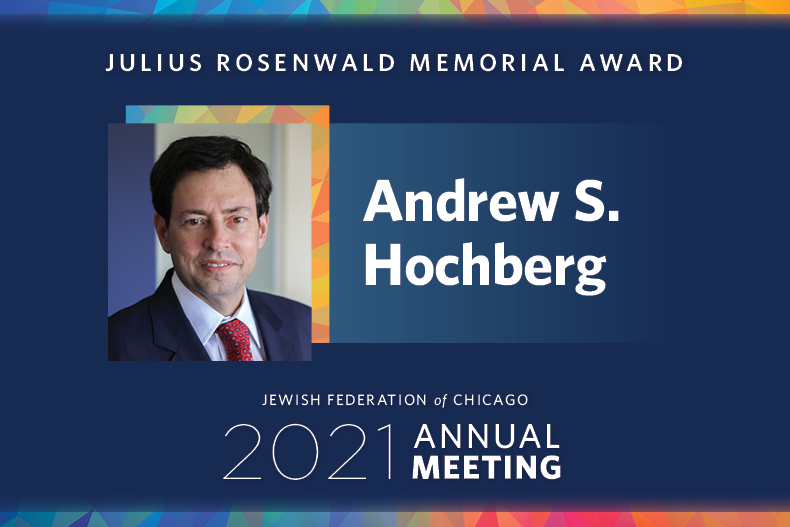
Meet Andrew S. Hochberg, 2021 Julius Rosenwald Memorial Award recipient
Celebrate Andy Hochberg at the virtual Annual Meeting on Sept. 14
Read more -
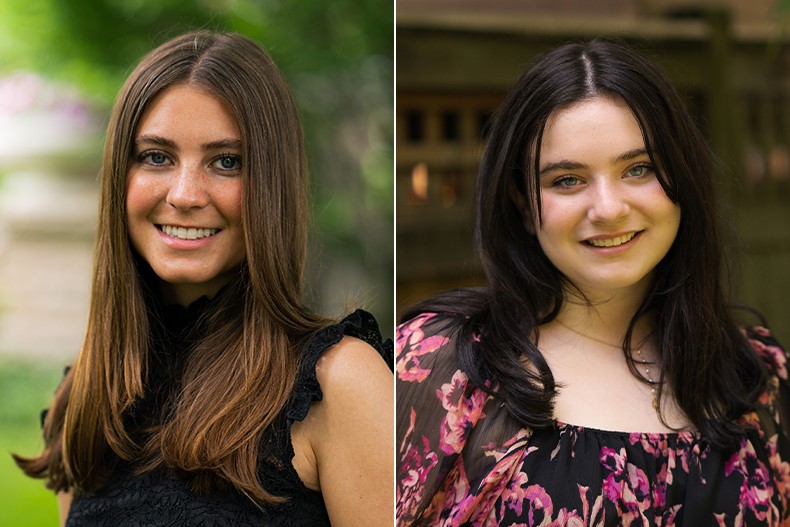
Two local teens win national recognition
Recipients of the annual Diller Teen Tikkun Olam Awards
Read more -
Celebrating six young award winners cultivating the community
Introducing young adult award winners
Read more
As the Executive Director of JUF’s Israel Education Center, I’ve been thinking a lot about the reality that our Jewish college students live in today and the association I keep returning to is George Orwell’s book 1984.
“Doublespeak,” is a close cousin of the book’s concept of “doublethink.” Right is wrong, wrong is right and up is down. The Israeli-Palestinian conflict is happening in doublespeak, especially on college campuses. In what world could we imagine Jewish college students being accused of sympathizing with genocidal murderers and racist apartheid supporters?
When did it become acceptable to host a fundraiser for a convicted terrorist at an institution of higher learning like the Students for Justice in Palestine event for Rasmea Odeh at DePaul University and coming up at Loyola? Odeh was convicted of murdering two Hebrew University students in 1969 in Israel, released in a prisoner exchange and then lied on her immigration papers to enter the United States. Is that really the person that Students for Justice in Palestine should lift up as role model? When did we turn the page on lauding violence over non-violence? When could we imagine anti-normalization/anti-dialogue would be the standing policy of a student group?
Isn’t college exactly the place to encounter and wrestle with opinions different from our own? In this Orwellian world, some LGBT, Latino, and black student communities have chosen to align themselves with anti-Israel campus organizations rather than forming their natural affiliation with student organizations like Hillel that support the country that has the most progressive agenda in the Middle East. At Northwestern University recently, we saw this new dynamic play out in a very sophisticated divestment campaign in Student Government that our Jewish students lost by a vote of 24 to 22 with three abstentions. Jewish students were portrayed as “white, privileged, and in power” and, therefore, the “oppressor” and against human rights, whereas anyone from an “oppressed” minority was seen as the natural ally of the Palestinians and, therefore, in favor of human rights.
These current realities on campus don’t exist in a vacuum. They are representative of national and international trends. Following the latest round of violence in Israel this summer and the more recent events in Paris, IEC saw an uptick in anti-Semitic activity on campuses nationwide despite the fact that Jews were the victims of this violence rather than the perpetrators. Swastikas were graffitied on Jewish fraternity houses, a Jewish student at Temple University was assaulted by a member of SJP, and Steven Salaita felt no shame in openly demonizing Israel and her supporters via Twitter. To many Jewish students and Israel’s supporters it feels as though we have entered an alternate reality. So what is the IEC doing about it?
The good news is that many non-Jewish students are turned off by pictures of dead babies and one-sided talking points during divestment campaigns. Gallup’s poll in February of 2014 told us that 62 percent of Americans overall support Israel. But to achieve this support requires consistent work.
Jewish college students do not go to university to become warriors for Israel. They want to experience the totality of college life. While the attacks on campus have become more radical—the unintended outcome has largely been rejection by the overall campus community and the galvanization of the Jewish student body. The extreme tactics used by Israel’s detractors have had the effect of mobilizing Jewish students to defend Israel and the Jewish people.
IEC’s approach is to win the majority through educational conversation and initiatives that focus on values and coalition building. IEC’s Israel Interns are trained to build partnerships with Jewish and non-Jewish student groups and campus influentials, but as we witnessed at Northwestern we need to do more. IEC partnered with national organizations to build the Chicago Israel Council which brings together student leaders once a month to discuss trends and best practices and learn from one another’s work. Hillel acts as a convener for a diverse array of Israel-related groups. And together we stand against the false accusations that pervade campus discourse about Israel.
We take the long-term view, but immediate and strategic responses to anti-Israel activity are necessary. No claim of apartheid, genocide, or oppression goes unchecked. IEC employs various strategies based on the particular incident and campus. IEC remains committed to ensuring Jewish students feel pride in their identity and in supporting Israel. Crisis mode is neither sustainable nor a winning strategy.
Consistent accusations of genocide, support of apartheid, and colonialism can take their toll on any student, especially ones with only a cursory knowledge of Israel’s history and their own Jewish identity. IEC’s most important job is to ensure that Jewish students, in an effort to empathize with their “friends,” do not end up feeling guilty for supporting Israel.
That is where JUF’s Hillels and IEC play a critical role. Investment in long and short-term travel programs like Taglit Birthright Israel, Onward Israel, and MASA help stem the tide against the distancing of our Jewish college students from Israel. Combined with Hillel’s and IEC’s 24/7 commitment to strengthening Jewish knowledge and leadership training, we have the right formula. IEC will not allow our colleges to become like Orwell’s “Ministry of Truth.”
With the help of a committed Jewish community and our generous donors, IEC and Hillel are producing the next generation of Jewish leaders who, while learning to stand up for Israel today, will be confident advocates for themselves and the wide array of Jewish needs in the future. We are making a difference.
Emily Briskman is the Assistant Vice President of Campus Affairs and Executive Director of JUF’s Israel Education Center.
Other stories
-
Local campus administrators convene on hate speech, bias
JUF and ADL brought together 17 student safety, diversity and inclusion and student affairs administrators and Hillel representatives from various Illinois campuses to discusses issues of hate speech and bias.
Read more -
Engaging students about Israel on campus
Too often we hear about difficulties facing Jewish college students on Illinois campus, but to focus solely on the politics gives only one piece of the complex narrative that is Jewish life on campus.
Read more -
Hillel International launches fellowship initiative to train young Jewish professionals
The Springboard Fellowship will train cohorts of young Jewish professionals in highly-valued skillsets and place them at local Hillel campuses for two years.
Read more
On Feb. 23, JUF’s Jewish Community Relations Council hosted a meeting on the pressing and timely topic of addressing Israel on college campuses.
The program featured a panel of experts, including Lonnie Nasatir, regional director of the Anti-Defamation League, Michael Simon, executive director Fiedler Hillel at Northwestern University, Nicole Constantine, a student and IEC Israel Intern at Loyola University, Emily Briskman, executive director of the Israel Education Center, and Josh Rinkov, chair of Metro Chicago Hillel.
The conversation covered current trends on college campuses to delegitimize Israel, key lessons learned from working with students to combat these harmful and divisive efforts and exploring where we as a community need to go from here.
“Each speaker has intimate knowledge on this issue, and presented a unique perspective on the challenges faced by Jewish students on our local campuses,” said Skip Schrayer, chair of JCRC. “This conversation could not have come at a more critical time for our community.”
Many Jewish organizations, including the Jewish Federation of Metropolitan Chicago and member organizations of the JCRC, have been working diligently to combat these efforts.
JCRC’s next meeting on April 1 will feature a conversation with Emily B. Landau from The Institute for National Security Studies in Tel Aviv, David Makovsky from The Washington Institute, and Israeli Consul General Roey Gilad on topics including the Iran nuclear talks, U.S.-Israel relations, and the Israeli elections.
Other stories
-
Meet Andrew S. Hochberg, 2021 Julius Rosenwald Memorial Award recipient
Celebrate Andy Hochberg at the virtual Annual Meeting on Sept. 14
Read more -
Two local teens win national recognition
Recipients of the annual Diller Teen Tikkun Olam Awards
Read more -
Celebrating six young award winners cultivating the community
Introducing young adult award winners
Read more
The mayoral runoff on April 7 is not the only undecided race in Chicago. Runoff elections will also be held in 19 wards to determine undecided aldermanic races, including several that are of particular interest to the Jewish community. These include the new 2nd ward, 43rd ward, and 46th ward.
New 2nd Ward: Six candidates ran for the new 2nd ward alderman spot, which will see a runoff between Alyx Pattision, a lawyer, and Brian Hopkins, Cook County Commissioner John Daley’s Chief of Staff. Pattision, who earned 24.4 percent of votes and Hopkins, who received 29.4 percent of the votes, will continue to aggressively campaign in the 2nd ward, which now encompasses parts of Streeterville, Lincoln Park, Bucktown, Wicker Park, Ukrainian Village and pieces of the Gold Coast.
43rd Ward: There were a total of four candidates in the 43rd ward: Alderman Michele Smith, a former federal prosecutor and one of two Jewish aldermen in Chicago (41.5 percent), Caroline Vickrey (35.7 percent), Jen Kramer (16.9 percent) and Jen Quandt (6.9 percent). Of the 30,254 registered voters in the 43rd, only 9,712 participated. This will be the third runoff for Smith. Vickery, a 20 year resident of the 43rd ward, is a former lawyer turned community volunteer. She is a member of the Oz Park Advisory Council, local school council, and is a MidNorth Association board member.
46th Ward: Also anticipating a tough race, incumbent James Cappleman, a social worker, gathered 46.7 percent of votes and faces a run-off with Amy Crawford, who obtained 37.66 percent. Crawford, a partner at Kirkland and Ellis, is a longtime Uptown resident and a board member of the Northside Federal Credit Union. The 46th ward encompasses EZRA and Anshe Emet Synagogue.
50th Ward: Jewish Alderman Debra Silverstien won with a decisive 64 percent of the votes. Silverstein’s ward is home to 19 Federation agencies, the largest concentration of Federation agencies in Chicago, including several Associate Talmud Torah programs, Jewish Child and Family Services, and CJE SeniorLife. The 50th is a chunk of West Rogers Park, ranging from Ridgeway to the East, a portion of Peterson to the south, Kedzie to the west, and Touhy to the north.
Other stories
-
Meet Andrew S. Hochberg, 2021 Julius Rosenwald Memorial Award recipient
Celebrate Andy Hochberg at the virtual Annual Meeting on Sept. 14
Read more -
Two local teens win national recognition
Recipients of the annual Diller Teen Tikkun Olam Awards
Read more -
Celebrating six young award winners cultivating the community
Introducing young adult award winners
Read more
From Feb. 8-10, exactly a month after the terrorist attacks on Charlie Hebdo and the Hyper Cacher kosher market, we and six other JUF leaders joined 40 Federation leaders from across the United States in a solidarity and fact-finding mission to Paris that was led by former JUF Board Chairman David T. Brown. Here are some of the insights we returned home with.
1. The sight of heavily armed soldiers now stationed outside France’s 600 Jewish institutions speaks to the government’s commitment to defend the country’s Jews, as well as to its inability to do so. It also is as much a demonstration of Jewish vulnerability as it is security. That is especially the case as community leaders express apprehension for the day, feared not too distant, when the government decides to withdraw those troops.
2. French Jews are facing this crisis as their beloved country – and make no mistake about it, French Jews are passionate French nationals – faces its own economic (20% unemployment), security, civic contract and personal identity crises; the national crises are fueling the Jewish crisis.
3. The government’s Ministry on Combating Racism and Anti-Semitism, with noble intention, is developing a “road map” that seems too reliant on filtering Google search results on topics like the Holocaust (to weed out or correctly label denial websites) and deploying a general anti-bigotry educational curriculum that is unlikely to root out the very specific sources of France’s anti-Semitism.
4. Anti-Semitic terrorism today differs from what French Jews endured in the 1970s and 1980s, when the attacks were conceived, orchestrated and executed by known organizations. The attacks of the past decade, while inspired by the ideology of such groups, are being carried out by “lone wolves” or a small, unaffiliated pack of wolves. It makes the law enforcement challenge even more difficult.
5. It’s a bit like Dickens’ “best of times, worst of times” scenario for French Jewry. Their community has many signs of health: Paris has more kosher restaurants than New York City or Tel Aviv; over 50% of their students attend Jewish day schools, and; the percentage of French Jews who speak Hebrew, travel to Israel and are affiliated with a synagogue is the highest in the Diaspora. At the same time, we heard anecdotes of men who now place a baseball cap atop their yarmulke when in public, who have moved their mezuzah from their outside doorpost to the inside, and who, having moved their children from public school to Jewish school in order to escape brutal anti-Semitic bullying, now have moved the same children to Catholic schools over fears of terrorists attacking Jewish schools, as happened in Toulouse in 2012.
6. While aliyah (immigration to Israel) rises dramatically, doubling annually since 2011, these are NOT the final days of France’s Jewish community. There will be a significant exodus, one that drains the community of some of its best and brightest, especially among its youth. But at over half a million strong – the world’s 3rd largest – there will be a French Jewish community for generations to come. At the risk of being cynical rather than appreciative for the welcomed sentiment, Prime Minister Manuel Valls could comfortably assert “France without Jews is not France” precisely because that hypothesis will not be tested.
7. Intense, sustained American Jewish advocacy on behalf of French Jewry – to our government and theirs – would be unprecedented. Whether it was for Soviet, Syrian, Iranian or even Argentinian Jewry, we have never run an advocacy campaign for a Jewish community that was not suffering from state-sponsored anti-Semitism, whose members were fully free citizens enjoying the full rights and protections of democracy, and that itself was affluent and influential. All those factors should inform our intentions to be helpful, lest we end up engaging in activities that are unwelcome by and perhaps detrimental to those we are actually trying to assist.
8. French Jews have identified three priority areas requiring additional resources: i) Increased facility security; ii) Increased support for Frenchmen moving to Israel, and; iii) Relocating the 2,000 Jews living in or near the most radical Arab/Muslim neighborhoods to safer areas, ones where the Jewish community is more concentrated.
9. No sooner had the terror in France re-focused our Jewish attention there than an all-too-similar deadly scenario played out in Copenhagen, with an initial attack against people embodying the principle of free speech followed by an attack against Jews at a Jewish institution. As we mourn for our brothers and sisters in Paris and Copenhagen, and not too long ago, Brussels, we sadly acknowledge that we will again be mourners.
10. We went to Paris to listen, to learn and to personify, on behalf of our great Chicago Jewish community, the solidarity we all feel with our French cousins. Their challenges are ours, as are their sorrows and joys. As are, despite the miles, our shared futures.
Other stories
-
Chicago to Israel to Kenya
A family’s story of living Jewishly on three continents Michelle Cohen World May 28, 2021 Avital, Tzofia, and Netanel Kaszovitz outside their home in Nairobi on Yom HaAtzmaut. When Avital Kaszovitz prepared to be a Modern Orthodox shlicha (emissary) to the Jewish community in Ke
Read more -
New exhibit spotlights the experience of ‘Shanghai Jews’
Explore a new Illinois Holocaust Museum and Education Center exhibit
Read more -
Europe’s brave new teachers of the Holocaust
Teaching the Holocaust in the modern era has its difficulties and rewards.
Read more
About 15,000 children passed through the Terezin concentration camp. Fewer than 100 survived. JCC Chicago will present I Never Saw Another Butterfly, a gripping play based on the writings of these Terezin children who, in the midst of unfathomable atrocity, find a beautiful inner spirit and courage.
I Never Saw Another Butterfly opens at 7:30 p.m., Thursday, Feb. 26, at Mayer Kaplan JCC, 5050 Church St., Skokie. The performance will be followed by a Q&A with local Holocaust survivors Lisl Bogart and Kurt Gutfreund, made possible in partnership with the Illinois Holocaust Museum & Education Center.
Two performances will be held at noon and 2:30 p.m., Sunday, Mar. 1; the final performance will take place at 2:30 p.m., Sunday, Mar. 8, followed by another Q&A session.
The bestselling book I Never Saw Another Butterfly has received critic accolades since its release in 1994. On the pages of poems and pictures drawn by the young inmates, we see the daily misery of these uprooted children, as well as their hopes and fears, their courage and optimism.
For JCC Chicago, it was important to bring this emotive and poignant story to the stage.
“Often we do fun musicals and lighter fare, but [we] feel this theatrical experience will be thought-provoking for audiences and a bridge to discuss a difficult subject with the whole family,” said Director Robert Bouwman.
Adults and children ages 12 and older are invited to join JCC Chicago for this moving and powerful production. Tickets are available online for $11 at www.gojcc.org/theater.Special pricing of $5 per person is also available for the Mar. 8 performance.
For more information about Lisl Bogart and Kurt Gutfreund, please contact Amanda Berrios of the Illinois Holocaust Museum & Education Center at [email protected].
Other stories
-
Meet Andrew S. Hochberg, 2021 Julius Rosenwald Memorial Award recipient
Celebrate Andy Hochberg at the virtual Annual Meeting on Sept. 14
Read more -
Two local teens win national recognition
Recipients of the annual Diller Teen Tikkun Olam Awards
Read more -
Celebrating six young award winners cultivating the community
Introducing young adult award winners
Read more
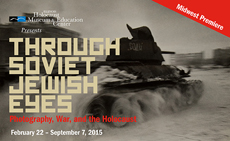
The Illinois Holocaust Museum & Education Center has announced the Midwest premiere of Through Soviet Jewish Eyes: Photography, War, and the Holocaust, a photographic exhibition that reveals a rarely seen perspective of World War II through the lens of the most important Soviet Jewish photojournalists. In order to reach Chicagoland’s significant Russian-speaking community, the Illinois Holocaust Museum will be the first museum in the world to present the entire exhibition with Russian translation.
Based on the award-winning book “Through Soviet Jewish Eyes,” written by curator David Shneer, the exhibition presents more than 60 photographs that span the Nazi-Soviet war, from June 22, 1941 until Victory Day on May 9, 1945. The photographs range from large-scale, dramatic prints in which the fine line between art and photojournalism is blurred, to intimate-scaled vintage prints that compel a close reading of the images.
“Through Soviet Jewish Eyes shows us that by looking through the camera lenses of liberator-photographers in the Soviet Union, we see another chilling image of the Holocaust—one made up of prosaic, intimate landscapes and emptiness that genocide leaves behind,” said Shneer.
The Russian-American community is an integral part of the World War II story:
- 62% of World War II survivors in the Chicago-area were born in the former Soviet Union
- The Russian-American population in the United States is estimated at nearly 2.9 million people
- 464,000 plus Russian-Americans live in Illinois
- 40,000 Russian speaking Jews reside in the Chicagoland area
“This exhibition which presents the Soviet Jewish experience of the Holocaust is a unique opportunity not only for our large Russian speaking Jewish population to explore their dual identity, but for people of all backgrounds to recognize the efforts and extend gratitude to those who fought so valiantly,” said Michael Polsky, presenting sponsor of the exhibition and Invenergy CEO.
World War II was one of the most documented global conflicts, yet western audiences know little about the Soviet Jewish photojournalists who captured some of the most riveting images of the war in the former Soviet Union. These wartime photographers were the first to witness Nazi atrocities from the liberator’s perspective, three years before Americans arrived at concentration camps like Buchenwald and Dachau.
“We feel honored to be the first museum in the Midwest to present the works of photographers including Evgenii Khaldei, Georgii Zelma, and Dmitrii Baltermants,” said Arielle Weininger, Museum Chief Curator of Collections and Exhibitions. “These brave liberators, charged by the Stalinist state to tell the visual story of the unprecedented horror we now call the Holocaust, merged documentary photography with avant-garde sensibilities to create works that had a profound influence on 20th century art and beyond.”
The exhibition opening event and book signing will take place at the Illinois Holocaust Museum at 2 p.m., Sunday, Feb. 22, and will feature curator and author David Shneer, Director of the Program in Jewish Studies at theUniversity of Colorado, Boulder, with special remarks by Michael Polsky, President and CEO of Invenergy and presenting sponsor of the exhibition. The event is free with Museum admission, and reservations are required at tsje.eventbrite.com. In honor of Holocaust survivors and World War II veterans, the Museum is pleased to offer them free admission to visit the exhibition. To view other exhibition related programming, visit http://www.ilholocaustmuseum.org/pages/exhibitions/special-exhibitions.
Other stories
-
Meet Andrew S. Hochberg, 2021 Julius Rosenwald Memorial Award recipient
Celebrate Andy Hochberg at the virtual Annual Meeting on Sept. 14
Read more -
Two local teens win national recognition
Recipients of the annual Diller Teen Tikkun Olam Awards
Read more -
Celebrating six young award winners cultivating the community
Introducing young adult award winners
Read more
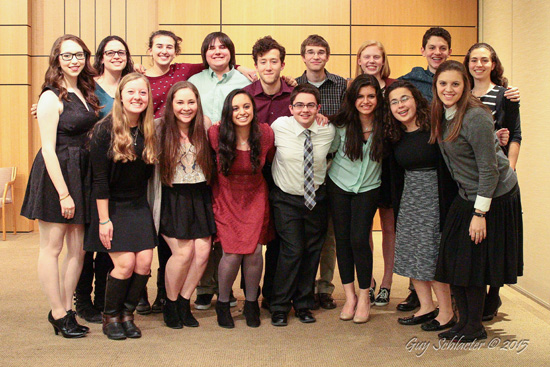
Chicago’s Diller Teen Fellows at their graduation Feb. 8. (Photo by Guy Schlacter)
On Sunday, Feb. 8, the first cohort of Diller Teen Fellows in Chicago graduated after a 15-month program.
Diller Teen Fellows is an international fellowship built around the four pillars of leadership, Jewish identity, Israel, and tikkun olam. The Fellows developed leadership skills, explored their Jewish identities and connections to Israel through workshops, retreats, a peer exchange with their Israeli partners from Kiryat Gat, Lachish and Shafir, and through a 12-day trip to Israel over winter break. Post-graduation, the Fellows are continuing their journey through the development of Alumni Impact projects with the hope of giving back to their communities.
Mazal tov to our amazing Fellows: Emily Bakal, Daniel Balogh, Leta Berkowitz, Shira Brandhandler, Talius Chickering, Robby Cohn, Liel Hagen, Amanda Jackson, Lizzy Katz, Sam Klein, Kyle O’Day, Jamie Schlacter, Colin Silverman, Leah Umanskiy, Alyssa Wexler, Zoe Zirlin.
If you are interested in being part of this incredible program, recruitment for the third cohort will begin in early spring. Visit www.juf.org/diller or email [email protected] for more information.
Other stories
-
Meet Andrew S. Hochberg, 2021 Julius Rosenwald Memorial Award recipient
Celebrate Andy Hochberg at the virtual Annual Meeting on Sept. 14
Read more -
Two local teens win national recognition
Recipients of the annual Diller Teen Tikkun Olam Awards
Read more -
Celebrating six young award winners cultivating the community
Introducing young adult award winners
Read more
Yesterday in Denmark, one person was killed at an event celebrating free speech and three police officers were wounded. Danish police believe the target was Lars Vilks, an artist who has received death threats for drawing images of the prophet Muhammad. Just hours later, a Jewish man, Dan Uzan, was killed and two police officers were wounded in an attack in front of Copenhagen’s Krystalgade synagogue. Uzan was part of a security patrol guarding the synagogue while a bat mitzvah took place inside.
The Jewish United Fund of Metropolitan Chicago condemns the brutal, hate-filled terror attacks in Copenhagen and extends our deepest sympathy to the victims’ families. We mourn those murdered, pray for the recovery of the wounded and stand in solidarity with the Danish Jewish community. We welcome the outpouring of public support being expressed and demonstrated outside the synagogue by non-Jewish Danes.
We also denounce the accelerating rise in global anti-Semitic activity and especially its violent manifestations in Europe. It is long past time for global leaders – political, diplomatic, law enforcement and religious – to take strong, unequivocal action against the sources and inspirations of this deadly anti-Semitism.
As in the attacks in Paris, this latest act of terrorism clearly and deliberately targeted symbols – and people – embodying free speech and the Jewish community.
Press reports indicate the Copenhagen terrorist was known to Danish intelligence. According to Jens Madsen, the head of the country’s security services, he may have been “inspired by militant Islamist propaganda issued by IS [Islamic State] and other terror organizations.”
These terrorists may represent a small minority of the world’s Muslims and may be distorting Islam’s teachings, but they are being incited to violence by clerics and websites calling themselves “Muslim” and are invoking that faith in their rampages. Our ignoring these realities slows the day when we all can enjoy greater inter-group harmony and security.
A delegation of 8 JUF leaders visited Paris last week as part of a national solidarity and fact-finding mission. One of the key issues identified was security outside Jewish facilities, and the readiness of host countries to provide it on an increased, sustained level. In France, the Jewish community, with nervous anxiety, awaits the pullout of military and police protection. We also note that Copenhagen’s Jewish leaders, in the immediate aftermath of the Paris attacks, made an official request to Danish Justice Minister Mette Frederiksen for a greater police presence at their synagogues.
We extend our gratitude to those law enforcement officials who put their own lives on the line to defend Jewish communities in Europe and here in Chicago.
Here is what JUF has done/is doing in response to this weekend’s attacks:
- The JUF-funded Jewish Agency for Israel (JAFI) dispatched $75,000 to help secure Jewish facilities in Denmark.
- The Secure Community Network (SCN), the national security project of the Jewish Federations of North America, has issued alerts that JUF in turn is sharing with Jewish schools, communal agencies, synagogues and Jewish Community Relations Council group leaders. Our community must continue providing facilities and services that are at once secure and welcoming.
- JUF remains in regular contact with federal, county and local law enforcement.
- JCRC sent a note of condolence and solidarity to Danish Jewry, and has been in contact with the local Danish Consul General and with Israel’s Ambassador to Denmark, our friend, former Consul General in Chicago, Barukh Binah.
Our hearts go out to the family of Dan Uzan, the Danish Jewish community, and to all Danes at this terrible, difficult time
Other stories
-
Chicago to Israel to Kenya
A family’s story of living Jewishly on three continents Michelle Cohen World May 28, 2021 Avital, Tzofia, and Netanel Kaszovitz outside their home in Nairobi on Yom HaAtzmaut. When Avital Kaszovitz prepared to be a Modern Orthodox shlicha (emissary) to the Jewish community in Ke
Read more -
New exhibit spotlights the experience of ‘Shanghai Jews’
Explore a new Illinois Holocaust Museum and Education Center exhibit
Read more -
Europe’s brave new teachers of the Holocaust
Teaching the Holocaust in the modern era has its difficulties and rewards.
Read more
Other stories
-
Meet Andrew S. Hochberg, 2021 Julius Rosenwald Memorial Award recipient
Celebrate Andy Hochberg at the virtual Annual Meeting on Sept. 14
Read more -
Two local teens win national recognition
Recipients of the annual Diller Teen Tikkun Olam Awards
Read more -
Celebrating six young award winners cultivating the community
Introducing young adult award winners
Read more